Your new post is loading...

|
Scooped by
Beeyond
January 29, 2024 2:52 AM
|
It has long been known that low-dose X-ray irradiation can enhance adaptive responses, including extending average life expectancy, stimulating the immune system, healing wounds and stimulating cell growth in animals as well as neuroprotection in animal model of neurodegenerative diseases, primarily due to immunomodulation. Based on these studies, Professor Ma and his team speculated that the immunomodulatory effects of LDIR could play a pivotal role in mitigating damage and promoting wound healing after brain injury.
|
|
Scooped by
Beeyond
January 29, 2024 2:50 AM
|
Climate change-related CV burden represents one of the latest challenges in preventive cardiology that physicians are facing. Although the impact of climate change on human health remains to be accurately estimated, several studies have demonstrated its negative effects on the risk and progression of CV diseases. Therefore, serious strategies should be planned to contrast global warming and climate change, involving physicians, researchers, public health professionals, political scientists, legislators, and national leaders who have to work together to alleviate the impacts of climate change and preserve public health.
|
|
Scooped by
Beeyond
January 28, 2024 10:13 AM
|
Le projet BSI (Brain-Spine Interface, ou interface cerveau-moelle épinière) vise à démontrer qu’une personne souffrant d’un grave handicap moteur, telle qu'une personne paraplégique, peut retrouver sa mobilité après entrainement, grâce à BSI. BSI est une interface cerveau-machine couplée à une technologie de stimulation de la moelle épinière pour permettre aux patients de contrôler de manière natu
|
|
Scooped by
Beeyond
January 28, 2024 10:13 AM
|
Researchers at the Clinatec laboratory in Grenoble have created an exoskeleton, which paralysed users can control with their mind in order to help them move both their arms and legs. This marks the first time that a prosthetic exoskeleton was successfully used to help a quadriplegic patient move all four of their immobilised limbs.
|
|
Scooped by
Beeyond
January 28, 2024 9:41 AM
|
Many have said that the brain and mind are the final frontier of science. Indeed, very little is known about that gray mass of cells in our skull that plays an important role in cognition; regulation of heart, lung, and other systems and functions; movement, and more. With approximately 100 billion neural connections, our brains are capable of processing billions of bits of information per second. The latest trend in unlocking the mysteries of the mind is brain-computer interfaces.
|
|
Scooped by
Beeyond
January 23, 2024 2:17 PM
|
Développé par la start-up Acticor Biotech, le glenzocimab a considérablement réduit le risque de décès de patients souffrant de la forme la plus courante d’accidents vasculaires cérébraux.
|
|
Scooped by
Beeyond
January 22, 2024 7:53 AM
|
It is difficult to predict the surgical effect and outcome of severe traumatic brain injury (TBI) before surgery. This study aims to approve an evaluation method of computed tomography angiography (CTA) to predict the effect of surgery and outcome in severe TBI. Between January 2010 and January 2020, we retrospectively reviewed 358 severe TBI patients who underwent CTA at admission and reexamination. CTA data were evaluated for the presence of cerebrovascular changes, including cerebrovascular shift (CS), cerebral vasospasm (CVS), large artery occlusion (LAO), and deep venous system occlusion (DVSO).
|
|
Scooped by
Beeyond
January 22, 2024 7:52 AM
|
Researchers have discovered a potential stroke recovery therapy that can restore brain function in mice after a stroke. This therapy, involving inhibitors of the metabotropic glutamate receptor mGluR5, has shown to improve sensorimotor functions even when administered days after a stroke. The study suggests that combined with rehabilitation training, this treatment could offer a new approach to stroke recovery. However, further research, including human trials, is necessary.
|
|
Scooped by
Beeyond
January 15, 2024 2:38 AM
|
In this study, three flow diverters were prepared with different wire types or combinations: NiTi FD, NiTi-Pt/W FD, and NiTi(Pt) FD. Their physical properties were compared. It was verified that the performance of the three types of FDs had complementary advantages and disadvantages. Excluding the NiTi FD, which is challenging to use in actual surgeries due to radiopacity issues, both the NiTi-Pt/W FD and the NiTi(Pt) FD are expected to have their different advantages, making them suitable for different clinical applications. However, the structure and size of ICA aneurysms vary widely, and there is a lack of research on which FD properties are necessary in different surgical situations. We plan to apply more diverse structures of 3D-printed ICA aneurysm models and gather additional information through animal experiments.
|
|
Scooped by
Beeyond
January 9, 2024 12:11 PM
|
Le gras c’est la vie ? Le gras c’est le plaisir répond la science. Trois universitaires décryptent la manière dont les aliments riches s’emparent de nos cerveaux. Ils mettent en avant le rôle de lipides contenus dans les produits gras.
|
|
Scooped by
Beeyond
January 1, 2024 12:16 PM
|
Antithrombotic agents (blood thinners), which prevent blood clots from forming, are widely used to prevent thromboembolic events such as ischemic stroke and myocardial infarction. This benefit of antithrombotic agents is not so rarely overshadowed by the drawback of an increased risk of bleeding complications, such as intracranial and gastrointestinal bleeding.
|
|
Scooped by
Beeyond
January 1, 2024 12:13 PM
|
Dual antiplatelet therapy (DAPT) with clopidogrel-aspirin given within 72 hours of a mild ischemic stroke or a high-risk transient ischemic attack (TIA) shows a greater risk reduction for new stroke than aspirin alone, although with a higher bleeding risk.
|
|
Scooped by
Beeyond
December 29, 2023 12:41 PM
|
The COMMAND trial is designed to be an early feasibility study (EFS) that will mainly evaluate the safety of the brain-computer interface device in addition to studying its quantified efficacy measures. According to the US-based Synchron, the Synchron Switch device is implanted via the blood vessels for people with no or limited mobility to operate mobile devices and computers using their thoughts.
|
|
Scooped by
Beeyond
December 29, 2023 12:39 PM
|
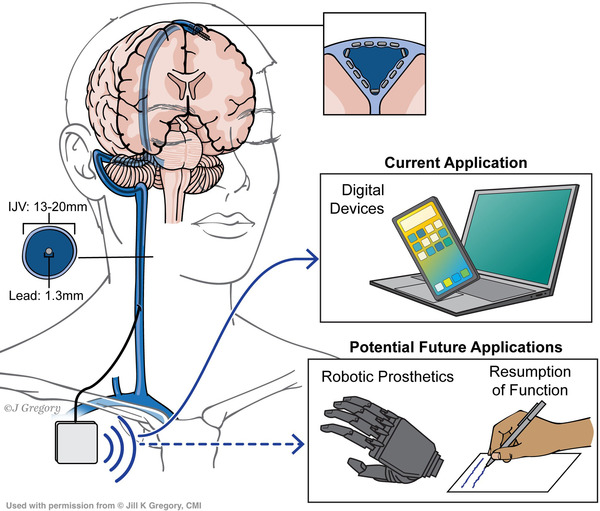
The Stentrode is a miniaturized neural interface that can record and stimulate the brain from within a blood vessel. The StentrodeTM derives its name from the amalgamation of its component parts – stent plus electrode – where the stent is used as a scaffold to support the electrodes. This device has been delivered through the jugular vein and placed adjacent to the brain in the superior sagittal sinus (SSS) without the need for brain surgery. The idea of recording and stimulating the brain from within a blood vessel has existed since 1973. Improvement over previous attempts for endovascular recording and stimulation came from mounting electrodes on a self-expanding stent allowing it to be anchored in place over long periods of time.
|
|
Scooped by
Beeyond
December 29, 2023 11:45 AM
|
Paralysis may result in a loss of control of muscles in the body while the brain can remain intact. Motor intent is the brain signal underlying the physical will to move. A brain-computer interface is designed to restore the lost motor intent signal transmission associated with paralysis. In a minimally invasive endovascular procedure, the device is implanted in the brain’s motor cortex via the jugular vein. Once implanted, it detects and wirelessly transmits motor intent to control personal digital devices and allow previously impossible communication.
|
|
Scooped by
Beeyond
December 29, 2023 11:43 AM
|
Recent breakthroughs in the field of neurotechnology are providing exciting new possibilities for families affected by motor impairment. The technology is designed to decipher the neural code of the brain and find new ways to restore motor intent to control digital devices.
|
|
Scooped by
Beeyond
December 29, 2023 11:37 AM
|
Based on the outcomes of concluded clinical trials for therapies focusing on diverse stroke treatment modalities, further exploration through clinical and preclinical studies is imperative to unravel the intricate mechanisms and optimal interventions tailored to various stroke types and individual patient profiles. Given the time-critical nature of strokes, the dynamic nature of patients’ conditions fluctuates with timing. Therefore, developing and implementing therapies intricately attuned to the temporal context holds the potential to markedly enhance patients’ prognosis. Meanwhile, the combinatory therapeutic approaches hold promise in benefitting patients exhibiting diverse attributes. Like other diseases, stroke therapy necessitates a precision medicine framework considering the intricate interplay between patients’ genetic predispositions and environmental contexts.
|
|
Scooped by
Beeyond
December 29, 2023 11:35 AM
|
Synchron’s Stentrode device is implanted inside a blood vessel in the brain to sense neural signals and relay them to another implant in the chest. Those signals are then translated into digital commands, allowing the patient to communicate electronically or control smart devices.
|
|
Scooped by
Beeyond
December 29, 2023 10:35 AM
|
Brain-Computer Interface (BCI) has opened up a new frontier for communication. Moving a device elsewhere, or typing a message on a laptop or a mobile phone just by thinking about it is no more an act of science fiction. Top companies around the world are building software and hardware, based on neurotechnology and neuroscience to expand human potential and more importantly, bring a new dawn in the lives of people facing physiological disorders.
|
|
Scooped by
Beeyond
December 29, 2023 10:30 AM
|
Brain-computer interfaces (BCI) have the potential to improve the quality of life for persons with paralysis. Sub-scalp EEG provides an alternative BCI signal acquisition method that compromises between the limitations of traditional EEG systems and the risks associated with intracranial electrodes, and has shown promise in long-term seizure monitoring. However, sub-scalp EEG has not yet been assessed for suitability in BCI applications. This study presents a preliminary comparison of visual evoked potentials (VEPs) recorded using subscalp and endovascular stent electrodes in a sheep. Sub-scalp electrodes recorded comparable VEP amplitude, signal-to-noise ratio and bandwidth to the stent electrodes.
|
|
Scooped by
Beeyond
December 29, 2023 10:26 AM
|
Endovascular access to the sensorimotor cortex is an alternative to placing BCI electrodes in or on the dura by open-brain surgery. These final safety and feasibility data from the first in-human SWITCH study indicate that it is possible to record neural signals from a blood vessel. The favorable safety profile could promote wider and more rapid translation of BCI to people with paralysis.
|
|
Scooped by
Beeyond
December 29, 2023 10:00 AM
|
We describe the first US in‐human experience of a minimally invasive, fully implanted, wireless motor neuroprosthesis using an endovascular stent‐electrode array to transmit electrocorticography signals from the motor cortex for multiple command control of digital devices.
|
|
Scooped by
Beeyond
December 29, 2023 9:54 AM
|
While brain-computer interface technology has the potential to revolutionize neurological care, clinical translation has been limited. Endovascular arrays present a novel form of minimally invasive brain-computer interface devices that have been deployed in human subjects during early feasibility studies. This article provides an overview of endovascular brain-computer interface devices and critically evaluates the patient with stroke as an implant candidate. Future opportunities are mapped, along with the challenges arising when decoding neural activity following infarction. Limitations arise when considering intracerebral hemorrhage and motor cortex lesions; however, future directions are outlined that aim to address these challenges.
|
|
Scooped by
Beeyond
December 29, 2023 9:41 AM
|
According to study results, all participants were able to use a computer with the recorded signals and perform daily activities such as texting, emailing and personal finance, online shopping and communicating care needs. Further, all implanted participants remained free of target vessel occlusion and device migration, as evidenced by post-operative imaging.
|
|
Scooped by
Beeyond
December 29, 2023 9:40 AM
|
Severe paralysis not only means being unable to move, but in many cases, being unable to speak as well. Scientists are working to develop brain-computer interfaces (BCIs) that allow individuals with paralysis to operate electronic communication tools with their thoughts. “Using thoughts, or even thinking about movement, the brain can generate signals that can then be used in a device to control the external world,” Phillip Starr, MD, PhD, a professor of neurological surgery at the University of California, San Francisco, explained in an interview with JAMA. “That’s really what a brain-computer interface is.”
|

Curated by Beeyond
BEEYOND is a consulting company in the field of disruptive innovation, accompanying established companies on out-of-the-core growth strategy, from creation of new concepts to product launch. Reach us at: contact@beeyond.fr.
|