Your new post is loading...

|
Scooped by
Beeyond
April 5, 2024 1:55 PM
|
The world's first self-expanding intracranial drug-coated stent system, called COMETIU™, complements the NOVA® Intracranial Drug-Eluting Stent System with its safety and non-neurotoxicity, reduced risk of in-stent restenosis and stroke recurrence, improved procedural safety in the area of the richly branched stent, access to the tortuous vessels, and ease of operation.
|
|
Scooped by
Beeyond
April 1, 2024 7:14 AM
|
The introduction of endovascular thrombectomy dramatically changed acute stroke management and became the standard treatment. Balloon guide catheters provide flow arrest during the clot retrieval process and have several advantages.This study aimed to compare balloon guide catheters (BGCs) versus non-balloon guide catheters (NBGCs) as a part of a combined treatment modality in patients presenting with acute ischemic stroke.
|
|
Scooped by
Beeyond
March 25, 2024 11:52 AM
|
Hypoxic-ischemic brain injury arises from inadequate oxygen delivery to the brain, commonly occurring following cardiac arrest, which lacks effective treatments. Recent studies have demonstrated the therapeutic potential of exosomes released from mesenchymal stem cells. Given the challenge of systemic dilution associated with intravenous administration, intranasal delivery has emerged as a promising approach. In this study, we investigate the effects of intranasally administered exosomes in an animal model.
|
|
Scooped by
Beeyond
March 25, 2024 11:51 AM
|
Aspirin nonadherence became more prevalent over time, from 10% at 2 years to 19% at 8 years. The greatest risk for recurrent MI, stroke or death occurred at 2 to 4 years for the adherent and nonadherent groups.
|
|
Scooped by
Beeyond
March 11, 2024 10:34 AM
|
The present study results suggest that direct aspiration is a safe and effective treatment for patients with BAO. We identified several factors affecting the patients
|
|
Scooped by
Beeyond
March 10, 2024 10:34 AM
|
Elevated untreated baseline LDL-C level was associated with an increased short-term risk of ischaemic stroke among patients presenting with minor ischaemic stroke or TIA. There was potential benefit of lipid-lowering treatment in minor stroke or TIA patients with LDL-C ≥2.6 mmol/L.
|
|
Scooped by
Beeyond
March 10, 2024 10:32 AM
|
Transient ischemic attacks (TIAs) are often incorrectly called “mini-strokes,” but they’re every bit as serious as a true stroke. Having a TIA often means you could have a stroke in the very near future. A TIA is a medical emergency you shouldn’t ignore. More importantly, it’s a chance to get treatment that can prevent a future stroke.
|
|
Scooped by
Beeyond
March 10, 2024 10:31 AM
|
As compared to aspirin alone, short-term DAPT within 24 hours of high-risk transient ischemic attack or mild-moderate ischemic stroke reduces the risk of recurrent stroke at the expense of higher risk of major bleeding.
|
|
Scooped by
Beeyond
March 4, 2024 2:47 AM
|
Dans 80 % des cas, l’AVC survient parce qu’un caillot (thrombus) bouche une artère cérébrale : c’est l’AVC ischémique ou embolie cérébrale. "Le traitement habituel, appelé thrombolyse, consiste à dissoudre l’obstacle grâce à un médicament injecté par voie sanguine moins de quatre heures et demie après le diagnostic par imagerie, explique le Pr Mazighi. Mais la masse peut être trop grosse, dans ce cas la thrombolyse ne suffit pas, et nécessiter une thrombectomie (libération de l’artère) dans les six heures. On introduit dans l’artère un petit outil appelé stent-retriever, chargé d’agripper le caillot et de le retirer. Mais certains sont difficiles à ôter. C’est pourquoi nous travaillons à la mise au point d’un nouveau stent-retriever, capable de mieux adhérer au thrombus grâce à un revêtement biologique particulier. Cette solution diminuerait le risque de fragmentation du caillot lors de ce geste délicat, donc de complications." Développé en partenariat avec l’entreprise française Balt, leader mondial dans le domaine neurovasculaire, ce nouveau stent-retriever devrait bientôt être testé lors d’essais cliniques.
|
|
Scooped by
Beeyond
March 4, 2024 2:45 AM
|
The researchers found a monotonically increasing risk for AIS onset in association with higher temperatures. The excess AIS risk occurred immediately at lag 0 hours and lasted for 10 hours. The cumulative odds ratio over lag 0 to 10 hours of AIS onset associated with extremely high temperature (33.3 degrees Celsius) compared with the reference temperature (12.1 degrees Celsius) was 1.88 nationwide. Compared with the South, the exposure-response curve was steeper in the North (odds ratio, 1.80 versus 1.57). Greater odds ratios were seen for men and patients with a history of dyslipidemia or atrial fibrillation, but the differences were not significant.
|
|
Scooped by
Beeyond
February 28, 2024 4:16 AM
|
A less-traumatic alternative to the traditional open-heart surgery, minimally-invasive structural heart interventions have made significant advances in the last few years. Interestingly, there is a wide range of cardiac diseases -- such as valvular heart disease, congenital defects and heart failure -- that can be treated with this approach. Dr Haresh G Mehta, director-interventional cardiology and Dr Kayan Siodia, consultant interventional cardiology, S L Raheja Hospital, Mahim -- a Fortis associate say that for patients with valvular heart disease, valve replacement or repair through open heart surgery was the only option, which had a "high procedural risk" and longer recovery time.
|
|
Scooped by
Beeyond
February 28, 2024 4:09 AM
|
Discover the latest advancements in neuroimmunology research and the potential for groundbreaking treatments in neuroinflammatory diseases. Uncover the challenges and triumphs on the path to revolutionizing brain health.
|
|
Scooped by
Beeyond
February 19, 2024 5:25 AM
|
For patients with acute ischemic stroke and large cores, endovascular thrombectomy (EVT) improves clinical outcomes compared with medical management (MM), according to a study published online Feb. 7 in the Journal of the American Medical Association to coincide with the annual American Stroke Association International Stroke Conference, held from Feb. 7 to 9 in Phoenix.
|
|
Scooped by
Beeyond
February 19, 2024 5:24 AM
|
The researchers found that the cumulative incidence of ischemic stroke was lower in the acupuncture cohort. At the end of the study, 341 and 605 patients in the acupuncture and no-acupuncture groups, respectively, experienced ischemic stroke (5.95 and 12.4 per 1,000 person-years, respectively; adjusted subhazard ratio, 0.57). The reduction in incidence of ischemic stroke was independent of sex, age, types of drugs used, and comorbidities.
|
|
Scooped by
Beeyond
February 18, 2024 11:44 AM
|
Despite excellent safety and efficacy, the risk of thromboembolic complications necessitates the use of dual antiplatelet therapy (DAPT). The use of DAPT makes hemorrhagic complications of stenting carry high morbidity and mortality. Additionally, DAPT usage carries a risk of “nuisance” complications that do not directly impact intracranial circulation but need to be managed nonetheless. To circumvent this issue, the most recent generation of flow diverters have undergone surface modification with various compounds to confer blood compatibility to limit clotting and thrombosis. While these newer generation flow diverters are marketed to enhance ease of deployment, the goal is to eventually facilitate single antiplatelet use with flow diverter treatment.
|
|
Scooped by
Beeyond
February 18, 2024 11:43 AM
|
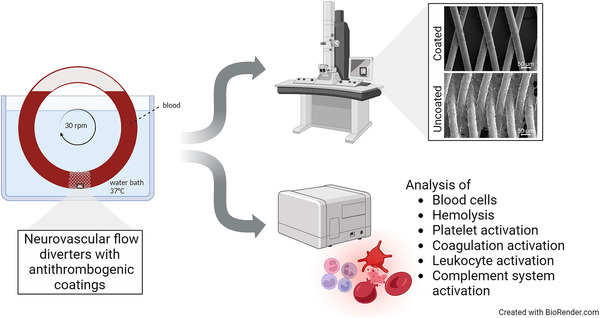
There were no significant differences between the coated flow diverters in terms of TAT and β-TG levels, as well as platelet adhesion. However, significantly lower activation of the complement system (SC5b-9 and C5a) was observed for the DERIVO 2heal flow diverter in comparison with the Pipeline Flex Shield and the p64 MW HPC flow diverters emphasizing the improved hemocompatibility of the fibrin/heparin-coated DERIVO 2heal flow diverter.
|
|
Scooped by
Beeyond
February 18, 2024 11:34 AM
|
The placement of intracranial devices in the cerebral circulation mandates the adjunctive administration of dual antiplatelet pharmaceuticals to the patient to minimize thromboembolic events, despite being associated with increased patient risk. We present a new multilayer, nanometer-scale coating technology platform suitable for commercial intracranial flow diverters to minimize the use of dual antiplatelet therapy in the elective setting and expand the use of intracranial devices in the acute setting of ruptured intracranial aneurysms.
|
|
Scooped by
Beeyond
February 18, 2024 11:31 AM
|
FDSM were safe with satisfactory effectiveness for intracranial ANs. More specific investigations are warranted to explore their performance in ANs beyond the ICA and optimal antiplatelet therapy.
|
|
Scooped by
Beeyond
February 18, 2024 11:29 AM
|
This first in vivo study of a BDFD shows the feasibility of using BDFDs for treating aneurysms; however, a longer follow‐up is required for comprehensive evaluation of the biological and mechanical behavior peculiar to biodegradable devices.
|
|
Scooped by
Beeyond
February 18, 2024 10:34 AM
|
Aberrant biocompatibility of implanted biomaterials and devices are a significant burden to the healthcare system and account for a large proportion of post-surgical clinical complications. Targeting the body’s natural mechanisms of inhibiting the immune response is a logical way to combat inflammation caused by implantable materials. This can be accomplished specifically through utilizing the ITIM family and related immune inhibitory receptors, which are involved in attenuating the inflammatory response. Given that these inhibitory receptors are expressed on immune cells makes them attractive targets for drug design or functionalization on implantable devices. Herein, we discussed the potential use of a select few immune inhibitory receptors some bearing classical ITIMs and others with alternative signaling mechanisms in attenuating the inflammatory response. We detailed the potential uses for recombinant CD47, the ligand for the ITIM receptor SIRPα, that we believe to be the best suited for promoting long-term biocompatibility of implanted medical devices. The further we expand our understanding of the role that ITIM proteins have in fine tuning the immune response, the better suited we will be to utilize ITIM proteins to increase medical device biocompatibility.
|
|
Scooped by
Beeyond
February 12, 2024 7:35 AM
|
Before, it was just a guess, but now we know that carotid or vertebral artery dissection not causing a stroke does not raise the risk of a heart attack, and it makes sense that clinicians should focus predominantly on stroke prevention in this subgroup of patients.
|
|
Scooped by
Beeyond
February 12, 2024 7:34 AM
|
Our findings reinforce the importance of monitoring people with stroke for cognitive decline, instituting appropriate treatments to address vascular risk factors and prevent recurrent stroke, and encouraging lifestyle changes, such as smoking cessation and increased physical activity, which have many benefits and may reduce the risk of dementia.
|
|
Scooped by
Beeyond
February 7, 2024 12:05 PM
|
Irish medical device firm Ceroflo announced today that it has raised €6.4 million in investment-round funding, which will be used to advance development of the company’s SubMax device—a novel stent intended to “revolutionise” intracranial atherosclerotic disease (ICAD) treatments. In a press release, Ceroflo reports that these funds will help support first-in-human clinical trials of its innovative stroke technology across 30 patients.
|
|
Scooped by
Beeyond
February 4, 2024 1:43 AM
|
Dans un contexte d’explosion des maladies chroniques, Withings, leader mondial de la santé connectée et multi-récompensé au CES de Las Vegas, déploie une stratégie multi-canale du 25 janvier au 22 février. La campagne met en avant la montre ultra-puissante de Withings, la ScanWatch 2, et vise à renforcer le positionnement de puissance clinique de la marque, tout en sensibilisant à la détection précoce, chez soi, des épisodes de fibrillations auriculaires, pouvant être des signes annonciateurs d’un AVC.
|
|
Scooped by
Beeyond
January 29, 2024 2:55 AM
|
Recurrent thrombosis in APS patients represents an area of unmet need and is the leading cause of mortality in this patient population. Platelets play a central role in thrombosis and there is extensive research confirming that platelets are not only key players in APS-related thrombosis, but also have a role in the formation and persistence of aPL. Much further research is needed to delineate the best way to apply antiplatelet agents in APS. Several established antiplatelet agents are available for further evaluation, either in combination with aspirin or VKA. There are also exciting novel approaches targeting the platelet-neutrophil interactions and NETs, and the mTORC2-AKT axis, as well as the potential for utilising complement activation as a biomarker for patients who would benefit from complement inhibition to reduce platelet activation. Finally, as procoagulant platelets are the prothrombotic product of many of the pathophysiological processes in APS, they represent an important new specific antiplatelet target.
|

Curated by Beeyond
BEEYOND is a consulting company in the field of disruptive innovation, accompanying established companies on out-of-the-core growth strategy, from creation of new concepts to product launch. Reach us at: contact@beeyond.fr.
|