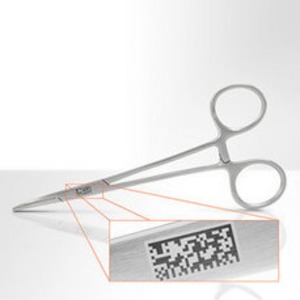
The medical sector uses laser marking to provide reliability and precision when marking medical supplies such as hearing aids, implants, instruments and medicines. This has the advantages of accuracy and traceability compared with traditional medical marking using ink or labels.
Thinfilm's temperature label is a low-cost integrated printed electronics smart label, which captures data on temperature thresholds and is ideal for item-le...
Nearly all medical devices need to be marked UDI compliant, while increasing pressure to cut costs is forcing manufacturers to improve their production efficiency. The laser marking process HELP, developed by FOBA, enables medical device manufacturers to mark devices UDI compliant, more efficient and in zero-defect quality.
Learn More: http://www.redlineforproduce.com PTI Milestone 2 This video explains why the PTI initially focused on tracking at the case level and not the item...
Learn More: http://www.redlineforproduce.com PTI Milestone 2 This video explains why the PTI initially focused on tracking at the case level and not the item...
This paper discusses the impact of item level RFID in inventory accuracy. The paper uses a simple mathematical approach for simulating the effects. The results are shown visually as well as in numeric data.
Xyntek is proud to partner with Antares Vision as the Exclusive Partner of the world’s leading solution for serialization, track & trace, and e-pedigree in North America. Xyntek-Antares’ unique global awareness and experience of the mass serialization market, standards, and implementations makes us an ideal partner for your emerging needs. Xyntek-Antares offers a suite of proven Track-and-Trace Serialization Solutions to help you define and execute on a serialization strategy that covers the factory floor and packaging lines through the entire enterprise and Supply Chain.
Indicating that the pharmaceutical-distribution supply chain is not ready to comply with product tracing provisions in the Food, Drug, and Cosmetic Act of 2013 (FD&C) scheduled to take effect on Jan. 1, 2015, FDA issued a new guidance document that delays enforcement of the regulations for trading partners.
FI-STAR’s pharmacy and surgery applications are using FI-WARE open software to offer innovative health care services. Munich Surgery and Leeds Pharmacy teams have jointly forged a generic reverse-supply-chain system that provides for bi-directional interaction of multiple stakeholders using medical prescriptions and surgical instruments. These applications are being tested in the real worlds of the Operating Theatre and Pharmacies in Munich and Leeds.
If a company wants to follow its items from manufacturing (or at least manufacturing country) all the way to the point of sale, it may well mean RFID investments in 6-10 different operations. However, this is usually not the case. To simplify things, let us take a look at the route of an item to a consumer.
"Is RFID for real? If RFID provides such great benefits, why aren't all retailers using it?" For those of us working with RFID every day, it is easy to forget how adoption must look to an "outsider." There are quite a few reasons for the current state of adoption.
There is broad agreement among supply-chain parties that clear standards are crucial to success, but considerable debate about crafting the specifics. Woodcock noted at the FDA workshop that it’s difficult to reach agreement on standards, formats, and practices because that usually requires some parties to change what they’re doing.
Who will own the data that supply chain trading partners store in some future cloud-based, semi-centralized Network Centric ePedigree (NCeP) data repository? I met one potential future repository service provider who seemed to think that they would own that data. Imagine their excitement. All the data about where drugs go throughout the supply chain! Think of the value they could mine from that.
The Drug Supply Chain Security Act (DSCSA) Implementation Plan regulation, which began phasing in on Jan. 1, 2015, provides a national policy for combating counterfeiting, theft, and diversion in the U.S. pharmaceutical supply chain. The law establishes extensive new regulations providing for the tracing and verification of products and transactions across all changes of ownership, from manufacturer to dispenser. As a result, the entire industry — and all of its many moving parts — is facing complicated data management, data exchange, and business process challenges that will impact operations and all supplier and trading partner relationships.
The TraceLink Life Sciences Cloud protects life and enables health by creating global connectivity, traceability and visibility of pharmaceuticals from raw materials through production, distribution and dispensation to the patient. TraceLink's cloud-based application platform, built on Amazon AWS, enables individual companies to integrate once into the Life Sciences Cloud then gain complete visibility and business collaboration with all supply, production and distribution partners across the globe.
VisioPharma Serialization for e-pedigree is a flexible turnkey solution especially tailored to the needs of pharmaceutical industry and its service providers with rapid implementation, modular structure and flexible adaptation to changing requirements.
Every manufacturer needs the capabilities to track from the item to the box to the pallet. From complex regulatory mandates to minimizing recalls, knowing where the product is and where it came from is critical. In this session you will learn how the QAD Serialization Inventory Management enables companies to enhance product visibility, enabling more effective track and trace to the item level.
The ezTRACK™ cloud-based track-and-trace platform has been launched jointly by PCCW Solutions and GS1 Hong Kong. ezTRACK™ is specifically designed for manufacturers, supply chain operators and retailers, and equips them with real-time visibility and goods information from the production floor and warehouse through to logistics all the way to retail outlets. The platform improves supply chain collaboration and visibility by enabling users to track
In this Q&A, Tim Kearns, Pharmaceutical and Medical Devices Manager, Videojet, discusses track-and-trace and serialization issues and the use of printing and marking equipment to help its customers comply with regulations in the pharmaceutical and medical device industries.
Brazilian producers face challenges in integrating track and trace tools into their systems between now and the deadline in late 2016, but countries like Turkey, China and South Korea, among others, offer models of success for integrating traceability laws into their pharma industries, and Brazil is already moving faster toward the goal than the United States.
The US FDA will give drugmakers and distributors until May to comply with new track and trace laws in order to minimise disruptions in the supply chain.
BEEYOND is a consulting company in the field of disruptive innovation, accompanying established companies on out-of-the-core growth strategy, from creation of new concepts to product launch. Reach us at: contact@beeyond.fr.
To get content containing either thought or leadership enter:
To get content containing both thought and leadership enter:
To get content containing the expression thought leadership enter:
You can enter several keywords and you can refine them whenever you want. Our suggestion engine uses more signals but entering a few keywords here will rapidly give you great content to curate.

 Your new post is loading...