


Over 90 percent of the world population has the virus that causes chickenpox lying dormant in their nervous system. Most people contract the varicella zoster virus, or VZV, when they get chickenpox as children.

 Your new post is loading...
 Scoop.it! Over 90 percent of the world population has the virus that causes chickenpox lying dormant in their nervous system. Most people contract the varicella zoster virus, or VZV, when they get chickenpox as children. 
No comment yet.
Sign up to comment
Scoop.it!

Proton pump inhibitors (PPIs) are widely used for the treatment of gastrointestinal diseases. However, recent studies have shown that chronic PPI use is associated with the progression of endothelial senescence and cerebrovascular diseases. We hypothesized that PPI users might be vulnerable to fast progression of cerebral small vessel disease (SVD) with cumulative effects.
Scoop.it!

The longer oxygen remains cut off from your brain, the more damage occurs. Often, acting quickly can be the difference between life and death. That’s why it’s so important to know the signs of a stroke and how to respond to a brain attack.
Scoop.it!

Permanent intracranial stenting offers a feasible, safe ‘bailout’ option following a failed mechanical thrombectomy procedure. This was the concluding message delivered recently by Sarah Power (Beaumont Hospital, Dublin, Ireland)—who highlighted stenting’s association with improved successful recanalisation rates (thrombolysis in cerebral infarction [TICI] 2b–3 of 65–100%); positive functional outcome rates (modified Rankin Scale [mRS] 0–2 of 34–49%); and acceptable rates of symptomatic intracranial haemorrhage (sICH; 5–12%), in the current literature.
Scoop.it!

There is a great degree of heterogeneity in the active thrombectomy trials concerning inclusion criteria, interventions used, and how outcomes are being reported. Therefore, there is a need to adopt a standardized study design and data reporting with CDEs during the completion and publication of these studies to allow high-quality collective evidence synthesis.
Scoop.it!

The study found that people with early stroke were more likely to have blood type A and less likely to have blood type O (the most common blood type) -- compared to people with late stroke and people who never had a stroke. Both early and late stroke were also more likely to have blood type B compared to controls. After adjusting for sex and other factors, researchers found those who had blood type A had a 16 percent higher risk of having an early stroke than people with other blood types. Those who had blood type O had a 12 percent lower risk of having a stroke than people with other blood types.
Scoop.it!

The ability of severe acute respiratory syndrome coronavirus 2 (SARS-CoV-2) to use the angiotensin-converting enzyme-2 (ACE-2) receptors to enter host cells is also linked to neurotropism and the effect of the virus on multiple organ systems. However, there is a scarcity of information on whether children with COVID-19 are at a higher risk of stroke.
Scoop.it!

Endovascular therapy (EVT) is complex in the context of intracranial atherosclerosis (ICAS)-related large vessel occlusion (LVO) and the re-occlusion rates are high due to residual stenosis, the procedure time is long and the optimal EVT technique is unclear. The Balloon AngioplaSty with the dIstal protection of Stent Retriever (BASIS) technique is a novel thrombectomy technique that allows emergent balloon angioplasty to be performed via the wire of the retrieval stent. Our study presents our initial experience with the BASIS technique in ICAS-related LVO and assesses its feasibility.
Scoop.it!

Johnson & Johnson MedTech’s Cerenovus subsidiary tracked outcomes for 1,000 ischemic stroke patients who underwent mechanical thrombectomy procedures with Embotrap devices as a first-line therapy.
Scoop.it!

The present study establishes inhaled models of cigarette and e-cigarette use with normalized nicotine delivery, then characterizes the impact on blood-brain barrier (BBB) function. Sequencing of microvessel RNA following exposure revealed downregulation of several genes with critical roles in BBB function. Reduced protein expression of Occludin and Glut1 is also observed at the tight junction in all groups following exposure. Pro-inflammatory changes in leukocyte-endothelial cell interaction are also noted, and mice exposed to nicotine-free e-cigarettes have impaired novel object recognition performance.
Scoop.it!

“Too often stroke results in long-term disability that adversely affects quality of life,” Dr. Kirshblum continued. “Now we know that with early and intensive intervention, stroke survivors have the capability to regain function. The EMAGINE trial capitalizes on this neuroplasticity of the brain and spinal cord by augmenting standard rehabilitation with electromagnetic stimulation and making therapy available in different settings, including the home,” he explained.
Scoop.it!

The team transplanted primary IESCs from healthy donors after stroke in a preclinical model. IESCs from young donors repaired gut architecture and decreased gut permeability and consequently decreasing blood levels of proteins and other molecules that are toxic to brain cells.
Scoop.it!

A new study investigates the potential effect of exercising at different times for preventing cardiovascular disease and stroke.
Scoop.it!

Stroke medically is called Cerebrovascular Accident (CVA). It is defined as the death of Brain cells on a small portion of the Brain due to a bleed in the Brain or blocked blood vessel. The damage in most people is permanent which is why most people with stroke are permanently disabled. There are many causes and risk factors associated with CVA which will be mentioned below. The treatment of stroke starts the moment the patient is seen by the doctor and involves multiple disciplinary approach.
Scoop.it!

Individuals with genetic gain-of-function variation in the proprotein convertase subtilisin/kexin type 9 (PCSK9) gene are at an increased risk of cardiovascular disease, including ischemic stroke. While PCSK9 inhibitors (PCSK9i) are effective in reducing cardiovascular disease risk and ischemic stroke risk, novel genomic technologies including the use of clustered regularly interspaced short palindromic repeats (CRISPR)-Cas9 complex-mediated delivery and adenine base editing (ABE) enable promising new therapeutic and preventative approaches. In this paper we discuss ongoing work into PCSK9 base editing and highlight future directions relevant to cardiovascular disease and ischemic stroke.
Scoop.it!

Intravascular OCT provides a wealth of data on coronary structures and pathologies, with rapidly progressing applications for the diagnosis and management of coronary artery disease. Systematic efforts are ongoing to educate the interventional cardiology community on the appropriate use and interpretation of OCT images, using practical algorithmic approaches. Robust evidence from the ongoing randomised trials on the impact of OCT guidance in improving clinical outcomes could increase the adoption of this imaging modality in clinical practice.
Scoop.it!
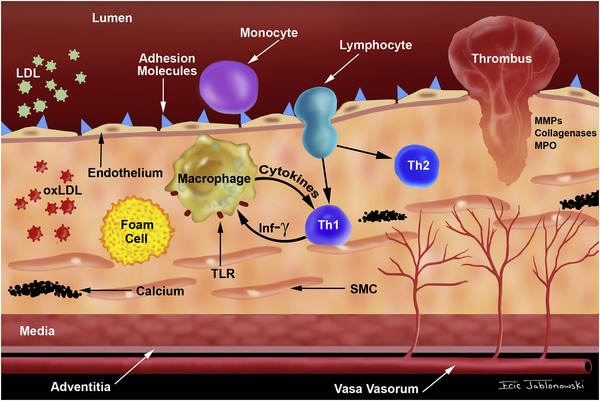
Arterial inflammation manifesting as atherosclerosis is the main pathology underlying cardiovascular disease (CVD), including myocardial infarction and ischemic stroke. As a chronic inflammatory disease of the arterial wall, atherosclerosis arises from unbalanced lipid metabolism and maladaptive inflammatory responses. Despite the success of lipid-lowering and anti-hypertensive medications in mitigating complications of atherosclerosis, CVD remains the main cause of death worldwide. Hence, the development of novel preventive and therapeutic strategies is necessary to alleviate the global burden of CVD.
Scoop.it!

Abundant data link hypercholesterolaemia to atherogenesis. However, only recently have we appreciated that inflammatory mechanisms couple dyslipidaemia to atheroma formation. Leukocyte recruitment and expression of pro-inflammatory cytokines characterize early atherogenesis, and malfunction of inflammatory mediators mutes atheroma formation in mice. Moreover, inflammatory pathways promote thrombosis, a late and dreaded complication of atherosclerosis responsible for myocardial infarctions and most strokes. The new appreciation of the role of inflammation in atherosclerosis provides a mechanistic framework for understanding the clinical benefits of lipid-lowering therapies. Identifying the triggers for inflammation and unravelling the details of inflammatory pathways may eventually furnish new therapeutic targets.
Scoop.it!

Atherosclerotic coronary artery disease (CAD) results from build-up of cholesterol-rich plaques in the walls of the coronary arteries and is a leading cause of death. Inflammation is central to atherosclerosis. Uncontrolled inflammation makes coronary plaques “unstable” and vulnerable to rupture or erosion, leading to thrombosis and myocardial infarction (MI). As multiple inflamed plaques often co-exist in the coronary system, patients are at risk of repeated atherothrombotic cardiovascular events after MI, with rates of 10–12% at one year and 18–20% at three years. This is largely because current therapies for CAD, such as lipid-lowering statins, do not adequately control plaque inflammation. New anti-atherosclerotic agents are therefore needed, especially those that better target inflammation.
Scoop.it!

Results are compatible with a moderate protective effect of influenza vaccine on IS appearing early after vaccination. The finding that a reduced risk was also observed in pre-epidemic periods suggests that either the “protection” is not totally linked to prevention of influenza infection, or it may be partly explained by unmeasured confounding factors.
Scoop.it!

One of the more recent concerns with PPI use is their role in the development or progression of chronic kidney disease. There is also some literature suggesting that PPIs contribute to the development of various micronutrient deficiencies. Most of the literature examining the potential adverse effects of PPI use is composed of retrospective, observation studies. There is a need for higher quality studies exploring this relationship.
Scoop.it!

“We think that this study definitely questions the cardiovascular safety of these drugs, and due to the extent of PPI use in the general population, even a low increased risk of ischemic stroke might have a major health impact,” Sehested said.
Scoop.it!

Patients with ischemic stroke caused by basilar-artery occlusion have high mortality. Whether endovascular thrombectomy can improve outcomes in these patients has been uncertain. New research findings are summarized in a short video.
Scoop.it!

Most of us think of stroke as a condition that only affects older people. But while it’s more common in old age, around 10% of all strokes happen in people under the age of 45 – and the figure is rising. Here’s what you need to know about why strokes happen, who’s most at risk, and what kind of symptoms you need to look out for.
Scoop.it!

Strokes happen suddenly and can cause permanent brain damage. If not treated quickly, they can kill you or leave you permanently disabled. If you think someone is having a stroke, call 911 immediately. Knowing the signs of a stroke can save a life.
|

Curated by Beeyond
BEEYOND is a consulting company in the field of disruptive innovation, accompanying established companies on out-of-the-core growth strategy, from creation of new concepts to product launch. Reach us at: contact@beeyond.fr.
Other Topics

#dotdot, the community internet

Aidants

Aston-Martin

Augmented & Virtual Reality

Blue Ocean Strategy

Brain Computer Interfaces & connected medical devices

Consumer Digital Health

Covid-19, SARS-Cov-2, vaccines, Remdesivir, Chloroquine...and all that Jazz

Critical Limb-Threatening Ischemia (CLTI)

Daily realities of diabetic patients

Fashion & technology
Healthcare: reloaded...

High level trending in...

In-Vitro Diagnostic

Innovating to what's next...

Instrumental cosmetics
Interventional Cardiology

Intra-Dermal drug delivery: Opportunities and Challenges?

Local delivery for Gene Directed Enzyme Prodrug Therapy
Engineered MSCs with suicide genes delivered intra-arterially to treat various cancers. Local delivery bypasses homing issues that plagued prior GDEPT programs.

Metabolic Activation Therapy

Neurovascular Intervention

Nudges

Peritoneal dialysis

Sclérose en Plaques

Solid tumors: latest on treaments and research pathways
glioblastoma, craniopharyngioma...

Tailored Expertise Sourcing & Market Intelligence in Global Consulting

The future of e-cigarette

The Revolution Of The Car Industry

Track & Trace

Transcatheter Treatment of Mitral Regurgitation
|




