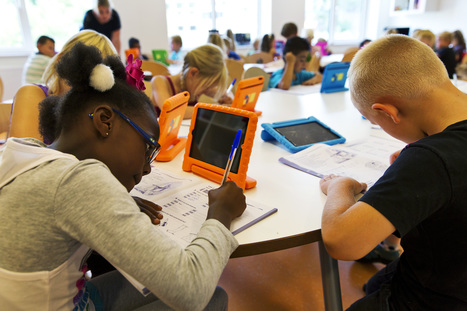
Download free background music for your videos, movies, and websites. Free both for personal and commercial projects.
Via Ana Cristina Pratas

 Your new post is loading...
 Scoop.it! Download free background music for your videos, movies, and websites. Free both for personal and commercial projects. Via Ana Cristina Pratas No comment yet.
Sign up to comment
Scoop.it!

"Getting feedback from learners about your online course is important. Feedback from course goers tells you what you can do to improve the course for future students. Asking for feedback from existing students also makes them feel that you value their input, which means they might enroll with you for another course. Asking for feedback from students on your online course can make you feel somewhat uncomfortable, but it can only help you to improve your courses and gain more students." Via EDTECH@UTRGV
Scoop.it!

"Classroom in a pocket? That’s right. Technology has developed to the point where we carry around with us pocketbook-sized computers that provide constant access to all the information in the world. That’s pure magic, isn’t it? It also means that students have in their hands, all the textbooks they might need, all the information related to their courses and even a means to interpersonal contact with their lecturers and other students. " Via EDTECH@UTRGV
Scoop.it!

The Fair Work Commission found using a mobile phone too much at work was a valid reason for the sacking, but fair dismissal procedures had not been followed. Via Peter Mellow
Scoop.it!
|

|
Rescooped by
Dennis Swender
from iPads, MakerEd and More in Education
December 7, 2019 11:12 AM
|
Scoop.it!

Did someone recently recommend you listen to a podcast? If your response was, “What’s a podcast?” we’ve got the answer, and more! Here’s a crash course on podcasts and how you can listen to them on your smartphone.
|
|
Rescooped by
Dennis Swender
from Education 2.0 & 3.0
December 7, 2019 11:08 AM
|
Scoop.it!

Teaching students to communicate with intelligent machines, moving from coding to computational thinking, and asking better questions before purchasing tech are top priorities.
|
|
Rescooped by
Dennis Swender
from University-Lectures-Online
December 7, 2019 11:07 AM
|
Scoop.it!

Here are 10 free physics courses you can take online now with top instructors. Their credits range from winning Nobel Prizes to field-defining work. Topics cover introductory concepts, Einstein's theory of relativity, particle physics, dark energy, quantum mechanics, and much more.
You can find numerous physics courses currently available online for free. Courses are taught by instructors with amazing credits like Nobel Prizes and field-defining work. Topics range from introductory to Einstein's theory of relativity, particle physics, dark energy, quantum mechanics, and more.
The internet has in many ways fulfilled its educational promise and can be an amazing resource to learn pretty much anything. This is especially true if you have an interest in physics, the study of matter, energy and the fundamental interactions and forces of our universe. There are hundreds of great free courses available, with field-leading and even Nobel Prize-winning instructors.
|
|
Rescooped by
Dennis Swender
from Educational Technology News
December 7, 2019 11:04 AM
|
Scoop.it!

What is the key to motivating learners and ensuring they stay on track throughout a course? The trick is to line the design with elements that promote motivation before, during, and even after course completion.
|
|
Rescooped by
Dennis Swender
from Edumorfosis.it
December 7, 2019 11:02 AM
|
Scoop.it!

Using videos in online learning may not sound ground-breaking or innovative, but that’s because you’re not using PlayPosit yet. PlayPosit is a tool that provides an intuitive, easy-to-use editing platform for creating interactive videos, also known as “bulbs.” You can use videos you create or content you have curated from the internet. With PlayPosit, you can add interactive elements such as multiple-choice questions, links to related articles, discussions, or even other videos in order to increase learner engagement.

Videos are another form of tools to engage students in their learning. PlayPosit allows interactions from the students when watching the video. For example, students can be stopped to check for understanding, there could be links to articles and open discussions. These features support and maintains the students' engagement throughout the lesson. These special interactions are what makes it more effective than playing a video from beginning to end.
|
|
Rescooped by
Dennis Swender
from Metaglossia: The Translation World
December 7, 2019 11:00 AM
|
Scoop.it!

Canva, the design company with nearly $250 million in funding, has today announced a variety of new features, including a video editing tool. The company has also announced Canva Apps, which allows developers and customers alike to build on top of Canva. Thus far, Dropbox, Google Drive, PhotoMosh and Instagram are already in the Canva […]
|
|
Rescooped by
Dennis Swender
from Daily Newspaper
December 5, 2019 12:04 PM
|
Scoop.it!


Digital games in general are considered as important and relevant to learning in our times. A recent reconceptualization of the term and its relevant approaches and affordances for pedagogy, relates deeply with play. Towards this direction, tabletop games are proposed as an appropriate means to explore the idea of play as experience.
This empirical paper draws on the findings from a workshop session during an international conference on play in education. It was evident that there is a rather vogue definition of the term tabletop play, which also stands for what accounts as 'play'. Derived from this ascertainment, the authors discuss play in education as experience with particular emphasis on the use of technology. The intention is to build and contribute to research and practice in the subject-matter, based on the conclusions drawn.
|
|
Rescooped by
Dennis Swender
from Daily Newspaper
December 5, 2019 12:02 PM
|
Scoop.it!

The main purpose of this article is to investigate the impact of teacher’s position on students’ performance in higher education. A new pedagogical approach based on collaborative learning is used due to the design of a smart learning environment (SLE). This workspace uses, respectively, information and communication technologies (ICT) and radio frequency identification (RFID)-based indoor positioning system in order to examine students’ perceptions and the involvement of groups into this smart classroom.
|
|
Rescooped by
Dennis Swender
from iGeneration - Humane Use of Technology in an AI world (Pedagogy & Digital Innovation)
December 12, 2019 1:54 PM
|
Scoop.it!

Free resource of educational web tools, 21st century skills, tips and tutorials on how teachers and students integrate technology into education
|
|
Rescooped by
Dennis Swender
from Physical and Mental Health - Exercise, Fitness and Activity
December 7, 2019 11:44 AM
|
Scoop.it!

There has been an exponential growth in the number of health apps, but experts have concerns about privacy as well as their effectiveness and accuracy.
|
|
Rescooped by
Dennis Swender
from AltaCali: Original Content by Joseph Thomas - BlackHorseMedia\The Planetary Archives on Scoop.it! & YouTube
December 7, 2019 11:28 AM
|
Scoop.it!

The most serious epidemic humankind has ever faced has swept the planet and has already affected billions of people; from the poorest illiterate rural villager to the people who have money and education. It affects young and old, black and white, Boyz and Girlz. It takes many different forms, but the result is the same; screenlock.
The Japanese have another name for it: ‘Facedown.’ Staring at that tiny screen for most of your waking hours. Oh sure, you watch Game of Thrones on your 72” 8K smartTV. But from the moment you wake up to the moment you fall asleep, you are engaged with and by that tiny little screen. That, amigos, is a form of mental illness.
It would be different if watching that screen was informing you of current events, or teaching you the Electric Sun theory, or even telling you the names of the plants and animals you see every day, but know nothing about.
Au contraire, mon ami. Numero uno, it’s impossible to actually see anything on that tiny little screen unless it is used in landscape mode, which nobody does. It blows peoples minds when I inform them that the phone was originally intended to be used this way.
The reason everyone uses portrait mode is so they can type with one thumb. Spoiler Alert: anything that can be typed with one thumb is not important. Indeed, most of the cellular data being sold for extortionate fees by the telecoms is used for frivolous purposes, social networking being the most abused.
I’ve observed toddlers, teenagers, and alleged adults so involved in their games they wouldn’t even make eye contact, let alone interact. Some people are so addled they can’t look away for 10 seconds straight. The problem is they don’t know how to interact because they never have to. I totally understand the need to disengage from the real world. I too have spent countless hours on mindless “entertainment.”
But some of that entertainment were things that might be considered art and literature. I have read hundreds of books, including the Holy Bible cover-to-cover. Twice. Great stuff; some of it even accurate. The Bhagdad Gita is a fun read, as is the I-Ching. Siddartha is still cool. The Master and Margarita and Captain Corelli’s Mandolin are lessons in poetry as narrative.
But nobody reads anything longer than a tweet on their tiny little screens. Nobody actually reads entire articles on their phone. Nobody scrolls below the ‘fold,’ or visits multiple pages on a website. Nobody spends more than a few seconds on any one app, unless it’s a game or their significant other. Nobody reads anymore; and that’s why the Elites continue to literally get away with murder.
Nobody does multiple searches or anything like serious research on their phones; and yet many people forgo getting computers because all they do is WhatsUp and MyFace. Oh, and actually watch videos and movies in portrait mode. Saints preserve us…..
Fortunately screen-lock or Facedown aren’t necessarily fatal, unless you die taking a selfie with a speeding train, from a vertigo-inducing height, or with a dangerous animal. Oh wait, many people have died doing exactly those things. Oh well, natural selection is a cruel master.
Since screenlock is more of a learned behavior than an organic disorder, de-programming is possible. I’ve found that immersing oneself in Nature to be the best way to overcome this addiction. The world is out there; not in there. And if you’re watching mainstream media, including the most popular so-so networking sites, you’re being given the mushroom treatment. That is, you’re being kept in the dark and fed shit.
What, you think the truth is freely available to the Talking Heads who read teleprompters? That the Powers That Be want an informed and/or enlightened electorate? Everything you see in the MSM is lies, damned lies, disinformation, half-truths, innuendo, gossip, propaganda, talking points, official statements, here-say, trash news, and did I mention damned lies? If you want the truth, you won’t find it in a tweet on your phone.
©2019 J. Thomas/BlackHorseMedia


|
|
Rescooped by
Dennis Swender
from Mastering Facebook, Google+, Twitter
December 7, 2019 11:13 AM
|
Scoop.it!

Content will always reign as king, but video content is the jewel that sits upon the top of the king’s crown. Especially when that video is on social media.
|
|
Rescooped by
Dennis Swender
from :: The 4th Era ::
December 7, 2019 11:10 AM
|
Scoop.it!

Starting a podcast has been one of the best decisions I have ever made. (I'll tell you why in a little bit.) In this complete tutorial, you're going to learn, step-by-step, how to start a podcast.
Thank you to the thousands of people who have emailed me and also those who have let me know in person that this is the very tutorial that helped you get started. That's why I do what I do, so let's get right to it!
Jim Lerman's insight:
Here's an article from the NY Times about Flynn and the remarkable success he has enjoyed from his podcast and related social media. This tutorial is excellent.

|
|
Rescooped by
Dennis Swender
from Education 2.0 & 3.0
December 7, 2019 11:07 AM
|
Scoop.it!

From blended learning to computerized testing, digital and online technologies are reshaping the classroom experience for millions of students.
|
|
Rescooped by
Dennis Swender
from Information and digital literacy in education via the digital path
December 7, 2019 11:06 AM
|
Scoop.it!
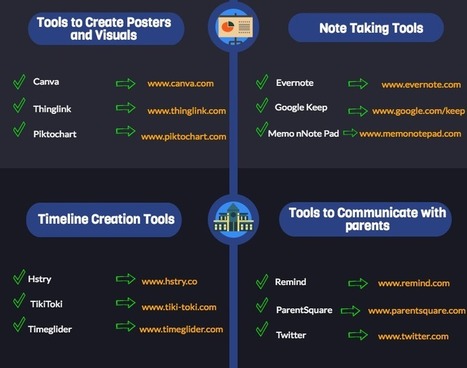
After posting about iPad apps for librarians, we are featuring another equally important visual comprising some of the best web tools to help librarians in their everyday work. We have arranged these tools into 10 main categories: Database portals, research tools, curation tools, animated video tools, poster creation tools, note taking tools, timeline creation tools, tools communicate with parents, presentation tools and reference tools.
|
|
Rescooped by
Dennis Swender
from Edumorfosis.it
December 7, 2019 11:04 AM
|
Scoop.it!

Is quality learning content a universal right?
If UNESCO statements are any indications, yes. In 2012, The Paris OER Declaration coined the term for “Open Educational Resources.” Based on principles an statements including the Universal Declaration of Human Rights and the Millenium Declaration, OER are conceived as content resources that permit no-cost access, use, redistribution and adaptation. Clearly open licenses or the public domain are optimal vehicles for OER’s ideal forms of use and exchange.
But we focus on the work UNESCO has been done for years until recently, the landscape does not strike as optimistic. Almost one by one, the recommendations have not become a modus operandi for education governing bodies, let alone media production companies. Keep in mind these are 8 years old:
|
|
Rescooped by
Dennis Swender
from Creative teaching and learning
December 7, 2019 10:58 AM
|
Scoop.it!

"A word cloud is a visual representation of the frequencies of words in a text. Teachers can use word clouds for a variety of instructional purposes from creating class groups using students' names to reflecting on lesson plans ..."
|
|
Rescooped by
Dennis Swender
from Daily Newspaper
December 5, 2019 12:03 PM
|
Scoop.it!

Most studies on traditional asynchronous online discussion suggest that facilitating dialogue, that is,commenting forum activities, result in better learning and performance. However, due to open entry and diverse learner backgrounds, learner behaviour inmassive open online courses (MOOCs) may be different. Viewing forum messages, which involvesfewer mental and physical actions as well as less cognitive processing, rather than posting forum massages, might better match the learner’sstudypurpose. In this study, we investigated the effects of three common types of online MOOC discussion forum activities (viewing, voting and commenting) on student peer learning (peer reviews) and performance (quiz scores). We used stepwise regression models to analyse two data samples of a humanity andart MOOC provided by a private university in the United States for exploring factors influencing peer learning and performance. The results indicate that peer learning and performance were primarily predicted by viewing, and to a lesser extent by commenting. The three plausible explanations for the findings are the learner’sstudy purpose, weaker instructor-learner ties, and voluntary forumparticipation. We suggest ways to encourage viewing messages in forumsand presentlimitations and further directions.