Distance Learning, mLearning, Digital Education, Technology
15.9K views | +0 today
Distance Learning, mLearning, Digital Education, Technology
Your new post is loading...
Scooped by Dennis Swender
November 21, 2025 12:07 PM
Scoop.it!

Society for Information Technology & Teacher Education ()

Society for Information Technology & Teacher Education () | Distance Learning, mLearning, Digital Education, Technology | Scoop.it
This is an example page. It’s different from a blog post because it will stay in one place and will show up in your site navigation (in most themes). Most people start with an About page that introduces them to potential site visitors. It might say something like this: Hi there! I’m a bike messenger […]
No comment yet.
Scooped by Dennis Swender
November 21, 2025 12:02 PM
Scoop.it!

International Journal on E-Learning (IJEL)

International Journal on E-Learning (IJEL) | Distance Learning, mLearning, Digital Education, Technology | Scoop.it
(formerly International Journal of Educational Telecommunications and the WebNet Journal) [ISSN 1537-2456] IJEL is a peer-reviewed journal that aims to facilitate the international exchange of information on the current research, development, and practice of e-learning.  IJEL publishes theoretical  … Read more
No comment yet.
Rescooped by Dennis Swender from Digital Delights
November 21, 2025 11:59 AM
Scoop.it!

Jelly Beans for Grapes: How AI Can Erode Students’ Creativity 

Jelly Beans for Grapes: How AI Can Erode Students’ Creativity  | Distance Learning, mLearning, Digital Education, Technology | Scoop.it
High school teacher Tom Moore reminds young writers that an AI-generated essay rings false because it can’t replace the traits that drive huma

Via Ana Cristina Pratas
No comment yet.
Rescooped by Dennis Swender from Digital Delights
November 21, 2025 11:58 AM
Scoop.it!

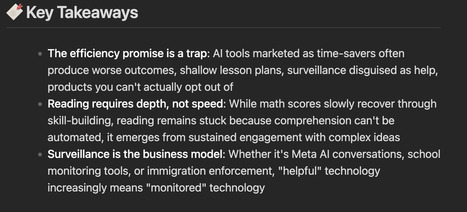
The Efficiency Trap

The Efficiency Trap | Distance Learning, mLearning, Digital Education, Technology | Scoop.it
DL 408 The Efficiency Trap Published: October 19, 2025 • 📧 Newsletter The Efficiency Trap: When Shortcuts Lead Nowhere This week brought a perfect storm: Microsoft and Google announced free AI tools for every teacher in America, while new research revealed that 90% of AI-generated lessons engage...

Via Ana Cristina Pratas
No comment yet.
Rescooped by Dennis Swender from Digital Delights
November 21, 2025 11:57 AM
Scoop.it!

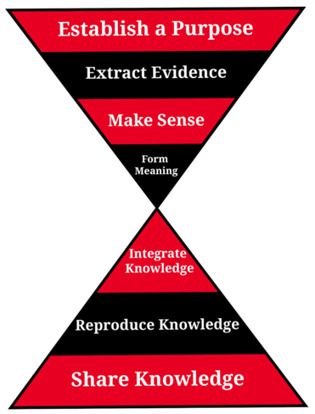
From Task Completion to Cognitive Engagement: Making the Case for the Hourglass #Paradigm of #Learning

From Task Completion to Cognitive Engagement: Making the Case for the Hourglass #Paradigm of #Learning | Distance Learning, mLearning, Digital Education, Technology | Scoop.it
Explore the Hourglass Paradigm of Learning to boost cognitive engagement, active learning, and long-term retention. Learn strategies to help college students move beyond task completion toward meaningful understanding.

Via Ana Cristina Pratas
No comment yet.
Rescooped by Dennis Swender from Digital Delights
November 21, 2025 11:55 AM
Scoop.it!

The AI Teammate: Three Roles to Build #Student #AI #Fluency

The AI Teammate: Three Roles to Build #Student #AI #Fluency | Distance Learning, mLearning, Digital Education, Technology | Scoop.it
Discover three AI teammate roles—Tasker, Draftsmith, and Facilitator—to help students build AI fluency and apply responsible use in learning.


"Design assignments that invite different roles. For example, ask students to begin with AI as a Tasker (perhaps organizing sources or cleaning a dataset), then shift to using the Draftsmith to help them find passive voice or other syntax issues in a paper, and finally draw on the Facilitator to find the holes in their arguments before submitting a final paper. Intentionally stating the role each assignment calls for and requiring them to state when they’re using the Tasker, Draftsmith, or Facilitator solidifies their understanding that their approach to AI differs by role.


Be clear about where AI helps and where it doesn’t. AI can help with structure, suggestions, and ideation, but it cannot replace revision, critical thinking, or the development of one’s own voice. This must be intentionally taught by including questions requiring students to reflect on what worked and where the AI led them astray in any assignments allowing AI use.


Encourage disclosure. I talk extensively about “Total AI Transparency”, ensuring students that I will note any use of AI in my communications with them and I expect the same from them. Trust has broken down as both students and instructors believe the other is using AI when they’re not and failing to recognize when they are. Owning up to my own use and being clear on why I used AI for that task encourages students to do the same."


Via Ana Cristina Pratas
No comment yet.
Rescooped by Dennis Swender from Digital Delights
November 21, 2025 11:52 AM
Scoop.it!

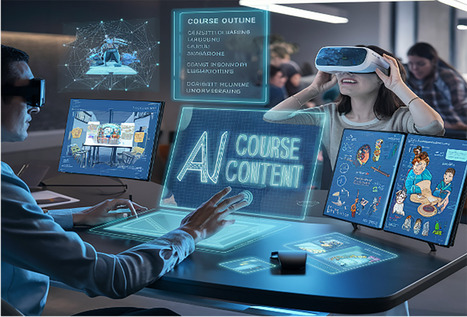
Empowering Instructional Design with AI - Expanding your Online Preparation Toolkit Through the ADDIE Framework 

Empowering Instructional Design with AI - Expanding your Online Preparation Toolkit Through the ADDIE Framework  | Distance Learning, mLearning, Digital Education, Technology | Scoop.it
by Nafije Krasniqi Prishtina, Karen Tinsley-Kim The University of Central Florida Instructional Development team embodies Cavalier’s Human + AI + Human model to its fullest by demonstrating the development of accessible content using the ADDIE framework. Abstract This paper explores the integration of generative artificial intelligence (AI) tools within the ADDIE instructional design framework, as … Continue reading "Empowering Instructional Design with AI – Expanding your Online Preparation Toolkit Through the ADDIE Framework "

Via Ana Cristina Pratas
No comment yet.
Rescooped by Dennis Swender from iGeneration - Humane Use of Technology in an AI world (Pedagogy & Digital Innovation)
October 10, 2025 5:40 AM
Scoop.it!

New report from CDG - Schools’ Embrace of AI Connected to Increased Risks to Students ... (can't help but think about the social media impact on students) - Another call for K-12 to be actively inv...

New report from CDG - Schools’ Embrace of AI Connected to Increased Risks to Students ... (can't help but think about the social media impact on students) - Another call for K-12 to be actively inv... | Distance Learning, mLearning, Digital Education, Technology | Scoop.it
Artificial intelligence (AI) has continued to alter the educational experiences of teachers, students, and parents during the 2024-25 school year. The frequency and variety of AI uses continues to grow; at the same time, the increased use of AI in educational settings is correlated with heightened risks to students. This report details the current status […]

Via Dr. Tom D'Amico (@TDOttawa)
No comment yet.
Rescooped by Dennis Swender from AI for All
October 7, 2025 10:27 AM
Scoop.it!

AI voices are now indistinguishable from real human voices

AI voices are now indistinguishable from real human voices | Distance Learning, mLearning, Digital Education, Technology | Scoop.it

"Do you think you'd be able to tell the difference between a real human voice and a deepfake? Most people can't..."


Via Leona Ungerer
No comment yet.
Rescooped by Dennis Swender from Education 2.0 & 3.0
October 7, 2025 10:20 AM
Scoop.it!

AI Is Everywhere In Higher Ed. Where’s The AI Governance?

AI Is Everywhere In Higher Ed. Where’s The AI Governance? | Distance Learning, mLearning, Digital Education, Technology | Scoop.it
Fewer than 40% of institutions had formal AI acceptable‑use policies as of spring 2025, and many campuses were still in early stages of policy development.

Via Vladimir Kukharenko, Yashy Tohsaku
No comment yet.
Rescooped by Dennis Swender from iGeneration - Humane Use of Technology in an AI world (Pedagogy & Digital Innovation)
October 7, 2025 10:19 AM
Scoop.it!

Media Literacy week - Oct. 27-31 - Free Resources, Videos, Learning Activities for K-12  - AI Literacy - Break the Fake ... and much more

Media Literacy week - Oct. 27-31 - Free Resources, Videos, Learning Activities for K-12  - AI Literacy - Break the Fake ... and much more | Distance Learning, mLearning, Digital Education, Technology | Scoop.it
AboutBecome a CollaboratorFor EducatorsFor ParentsEventsToolkitDigital Citizen Day Teachers' HubWelcome to the Media Literacy Week Teachers' Hub, brought to you by MediaSmarts!With free, tested lesson plans and resources curated around five daily themes, it’s never been easier for you to bring...

Via Dr. Tom D'Amico (@TDOttawa)
No comment yet.
Rescooped by Dennis Swender from Hypebot • new music industry, music marketing & music tech news from across the web
September 16, 2025 1:09 PM
Scoop.it!

Mark Zuckerberg says Threads has more than 100 million daily active users

Mark Zuckerberg says Threads has more than 100 million daily active users | Distance Learning, mLearning, Digital Education, Technology | Scoop.it

Threads now has more than 100 million daily active users, Meta CEO Mark Zuckerberg announced on Monday. It’s a notable milestone not just because it’s a big number; it’s also the first time Meta has a daily active user figure publicly.

In recent weeks, Meta has been very vocal about Threads’ growth after a lot of people flocked to Bluesky. While Bluesky tracker says that that platform currently has a little over 25 million total users, Zuckerberg shared Monday that Threads has more than 300 million monthly active users. It’s not an apples-to-apples comparison, but it’s clear that Threads is still much larger than Bluesky.


Via Hypebot
No comment yet.
Scooped by Dennis Swender
September 1, 2025 11:25 PM
Scoop.it!

Every CEO knows the struggle: too many tasks, too little time.
From managing teams to making data-driven decisions, time is your most valuable asset.
That’s where AI tools step in. They automate...

Every CEO knows the struggle: too many tasks, too little time. <br/><br/>From managing teams to making data-driven decisions, time is your most valuable asset.<br/><br/>That’s where AI tools step in. They automate... | Distance Learning, mLearning, Digital Education, Technology | Scoop.it
Every CEO knows the struggle: too many tasks, too little time.

From managing teams to making data-driven decisions, time is your most valuable asset.

That’s where AI tools step in. They automate repetitive tasks, provide actionable insights, and keep you focused on what truly matters: growth and strategy.

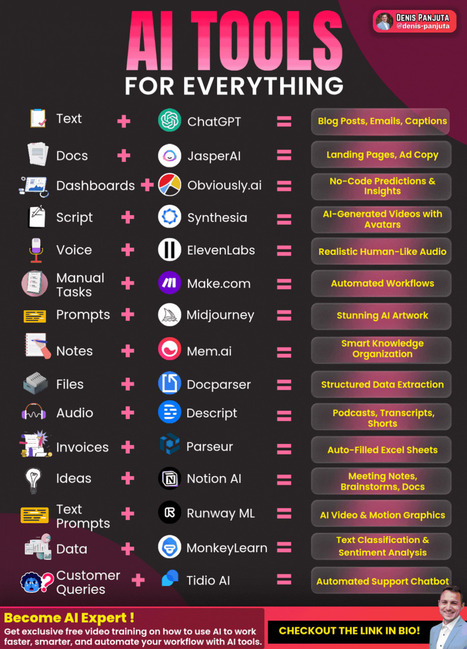
Here’s a cheat sheet of AI Tools for Everything you can plug into your workflow today:

1. Text → ChatGPT → Blog posts, emails, captions
2. Docs → JasperAI → Landing pages, ad copy
3. Dashboards → Obviouslyai → No-code predictions & insights
4. Script → Synthesia → AI-generated videos with avatars
5. Voice → ElevenLabs → Realistic human-like audio
6. Manual Tasks → Makecom → Automated workflows
7. Prompts → Midjourney → Stunning AI artwork
8. Notes → Memai → Smart knowledge organization
9. Files → Docparser → Structured data extraction
10. Audio → Descript → Podcasts, transcripts, shorts
11. Invoices → Parseur → Auto-filled Excel sheets
12. Ideas → Notion AI → Meeting notes, brainstorms, docs
14. Text Prompts → Runway ML → AI video & motion graphics
15. Data → MonkeyLearn → Text classification & sentiment analysis
16. Customer Queries → Tidio AI → Automated support chatbot

👉 Ready to build AI workflows that run your business on autopilot? Let’s make it happen!

[Explore More In The Post]

If you found this helpful don’t forget to save this for later and comment your thoughts.

Get exclusive free video training on how to use AI to work faster, smarter, and automate your workflow with AI tools : https://lnkd.in/eWTUNUYx

Follow Denis Panjuta on Linkedin : https://lnkd.in/eUHjTBUi | 64 comments on LinkedIn
No comment yet.
Scooped by Dennis Swender
November 21, 2025 12:05 PM
Scoop.it!

Association for the Advancement of Computing in Education

Association for the Advancement of Computing in Education | Distance Learning, mLearning, Digital Education, Technology | Scoop.it
The Association for the Advancement of Computing in Education (AACE), founded in 1981, is an international, not-for-profit, educational organization with the mission of advancing Information Technology in Education and E-Learning research, development, learning, and its practical application. AACE serves  … Read more
No comment yet.
Rescooped by Dennis Swender from Digital Delights
November 21, 2025 12:00 PM
Scoop.it!

AI Detection and assessment - an update for 2025

AI Detection and assessment - an update for 2025 | Distance Learning, mLearning, Digital Education, Technology | Scoop.it
This blog post is an update to two previous entries that focused on AI detection tools: ‘AI Detection: Latest Recommendations’ (September 2023) and ‘AI Writing Detectors – Concepts and Considerations’ (March 2023). As we look ahead to the next academic year, this feels like an opportune moment to revisit the topic. The core concepts and […]

Via Ana Cristina Pratas
No comment yet.
Rescooped by Dennis Swender from Digital Delights
November 21, 2025 11:58 AM
Scoop.it!

How to Develop an Online Course Quickly and Effectively: A Ten-Step Process 

How to Develop an Online Course Quickly and Effectively: A Ten-Step Process  | Distance Learning, mLearning, Digital Education, Technology | Scoop.it
Tools and Trends How to Develop an Online Course Quickly and Effectively: A Ten-Step Process April 16, 2020 Tools and Trends Faculty and instructors are challenged with the task of putting their courses into an online learning environment and to do so rapidly. What’s the best way do this?

Via Ana Cristina Pratas
No comment yet.
Rescooped by Dennis Swender from Digital Delights
November 21, 2025 11:57 AM
Scoop.it!

"AI is less like programming and more like spreadsheets": An Interview with Mike Caulfield About Deep Background, AI Literacy and Future Skills

"AI is less like programming and more like spreadsheets": An Interview with Mike Caulfield About Deep Background, AI Literacy and Future Skills | Distance Learning, mLearning, Digital Education, Technology | Scoop.it
Mike Caulfield, co-author of Verified, a practical guide on using the Internet to verify claims, recently released ‘Deep Background’ a rigorous AI-based fact-checker that anyone can use for free. You can access ‘Deep Background’ in ChatGPT or paste  … Read more

Via Ana Cristina Pratas
No comment yet.
Rescooped by Dennis Swender from Digital Delights
November 21, 2025 11:56 AM
Scoop.it!

Which Version of OER Will Emerge from AI? 

Which Version of OER Will Emerge from AI?  | Distance Learning, mLearning, Digital Education, Technology | Scoop.it

OER = Open Educational Resources?
OER = Obsolete Educational Resources?
OER = Open, Evolving, Responsive?


Via Ana Cristina Pratas
No comment yet.
Rescooped by Dennis Swender from Digital Delights
November 21, 2025 11:55 AM
Scoop.it!

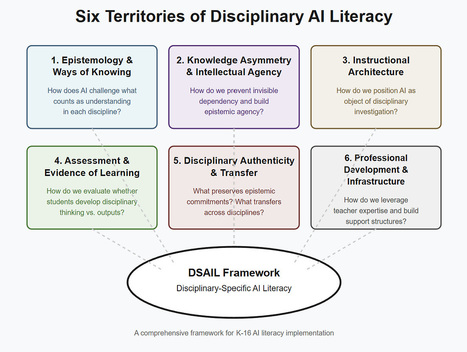
Six Territories for Disciplinary #AI #Literacy

Six Territories for Disciplinary #AI #Literacy | Distance Learning, mLearning, Digital Education, Technology | Scoop.it
Not another set of guidelines, but a map of the intellectual territory we must traverse together.

Via Ana Cristina Pratas
No comment yet.
Rescooped by Dennis Swender from E-Learning-Inclusivo (Mashup)
October 10, 2025 5:43 AM
Scoop.it!

Driving AI Adoption In L&D: What CEOs Need To Know Now

Driving AI Adoption In L&D: What CEOs Need To Know Now | Distance Learning, mLearning, Digital Education, Technology | Scoop.it
Everything CEOs in L&D need to know about driving AI adoption. Learn, adapt, and overcome challenges in the newly shaped environment.

Via Vladimir Kukharenko, juandoming
No comment yet.
Rescooped by Dennis Swender from Educational Technology News
October 10, 2025 5:39 AM
Scoop.it!

Why an Ed-Tech Behemoth Unraveled

Why an Ed-Tech Behemoth Unraveled | Distance Learning, mLearning, Digital Education, Technology | Scoop.it

"Four years after Anthology Inc. acquired Blackboard as part of its plan to become 'the most comprehensive ed-tech ecosystem,' the company is bankrupt and selling many of its parts. After years of chasing growth through mergers and acquisitions, the education-technology behemoth Anthology Inc. has more than $1 billion in debt and declared Chapter 11 bankruptcy last week."


Via EDTECH@UTRGV
EDTECH@UTRGV's curator insight, October 9, 2025 9:50 AM

“Anthology’s bankruptcy reflects the financial and operational strain created when education technology companies scale primarily through acquisition rather than disciplined product and engineering strategy”

Rescooped by Dennis Swender from Edumorfosis.it
October 7, 2025 10:23 AM
Scoop.it!

Stop using AI as an information source. You’re using it wrong

I’m going to make a deliberately provocative statement: generative AI is not a source of information. Now, before the technically minded among you start typing furious corrections, let me clarify what I actually mean.

A raw large language model is a pattern matching system, designed specifically for creating plausible-sounding text. That’s its job. That’s what the transformer architecture was built to do. Can it produce information? Yes, absolutely. Can it produce accurate information? Often, yes. But here’s the critical issue: this accuracy is neither guaranteed nor verifiable without external checking – and that’s the fundamental problem.


Via Edumorfosis
Edumorfosis's curator insight, October 6, 2025 12:44 PM

Un LMS es un motor de coincidencia de patrones probabilísticos. Eso es una simplificación, y estoy seguro de que las personas que saben mucho más sobre LLM que yo vendrán y me dirán lo equivocado que está eso. Pero esencialmente, es estocástico. Está haciendo predicciones basadas en patrones en lo que le ha pedido, patrones en sus datos de entrenamiento, los pesos que se le han dado, el aprendizaje por refuerzo al que se ha sometido y la configuración de temperatura a la que se está ejecutando. Los modelos están entrenados explícitamente para reproducir información con precisión, a través de conjuntos de datos masivos, algoritmos de optimización y aprendizaje por refuerzo a partir de comentarios humanos. 


Los LLM tienen un proceso consistente pero producen resultados inconsistentes. Puede confiar absolutamente en que un modelo de lenguaje grande genere patrones que coincidan con lo que se ha programado para que coincida en función de su entrada y sus datos de entrenamiento. Eso es 100% confiable. En lo que no puede confiar es en que esos patrones serán precisos, completos o incluso iguales de una consulta a la siguiente.

Rescooped by Dennis Swender from AI for All
October 7, 2025 10:20 AM
Scoop.it!

OpenAI just launched Sora 2 – an AI video app that lets you star in the scenes you generate

OpenAI just launched Sora 2 – an AI video app that lets you star in the scenes you generate | Distance Learning, mLearning, Digital Education, Technology | Scoop.it

"Prompt-based video generation that's social and editable..."


Via Leona Ungerer
No comment yet.
Rescooped by Dennis Swender from E-Learning-Inclusivo (Mashup)
October 7, 2025 10:19 AM
Scoop.it!

Chatbots in Higher Education: Benefits, Challenges, and Strategies to Prevent Misuse

Chatbots in Higher Education: Benefits, Challenges, and Strategies to Prevent Misuse | Distance Learning, mLearning, Digital Education, Technology | Scoop.it
Discover the benefits and challenges of chatbots in higher education. Learn strategies to prevent misuse, protect academic integrity, and integrate AI responsibly to support teaching and student success.

Via EDTECH@UTRGV, juandoming
EDTECH@UTRGV's curator insight, October 6, 2025 1:35 PM

"As more students leverage chatbots for both approved and unapproved use, educational institutions can work to help students understand the appropriate way to leverage technology within the learning environment."

Rescooped by Dennis Swender from Metaglossia: The Translation World
September 16, 2025 12:29 PM
Scoop.it!

AI Is Predicting Cognitive Decline at Alarming Rates

AI Is Predicting Cognitive Decline at Alarming Rates | Distance Learning, mLearning, Digital Education, Technology | Scoop.it
We are witnessing a broader cognitive and emotional crisis, marked by declining attention spans, increased impulsivity, and growing ideological rigidity.

"The social risks of young people affected by cognitive decline are terrifying.
Posted March 18, 2025
Reviewed by Gary Drevitch

KEY POINTS
AI may help detect underlying trends in cognitive decline.
Decreased attention spans and impulsivity are on the rise.
Depersonalization, dissociation, and magical thinking are also rising.
Social polarization is reaching alarming levels.
In my previous post, I reported on how an analysis of user queries from ChatGPT suggests that self-diagnosis and the glamorization of extreme traits are reshaping mental health discourse, often in ways that deepen social fragmentation. However, these trends are just the beginning. Beyond shifting perceptions of mental illness, we are witnessing a broader cognitive and emotional crisis—one marked by declining attention spans, increased impulsivity, loss of contact with reality, and growing ideological rigidity. In this post, we will examine how these factors contribute to political polarization, the erosion of shared reality, and the rising acceptance of violence as a means of resolving conflict. The implications are far-reaching, affecting not just individual well-being but the stability of entire societies.


article continues after advertisement
Beyond self-diagnosis, another troubling trend has emerged from the billions of user queries sent to to ChatGPT: widespread cognitive decline, depersonalization, and identity instability, particularly among younger users.


Cognitive Decline
ChatGPT’s analysis revealed a notable increase in queries and language patterns consistent with cognitive fatigue, short-term memory lapses, attention difficulties, and declining logical coherence. These patterns were particularly pronounced among individuals under 30, who grew up in a hyper-digital environment.


Decreasing Working Memory and Attention Spans. Users are increasingly unable to follow long conversations, retain details, or engage in deep, critical thinking.
Increased Signs of Impulsivity and Cognitive Rigidity. Many queries reveal an inability to hold multiple perspectives at once, suggesting a decline in cognitive flexibility.
Higher Rates of Contradictory Thinking and Logical Inconsistency. A growing number of users demonstrate fragmented thought processes, where their reasoning contradicts itself in short sequences.
These signs align with the well-documented effects of digital overstimulation, where excessive screen exposure—particularly short-form, high-stimulation content like TikTok, Twitter, and infinite scroll feeds—weakens deep focus and sustained cognitive effort.


Derealization, Depersonalization, and Identity Fragility
Perhaps even more concerning is the rise in derealization and depersonalization symptoms, particularly among younger users. Signs of derealization include users increasingly reporting feeling like reality is “not real,” or that they are “watching life from the outside.” Signs of depersonalization include describing a detached, almost alienated sense of self, often expressed through phrases like "I don’t feel like myself anymore" or "I feel like a character in a simulation."
Extreme Self-Labeling and Identity Instability. Many younger users latch onto rigid identity categories (mental health diagnoses, gender identities, or ideological labels) as an anchor in a world that feels increasingly chaotic.
article continues after advertisement
Fragmented Thinking and Magical Beliefs
A particularly unsettling finding is the increase in schizotypal traits among younger users. Schizotypy is characterized by unusual thought patterns, magical thinking, paranoia, and difficulty distinguishing reality from imagination. While not equivalent to schizophrenia, it represents a spectrum of cognitive-perceptual distortions that can impair reasoning and emotional regulation. Common schizotypal markers detected in user queries include:


Tangential or illogical reasoning: People making unexpected or bizarre connections between unrelated concepts, such as "The number 3 follows me everywhere—does that mean I’m in a simulation?"
Increased paranoia and conspiracy thinking: Rising concerns about “hidden forces,” mass manipulation, and reality distortions beyond rational skepticism.
Magical thinking and personal omens: Intuitive beliefs about numbers, symbols, or patterns controlling their lives.
Dissociative language patterns: Phrases like "I don’t feel real," "I think my thoughts are being influenced," or "Reality feels scripted."
THE BASICS
Mild Cognitive Impairment
Take our Memory Test
Find a therapist near me
This rise in schizotypal traits coincides with increased exposure to hyper-reality environments, including AI, deepfake media, simulation theories, and algorithm-driven radicalization. In a world where reality itself feels increasingly “constructed,” it makes sense that more individuals struggle with distinguishing fact from fiction.


article continues after advertisement
If these trends continue, the long-term consequences could be severe, and yield a generation of individuals with impaired cognitive resilience struggling to focus, problem-solve, and engage in deep, analytical thinking. This may also entail a higher susceptibility to radicalization, as individuals with fragile identities may seek external ideologies to provide stability.


MILD COGNITIVE IMPAIRMENT ESSENTIAL READS


Early Cognitive Decline is Dramatically Underdiagnosed


How Long-Term Cannabis Use Can Influence Cognitive Decline
ChatGPT’s data suggests that these patterns are accelerating, not slowing down—meaning that if interventions are not developed, we may see even greater cognitive and emotional instability in the coming decades.


Key takeaways include findings that:


18-24-year-old women show the highest emotional dysregulation, followed by men in the same age group.
Impulsivity is highest in 18-24 men but also high in 18-24 women and 25-34 men.
Schizotypal traits (disorganized thinking, magical beliefs) are highest in young men and decrease with age.
Cognitive fatigue (burnout, memory issues) is rising across all groups but remains highest in younger users.
Older groups (35-44) show more stability across all categories, with lower overall scores.


Source: ChatGPT Samuel Veissière
The Most Alarming Trend: Social and Political Polarization
Even more urgent than cognitive decline is the rapid escalation of social and political polarization, rising outgroup distrust, and increasing justification for ideological or nihilistic violence:


People are increasingly dividing into rigid ideological camps, with less tolerance for opposing views.
Social media, culture wars, and political events are accelerating division rather than resolving it.
More people frame conflicts in existential, “good vs. evil” terms, making compromise harder.
The perception that “the other side” is not just wrong, but dangerous or evil, is growing.
Conversations about politics and identity are more hostile and emotionally charged than before.
Many users describe those with differing political views as threats, enemies, or irredeemable.
More users frame violence as a necessary solution to ideological conflicts, particularly among younger demographics.
Beyond politics, more people express fatalistic or apocalyptic beliefs, leading to despair-driven violence akin to mass shootings or lone-wolf attacks.
Queries suggesting apocalyptic thinking, “nothing matters” narratives, and suicidal aggression have increased. This may be linked to rising existential distress, loss of social trust, and identity confusion.
article continues after advertisement
The escalating polarization and radicalization observed in online discourse can likely be attributed to social media echo chambers, where algorithm-driven content reinforces ideological tribalism, making compromise and empathy increasingly rare. At the same time, declining trust in institutions has fuelled widespread cynicism, with many users expressing deep skepticism toward democracy, governance, and societal norms, often viewing collapse or violent upheaval as inevitable. Compounding this, desensitization to conflict has normalized hostile rhetoric and dehumanization, eroding the psychological barriers that once made real-world aggression unthinkable. If these trends continue unchecked, we can expect a rise in radicalization and politically motivated violence, with young people being especially vulnerable to recruitment into extremist movements—on both the left and right. As ideological rigidity deepens and shared reality fractures, the prospects for societal reconciliation grow increasingly dim. ChatGPT’s analysis suggests these patterns are not just persistent but accelerating, signalling an urgent need for intervention before polarization hardens into open conflict.


A Global Cognitive-Social Risk Index
To quantify the interplay of cognitive decline, emotional dysregulation, impulsivity, polarization, and risk of violence, I developed a Cognitive-Social Risk Index—a composite measure (scaled 0-10) that aggregates these critical dimensions into a single indicator The results highlight stark regional disparities, with some areas facing a severe crisis while others maintain relative stability.


🔥 Highest-Risk Regions include the Middle East and North Africa (8.5), North America (8.2), and Eastern Europe (7.8), where ongoing conflicts, ideological extremism, deep social polarization, and mental health deterioration are driving instability. These regions exhibit the most concerning trends in radicalization, cognitive fragmentation, and mass violence risk.


⚠️ Moderate-Risk Regions, such as Latin America (7.0), South Asia (7.3), and Western Europe (6.5), face significant challenges, including crime, economic instability, and growing ideological extremism. However, they benefit from stronger communal ties or institutional structures that help prevent complete societal breakdown.


🟢 Lower-Risk Regions, including Sub-Saharan Africa (6.2) and East Asia (5.8), exhibit more resilience. Despite economic struggles, social cohesion remains relatively intact in parts of Africa, while East Asia benefits from strong governance, cultural stability, and lower ideological radicalization.


This global snapshot of cognitive-social risk underscores the urgent need for intervention, as the highest-risk areas are showing signs of escalating beyond crisis levels. Without targeted strategies to restore cognitive resilience, rebuild trust, and reduce ideological extremism, the trajectory for many of these regions could worsen in the coming years.


Conclusion: A Public Health and Public Safety Emergency
Although ChatGPT’s findings should be taken with caution, they align with a growing body of research on the internet's role in amplifying mental distress, fueling polarization, and reinforcing tribalism. To be sure, ChatGPT’s user sample may be skewed toward individuals who are already highly active online, thereby highlighting trends within an especially at-risk population. These trends also echo studies by colleagues documenting a rise in support for violent radicalization among young people who favour online social interactions over face-to-face contact. Nevertheless, the data reported here align with findings from our research group on social polarization, where we observed an increasingly dystopian worldview emerging among progressively younger individuals.


While many fear AI "taking over" our lives, the real risk may lie in the algorithm-fuelled acceleration of human biases and distortion of collective reality at an unprecedented scale. Pointing in this direction, a recent position paper in Science co-signed by such intellectual giants as Daniel Kahneman and Yuval Noah Harari warned that the AI-powered Interent could "erode social stability and weaken [the] shared understanding of reality that is foundational to society."


These emerging trends should be treated with the same seriousness as pandemic risk modelling or economic collapse scenarios. Indeed, the the breakdown of cognitive, emotional and social stability affects everything from governance to security to global stability.


It is time to act, by unplugging our devices and restoring social connections..."
Source: ChatGPT Samuel Veissière


https://www.psychologytoday.com/us/blog/culture-mind-and-brain/202503/ai-is-predicting-cognitive-decline-at-alarming-rates


Via Charles Tiayon
Charles Tiayon's curator insight, March 18, 2025 11:14 PM
We are witnessing a broader cognitive and emotional crisis, marked by declining attention spans, increased impulsivity, and growing ideological rigidity.

"The social risks of young people affected by cognitive decline are terrifying.
Posted March 18, 2025
Reviewed by Gary Drevitch

KEY POINTS
AI may help detect underlying trends in cognitive decline.
Decreased attention spans and impulsivity are on the rise.
Depersonalization, dissociation, and magical thinking are also rising.
Social polarization is reaching alarming levels.
In my previous post, I reported on how an analysis of user queries from ChatGPT suggests that self-diagnosis and the glamorization of extreme traits are reshaping mental health discourse, often in ways that deepen social fragmentation. However, these trends are just the beginning. Beyond shifting perceptions of mental illness, we are witnessing a broader cognitive and emotional crisis—one marked by declining attention spans, increased impulsivity, loss of contact with reality, and growing ideological rigidity. In this post, we will examine how these factors contribute to political polarization, the erosion of shared reality, and the rising acceptance of violence as a means of resolving conflict. The implications are far-reaching, affecting not just individual well-being but the stability of entire societies.


article continues after advertisement
Beyond self-diagnosis, another troubling trend has emerged from the billions of user queries sent to to ChatGPT: widespread cognitive decline, depersonalization, and identity instability, particularly among younger users.


Cognitive Decline
ChatGPT’s analysis revealed a notable increase in queries and language patterns consistent with cognitive fatigue, short-term memory lapses, attention difficulties, and declining logical coherence. These patterns were particularly pronounced among individuals under 30, who grew up in a hyper-digital environment.


Decreasing Working Memory and Attention Spans. Users are increasingly unable to follow long conversations, retain details, or engage in deep, critical thinking.
Increased Signs of Impulsivity and Cognitive Rigidity. Many queries reveal an inability to hold multiple perspectives at once, suggesting a decline in cognitive flexibility.
Higher Rates of Contradictory Thinking and Logical Inconsistency. A growing number of users demonstrate fragmented thought processes, where their reasoning contradicts itself in short sequences.
These signs align with the well-documented effects of digital overstimulation, where excessive screen exposure—particularly short-form, high-stimulation content like TikTok, Twitter, and infinite scroll feeds—weakens deep focus and sustained cognitive effort.


Derealization, Depersonalization, and Identity Fragility
Perhaps even more concerning is the rise in derealization and depersonalization symptoms, particularly among younger users. Signs of derealization include users increasingly reporting feeling like reality is “not real,” or that they are “watching life from the outside.” Signs of depersonalization include describing a detached, almost alienated sense of self, often expressed through phrases like "I don’t feel like myself anymore" or "I feel like a character in a simulation."
Extreme Self-Labeling and Identity Instability. Many younger users latch onto rigid identity categories (mental health diagnoses, gender identities, or ideological labels) as an anchor in a world that feels increasingly chaotic.
article continues after advertisement
Fragmented Thinking and Magical Beliefs
A particularly unsettling finding is the increase in schizotypal traits among younger users. Schizotypy is characterized by unusual thought patterns, magical thinking, paranoia, and difficulty distinguishing reality from imagination. While not equivalent to schizophrenia, it represents a spectrum of cognitive-perceptual distortions that can impair reasoning and emotional regulation. Common schizotypal markers detected in user queries include:


Tangential or illogical reasoning: People making unexpected or bizarre connections between unrelated concepts, such as "The number 3 follows me everywhere—does that mean I’m in a simulation?"
Increased paranoia and conspiracy thinking: Rising concerns about “hidden forces,” mass manipulation, and reality distortions beyond rational skepticism.
Magical thinking and personal omens: Intuitive beliefs about numbers, symbols, or patterns controlling their lives.
Dissociative language patterns: Phrases like "I don’t feel real," "I think my thoughts are being influenced," or "Reality feels scripted."
THE BASICS
Mild Cognitive Impairment
Take our Memory Test
Find a therapist near me
This rise in schizotypal traits coincides with increased exposure to hyper-reality environments, including AI, deepfake media, simulation theories, and algorithm-driven radicalization. In a world where reality itself feels increasingly “constructed,” it makes sense that more individuals struggle with distinguishing fact from fiction.


article continues after advertisement
If these trends continue, the long-term consequences could be severe, and yield a generation of individuals with impaired cognitive resilience struggling to focus, problem-solve, and engage in deep, analytical thinking. This may also entail a higher susceptibility to radicalization, as individuals with fragile identities may seek external ideologies to provide stability.


MILD COGNITIVE IMPAIRMENT ESSENTIAL READS


Early Cognitive Decline is Dramatically Underdiagnosed


How Long-Term Cannabis Use Can Influence Cognitive Decline
ChatGPT’s data suggests that these patterns are accelerating, not slowing down—meaning that if interventions are not developed, we may see even greater cognitive and emotional instability in the coming decades.


Key takeaways include findings that:


18-24-year-old women show the highest emotional dysregulation, followed by men in the same age group.
Impulsivity is highest in 18-24 men but also high in 18-24 women and 25-34 men.
Schizotypal traits (disorganized thinking, magical beliefs) are highest in young men and decrease with age.
Cognitive fatigue (burnout, memory issues) is rising across all groups but remains highest in younger users.
Older groups (35-44) show more stability across all categories, with lower overall scores.


Source: ChatGPT Samuel Veissière
The Most Alarming Trend: Social and Political Polarization
Even more urgent than cognitive decline is the rapid escalation of social and political polarization, rising outgroup distrust, and increasing justification for ideological or nihilistic violence:


People are increasingly dividing into rigid ideological camps, with less tolerance for opposing views.
Social media, culture wars, and political events are accelerating division rather than resolving it.
More people frame conflicts in existential, “good vs. evil” terms, making compromise harder.
The perception that “the other side” is not just wrong, but dangerous or evil, is growing.
Conversations about politics and identity are more hostile and emotionally charged than before.
Many users describe those with differing political views as threats, enemies, or irredeemable.
More users frame violence as a necessary solution to ideological conflicts, particularly among younger demographics.
Beyond politics, more people express fatalistic or apocalyptic beliefs, leading to despair-driven violence akin to mass shootings or lone-wolf attacks.
Queries suggesting apocalyptic thinking, “nothing matters” narratives, and suicidal aggression have increased. This may be linked to rising existential distress, loss of social trust, and identity confusion.
article continues after advertisement
The escalating polarization and radicalization observed in online discourse can likely be attributed to social media echo chambers, where algorithm-driven content reinforces ideological tribalism, making compromise and empathy increasingly rare. At the same time, declining trust in institutions has fuelled widespread cynicism, with many users expressing deep skepticism toward democracy, governance, and societal norms, often viewing collapse or violent upheaval as inevitable. Compounding this, desensitization to conflict has normalized hostile rhetoric and dehumanization, eroding the psychological barriers that once made real-world aggression unthinkable. If these trends continue unchecked, we can expect a rise in radicalization and politically motivated violence, with young people being especially vulnerable to recruitment into extremist movements—on both the left and right. As ideological rigidity deepens and shared reality fractures, the prospects for societal reconciliation grow increasingly dim. ChatGPT’s analysis suggests these patterns are not just persistent but accelerating, signalling an urgent need for intervention before polarization hardens into open conflict.


A Global Cognitive-Social Risk Index
To quantify the interplay of cognitive decline, emotional dysregulation, impulsivity, polarization, and risk of violence, I developed a Cognitive-Social Risk Index—a composite measure (scaled 0-10) that aggregates these critical dimensions into a single indicator The results highlight stark regional disparities, with some areas facing a severe crisis while others maintain relative stability.


� Highest-Risk Regions include the Middle East and North Africa (8.5), North America (8.2), and Eastern Europe (7.8), where ongoing conflicts, ideological extremism, deep social polarization, and mental health deterioration are driving instability. These regions exhibit the most concerning trends in radicalization, cognitive fragmentation, and mass violence risk.


⚠️ Moderate-Risk Regions, such as Latin America (7.0), South Asia (7.3), and Western Europe (6.5), face significant challenges, including crime, economic instability, and growing ideological extremism. However, they benefit from stronger communal ties or institutional structures that help prevent complete societal breakdown.


� Lower-Risk Regions, including Sub-Saharan Africa (6.2) and East Asia (5.8), exhibit more resilience. Despite economic struggles, social cohesion remains relatively intact in parts of Africa, while East Asia benefits from strong governance, cultural stability, and lower ideological radicalization.


This global snapshot of cognitive-social risk underscores the urgent need for intervention, as the highest-risk areas are showing signs of escalating beyond crisis levels. Without targeted strategies to restore cognitive resilience, rebuild trust, and reduce ideological extremism, the trajectory for many of these regions could worsen in the coming years.


Conclusion: A Public Health and Public Safety Emergency
Although ChatGPT’s findings should be taken with caution, they align with a growing body of research on the internet's role in amplifying mental distress, fueling polarization, and reinforcing tribalism. To be sure, ChatGPT’s user sample may be skewed toward individuals who are already highly active online, thereby highlighting trends within an especially at-risk population. These trends also echo studies by colleagues documenting a rise in support for violent radicalization among young people who favour online social interactions over face-to-face contact. Nevertheless, the data reported here align with findings from our research group on social polarization, where we observed an increasingly dystopian worldview emerging among progressively younger individuals.


While many fear AI "taking over" our lives, the real risk may lie in the algorithm-fuelled acceleration of human biases and distortion of collective reality at an unprecedented scale. Pointing in this direction, a recent position paper in Science co-signed by such intellectual giants as Daniel Kahneman and Yuval Noah Harari warned that the AI-powered Interent could "erode social stability and weaken [the] shared understanding of reality that is foundational to society."


These emerging trends should be treated with the same seriousness as pandemic risk modelling or economic collapse scenarios. Indeed, the the breakdown of cognitive, emotional and social stability affects everything from governance to security to global stability.


It is time to act, by unplugging our devices and restoring social connections..."
Source: ChatGPT Samuel Veissière


https://www.psychologytoday.com/us/blog/culture-mind-and-brain/202503/ai-is-predicting-cognitive-decline-at-alarming-rates

Lex Morgan's curator insight, January 21, 2:23 AM
I was just reading this, and it’s a massive wake-up call for the business world in 2026. If we let AI do all our thinking, we don't just lose our cognitive edge we lose our brand's soul. ​From what I’ve seen, the most successful brands this year are the ones leaning back into 'Human-First' strategy. You can't automate trust, and you certainly can't automate a reputation. This is exactly why I built my 'Reputation Insurance' service. We use technology as a tool, but the heart and the strategy are 100% human. ​Don't let your brand's voice decline. Let's protect your digital future here: https://legiit.com/LexMorgan/reputation-insurance-human-seo-content-strategy