




Jerome Pesenti is encouraged by progress in artificial intelligence, but sees the limits of the current approach to deep learning.

 Your new post is loading...
 Scoop.it! Jerome Pesenti is encouraged by progress in artificial intelligence, but sees the limits of the current approach to deep learning. No comment yet.
Sign up to comment
Scoop.it!

Inquiry-based Learning is increasingly suggested as an efficient approach for fostering learners' curiosity and motivation. It helps learners to devel… Via Ana Cristina Pratas 
Ana Cristina Pratas's curator insight,
December 5, 2019 7:17 AM
AbstractInquiry-based Learning is increasingly suggested as an efficient approach for fostering learners' curiosity and motivation. It helps learners to develop their ability to work in complex and unpredictable environments making them more critical thinkers and agentic learners. Although mobile technology is a suitable support for this learning process, there is a lack of practical strategies for educational practitioners to enact the right balance between enabling agency and supporting the students through the mobile technology. Thus, we conducted a literature review that analyzed 62 studies on mobile inquiry-based learning. The analysis focused on the level of agency supported by mobile technology. This review study provided two main results. The first result is a two-layer classification –with five types and twelve subtypes– of the most common mobile activities used in inquiry-based learning. The types and subtypes are: 1) Direct instruction formed by 1a) location guidance, 1b) procedural guidance and 1c) metacognitive guidance, 2) Access to content formed by 2a) fixed and 2b) dynamic content, 3) Data collection that consists of 3a) cooperative and 3b) collaborative data collection, 4) Peer-to-peer communication formed by 4a) asynchronous and 4b) synchronous social communications and 5) Contextual support that includes 5a) augmented experience, 5b) immersive experience and 5c) adaptive feedback. The second result consists of an analytical framework –based on six dimensions– to assess the level of agency supported by the different types of mobile activities. The learners' agency dimensions are: 1) Goals, 2) Content, 3) Actions, 4) Strategies, 5) Reflection and 6) Monitoring. Finally, the review presents insights on how this analytical framework can be used by educational practitioners to identify mobile activities that effectively balance learners’ agency with mobile technology.
Scoop.it!

"Integrating technology in the math classroom can go far beyond substitution, digital worksheets, and simple quizzes. In this blog post and episode, my guest, Craig Klement, will share 10 ways to use technology in the math classroom ..." Via Leona Ungerer
Scoop.it!

If you are doing instructional design (ID) you may also be doing learning engineering according to the definition from the designers, engineers, researchers, and practitioners involved in the IEEE ICICLE industry consortium on learning engineering. They defined learning engineering as follows: Via Marta Torán 
Marta Torán's curator insight,
December 4, 2019 5:37 PM
Jim Goodell (@jgoodell2) nos explica qué es la ingeniería del aprendizaje y la conexión con el diseño instruccional.
Hacer ingeniería del aprendizaje implica, según IEEE ICICLE, aplicar las ciencias del aprendizaje, utilizar metodologías de diseño de ingeniería centradas en el ser humano y tomar decisiones a partir de datos.
Scoop.it!

If there's one cliché about eLearning, it's a slide full of bullet points followed by the instruction to "click next." It doesn't have to be that way, and you can provide context, invite analysis, and encourage engagement. In fact, if you want people to experience learning in an engaging way, you need to banish the bullets and require interactivity. In this interview, Trina Rimmer draws on years of eLearning design and development expertise to suggest ways to move your eLearning to the next level. Via Marta Torán
Scoop.it!

In this blog post and episode, Kasey will share 25+ awesome ways to use Google Keep, which she refers to as the "Instantpot of G Suite!" Find out how to use this tool for notes, labeling, annotation, speech to text, feedback, and more! And get the FREE Bonus: The Google Keep Cheat Sheet! Via Yashy Tohsaku
Scoop.it!

"Here is a list of some useful iPad apps students can use to unleash their creative thinking and engage in hands-on learning activities ..." Make a movie Create music Edit photos Draw and sketch Tell a storyVia Leona Ungerer
Scoop.it!

The trouble with designing eLearning in 2019 is that with all the different options and formats available, a designer may have a feeling that something in the visuals of an eLearning project isn't quite right. The problem is putting your finger on what's wrong and knowing what to do about it. But help is available! Bianca Woods suggested some visual design ideas recently during an interview." Via EDTECH@UTRGV 
EDTECH@UTRGV's curator insight,
November 21, 2019 4:00 PM
Poor visual design in e-learning is a pet peeve of mine. First impressions are important. If a poorly designed UX is the first thing students see, they'll start the course with a bad impression that may last throughout the course.
Scoop.it!

Google released an update to Google Drive. They call it Google Drive’s Priority Page. When I first saw this I was not sold on it Via Dr. Tom D'Amico (@TDOttawa)
Scoop.it!

Description by Stephen Downes:
"This is a detailed and useful look at Amazon's new Ignite platform selling teacher-produced learning materials (mentioned here a couple of weeks ago). "Amazon Ignite... represents the next-stage instantiation of the brand ambassador and the teacher as micro-influencer," writes Ben Williamson. "Teachers are not contracted as platform ambassadors, but invited to become self-branded sellers in a competitive marketplace, setting up shop as micro-edubusinesses." He also notes that "Amazon Ignite is ‘invitation-only’ and as such makes highly consequential decisions over the kinds of content and resources that can be purchased and used."
Jim Lerman's insight:
The move by Amazon is rightfully identified as very significant for education/educators, and as a further move to privatize public education. Via Jim Lerman
Scoop.it!

If you meet “the specified network name is no longer available” error, then you don’t need to worry about it because you can find methods in this post. Via MiniTool Software
Scoop.it!

This Inforgaphic reveals just how much of your data is stored withinyour device's memory.
Scoop.it!

Are you facing that pressing the arrow key is moving the entire spreadsheet instead of a single cell? Read the post and get the solutions to fix this issue. Via MiniTool Software |
Scoop.it!

“When words become unclear, I shall focus with photographs. When images become inadequate, I shall be content with silence.” – Ansel Adams The importance of images in creating quality and engaging content cannot be disputed or discounted.
Scoop.it!

ABSTRACTFacial recognition technology is now being introduced across various aspects of public life. This includes the burgeoning integration of facial recognition and facial detection int Via Ana Cristina Pratas
Ana Cristina Pratas's curator insight,
December 5, 2019 7:19 AM
ABSTRACTFacial recognition technology is now being introduced across various aspects of public life. This includes the burgeoning integration of facial recognition and facial detection into compulsory schooling to address issues such as campus security, automated registration and student emotion detection. So far, these technologies have largely been seen as routine additions to school systems with already extensive cultures of monitoring and surveillance. While critical commentators are beginning to question the pedagogical limitations of facially driven learning, other this article contends that school-based facial recognition presents a number of other social challenges and concerns that merit specific attention. This includes the likelihood of facial recognition technology altering the nature of schools and schooling along divisive, authoritarian and oppressive lines. Against this background, the article considers whether or not a valid case can ever be made for allowing this form of technology in schools.
Scoop.it!
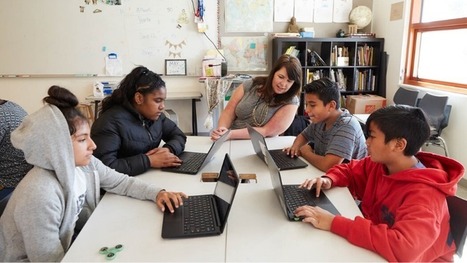
When and how much should students be using technology in class? Via Elizabeth E Charles
Scoop.it!

This article covers the basics of Instructional Design that should be considered when designing content. Download the eBook: Instructional Design 101. Via EDTECH@UTRGV
Scoop.it!

Microlearning is an up-and-coming area in eLearning. Discover why micro-courses are expected to become a trend and the benefits they offer. Via EDTECH@UTRGV
Scoop.it!

What’s the size of Facebook cover video? Can I put a video as my Facebook cover? How can I make a Facebook cover video? All problems will be solved here. Via MiniTool Software
Scoop.it!
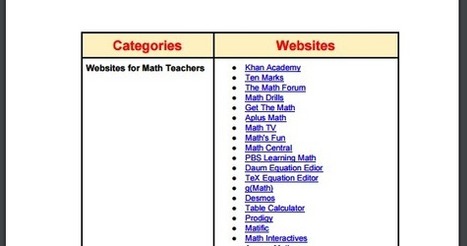
"Below is a chart we have been working on during the last few weeks. It features a number of key websites and online resources arranged into different categories ..." Via Leona Ungerer
Scoop.it!

Australia's University of Canberra is simplifying students' higher education journeys with a holistic approach to constituent relationship management. Via Peter Mellow
Scoop.it!

Institutions have access to more student data than ever before—but it's hard to really grasp what that means, since many of the digital tools that colleges use are from third parties or companies that keep their algorithms private. That makes it hard for students, professors or even journalists to get a glimpse inside. Via Peter Mellow, THE OFFICIAL ANDREASCY
Scoop.it!

If you want to manage Chrome extensions easily but don’t know how to do, then you can read this post to find the way to remove extensions and so on. Via MiniTool Software
Scoop.it!

"The study is a computer-based international assessment of eighth-grade students’ capacities to use information communications technologies in different ..." Via Leona Ungerer
Scoop.it!

Steps which help you to select the right authoring tool with features that support your rapid eLearning content development. Via Marta Torán, Yashy Tohsaku
Marta Torán's curator insight,
November 20, 2019 2:58 AM
Consejos para seleccionar una herramienta de autor para Rapid eLearning -> |





