In today’s leadership landscape, soft skills are undeniably en vogue. However, don’t be quick to lump empathy in with the rest. That’s because Microsoft CEO Satya Nadella firmly believes the art of comprehending others transcends the soft skills category. In his view, characterizing it as “soft” understates its significance, as he asserts that mastering empathy is, in fact, the most formidable skill of them all.
“Empathy is not a soft skill,” Nadella said in a 2023 interview with Axel Springer’s CEO Mathias Döpfner. “In fact, it’s the hardest skill we learn—to relate to the world, to relate to people that matter the most to us.”
Not only does being empathetic enable leaders to better connect with their staff, but according to Nadella, customers too.
I am really enjoying reading your blog. If you want to buy villa in Noida Extension then call on the given number-8375000707 as we give you the best offers for buying villa in Noida Extension. https://www.villasinnoida.com/villas-in-noida-extension.php
Compassionate Geek's empathy training programs equip IT professionals and teams with essential emotional intelligence, active listening, and interpersonal skills to transform technical support interactions. Our evidence-based curriculum combines real-world scenarios, structured video modules, and practical exercises to help IT teams reduce customer effort scores, improve satisfaction, and build lasting client relationships through compassionate, human-centered service delivery.
una capacitación especializada en servicio al cliente para profesionales de TI, tus equipos pueden aprender a: ✅ Comunicarse con mayor claridad ✅ Escuchar activamente ✅ Resolver conflictos de manera constructiva ✅ Generar confianza y mejorar la experiencia del cliente
Instead, take the time to develop a strong empathy map of the other person. Begin by describing who you are empathizing with, including factual details such as approximate age and job role. It’s okay to include assumptions and even bias so long as you phrase them such (“I sometimes think” or “It seems to me” or “In my experience”). Continue your factual context with examples of things you have heard them say and behaviors you have observed.
Now, dive deeper by placing yourself in their position. To the best of your ability, answer questions from their perspective:
What are they trying to achieve? What are they trying to avoid? What are they seeing and hearing? What are their underlying needs and wants? What don’t I know? What should I ask them about? What would I want to know if I were in their situation?
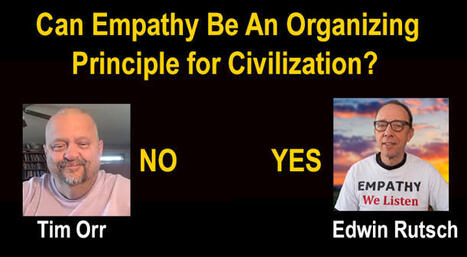
Edwin Rutsch and Tim Orr meet to explore whether empathy can function as an organizing principle for civilization. Edwin argues from a secular perspective that mutual ("wholistic") empathy and deep listening can serve as the foundational bedrock for society. Tim contends that while empathy is an essential moral virtue, civilization also requires objective truth, moral value judgments, and structural frameworks to function effectively.
Tim Orr is an ordained Evangelical minister, seasoned academic, and passionate advocate for interreligious dialogue. He serves as a Research Fellow with the Institute for the Study of Global Anti-Semitism and Policy, where his scholarship focuses on the intersections of religion, ideology, contemporary anti-Semitism, and public life.
Dedicated to fostering understanding across divides, his digital ministry and platform are centered on building bridges, uniting hearts, and helping faith flourish. A contributing writer for The Times of Israel, his published essays include "Beyond the Red-Green Alliance: Empathy and Structural Asymmetry" and "Toxic Empathy is Not Love - and It's Dangerous."
At a time when societies are marked by polarisation, online toxicity, hurried judgements and widening generational divides, we must all make an extra and deliberate effort to preserve empathy in how we think, lead, teach, work and communicate.
Empathy does not mean agreeing with everyone. It means pausing long enough to understand another person’s experience, dignity and perspective before reacting.
University of Phoenix has launched "Communicating with Compassion and Empathy," a new professional development training pathway designed to help organizations strengthen empathetic communication, support employee well-being and navigate emotionally complex workplace interactions. The four-hour pathway provides practical learning experiences focused on active listening, emotional management, sensitive conversations and strategies for addressing compassion fatigue.
"As organizations continue to prioritize employee well-being and meaningful workplace interactions, there is growing value in helping employees develop communication skills that support empathy, understanding and professionalism," said Mukund Sudarsan, vice president and general manager of Professional Development Programs at University of Phoenix. "This pathway provides practical tools that can help employees communicate effectively, manage emotional situations and contribute to supportive workplace environments."
In this exclusive interview with the Diversity & Inclusion Speakers Agency, Bukky explains why empathy remains misunderstood, how organisations can embed it into everyday decision-making and the leadership shift needed to strengthen workplace performance.
The findings, released in Businessolver’s 2026 State of Workplace Empathy AI Special Report, point to a single lever that separates employees who feel AI is advancing their careers from those who feel it is threatening them—whether their employer trained them to use it. Employees who received adequate employer-sponsored AI training report up to 1.5 times stronger career progression, confidence, and optimism than employees left to figure it out alone. Nearly half of employees— 49%—are in the second group.
“No matter your role, there’s no way to know it all with AI—it’s just changing too quickly,” said Jon Shanahan, President and CEO of Businessolver. “That’s why employees need active training, guidance, and forums to exchange role-specific best practices. Our data clearly shows those who receive dedicated AI support feel more confident, in control, and optimistic about their careers, which is a formula for fueling productivity and competitive advantage.”
Support students’ social, emotional, academic, and personal growth with this colorful and engaging Social-Emotional Learning Educational Poster.
Designed for classrooms, counseling spaces, and learning environments, this printable resource helps students understand and practice important life skills through clear explanations, practical strategies, organized information, and student-friendly visuals.
This resource is part of a growing Social-Emotional Learning Educational Poster Series. Each poster focuses on one essential topic related to emotional awareness, self-management, relationships, communication, responsible decision-making, academic success, personal wellbeing, or positive classroom behavior.
Empathy does not require agreement. It requires understanding. Whether we’re talking about politics, workplace disagreements, family conflicts or interactions with strangers, meaningful progress almost always begins with understanding another person’s perspective before deciding how to respond. We may never reach the same conclusion, but we can still learn why someone arrived at theirs.
For the purpose of this discussion, empathy is the ability to understand another person’s thoughts, feelings and experiences from their perspective. It is different from sympathy. Sympathy is feeling for someone. Empathy is attempting to feel with them — to understand what they are experiencing and why.
Half-day, online (MS Teams) 11th February 2027, (9.30-13.00) This interactive half-day webinar from the Stoneygate Centre for Empathic Healthcare explores
Half-day, online (MS Teams)
11th February 2027, (9.30-13.00)
This interactive half-day webinar from the Stoneygate Centre for Empathic Healthcare explores the what, why, and how of teaching empathy. Drawing on current evidence and practice from the Stoneygate Centre for Empathic Healthcare, participants will examine frameworks such as therapeutic empathy and the CARE Measure, and learn practical strategies to foster empathy in medical education. Participants will also work collaboratively to design a teaching intervention tailored to their clinical or educational context.
This course is aimed at clinical educators, supervisors, and healthcare professionals involved in training students or junior colleagues. Whether you’re based in a university, hospital, or community setting, if you’re looking to embed empathy in medical education or workplace learning, this session is for you.
According to the Double Empathy Problem theory, communication difficulties and misunderstandings arise between autistic and non-autistic people because they experience and communicate emotions differently, making it harder for both sides to accurately understand one another.
To explore this, researchers created a novel test designed to measure empathy that goes beyond traditional questionnaires. They recorded autistic and non-autistic adults sharing their real-life emotional stories. Hundreds of participants then watched the videos and continuously rated what they believed each storyteller was feeling, allowing researchers to compare those judgments with how the storytellers themselves described their emotions.
In conclusion, our study provided preliminary insights into empathy and compassion differences between four cohorts of medical students during the 2023–2024 academic year. While lower levels of empathy and related constructs were noted during both preclinical and clinical stages, levels were higher during the fourth year.
These preliminary findings contribute to the growing body of literature on empathy and compassion among medical students. Additional waves of data will provide a more comprehensive examination of both cohort differences and the longitudinal progression of students from different cohorts over time. Our future research will also investigate the effects of mandatory and elective curricula focused on enhancing empathy and compassion by comparing outcomes across different levels of curricular exposure in order to examine a potential dose–response effect.
The components of good listening go much deeper than simply hearing words.
Be present with genuine concern
Turn towards the person who wants to be heard. Maintain eye contact, nod and lean in slightly. Every verbal and non-verbal gesture should communicate: “I am with you.” The attitude must be geared towards listening, not talking. Avoid all distractions, including using a mobile phone.
Use open questions
“What was that like for you?” is an example of a question that invites more sharing.
Parents and guardians are a child’s first teachers because they shape early brain growth, language and core values.
From playgrounds to sports fields to beach cleanups. Some of life’s biggest lessons happen outside the home.
“Community plays a huge role in creating opportunities for kids to get out, explore, like in sports coaches as mentors, to really role model how to navigate relationships,” said Tia Hartstock, Office of Wellness and Resilience.
In today’s leadership landscape, soft skills are undeniably en vogue. However, don’t be quick to lump empathy in with the rest. That’s because Microsoft CEO Satya Nadella firmly believes the art of comprehending others transcends the soft skills category. In his view, characterizing it as “soft” understates its significance, as he asserts that mastering empathy is, in fact, the most formidable skill of them all.
“Empathy is not a soft skill,” Nadella said in a 2023 interview with Axel Springer’s CEO Mathias Döpfner. “In fact, it’s the hardest skill we learn—to relate to the world, to relate to people that matter the most to us.”
Not only does being empathetic enable leaders to better connect with their staff, but according to Nadella, customers too.
In clinical terms, we might speak of dissociation, or of the protective narrowing of affect that serves as a buffer against overwhelm. But at a population level, the implications are less forgiving. Collective empathy is not merely a pleasant social nicety. It is the substrate upon which public health interventions, international aid, social solidarity, and political will are all built. When that substrate erodes quietly, without announcement, the consequences accumulate silently — in funding cuts that go unchallenged, in refugee crises met with shrugged policy, in communities that fracture inward.⁴
In a surprising interview statement, Elon Musk claimed that “the fundamental weakness of Western civilization is empathy” (Wolf, 2025).
Most people reading this will recoil. Empathy is supposed to be the cure for polarization and dehumanization. If we could just understand one another better, surely we would fight less. And in many cases, that intuition is right.
But in other cases, empathy does not ease our divisions. It intensifies them. It fuels moral outrage, locks us into sides, and makes constructive disagreement feel impossible.
This asymmetry is not a flaw in empathy. It’s actually its defining feature. The word empathy comes from the German Einfühlung, which roughly means “feeling into.” Empathy was never meant to be a rational spreadsheet or a cost benefit analysis. It was meant to function as an emotional bridge, a way of entering into another person’s experience by feeling with them.
Our Mission The Wisconsin Empathy Project is a nonprofit organization dedicated to building a culture of curiosity, deep listening, and fellowship across Wisconsin. We promote empathy as a practice—one that is active, ongoing, and essential. Through experiential learning, creative publications, and public engagement, we engage with empathy to foster personal transformation.
Research has found that 95% of HR managers believe that emotional intelligence is integral to a healthy and productive workplace.
Emotional intelligence is an increasingly important approach to practice in modern business. Being in tune with your feelings and in touch with the emotions of others around you is an ethical principle for your personal life, as well as professionally.
Dr. Benedict Beckeld explains why Gad Saad's concept of "suicidal empathy" is incorrect as a description of certain contemporary behavior, which, rather, is more accurately labeled oikophobia.
For him, this is not an argument for novels about climate change or immigration. “It’s an argument for writing in a way that makes people feel empathy”. Because empathy, he believes, rarely remains confined to a single cause. “People who feel empathy, who are open to the world, tend to feel very broad empathy”, he says. “My sense is there are people who are open and there are people who are closed... And art is a great tool for opening people”.
Facilitator: Dr Helen Foster – Creative Writing Associate, Stoneygate Centre for Empathic Healthcare
Format: Online (MS Teams)
How to Join: All participants who have booked a place will receive an email before the session with a MS Teams joining link. If you do not receive this email, please contact us on empathy@le.ac.uk before the session is due to commence.
by Mark Standish When evangelicals call empathy sinful, what are they protecting? On Doug Wilson, control disguised as love, and the touch that heals in Mark 5.
The Force of Empathy
I have to admit that when I first heard the phrase “toxic empathy,” I was caught off guard. For much of my life, especially my evangelical life, I had taken for granted that empathy was pretty much equivalent to love. So, when I started hearing evangelicals decrying “empathy” as the root of our contemporary moral crises, it gave me pause.
Of course, I’m not particularly surprised that Doug Wilson and his ilk believe that empathy is “sinful.” I am, however, surprised that so many evangelicals find it a palatable claim. In other words, what unsettles me is less the argument than the appetite for it.
A new study reveals important nuances in how autistic and non-autistic people understand one another. Guided by the Double Empathy Problem theory, research suggests that communication difficulties are often mutual rather than stemming from a one-sided "empathy deficit," in autistic people. Using a novel empathy test based on real-life emotional stories, the researchers found that autistic participants were just as capable of understanding others' emotions, challenging long-held assumptions about autism and highlighting the importance of mutual understanding.
Empathy and holistic thinking support students’ relationship skills by practising seeing the world from the perspectives of different others; creative thinking and critical questioning support autonomy by encouraging students to understand the world in their own preferred way, and experimentation strengthens competence by creating mastery experiences through trial, feedback and refinement.
To get content containing either thought or leadership enter:
To get content containing both thought and leadership enter:
To get content containing the expression thought leadership enter:
You can enter several keywords and you can refine them whenever you want. Our suggestion engine uses more signals but entering a few keywords here will rapidly give you great content to curate.





 Your new post is loading...