In conclusion, our study provided preliminary insights into empathy and compassion differences between four cohorts of medical students during the 2023–2024 academic year. While lower levels of empathy and related constructs were noted during both preclinical and clinical stages, levels were higher during the fourth year.
These preliminary findings contribute to the growing body of literature on empathy and compassion among medical students. Additional waves of data will provide a more comprehensive examination of both cohort differences and the longitudinal progression of students from different cohorts over time. Our future research will also investigate the effects of mandatory and elective curricula focused on enhancing empathy and compassion by comparing outcomes across different levels of curricular exposure in order to examine a potential dose–response effect.
I am really enjoying reading your blog. If you want to buy villa in Noida Extension then call on the given number-8375000707 as we give you the best offers for buying villa in Noida Extension. https://www.villasinnoida.com/villas-in-noida-extension.php
According to the Double Empathy Problem theory, communication difficulties and misunderstandings arise between autistic and non-autistic people because they experience and communicate emotions differently, making it harder for both sides to accurately understand one another.
To explore this, researchers created a novel test designed to measure empathy that goes beyond traditional questionnaires. They recorded autistic and non-autistic adults sharing their real-life emotional stories. Hundreds of participants then watched the videos and continuously rated what they believed each storyteller was feeling, allowing researchers to compare those judgments with how the storytellers themselves described their emotions.
In conclusion, our study provided preliminary insights into empathy and compassion differences between four cohorts of medical students during the 2023–2024 academic year. While lower levels of empathy and related constructs were noted during both preclinical and clinical stages, levels were higher during the fourth year.
These preliminary findings contribute to the growing body of literature on empathy and compassion among medical students. Additional waves of data will provide a more comprehensive examination of both cohort differences and the longitudinal progression of students from different cohorts over time. Our future research will also investigate the effects of mandatory and elective curricula focused on enhancing empathy and compassion by comparing outcomes across different levels of curricular exposure in order to examine a potential dose–response effect.
The sense of warmth that won the empathy studies is the same one that worries regulators. A chatbot that never pushes back, never lets silence sit, and never tells a user something they don't want to hear is doing the opposite of what a therapist is trained to do. The warmth these studies measured is the same reflex a good clinician is trained to override.
Our age has hardly changed, as we currently live in the cult of empathy, which relates to the second type of pity depicted by Zweig. I recall from my own experience, even during my university times, that it was repeatedly emphasized: if you are not empathetic, you cannot be a good teacher since you must put yourself in the child’s shoes. This is undeniably true but just to a rational extent. Nowadays you cannot even be a corporate executive without empathy, as its absence is said to harm workplace well-being and increase organizational turnover. In fact, even the police are now expected to be empathetic since, according to contemporary progressive narratives, a person exhibiting unlawful behavior is often merely a victim of social circumstances like ‘systemic, white supremacist oppression.’
Empathy and compassion in One Health: Perspectives across disciplines, species and ecosystems Royal (Dick) School of Veterinary Studies, University of Edinburgh
Please join us at this inaugural event of the Edinburgh Empathy Place, an initiative of the Royal (Dick) School of Veterinary Studies at the University of Edinburgh. The conference will host international leaders and experts from the Global Empathy in Healthcare Network and is being held in collaboration with the University of Edinburgh’s Global Compassion and Empathy Initiative. We are delighted this conference is part of the Edinburgh Medical School’s 300th year anniversary celebrations.
The conference has been made possible with kind support from the Stoneygate Centre for Empathic Healthcare, University of Leicester, and the Sanford Institute for Empathy and Compassion, University of California San Diego.
We are living through a crisis of empathy and, more precisely, of empathy not being learned. We live saturated in opinion, reaction and digital noise, a culture that turns other people into content: flattened, accelerated, easy to dismiss. We’re quick to cut off those we disagree with, and the conditions that might allow for empathy to flourish — time, attention, presence and vulnerability — are increasingly scarce. Empathy becomes something we endorse in principle but rarely practice. There is one place, however, where these conditions not only still exist, but are required: the stage
Over many years of creating and delivering hospitality training, I have encountered various acronyms ranging from H.E.A.T. to L.E.A.R.N. that are intended to summarize the steps in resolving complaints, which is known more recently as “service recovery.”
Typically, the “E” stands for showing “empathy” and is clearly placed before the “A,” which represents “apologize.” In KTN’s current front desk Heart of Hospitality Certification training, we use E.A.R.S, which encourages participants to first listen with intention, then to empathize, apologize, resolve, and check back later to ensure satisfaction.
Sure, chatbots imitate empathy. But they can’t feel the emotion, and that will forever be a limitation. Participants in a study published in the journal Communications Psychology in January compared empathetic responses from a chatbot and a person. Even though the participants rated the AI’s performance higher than the human’s, they still preferred receiving comfort from actual people, the study results found.
So even when we don’t get it 100% right, our efforts still mean more than a machine’s. “People are hungry for emotional connection,” says psychiatrist Judith Orloff, MD, author of The Genius of Empathy. “Looking at screens all day can leave people feeling empty, numb and emotionally disconnected. Being with an empathic person makes you feel seen, heard and valued.”
Throughout my career studying empathy in healthcare, I have been inspired by the extraordinary commitment of clinicians who enter medicine with a profound desire to help others. Their dedication to patients is often what drives them to take on greater responsibility—as department chairs, service line leaders, chief medical officers, and influential voices within their organizations.
As these clinicians move into leadership roles, however, they encounter a new challenge: balancing support with accountability.
For many, holding others accountable feels fundamentally different from patient care. It requires making difficult decisions, setting expectations, addressing performance concerns, allocating limited resources, and navigating organizational change. Too often, leaders are given the impression that they must choose between being empathic and being accountable—as though compassion and high standards are somehow incompatible.
“Empathic AI” is being adopted in clinics as a means of offloading some of the work of clinician‐patient encounters. Indeed, a recent study reported that generative large language models such as GPT4 were perceived as being more empathetic than human physicians. I argue that encounters between AI chatbots and patients lack an essential feature of good clinical encounters—recognition.
More fundamental than empathy, Hegelian recognition is a precondition for features such as honesty and respect for autonomy that are central tenets of medical ethics. I argue that patients have a justified expectation of mutual recognition in a clinical encounter and that, given specific limitations of AI chatbots, this justified expectation cannot be met by them. Problematically, however, AI chatbots are designed to mimic human expressions of recognition, resulting in an alienating absurdity at the heart of “empathic AI.”
This fundamental incoherence is not merely a philosophical curiosity; it is an issue that must be directly addressed if AI chatbots are to take on roles in clinical encounters.
by Luc Olinga Every movement gets the vocabulary it deserves, and the vocabulary of the online right in 2026 is “suicidal empathy.”
The phrase belongs to Gad Saad, the Concordia marketing professor turned culture warrior, who built a book around the idea that the West’s compassion has metastasized into a death drive. Elon Musk carried it to Joe Rogan’s audience, calling empathy the fundamental weakness of Western civilization. And on Monday night it reached the church: Bishop Robert Barron, the Catholic Church’s most followed online evangelist, posted a 1.2-million-view endorsement of Saad’s book, ranking it with Chris Rufo and James Lindsay as “the best take-down of the lunacy at the heart of the wokeist philosophy.”
Barron’s version was careful. Empathy is “in itself a perfectly decent trait,” he wrote, but it is not love, which Aquinas defined as willing the good of the other, and which sometimes requires hurting someone’s feelings. Jesus said “love one another,” the bishop noted, never “have empathy for one another.
Human–Machine Coexistence: Why We Need to Rethink Empathy
We are continuously monitoring our internal trend radar, where we define overarching developments and trends that directly impact and shape our organization. One of these trends is human–machine coexistence, which raises fundamental questions about empathy, responsibility, and collaboration in the age of AI:
What if we need to rethink empathy?
What if machines are better at simulating empathy?
What if machines could help us understand both other humans and machines better?
And: What if we outsource empathy to machines?
Artificial intelligence is rapidly moving beyond pure automation. Its potential lies not only in performing tasks faster or more efficiently, but in enhancing activities once considered uniquely human, such as moral judgment, care, or empathic communication.
by Mark Standish When evangelicals call empathy sinful, what are they protecting? On Doug Wilson, control disguised as love, and the touch that heals in Mark 5.
The Force of Empathy
I have to admit that when I first heard the phrase “toxic empathy,” I was caught off guard. For much of my life, especially my evangelical life, I had taken for granted that empathy was pretty much equivalent to love. So, when I started hearing evangelicals decrying “empathy” as the root of our contemporary moral crises, it gave me pause.
Of course, I’m not particularly surprised that Doug Wilson and his ilk believe that empathy is “sinful.” I am, however, surprised that so many evangelicals find it a palatable claim. In other words, what unsettles me is less the argument than the appetite for it.
A new study reveals important nuances in how autistic and non-autistic people understand one another. Guided by the Double Empathy Problem theory, research suggests that communication difficulties are often mutual rather than stemming from a one-sided "empathy deficit," in autistic people. Using a novel empathy test based on real-life emotional stories, the researchers found that autistic participants were just as capable of understanding others' emotions, challenging long-held assumptions about autism and highlighting the importance of mutual understanding.
Empathy and holistic thinking support students’ relationship skills by practising seeing the world from the perspectives of different others; creative thinking and critical questioning support autonomy by encouraging students to understand the world in their own preferred way, and experimentation strengthens competence by creating mastery experiences through trial, feedback and refinement.
While we need to satisfy our most basic needs, such as food, shelter, and Wi-Fi, to exist; it’s a pretty miserable existence without emotional connection. In our increasingly productivity-driven world, many of us are beginning to realise that perhaps human connection is more critical than ever. The foundations of such connection can be found in empathy. Humans and animals alike benefit from empathy for many reasons. Empathy deepens our connections with those around us, improves our relationships, and helps us manage conflict more productively. In the wild, survival may depend on empathy. However, it doesn’t always come naturally. Most of us rarely get it right. But empathy can be taught and learned; you just need to want to learn.
Whatever it is, it lacks moral reasoning and logic. It’s out-of-control empathy. Suiciddal empathy, as Gad Saad says.
This same problem appears everywhere liberal ideology runs free:
criminal justice reform that prioritizes the offender over the safety of the victim
open-borders that prioritize the accommodation of illegals—many with criminal backgrounds—over native women and children
educational policies that elevate the disruptive student above the learning of the rest of the class
When empathy becomes the sole metric, logic collapses every time guaranteed. Trade-offs disappear, and reality is required to rearrange itself around feelings.
Most of us have the same idea about what defines a good listener: She makes warm eye contact. He nods at all the right moments. She reflects your feelings back in a soft, non-judgmental voice; he doesn’t check his phone once.
But wait until you hear this: That person is, according to one of the leading researchers in the field of listening, the product of cultural fiction.
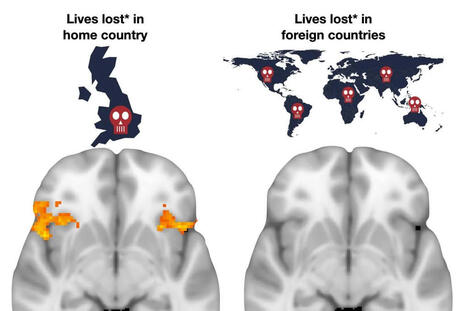
Empathy may not always increase with the scale of a crisis.
A new study from the University of Sussex has found that the human brain can become less responsive to large-scale humanitarian disasters, especially those occurring far from home.
The study, published in the journal Social Cognitive and Affective Neuroscience, used MRI scans to examine how British participants processed headlines about real-life threats to human life.
Zaid Jilani America's right-wing elites have a theatrical new indictment of liberals that they warn will lead to catastrophe: They care too much.
"Suicidal empathy," the phrase coined by Canadian marketing professor and conservative influencer Gad Saad, is suddenly on the lips of everyone right-of-center — including billionaire Elon Musk, who has promoted Saad's book by the same name.
Empathy is something many of us value, but it isn’t always easy to put into practice, especially when conversations become difficult. One of the ways 16 Guidelines Facilitators Janna Weiss and Maria Trottmann support this practice is through Empathy Circles with Conversations that Matter, which appear regularly on our events calendar.
To learn more, we spoke with Janna and Maria about what Empathy Circles are, why they matter, and how the 16 Guidelines for Life can help create deeper, more compassionate conversations.
What are Empathy Circles? Developed by Edwin Rutsch, founder and director of The Empathy Center, and rooted in the humanistic psychology of Carl Rogers, the practice is a structured dialogue process designed to deepen empathy and nurture an empathic way of being. Built on four core values – empathy, mutuality, openness, and caring, the circle provides a clear framework for respectful, equal participation. Participants take turns speaking and listening. While one person shares, the active listener reflects back what they’ve heard without giving advice, interrupting, or debating. The result is a rare conversational rhythm where every speaker feels fully seen and understood.
Empathy — the ability to understand and share the feelings of another — is a noble virtue. But empathy can also lead us astray. In fact, it can be fatal. Gad Saad, a scholar at the Declaration of Independence Center for the Study of American Freedom at the University of Mississippi, warns how misdirected empathy endangers not just well-intentioned individuals but Western Civilization itself.
Empathy Creates Better Patient Experiences Every successful Healthcare Innovation begins with listening. Patients share valuable insights about their symptoms, concerns, and expectations. When healthcare professionals pay close attention, they discover opportunities that technology alone cannot reveal.
For example, a patient may struggle to follow a treatment plan because instructions seem confusing. Instead of blaming the patient, an empathetic team simplifies communication and offers practical guidance. As a result, the patient feels more confident and follows the treatment more consistently.
While AI can generate words that make people feel understood, comforted, and less alone, it cannot sit beside them, offer a comforting hug, or share the burden of what they are feeling.
That tension sits at the center of a growing scientific and policy debate. Recent research suggests that AI can produce responses people often rate as highly empathic, though they discount those same responses when they learn they came from a machine. In fact, legislation was introduced earlier this year to put parents in charge of how children and teens interact with AI chatbots. Other research suggests that AI’s apparent empathy may not be machine empathy at all, but a statistical synthesis of human empathy drawn from vast amounts of human language.
To get content containing either thought or leadership enter:
To get content containing both thought and leadership enter:
To get content containing the expression thought leadership enter:
You can enter several keywords and you can refine them whenever you want. Our suggestion engine uses more signals but entering a few keywords here will rapidly give you great content to curate.


 Your new post is loading...