Let's collaboratively create; the biggest, most comprehensive, easiest to use, most useful, continually expanding, improving and deepening, empathy and compassion curriculum! Everyone is invited to contribute, especially; educators, researchers, writers, technophiles, etc. etc, that would like to work on this project.
Search the internet and add any empathy & compassion lesson plans, activities and curriculum that you find to this page. Just clink on the POST button above and fill out the questions.
“Democratic listening” In her Political Empathy and Deliberative Democracy class, Howard teaches the concept of “democratic listening,” which “is all about developing attitudes and predispositions necessary for listening towards better understanding people who do not think the way you do.”
Who is the course for: Leaders in healthcare education with an interest in developing, improving and delivering empathy-focussed training in undergraduate and postgraduate curricula.
This innovative and pioneering training course provides clinicians, educators and academics with the skills needed to effectively teach empathy to healthcare students and practitioners. In addition, attendees will learn to support others to recognise the barriers and challenges to embedding empathy across the systems they work in, and to develop effective strategies for overcoming them.
Aims of the course
Explore different educational models for teaching empathy.
Identify and discuss issues of pedagogy, curriculum design, development and evaluation.
Enable the embedding of empathic healthcare education within your institution.
Extend and advance participants’ existing critical appraisal and teaching skills.
Develop understanding of the components of an effective curriculum for empathic
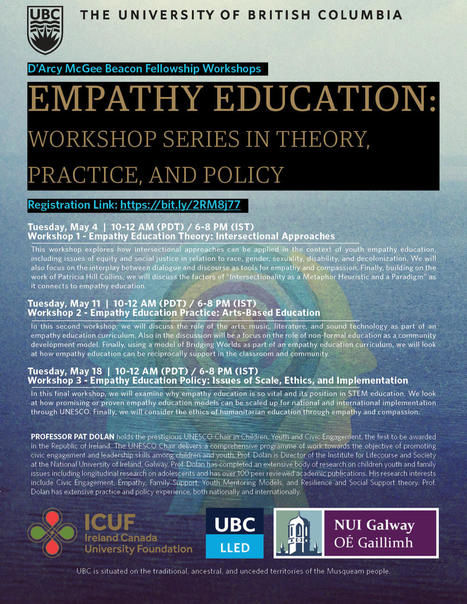
Empathy Education Workshop Series in Theory, Practice, and Policy
Tuesday, May 4 | Workshop 1 – Empathy Education Theory: Intersectional Approaches This workshop explores how intersectional approaches can be applied in the context of youth empathy education, including issues of equity and social justice in relation to race, gender, sexuality, disability, and decolonization.
We will also focus on the interplay between dialogue and discourse as tools for empathy and compassion. Finally, building on the work of Patricia Hill Collins, we will discuss the factors of “Intersectionality as a Metaphor Heuristic and a Paradigm” as it connects to empathy education.
Tuesday, May 11 | Workshop 2 – Empathy Education Practice: Arts-Based Education In this second workshop, we will discuss the role of the arts, music, literature, and sound technology as part of an empathy education curriculum.
Also in the discussion will be a focus on the role of non-formal education as a community development model. Finally, using a model of Bridging Worlds as part of an empathy education curriculum, we will look at how empathy education can be reciprocally support in the classroom and community.
"The ACT program is comprehensive, experiential and uses evidence-based approaches to teaching, learning and practice to ensure that you are fully prepared to lead, facilitate, and model applied compassion in your professional workplaces, communities and with your families and loved ones.
In the Applied Compassion Training, you will develop competency and skills in the areas of applied compassionate leadership, communication, collaboration, coaching and facilitation, as well as in your personal and professional relationships.
"In the last few years, I’ve been exploring the use of Empathy Circles with some of my organizational clients, with facilitator learning groups, and in communication workshops. I’ve been finding that it is a great introduction and warm-up for Dynamic Facilitation, one of my core practices, as it offers everyone in the room the opportunity to engage in offering listening reflections to one another.
At the same time, I’m totally excited to see that Edwin Rutsch, the creator of Empathy Circles, has been bringing his work into the arena healing political divides. My experience is that this simple-yet-powerful form is actually quite revolutionary, in the best sense of the word, and so I want to delve a bit into what I see as the underlying dynamics. But first, a brief description, followed by a distinction and clarification…"
Leading with Empathy is a course designed and taught by Xuan Zhao at Brown University. It is housed in the Brown Leadership Institute and is part of the Brown Pre-college Program.
THE COURSE
What is empathy?
Why is it a powerful tool for leadership?
How does it work in human brains?
How to use it for social change?
How to cultivate empathy in oneself and in the society?
THE INSTRUCTOR
Xuan Zhao is a Ph.D. candidate in social psychology at Brown University. She will start as a Postdoctoral Researcher at the University of Chicago Booth School of Business in Fall 2017.
The Empathy Training Project (ETP) provides a school-based emotional literacy program for children ages 6 through 13, focused on increasing pro-social behavior, reducing bullying/negative behavior, and improving the overall social environment among youth.
The ETP curriculum functions from a Rogerian perspective, teaching understanding and the development of Empathy by focusing on the following elements: feelings vocabulary, communication skills, listening skills, adaptive thinking skills, negotiating/conflict resolution, perspective taking, self-regulation, self-care, and cross-cultural awareness.
Education Transformations, located in San Diego, California, is a dynamic, leading edge nonprofit company with the vision of transforming our children’s learning environments by providing teachers and students with skills
Here are the various workshops and customized programs we offer. We can meet your teaching needs in many ways.
• K-12 Relational Competency Student Curriculum - Social/Emotional Intelligence and Character Development for the Common Core Student
•Cultivating a Person Centered Approach (PCA) in the Classroom (formerly “A Taste of Transformation!”) - a Person Centered Communications Model for Student Involvement
• Mastering Relationships & Restorative Practices in the Classroom - a Comprehensive ‘Person Centered Approach’ to Learning and Classroom Management • The Powerful Classroom - Advanced Workshop
• Summer Week-long Intensive Workshops: - The Diverse Classroom – Power Plays
• Customized School Programs • Personal Coaching & Mentoring
Read more about each below, and click on the links to register or get complete details about each offering…
Through weekly email messages, the course imparts concepts, stories and practices that empower us to be more compassionate. We learn clear practices that help us and those around us, have more understanding and well-being in our lives (see sample weeks below). The lessons explain and demonstrate ways of thinking, speaking and acting that allow us to get through conflict without hurting or hating.
As a global community, we share resources including links and exercises, message forums, conferences and enjoy a sense of connection and expanded learning while preserving personal space and time. The weekly email messages will include access to multiple message boards, access to archived messages, conference call recordings, documents, video content, special exercise pages and more.
PBS KIDS Arthur kicks off Season 19 with all-new episodes and exciting scientific adventures beginning Monday, January 18.
Whether exploring the inner workings of the brain or illustrating the many fun uses of math, these stories of self-discovery tackle a STEM curriculum with Arthur’s enduring empathy and humor.
This one-day workshop is designed for healthcare practitioners, clinical educators, educational supervisors and training leads.
An increasing amount of evidence shows that empathy improves patient outcomes (including patient satisfaction) and practitioner well-being. With a keynote on the latest evidence around empathic healthcare, group work, and patient stories, this workshop will cover the theory and practice of empathy in healthcare and facilitate the development of evidence-based ‘empathy habits’ to enhance empathy in clinical practice and organisations.
This workshop will be facilitated by Dr Andy Ward, Director of Education and Training for the Stoneygate Centre for Empathic Healthcare.
This course seeks to understand contemporary political divisions in the United States. Guiding our analysis will be scholarship from the discipline of political science, with particular attention given to political culture, American political development and federalism while incorporating scholarship from several other disciplines.
As we study political culture at the national level, we will unpack our own individual attitudes towards politics. There will be an emphasis throughout the course on personal wellness during dialogue with assignments ranging from written reflections on experiences to textual analysis to their combination.
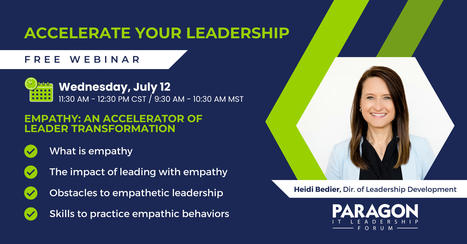
Join Paragon's Director of Leadership Development, Heidi Bedier, as she discusses how leading with empathy and kindness can create a more productive, inclusive and innovative culture.
Participants will: Learn what empathy is and the role it plays at work The impact empathy can have on others What can get in the way of our ability to lead with empathy How to strengthen empathetic behaviors
The next US CCT Teacher Training cohort will begin August 29, 2020. Applications open June 15, 2020. In addition to the class and meeting sessions, you will complete additional homework for an estimated 5-15 hours per week.
Creating and sustaining productive, trusting relationships is key to success in life and work. This workshop will boost your capacity to cultivate positive relationships through mindful empathy. Mindfulness is the skill of becoming more fully present in each moment. Empathy is the skill of understanding the emotions, circumstances, thoughts, intentions, and needs of people around you.
The practice of mindful empathy fosters effective collaboration, authentic communication, and interpersonally astute decision-making. It is crucial for any relationship or leadership role where trust and communication strongly determine productivity and satisfaction. This workshop will help you develop mindful empathy through experiential practices. It begins with mindfulness exercises to become grounded, calm, and aware of your own thoughts, emotions, and sensations.
A self-empathy activity will help students develop clarity around their own needs and goals. Following these, we will dive into practices for building empathy and compassion for others. Finally, we will look at negotiation and co-creation to meet each other’s needs while remaining centered and authentic to ourselves. Students will leave with a set of practices that can be incorporated in daily life. These new skills will empower you to manage yourself and engage with others more fully. Making others feel understood can inspire them to respond with enthusiasm, promoting a virtuous cycle of reciprocity.
"Project-Based Learning (PBL) is a dynamic approach to teaching in which students explorereal-world problems and challenges. With this type of active and engaged learning, students are inspired to obtain a deeper knowledge of the subjects they're studying" (Edutopia). PBL teaches students essential skills such as communication, collaboration, and critical thinking skills.
This project site and PBL project will help students take a deep look at empathy.
What does it mean?
How do we empathize?
The answers to those questions will be used to develop strategies and ideas about how to use empathy to solve problems in a classroom and school. The students will end the project with a PSA highlighting their findings and possible ideas on how to use empathy to solve conflicts. They will be encouraged to share their PSA with their school community.
The Intergroup Dialogue Program is a nationally recognized 1-credit course that brings together small groups of students from diverse backgrounds to share their experiences and gain new knowledge related to diversity and social justice. This 8-week course is open to all NYU undergraduate students, facilitated by graduate students or NYU professionals, and takes place in the Fall and Spring semester.
The IGD model is designed to promote positive intergroup relations among students, staff, and faculty and improve the campus climate at NYU. The model focuses specifically on intergroup dynamics within the context of an institution of higher education while promoting awareness and change in intergroup relations at the individual, cultural, and institutional levels. The guiding assumption is that diversity is an institutional asset and can be used to enhance growth of the NYU community while also achieving specific educational outcomes.
Dynamic Emotional Integration® Course Schedule This course schedule contains information about all 8 courses (and 3 intensive retreats) in the Dynamic Emotional Integration® (also known as DEI) series.
There are 3 learning tracks to consider:
The Self-Care and Awareness Track: You can take the first 4 courses for your own emotional health and well-being without needing to go onward into a licensing track. The Self-Care track is a 5-month program.
The Self-Care track includes the first 4 courses: Learning the Language of Emotions (4 weeks); Deeper Inquiry (4 weeks); Exploring the Art of Empathy (4 weeks); and the Self-Care Practicum (6 weeks).
The 2 Licensing Tracks: If you complete the first 4 courses successfully, you’ll have the option to go forward into the full 14-month program in one of these 2 DEI licensing tracks:
EMPATHY Explanation of the skill This skill involves working with the challenge of another person feeling heard, understood, and in connection with themselves and others. It is about being fully present with a person's experience (following vs. leading).
Intentions of Empathy
Empathy vs. Expression: I want to maintain clarity of where my focus of attention in the conversation is, and do I wish to offer empathy or self- expression to create the quality of connection I am wanting and to contribute to myself and the other person. When I am choosing empathy I want to maintain my focus of attention on what is going on in that person, what is "alive" in them, in the present moment of their speaking/being with me, rather than sharing what is going on in me. Following rather tha
2-hours Intended for: Students, junior managers and senior managers - people who need to communicate effectively, especially in situations in which there is a lot at stake
Contents: Workshop plan including warm-up exercise and 4 group exercises with a focus on what empathy actually means and how we can empathise more effectively. PowerPoint slides, trainers tips, further activities and further resources for both trainer and learner are included.
Objectives:
By the end of this roughly two-hour session your learners should be able to develop their skills in:
Understanding more clearly what empathy actually means
Understanding the physical and evolutionary basis of empathy
Critically evaluating their own current ability to empathise
Focusing on another person's thoughts and feelings (i.e. empathise)
Being aware of what it feels like to empathise
Letting go of anything that might distract them for being empathic
Resisting the temptation to speak when inappropriate
Critically evaluating another’s person’s ability to empathise
Handling an external evaluation (of their ability to empathise) in an aware and responsible way
Empathising more effectively in their everyday lives
Hello, I'm John Lykurgus Wade, and I along with my wife Roxy are the co-founders of Living Heart+Mind where we bring to you the world's first Online Cognitively-Based Compassion Training (CBCT). Developed at Emory University, CBCT helps you to harness the power of neuroplasticity to Wire your brain for WELLBEING.
That said, this channel is dedicated to offer you resources that will also help you - you guessed it - Wire for WELLBEING - stay tuned
The Science of Happiness Register now for the acclaimed online course, re-launching January 5, 2016
A free online course exploring the roots of a happy, meaningful life. Co-taught by the GGSC’s Dacher Keltner and Emiliana Simon-Thomas. Up to 16 CE credit hours available.
The Science of Happiness is a free online course that explores the roots of a happy and meaningful life. Students will engage with some of the most provocative and practical lessons from this science, discovering how cutting-edge research can be applied to their own lives. The course is divided into eight one-week segments, with an additional week in the middle for a midterm and an extra week at the end for a final exam. For this run of the course, students will have six months to complete the material at their own pace.
To get content containing either thought or leadership enter:
To get content containing both thought and leadership enter:
To get content containing the expression thought leadership enter:
You can enter several keywords and you can refine them whenever you want. Our suggestion engine uses more signals but entering a few keywords here will rapidly give you great content to curate.


 Your new post is loading...



















Looking for empathy and compassion lesson plans?