Activating Social Empathy is a practical classroom resource designed to help teachers promote empathy skills and understanding among young people in Senior Cycle. The programme was developed by researchers at the UNESCO Child and Family Research Centre at University of Galway, along with colleagues in the University’s School of Education, working closely with a Youth Advisory Panel from Foróige. It is endorsed by the National Council for Curriculum Assessment.
Dr Charlotte Silke is a lead researcher with UNESCO Child and Family Research Centre at University of Galway. She said that the fundamental aim of the programme is to "support young people in becoming more attuned to the feelings and perspectives of others" and to become "more confident in expressing empathy across a variety of real-world contexts".
Activating Social Empathy is a practical classroom resource designed to help teachers promote empathy skills and understanding among young people in Senior Cycle. The programme was developed by researchers at the UNESCO Child and Family Research Centre at University of Galway, along with colleagues in the University’s School of Education, working closely with a Youth Advisory Panel from Foróige. It is endorsed by the National Council for Curriculum Assessment.
Dr Charlotte Silke is a lead researcher with UNESCO Child and Family Research Centre at University of Galway. She said that the fundamental aim of the programme is to "support young people in becoming more attuned to the feelings and perspectives of others" and to become "more confident in expressing empathy across a variety of real-world contexts".
Most heart-led leaders are celebrated for their empathy, and with good reason. Empathy builds trust and fosters connection, building blocks of high-performing teams. As a strength, empathy enables leaders to "connect to the emotions that underpin an experience," Brené Brown writes. But when leaders begin to feel those emotions as their own, that asset can quietly (and quickly) become a liability.
Over-empathy occurs when a leader absorbs their team members’ emotions, experiences and performance. They cease knowing where their job ends and their direct report’s job begins. Boundaries blur, leaders’ feedback softens or stops and their responsibilities multiply. Leaning too far into empathy, they often end up depleted, with a low-performing team.
Empathy is ancient. For millennia, it has helped us understand what others feel by simply observing them. We are wired to detect signs of emotion from one another, and to take on similar emotions in response. We tear up when a loved one cries, smile when a friend laughs, and frown when a teammate hangs their head. This is empathy.
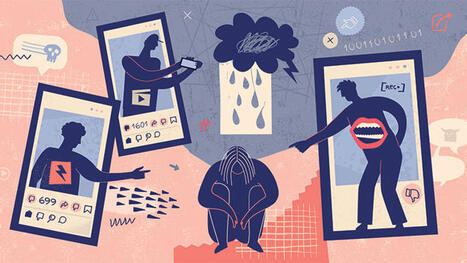
Yet, as social media platforms grow more central to how we connect, we’re spending more time sharing emotions in digital worlds through likes, shares, and comments. This shift in how we engage with one another does not go unnoticed by the molecular systems in our brains. In fact, we believe it is fundamentally altering the neurochemistry behind our interactions. We presented our case in a recent paper, arguing that our brains may not properly respond to others’ emotions in online environments. We call this new theory the “Virtual Disengagement Hypothesis.”
The other side: "In the Christian tradition, to have anybody argue that a spirit of empathy is somehow a vulnerability... is insane," Father Brendan Busse, pastor of Dolores Mission Catholic Church in Los Angeles, tells Axios.
Busse said the suffering of Jesus on the Cross invokes empathy, as does the call to help "the least of these" in the Gospels.
Empathy drives the mission of Homeboy Industries, the Los Angeles-based (and world's largest) gang intervention organization, founded by Catholic priest Greg Boyle.
The North Carolina-based Repairers of the Breach, founded by Bishop William J. Barber II, uses empathy to fight poverty and economic inequality.
By Amanda Marcotte Thanks to Elon Musk, most Americans learned earlier this year that MAGA thinks empathy is evil. Cruelty isn’t the problem, the Tesla CEO claimed in an attempt to justify his turn toward authoritarian politics. “The fundamental weakness of Western civilization is empathy,” he declared on Joe Rogan’s podcast in February.
As the billionaire was decimating much of the federal bureaucracy devoted to serving Americans, he said it was good to be heartless, comparing “the empathy response” to a computer bug. “We’ve got civilizational suicidal empathy going on,” he said, arguing counterintuitively that caring about others will somehow bring ruin to the entire human species.
Some call empathy "toxic" as others says it's core to Jesus' teachings
As the U.S. grows more diverse, a quiet civil war is unfolding within American Christianity over who deserves empathy.
Why it matters: Conservatives ranging from evangelical pastors to Elon Musk have started framing empathy not as a virtue but as a vulnerability on immigration, racial justice and LGBTQ+ rights.
They are working to drive out school lessons on empathy and argue in books and sermons that empathy is for the weak or "woke."
Others say empathy is central to Christianity and the teachings of Jesus.
This split comes as Christianity and organized religion are shrinking and the U.S. undergoes a profound demographic transformation: no single racial group will hold a majority within two decades.
The Empathy Gap: Why Algorithms Can Simulate Understanding But Cannot Replace Connection
Despite the rapid advancement of these tools, the consensus among service leaders remains that AI hits a hard ceiling when it comes to genuine emotional connection. While an LLM can simulate empathetic language, it lacks the shared human experience required to de-escalate a truly distraught customer. As highlighted in broader industry discussions by Harvard Business Review, customers can instinctively detect the difference between a scripted apology and genuine concern. The "uncanny valley" of customer service is real; when a machine tries too hard to sound human, it often alienates the user. Therefore, the goal of Amazon Connect’s architecture is to make the human agent more human, not to make the AI pretend to be one.
Empathy is a crucial skill for public servants because they need to contextually understand who they are designing policies for, a researcher tells GN.
“Empathy can be used in decision making by understanding exactly how the program or policy will actually affect the person,” says Assel Mussagulova, from the School of Social and Political Sciences at the University of Sydney.
Applying empathy to policymaking can be achieved by collecting more data, engaging with the data “and empathetically trying to understand how the policy will affect different cohorts based on their individual circumstances”, says Mussagulova.
About the Activating Empathy Program Activating Empathy consists of twelve thematic lessons that take approximately twelve classroom sessions to complete. Each 50 minute session contains a variety of group activities designed to activate and develop empathy, cultivate prosocial behavior, and recognize the link between empathy and civic behavior. In this curriculum, students will learn how to activate empathy, practice empathy skills, and recognize the importance of empathy to interpersonal relationships and to the wider global community. Students will be asked to reflect on their learning outside of these core sessions using their Learning Journals.
On completion of Activating Empathy, students will be able to:
Define empathy Explain the importance of empathy in improving interpersonal relationships Explain how empathy motivates civic behavior, social action and active citizenship Practice core empathy skills such as empathetic listening, perspective-taking and responding with empathy Identify and set clear empathy goals relevant to their own lives Reflect on their learning
AI journaling app Rosebud attempted to quantify chatbots’ empathy by testing 25 popular models across various mental health-related scenarios, scoring them based on how well they could recognize a crisis, prevent harm, and intervene.
Psychology, linguistics, neuroscience and philosophy have led a recent shift in autism research. Instead of autistic communication being studied at the individual level, interactions are examined at the dyadic level within a ‘double empathy’ framework,, which refers to the ‘disjuncture in reciprocity between two differently disposed social actors who hold different norms and expectations of each other,’ such as autistic and non-autistic people.
Reference Milton, Heasman, Sheppard and Volkmar3 By comparing how autistic and non-autistic people interact with people of the same (i.e. autistic pairs, non-autistic pairs) and different (i.e. one autistic person, one non-autistic person) diagnostic statuses, we can learn more about how the diagnostic status of an interaction partner shapes the way that people communicate.
Research shows two key findings. First, communication difficulties are not exclusive to autistic people; non-autistic individuals also struggle to understand autistic social behaviours, leading to a ‘double’ problem in mixed-neurotype interactions.
Why Empathy Matters in Leadership For organizations committed to developing the next generation of leaders, one truth is becoming impossible to ignore: the technical excellence that drives early-career success is not enough to carry executives into enterprise-level roles.
Increasingly, boards and executive teams want leaders who can build trust, inspire alignment, and elevate the performance of others. And among all the capacities required to do that, empathy stands out as one of the most strategically valuable — yet least developed. In The Six CEO Fundamentals, we outlined how personal readiness is just as critical as professional readiness. Empathy sits squarely at that intersection.
We've built a modern world that is flourishing with advanced technologies, but certainly not with values. We've built a world where almost everybody is obsessed with materialistic gains, often at the expense of humanity. In fact, Dr. Brianna J. Migliore (@dysregulationnation), a neuroscientist, believes that we, particularly Americans, have built a world that lacks empathy, and it all comes down to one underlying cause. In her video posted on December 1, Dr. J. Migliore explained why America is in an empathy crisis, and no, it's not because people are becoming more cruel.
For years, philosophers and psychologists have debated whether empathy helps or hinders the ways people decide how to help others. Critics of empathy argue that it makes people care too narrowly – focusing on individual stories rather than the broader needs of society – while careful reasoning enables more impartial, evidence-based choices.
Our new research, forthcoming in the academic journal PNAS Nexus, a flagship peer-reviewed journal of the National Academy of Sciences, suggests this “heart versus head” argument is too simple. Empathy and reasoning aren’t rivals – they work together. Each one on its own predicts more generous, far-reaching acts of assistance. And when they operate side by side, people tend to help in the fairest ways – not favoring some over others – and in ways that touch the most lives.
by Nicole Charky-Chami An analyst Monday called a MAGA influencer's weaponization of her gender and crusade against empathy "especially dangerous."
Salon's Amanda Marcotte wrote in an opinion piece about far-right Christian pundit Allie Beth Stuckey and how "the right’s modern war on empathy really began with a woman."
Stuckey, a creationist and podcaster, has tried "scaring women into stopping birth control by falsely portraying it as dangerous" and has captured the attention of MAGA with her 2024 book “Toxic Empathy: How Progressives Exploit Christian Compassion,” Marcotte wrote. The concept for her book originated on her podcast "Relatable."
AI Can’t Do Empathy—That’s What People Do DeMaio said, “People aren’t really looking for technology to form that emotional connection when they’re trying to achieve an outcome.” While AI can talk to a customer and sound like a human, the customer knows it’s just a machine. It can say, “I’m sorry,” and sound empathetic, but it’s not, and the customer knows it. Authentic empathy is a human-to-human experience.
The question I have for you, Mark, is what role, if any, does this feeling of empathy have in the evolutionary process of humankind?
Mark: Frank, I believe that empathy functions in a way similar to a muscle: It requires constant conditioning, strengthening and continuous use. Without such regular development and deployment, it will quickly atrophy and fall into disuse.
The question you ask operates on a very macro level. On the broad stage of human drama and human history, one can make the argument that each successive generation has made us gradually more empathetic to the needs, concerns, rights, and freedoms of others. This holds true, especially within Western democracies within the past two hundred and fifty years. Even then, one can argue, the development of empathy to the civil rights and liberties of others — minority groups in particular — has not come without struggle and often setbacks.
Empathy and Ethics as the Foundation of Responsible Citizenship Empathy and ethics are fundamental qualities that shape responsible citizenship in any society. Empathy allows individuals to understand and share the feelings of others, fostering compassion and cooperation. Ethics provides a moral framework that guides behavior, ensuring actions are just and respectful towards others.
When citizens practice empathy, they become more aware of the challenges and needs of their community members. This awareness encourages supportive actions and promotes social harmony. Ethics complements empathy by establishing principles such as honesty, fairness, and respect, which are essential for maintaining trust and order in society.
A new empathy education programme developed at University of Galway is to be rolled out for Transition Year (TY) students in secondary schools nationwide. ‘Activating Social Empathy’ is a classroom resource designed for helping teachers to promote empathy skills and understanding amongst students.
The programme was developed by researchers at the UNESCO Child and Family Research Centre at University of Galway alongside colleagues in the University’s School of Education, working closely with a Youth Advisory Panel from Foróige.
His point reflects a deeper clinical truth: empathy only functions when both parties are psychologically invested in resolution.
This essay examines, through an academic lens, why empathy collapses in intimate relationships, with specific attention to gendered patterns in emotional communication, avoidant attachment dynamics, and the role of reciprocity.
I. Tactical Empathy: A Theoretical Overview Tactical empathy is defined in negotiation literature as the process of accurately understanding and articulating the emotions, needs, and perspectives of another person to reduce defensiveness and facilitate cooperation (Voss & Raz, 2016).
A first-of-its-kind empathy education programme from the University of Galway is being rolled out to Transition Year students nationwide, aimed at boosting compassion and emotional skills in schools across the country.
We discussed this with Brendan Kelly, Professor of Psychiatry at Trinity College Dublin.
To get content containing either thought or leadership enter:
To get content containing both thought and leadership enter:
To get content containing the expression thought leadership enter:
You can enter several keywords and you can refine them whenever you want. Our suggestion engine uses more signals but entering a few keywords here will rapidly give you great content to curate.





 Your new post is loading...