 Your new post is loading...

|
Rescooped by
Edwin Rutsch
from Compassion
September 28, 2024 3:35 PM
|
|
|
Scooped by
Edwin Rutsch
March 11, 10:59 PM
|
Former New Zealand prime minister Jacinda Ardern has warned that the rise of “strongman” leadership across global politics is worsening political division and weakening democracy.
Ardern, who served as New Zealand’s Prime Minister from 2017 to 2023, has often been associated with an empathetic leadership style that prioritised compassion, transparency and values-driven decision-making. But during her conversation in Sydney, she pushed back on the notion that empathy should be viewed as a softer or less effective approach to power.
|
|
Scooped by
Edwin Rutsch
March 11, 10:51 PM
|
When executives were asked which skills will be essential in the next two to three years to compete in an AI-driven world, 52% championed critical thinking, while only 17% rated empathy as essential. That ratio should worry anyone building a product.
To be clear: when we talk about empathy in AI strategy, we don’t mean being nice. We mean cognitive empathy, the strategic ability to model how your users actually think, decide and behave. It’s what helps you spot patterns in genuine human behaviour that your data hasn’t captured yet. Without it, you’re not just building blind; you’re building something expensive that nobody wants.
|
|
Scooped by
Edwin Rutsch
March 11, 10:46 PM
|
In The Empathy Paradox, Rachel McCabe analyzes the evolving role of empathy in contemporary media, film, literature, and culture. She advocates for a critical understanding of it, asking what happens when readers and viewers directly consider the complex ways that empathy guides their understanding and assessment of the culture they consume. By developing an awareness of our assumptions, she adds, we can avoid the pitfalls of self-interest and overidentification and develop more constructive applications of empathy that will help us become better readers and writers.
|
|
Scooped by
Edwin Rutsch
March 11, 10:35 PM
|
Empathy, our capacity to feel the inner experience of another, underlies much of our behavior and the choices and decisions we make. It is a more powerful teacher than its cousins, sympathy and compassion, in which we feel deeply for rather than with another, because the feelings it generates are so strong.
The neuroscientific exploration of empathy has taught us that it involves multiple emotional and cognitive processes, some of which rely on ancient subcortical structures in the brain (Marsh, 2018). In the 1990s, studies of monkeys led to the discovery of “mirror neurons”—specialized cells that fire whether the monkey is itself performing an activity or simply observing another performing it. Thirty years of research strongly suggests that humans also have mirror neurons, and they may be the basis for empathic responses when we see another person’s emotion or action (Bonini, Rotunno et al., 2022).
|
|
Scooped by
Edwin Rutsch
March 11, 10:21 PM
|
Many of us grew up in an empathy desert and missed out on being seen, known, and loved. Sadly, a lack of being understood and accepted often unintentionally creates emotional distance in our churches, friendships, and even our relationship with God. We might fail to realize that we can’t become more loving and healthy like Jesus without the grace of empathy.
Tune in for this episode of Soul Talks to listen to part one of a talk that Bill and Kristi shared at the American Association of Christian Counselors Conference. You’ll see that empathy is more than just a listening skill — it’s an expression of love that helps us cultivate the secure attachment necessary to persevere through trials and grow in Christlikeness.
|
|
Scooped by
Edwin Rutsch
March 11, 8:32 PM
|
Seeing Animals: The Evolving Role of Animal Photojournalism in Advocacy and Culture Change”
In this presentation, Jo-Anne McArthur explores the emerging genre of Animal Photojournalism (APJ)—a field that documents the lives of animals living in the shadows of human industry. While photography of animals has historically focused on wildlife, conservation, and companion animals, APJ centers on the animals used in our food systems, for entertainment, research, and labor. In other words, the animals whose lives are inextricably linked to ours.
McArthur discusses how compelling, rigorous visual storytelling can act as a catalyst for ethical and cultural shifts. By bringing these "invisible" animals into the light of the public eye, animal photojournalism challenges the anthropocentric gaze and provides the evidence-based media necessary to accelerate systemic change. The talk examines the power, the challenges, and the limitations of APJ to spark change at the personal and the political level.
|
|
Scooped by
Edwin Rutsch
March 8, 4:37 PM
|
An abstract is unavailable.
|
|
Scooped by
Edwin Rutsch
March 7, 10:22 PM
|
The Business Case for Empathy in Corporate Learning
The data is unambiguous. A landmark study by Catalyst found that employees with highly empathetic managers report greater innovation, engagement, and retention — and are far less likely to experience burnout. A separate Deloitte report on human capital trends identified empathy as a foundational capability for the future of work, noting that organizations with high-empathy cultures significantly outperform their peers on multiple business metrics.
Despite this, a 2022 survey by Businessolver found that while 91% of CEOs believe empathy is directly linked to financial performance, only 48% of employees feel empathy is meaningfully demonstrated in their workplaces. That gap — between executive belief and daily employee experience — is a corporate learning failure.
|
|
Scooped by
Edwin Rutsch
March 7, 10:04 PM
|
Despite the emphasis on empathy as an important aspect of good leadership, managers may find a certain level of emotional detachment helpful, particularly in environments where difficult calls are routine, according to new research from resume template provider Zety and human resources service firm Sigma Assessment Systems.
The Empathy in Management Report analyzed almost 20 years of Sigma’s proprietary Jackson Personality Inventory-Revised, or JPI-R, personality tests and found that managers scored lower than the general population across what the study called “the Emotional cluster,” which measured emotional sensitivity through empathy, anxiety and cooperativeness categories.
|
|
Scooped by
Edwin Rutsch
March 5, 8:07 PM
|
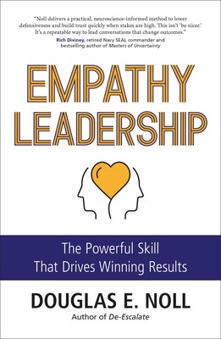
Empathy is your new leadership edge. Grounded in neuroscience and real-world stories, Empathy Leadership teaches leaders how to navigate conflict, build trust, and lead with clarity and confidence.
In today’s workplace, empathy isn’t a soft skill—it’s the competitive edge that distinguishes great leaders and thriving organizations. Drawing from neuroscience, psychology, and real-world narratives, Douglas E. Noll reveals how calm authority, emotional intelligence, and compassionate communication are strategic advantages in effective leadership. Empathy Leadership is a revolutionary framework that prioritizes emotional connection as the foundation for success.
Through practices like reflective listening and affect labeling, leaders learn to recognize emotions in real time, diffuse tension, and strengthen trust and collaboration in the workplace. For leaders at every level, Empathy Leadership provides the actionable insights and tools to lead with both head and heart—demonstrating how empathy leverages emotional connection to build and maintain high-performing teams and authentic human connection.
|
|
Scooped by
Edwin Rutsch
March 4, 8:16 PM
|
Ed’s time in the classroom revealed a simple truth: empathy helps every student flourish. Since leaving teaching, he has built Empathy Week – a movement now reaching 2.5 million students worldwide. His story shows the power of a teacher’s vision to spark global change. Here, Ed tells his story in his own words.
I loved my time teaching in classrooms. It was those days, weeks and years that solidified in me that empathy was the underlying skill to master to create a learning environment that allowed students to flourish.
I left in 2017, and now I’m looking at a global movement that has reached over 2.5 million students in seven years and 700,000 students alone this year.
The journey from being a teacher to founding Empathy Week has been a whirlwind of storytelling, cinematic exploration, and a deep-seated belief that empathy is the most important skill we can teach the next generation.
|
|
Scooped by
Edwin Rutsch
March 3, 11:41 PM
|
Artificial intelligence tools that give the impression of understanding our emotions are proliferating. From Replika to Snapchat AI, millions of users converse daily with systems designed to listen and reassure. Replika has 25 million users, Snapchat AI gathers 150 million, and Xiaoice reaches 660 million users in China, according to a 2025 Amplyfi report. Available 24/7, without judgment or emotional fatigue, these systems simulate empathic listening. But does this artificial empathy genuinely help lonely people, or does it create new forms of dependency?
|
|
|
Scooped by
Edwin Rutsch
March 11, 11:01 PM
|
Empathy in governance means the capacity of leaders and institutions to understand, feel, and respond to the lived realities of citizens which is rapidly emerging as a powerful currency for nation-building. In parallel, empathy is not a soft virtue reserved for private relationships; it is a strategic leadership capability. Nations that succeed in building resilient institutions and inclusive economies often do so because their governance structures are designed with a deep awareness of the human consequences of policy decisions. Empathy bridges the distance between policymakers and the people they serve, ensuring that governance is not merely about authority but about stewardship.
|
|
Scooped by
Edwin Rutsch
March 11, 10:57 PM
|
At a time when global politics is defined by confrontation and “strongman” leadership, former New Zealand Prime Minister Jacinda Ardern believes something different belongs at the centre of power: empathy. Speaking at the All About Women event at the Sydney Opera House on Sunday, Ardern reflected on the values that shaped her six years in office — and why empathy, often dismissed as soft or overly emotional, is in fact a crucial political value.
Central to that philosophy was empathy — something she believes politics has historically glossed over. “Empathy is a political value,” Ardern said, reflecting on the approach she tried to bring to government. Her empathy-led leadership, she continued, wasn’t just about rhetoric or symbolic gestures.
|
|
Scooped by
Edwin Rutsch
March 11, 10:50 PM
|
The study, a systematic review published in the Journal of Adolescence, analyzed data from 13 studies involving more than 10,000 adolescents with an average age of about 16. It found a small positive association between social media use and overall empathy.
“While the association between social media use and total empathy was small, I was a bit surprised that it was positive given the mixed findings among the individual studies,” said Erin McDonald (Ph.D. ’25), the study’s lead author.
McDonald conducted the research as a doctoral student in psychology at Georgia State. She is now a postdoctoral fellow at McLean Hospital in Belmont, Mass., and Harvard Medical School.
Not all types of social media use showed the same relationship with empathy.
Studies that measured how often teens engaged with social media — checking feeds, posting or messaging — showed stronger associations with empathy than studies that measured total time spent online.
|
|
Scooped by
Edwin Rutsch
March 11, 10:36 PM
|
Empathy is understanding and feeling what someone is going through. Compassion is empathy, then action. And strong leadership in a startup community is an action sport. If you’re only empathic, you can become the community equivalent of a “thoughts and prayers” tweet: heartfelt, sincere… and ultimately not very useful when the building’s on fire.
|
|
Scooped by
Edwin Rutsch
March 11, 10:28 PM
|
by Austin Perlmutter M.D. A practical application of this thought exercise is easy to appreciate. Many of us treat others far better than we treat ourselves. By seeing your future self as another person, you can start showing empathy for a separate individual. You can begin to look at your short-term-oriented choices not just for their immediate consequences, but also for their impact on this future character. Imagine your future self as a close friend or family member, and it is harder to make choices that disadvantage this person or put them at risk for suffering or failure.
|
|
Scooped by
Edwin Rutsch
March 11, 10:04 PM
|
Empathy
Before you come up with a 'How might we...?' question to solve or any ideas, you first need to figure out what exactly the user wants in the first place. You also want to make sure that you do this without any judgement, bias fallasies or assumptions and make sure to keep an open mind with curiosity and respect.
Empathy is all about understanding the user; their wants, needs, background, emotions, pain points and more. This can be done in many ways, both by meeting and interviewing the user in person or conduction online surveys and rearch.
|
|
Scooped by
Edwin Rutsch
March 9, 12:33 PM
|
By David French The problem in those cases isn’t with empathy, which is a vital human virtue, but rather in its selective application. Just as we wouldn’t call love a sin because we might be stingy in our love, empathy isn’t a sin because its application is incomplete.
Or, put another way, our problem isn’t with too much empathy, but too little. We’re unwilling to place ourselves in other people’s shoes, to try to understand who they are and what their lives are like.
It’s hard to talk about this issue without recognizing a fundamental truth of the moment: The attack on empathy would have gained very little traction in the church if Donald Trump weren’t president. He delights in vengeance, and he owes his presidency to the evangelical church.
|
|
Scooped by
Edwin Rutsch
March 8, 4:26 PM
|
Radical has often been interpreted simply as extreme, but that does not do the concept justice. Radical means rooted, grounded, solid, strong.
Combine these two, and see here a powerful concept to help us resist the cruelty and evil now dominating our airwaves, threatening the future of all human and other life on our beautiful planet, threatening the planet itself.
Radical Empathy must be fierce, stubborn, creative, persistent. We must hold on to each other, build community, be willing to take risks and accept consequences. Seek alternatives. Stand in solidarity with all who resist oppression and the violence of power and greed.
|
|
Scooped by
Edwin Rutsch
March 7, 10:20 PM
|
Humans and animals share a remarkable capacity to sense when others are in distress and respond with comforting behavior. But the motivation for doing so, and why it sometimes breaks down, has been poorly understood. UCLA Health researchers sought to better understand this in a study published in Nature that uncovers the brain circuitry in mice linking two seemingly distinct social behaviors: caring for vulnerable offspring and comforting distressed peers.
|
|
Scooped by
Edwin Rutsch
March 7, 9:57 PM
|
by @Chris Kaufman
Leading with empathy is often equated with being “soft” or sacrificing high standards. Some leaders fear that heart-first leadership will undermine their authority or that any sign of vulnerability will be seen as weakness. In fact, empathy can actually motivate teams and drive better performance. The idea of empathy-versus-excellence is a false dichotomy—the two can go hand in hand under the right conditions.
Empathy is a cornerstone of psychological safety, which is essential if employees are going to think outside the box, get creative, and take risks. The adage that “you miss 100% of the shots you don’t take” holds true here: To make a shot, you’ve got to take the shot, and taking the shot requires confidence. In this way, empathy enables experimentation.
|
|
Scooped by
Edwin Rutsch
March 5, 8:06 PM
|
Leading with empathy is often equated with being “soft” or sacrificing high standards. Some leaders fear that heart-first leadership will undermine their authority or that any sign of vulnerability will be seen as weakness. In fact, empathy can actually motivate teams and drive better performance. The idea of empathy-versus-excellence is a false dichotomy—the two can go hand in hand under the right conditions.
Empathy is a cornerstone of psychological safety, which is essential if employees are going to think outside the box, get creative, and take risks. The adage that “you miss 100% of the shots you don’t take” holds true here: To make a shot, you’ve got to take the shot, and taking the shot requires confidence. In this way, empathy enables experimentation.
Empathy also builds the trust needed for the kind of honest feedback that fosters continuous improvement.
|
|
Scooped by
Edwin Rutsch
March 4, 8:12 PM
|
Yet to some conservative Christians these days, Jesus is a double-fisted, muscle-bound tough guy ever-ready to vanquish foes, apparently including Christians of the Jesus-is-love persuasion. They warn against “the sin of empathy,” which they say leads to a nation of wimpy and wussy menfolk. There’s even a book titled The Sin of Empathy. Growing up Presbyterian, I learned that empathy was a big-time Christian virtue. It still is, according to the Rev. Dwain Lee, pastor at Louisville’s Springdale Presbyterian Church.
“From the beginning of Genesis to the end of Revelation, empathy is the absolute, essential cornerstone of everything in the Scriptures and everything in the faith,” he said. “It takes an awfully skewed distortion of that continuous story to get where these guys are going.”
I suspect many, if not most, Kentucky churchgoers don’t believe empathy is a sin. I hope they don’t.
|
|
Scooped by
Edwin Rutsch
March 3, 11:36 PM
|
Three GW students are expanding the reach of and pursuing nonprofit status for an organization they formed last year to foster students’ empathy by inviting women from conflict zones to campus to engage in dialogues on their experiences.
Trigger Empathy, a project started by three students in January 2025, has so far invited three women with personal experience in an international conflict for discussions on GW’s campus, creating intimate, safe spaces for students to learn from their stories with the hopes to influence the next generations’s leaders and changemakers to be more empathetic. The group’s leaders said they are in the process of applying for nonprofit status and aim to become a larger organization with chapters at universities nationwide in the future, expanding the network of events and fostering greater empathy at colleges throughout the United States.
|



















What if we had waited to end slavery until community norms and moral sensibilities had changed? Yes, that approach could have fostered mutual respect but would it have ever ended slavery?
In Loving vs Virginia, the landmark Supreme Court case that overturned all state bans on interracial marriage, the justices wrote that marriage is "one of the basic civil rights of man".
They were talking about our so-called inalienable rights there I believe. These are not rights that the federal or state governments (or our neighbors) grant to us. Rather, they are inalienable because we are born with them and do not have to ask permission to exercise them.
This is why Loving is called a landmark case. It overruled community norms and moral sensibilities across the land because those norms and sensibilities were codified in a form of injustice that was absolutely incompatible with our nation's highest ideals.
Laws that said whites could only marry other whites never actually defined who was "white" except to say that even "one drop" of black blood disqualified you (but such laws never really defined black either, and assumed it was self-evident). The Supreme Court saw the problems with such laws. I am confident they will see similar problems with DOMA and other laws against same-sex marriage. There is no legal definition for man or woman, nor is it possible to construct one without denying some intersex people their fundamental rights.
The recognition of injustice seems to me to be a special kind of empathy. I suffer because I see others suffering, and relate it back to my own position of relative privilege that is free from that suffering. In this case, I understand that it isn't a matter of gay rights but of human rights, and if they can be denied the basis to marry the person they love on the basis of sex, my own rights may be abridged some day on the very same basis. So there's an element of self-protection involved in this kind of empathetic response to injustice. I'm genuinely suffering for their suffering, and also fearful that their suffering will become mine by law when the political winds shift some day.