Empathy, our capacity to feel the inner experience of another, underlies much of our behavior and the choices and decisions we make. It is a more powerful teacher than its cousins, sympathy and compassion, in which we feel deeply for rather than with another, because the feelings it generates are so strong.
The neuroscientific exploration of empathy has taught us that it involves multiple emotional and cognitive processes, some of which rely on ancient subcortical structures in the brain (Marsh, 2018). In the 1990s, studies of monkeys led to the discovery of “mirror neurons”—specialized cells that fire whether the monkey is itself performing an activity or simply observing another performing it. Thirty years of research strongly suggests that humans also have mirror neurons, and they may be the basis for empathic responses when we see another person’s emotion or action (Bonini, Rotunno et al., 2022).
I am really enjoying reading your blog. If you want to buy villa in Noida Extension then call on the given number-8375000707 as we give you the best offers for buying villa in Noida Extension. https://www.villasinnoida.com/villas-in-noida-extension.php
Years before evangelicals began issuing warnings about “the sin of empathy,” Paul Bloom, a Yale psychologist, published a book warning against making ethical judgments based on identifying with others’ feelings. I read Against Empathy before I heard Christian conservatives warn that caring about LGBTQ people and immigrants led Christians to embrace anti-biblical public policy. But I had an uneasy intuition that Bloom was naming a real moral danger.
In anti-racism organizing, I’d witnessed what psychologists call the empathy gap: White people persistently underestimate the pain of Black people, with devastating consequences. Last year, Karrie Johnson was minutes away from giving birth and in obvious distress when a hospital nurse peppered her with questions and insisted that she complete her paperwork before being admitted. She’s not an exception. Health practitioners routinely downplay or ignore the reported pain of Black women like Johnson, leading to them being four times as likely to die in childbirth as White women.
A participant in a coaching call got quite upset when I shared a celebration about a peace protest. She said that was about politics and she wants nothing to do with politics. This video demonstrates step-by-step how to navigate a situation like this in a way that leads to connection rather than separation.
Empathetic leadership, often rooted in parental guidance, is crucial for both professional and family success. This article, drawing on personal experience and expert Justin Jones-Fosu's insights, outlines five vital strategies. Leaders must first seek the full story to avoid assumptions, then actively ensure people feel seen and heard, offering support tailored to their needs.
It's also essential to prioritize personal well-being and family time, avoiding giving only "leftovers" after work demands. Furthermore, modeling vulnerability and continuous learning builds trust, while honoring small, often unseen acts of appreciation fosters connection. Ultimately, true leadership means making individuals feel genuinely valued and understood.
The Kabiller Science of Empathy Prize is awarded biennially to a Kellogg faculty member and an alum, whose work advances our understanding of empathy and its impact in business and society. In November 2025, Professor William Brady was awarded the prize for his research on how emerging technologies —like artificial intelligence and algorithms — shape human psychology, particularly in digital environments.
Hosted by Professor Brady as part of the prize award, this conference brings together researchers across psychology, computer science, human-computer interaction, and the behavioral sciences to examine a central question: Can empathy be embedded into AI systems, and what happens to humans when it is? We’ll share emerging research on the psychology of empathic interaction with AI and machines and build cross-disciplinary bridges to push research forward.
’Been wondering what to read next? That’s an easy one. Buy, borrow, or download Professor Gad Saad’s newest book, Suicidal Empathy: Dying to be Kind. It will jar your mindset and leave you with a degree of shock — but you’ll want to tell others about it. It’s going to be a bestseller. In fact, it already is.
In one of the book cover’s endorsements, Bruce Bawer — author of While Europe Slept: How Radical Islam is Destroying the West from Within — says Suicidal Empathy “…is easily more important than any book in recent memory.” He’s right. For, as Elon Musk adds: “Western civilization is doomed unless the core weakness of suicidal empathy is recognized and actions are taken…”
Our culture, along with the Christian beliefs that undergird it, is under attack. Not from armies, but from ideologies. The liberty we enjoy allows for different ideas about right and wrong, and many Christians aren’t sure what side to always take – or worse, we decide for ourselves.
Many issues of our time that are seen as political are in fact moral issues, and that means that the Bible has something to say that Christians need to understand. We don’t need to memorize talking points though, we need to be convinced by scripture.
To be ready to defend our faith against progressive ideology that uses Christian compassion against us, we need to make sure our compass is pointing north. Join us as we prepare our hearts to deal with the main subject of our short series – Toxic Empathy.
SuccessBooks® proudly celebrates the outstanding achievement of "Lead with Empathy" co-authored by Sue Tomat, alongside Chris Voss and distinguished professionals worldwide. Launched on June 4th, 2026, the book has achieved Amazon Best-Seller status, marking a significant milestone in its journey.
Central to the success of "Lead with Empathy" is Sue Tomat’s chapter, "The Backing Vocalist’s Revolution.” Sue shares stories about how empathetic leadership in the workplace demands shifts in perspective and courage. It is wise self-interest, the clear-eyed view that our long-term success is inseparable from the success of the people around us. And it is good judgement, a quality that will only grow more valuable as AI takes over more of what we once considered thinking.
“Lead with Empathy” has achieved outstanding success on Amazon, earning Best Seller status across multiple business and leadership categories, including Communication & Skills, Marketing, Entrepreneurship, Marketing & Sales, and Direct Marketing.
Do empathetic healthcare organisations deliver better care? Howick has spent more than a decade researching what empathy does inside healthcare systems and, critically, what destroys it. His most recent study, the first of its kind, built a system empathy index across NHS trusts in England and tested whether more empathic organisations actually deliver better care.
The results are stark. A healthcare trust scoring just 2.5% higher on the empathy index had 76% higher odds of being rated good or outstanding for patient safety, and 46% greater odds of being rated good or outstanding for effectiveness. Higher empathy scores were also associated with lower staff burnout, lower sickness absence, and lower spending on agency and temporary staff – the very pressures that Nottingham’s maternity unit was drowning in.
Empathy has become one of the most appreciated and universal ingredients of work-related potential. Leadership books praise it. CEOs display it on LinkedIn. HR departments measure it, train it, benchmark it, and occasionally weaponize it. In the modern organization, empathy is no longer a “nice to have,” but widely treated as the hallmark of modern leadership.
To be fair, there are actually good reasons for this.
Empathy, broadly defined, is the ability to understand and share the feelings of others. Psychologists usually distinguish between cognitive empathy, understanding what someone else feels, and affective empathy, actually feeling some version of it yourself.
Our summits are comprised of a number of 15 minute presentations on the chosen theme for the quarterly summits. After the presentations the attendees are invited to participate in an Empathy Circle. Past summits have been on conflict resolution, training programs from around the world, and empathy book authors.
In addition the summit is reunion and re-connection of circle trainers, trainees, facilitators, practitioners and supporters.
Our theme is on The Foundational Practice of the Empathy Movement.
Join this Summit if you are ready to roll up your sleeves and help build the Movement. The Empathy Movement is a transformative force in addressing the growing fragmentation and polarization in modern societies. At its core, the movement seeks to reorient how individuals and groups relate to one another, shifting from transactional, adversarial and authoritarian interactions to ones rooted in mutual listening, deep dialogue, understanding, constructive collaboration and seeing our shared humanity.
The death of human empathy is one of the earliest and most telling signs of a culture about to fall into barbarism.” — Hannah Arendt
I’d come across the line years ago, but its true implications were lost on that younger version of myself. But the words popped up in my Facebook feed recently and I couldn’t help thinking this is us right now. You need only read or watch the news on a typical day and — if you’re paying attention — you’ll understand we’re on the precipice of becoming exactly that sort of cultural catastrophe.
If you don’t look like me, I hate you.
If you don’t act like me, I hate you.
If you don’t vote like me, I hate you.
If you don’t share my beliefs on this, that or the other — you guessed it. I hate you.
Gad Saad, in his book "Suicidal Empathy: Dying To Be Kind," warns that excessive empathy and unbounded tolerance is leading the West toward its own destruction. With examples in New York, California and transgender activism, the professor explains how prioritizing foreigners, criminals and activists over one's own citizens can be suicidal for a society. The theory is supported by Elon Musk.
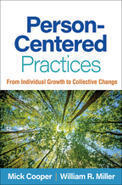
1. Person-Centered Practices: An Introduction, William R. Miller & Mick Cooper
2. Person-Centered Counseling and Psychotherapy, Gina Di Malta, Mick Cooper, & William R. Miller
3. A Whole-Person Approach to Person-Centered Life and Health Coaching, Cecilia H. Lanier & Leslie M. Atley
4. Person-Centered Approaches for Sports Practitioners, Sebastian Kaplan & Jeff Breckon
5. Command and Connect: Integrating Person-Centered Development and Leadership in the Military, Aaron Hunnel
6. Person-Centered Spiritual Development: Concepts and Methods for Psychotherapists and Pastoral Counselors, Jared D. Kass
7. People First: Principles of Effective Person-Centered Leadership, Colleen Marshall & Greg Sumpter
8. Making the Impossible Possible? Child Protection and Person-Centered Approaches, Donald Forrester
9. Person-Centered Police Interviewing: Pursuing Truth versus Chasing a Confession, Emily Alison, Laurence Alison, Frances Surmon-Böhr, & Vern Pierson
10. Care with Compassion: Understanding Person-Centered Health Care, Imelda Coyne
11. Person-Centered Education: Rogers’s Model and Evolving Principles, Renate Motschnig & Jeffrey H. D. Cornelius-White
12. A Person (Learner)-Centered Approach to Continuing Professional Education, Michael B. Madson & Julie A. Schumacher
13. Thomas Gordon’s Model for Creating Effective Parent-Child Relationships, Linda Adams
14. Nonviolent Communication as a Way of Being, Thomas Stelling
15. Person-Centered Self-Development, Sue Renger
16. Models for Peace and the Person-Centered Approach, Emma Tickle, Gay Barfield, Rob Barry, Maria Kontarini, John Wilson, Sophie Muller, & Mick Cooper
17. Toward a Person-Centered Politics, Matt Hawkins
18. Person-Centered Practices: Synthesis and Evolution, William R. Miller & Mick Cooper
by Karina Petrova Psychopathic traits exist on a spectrum in the general population. A new study breaks down exactly how traits like callousness and selfishness correspond to distinct deficits in our ability to understand and feel the emotions of others.
People who exhibit psychopathic traits experience deep deficits in empathy, but these deficits vary greatly depending on their specific personality profile. A new study reveals that highly callous individuals struggle to feel the emotions of others, while highly antisocial individuals primarily struggle to understand other people’s perspectives. This research was published recently in the journal Personality and Individual Differences.
A study examining whether the Loving Kindness Meditation reduces loneliness by increasing empathy found that it does not. While it did reduce loneliness as much as the control treatment, empathy was not affected. The study also found that loneliness was associated with lower self-reported empathy, but not with differences in neural functioning during an empathy task. The paper was published in Social Cognitive and Affective Neuroscience.
The growing literature on empathic leadership Research on empathic leadership is thriving. Forbes1 and the Harvard Business Review2 have extensively explored the concept, and there are a growing number of books on the topic.3 4 Yet, despite the increased recognition of empathic leadership, two significant gaps remain in current research.
First, research on empathy’s benefits in healthcare (for both patients5 and healthcare practitioners)6 suggests potential applications in leadership, but this potential has not been applied to empathic leadership. Second, no model of empathic leadership has been developed, whereas such a model would be useful for explanatory and pedagogical purposes.
Drawing on the proven benefits of empathy in healthcare, we propose a novel model to address these gaps. The model offers a potential solution to current leadership challenges while providing a foundation for future research and understanding. Although our primary emphasis is on leadership within healthcare, we believe the model could potentially offer insights applicable to other professional contexts
We present our empathic leadership model by examining limitations in current and traditional leadership approaches, defining empathic leadership and demonstrating its potential benefits for leaders, healthcare systems and patient outcomes. We propose that future research explore the effects of this new model in real-world settings.
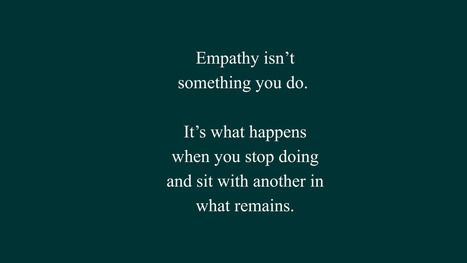
I believe empathy isn’t something you do, but what happens when you stop doing. Or trying to do.
When a German philosopher coined the word that became ‘empathy’ (Einfühlung) in 1873, it’s unlikely he saw it as a leadership style.
Vischer described the capacity to ‘feel into’ a piece of art and experience what it evokes. In 1909, the word Einfühlung was translated into ‘empathy’ and only in the 1950s migrated into psychology, communication, and eventually leadership, describing our ability to resonate with or infer the experience of another.
Today, empathy is, at best, equated with active listening and understanding and, at worst, with enmeshed emotions with no boundaries. There’s hot and cold empathy, wet and dry empathy, cognitive and affective empathy. But the principle of being able to infer someone else’s experience, whether at the emotional or perspectival level, is the same.
Why empathy needs to be built Empathy is often considered an inherent quality, but it can be developed through deliberate training and organisational focus.
The Zurich study highlights that consumers expect companies to equip employees with the skills needed to engage empathetically. However, many organisations continue to focus heavily on systems and processes while providing limited guidance on managing the human side of interactions.
Empathy programmes can help employees understand communication styles, recognise customer emotions, and apply practical techniques in everyday conversations. Building these capabilities transforms customer service from a transactional function into a relationship-building capability.
What if listening may be the key to helping solve our biodiversity crisis? Not just hearing — really listening. To the roar of a lion. The haunting song of a humpback whale. To the layered chorus of a forest at dawn, or the unsettling quiet of an ecosystem in collapse. The sounds of our living world are everywhere, and science is revealing what many of us have always sensed: that truly listening to nature changes us. It deepens our connection to the animals we share this planet with. It builds our empathy. And empathy, it turns out, may be one of the most powerful conservation tools we have.
Empathy and compassion in One Health: Perspectives across disciplines, species and ecosystems Royal (Dick) School of Veterinary Studies, University of Edinburgh
Please join us at this inaugural event of the Edinburgh Empathy Place, an initiative of the Royal (Dick) School of Veterinary Studies at the University of Edinburgh. The conference will host international leaders and experts from the Global Empathy in Healthcare Network and is being held in collaboration with the University of Edinburgh’s Global Compassion and Empathy Initiative. We are delighted this conference is part of the Edinburgh Medical School’s 300th year anniversary celebrations.
Why Empathy Cannot Be Left To Chance Child development researchers are clear on one point: empathy is not a trait children simply arrive with fully formed. According to a Psychology Today contributor whose work was reviewed by Gary Drevitch, empathy develops through experience and practice, not automatically.
As the piece explains, empathy is not something a child simply "has" or "doesn't have" by a certain age, and there is no definitive checklist parents can use to confirm their child is on track.
That same research makes clear that empathy is not a developmental checkbox parents can tick off at a certain age. It is shaped by genetics, temperament, environment, and the quality of relationships a child experiences, and it continues evolving well into adolescence.
A new faith in empathy is spreading through academia, technology and politics. The promise sounds humane, but the politics beneath it may be far less innocent than its advocates imagine.
Suddenly, a lot of people, not least in academia, are talking of “empathy”. There are even AI tools and games to help you develop empathy. A highly learned academic told me that she is using some sort of AI interlocutor developed to help you exercise your empathy, because she finds it so difficult to understand Zionists after Gaza. I wanted to ask her why one would want to “empathise” with genocidal Zionists. I, for one, have no desire to empathise with Nazis, or racists, or Al Qaeda terrorists. I might wish to want to understand them, in order to counter them, but understanding does not require empathy.
Don’t misunderstand me. I think empathy is a core and necessary human attribute.
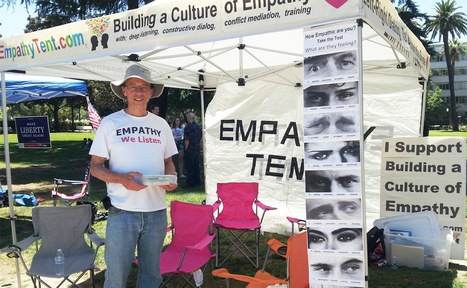
What if one of the most powerful ways to strengthen human connection is the simple act of feeling deeply heard and understood? Join Michelle Villegas for a rich and inspiring conversation with Edwin Rutsch, founder of the Empathy Center, as they explore the transformative role empathy can play in our relationships, communities, and society as a whole.
Drawing from years of research and practice, Edwin shares his vision for building a global culture of empathy and introduces concepts including self-empathy, mutual empathy, imaginative empathy, and the practice of empathy circles—structured spaces where people experience the power of deep listening and authentic understanding. Michelle, bringing her perspective as a therapist, educator, singer, songwriter, and host, helps bridge these ideas with psychology, human development, and creative expression.
Together they explore barriers that often block empathy—including rushing to solutions, judgment, analysis, and disconnection—and discuss how learning to truly listen can open pathways to deeper connection. The conversation also reaches into larger social issues, including , education, and the importance of nurturing empathy in children and future generations.
by @Elizabeth Grace Matthew These are some of the questions animating (and sometimes paralyzing) conversations among thought leaders on today’s political right.
There is Allie Beth Stuckey’s 2024 book Toxic Empathy, which asks readers not to wallow in selective empathy for the pregnant woman or the illegal immigrant unto forgetting that unborn babies and American citizens also deserve due regard. Then there is Stuckey’s conversation with the conservative New York Times columnist David French, in which the two argued about proper Christian attitudes toward transgender issues, abortion, decency, empathy itself, and more.
Most recently, there is Canadian academic Gad Saad’s May 12 book Suicidal Empathy, which remakes many of Stuckey’s arguments in a more visceral and discursive way—and which, truth be told, adds little if any substance to the conversation.
1. The Health Communications Gap: You’ve worked across pharma, biotech, non-profits, and academia. Where do most health communications strategies fail—lack of scientific rigor, lack of human empathy, or lack of boldness?
Probably all three but if I had to name the one that holds everything else back, it’s the failure of empathy. You can have the most rigorous science and the most daring creative strategy in the world, but if the work doesn’t connect with how a real person actually feels about their health, their body, their fears, it doesn’t move anyone.
To get content containing either thought or leadership enter:
To get content containing both thought and leadership enter:
To get content containing the expression thought leadership enter:
You can enter several keywords and you can refine them whenever you want. Our suggestion engine uses more signals but entering a few keywords here will rapidly give you great content to curate.


 Your new post is loading...