More than nine out of ten parents think digital media and technologies are a negative distraction in their lives. And 83% think their children are als
Via Dr. Tom D'Amico (@TDOttawa)

 Your new post is loading...
 Scoop.it! More than nine out of ten parents think digital media and technologies are a negative distraction in their lives. And 83% think their children are als Via Dr. Tom D'Amico (@TDOttawa)
Sign up to comment
Scoop.it!

By Derek Newton Students newly accepted by colleges and universities this spring are being deluged by emails and texts in the hope that they will put down their deposits and enroll. If they have questions about deadlines, financial aid and even where to eat on campus, they can get instant answers. The messages are friendly and informative. But many of them aren’t from humans.
AI has long been quietly embedding itself into higher education in ways like these, often to save money — a need that’s been heightened by pandemic-related budget squeezes. Now, simple AI-driven tools like these chatbots, plagiarism-detecting software and apps to check spelling and grammar are being joined by new, more powerful – and controversial – applications that answer academic questions, grade assignments, recommend classes and even teach.
The newest can evaluate and score applicants’ personality traits and perceived motivation, and colleges increasing are using these tools to make admissions and financial aid decisions. As the presence of this technology on campus grows, so do concerns about it. In at least one case, a seemingly promising use of AI in admissions decisions was halted because, by using algorithms to score applicants based on historical precedence, it perpetuated bias."...
For full post, please visit: Via Roxana Marachi, PhD, michel verstrepen, juandoming
Scoop.it!
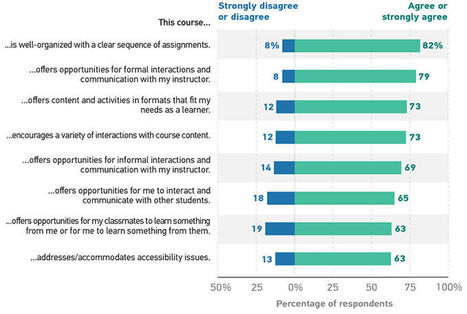
EDUCAUSE conducted a special Fall 2020 study to gain insights on the student experience during what has been an exceptional time of disruption. In the Via Helena Afonso Dos Santos
Scoop.it!

Integrating active learning techniques into your Spring course can infuse your synchronous Zoom session with energy. These activities help break up lectures, give students the opportunity to practice skills befor Via Vladimir Kukharenko, Helena Afonso Dos Santos 
Bheka Simelane's curator insight,
October 31, 2024 8:44 PM
Digitalized learning offers an array of opportunities for learners to meaningfully engage with learning materials and construct knowledge.
Scoop.it!

I’ve worked with schools in a number of countries during COVID. The schools and teachers who have excelled the most are those who readily accepted and embraced remote technology, and the…
Via Nik Peachey, EDTECH@UTRGV
Scoop.it!

Install Add-on Install TemplateTab TemplateTab TemplateTab is a Google Sheets Add-on that allows you to duplicate a graphic organizer within a spreadsheet Via Yashy Tohsaku
Scoop.it!
Using MMTS (multimedia text sets) is a simple, but not necessarily easy, strategy to engage students in topics, explore perceptions and get kids excited to learn! What is an MMTS? A multimedia text set –... Read more Using MMTS To Engage Students! Via Filomena Gomes
Scoop.it!
Learn how to use Google Meet to make telephone calls from your computer. Via Dr. Tom D'Amico (@TDOttawa) , GwynethJones 
GwynethJones's curator insight,
April 24, 2021 7:48 AM
I use this all the time to contact my students & families helping with technology issues! Best to warn them though that the call will show up as unknown number.
Scoop.it!

An interview in Second Life at the CVL Podcast station. Sandrika shares her research in gamification as she works on a PhD through engaging students in virtual world learning. Via Edumorfosis
Scoop.it!

Free resource of educational web tools, 21st century skills, tips and tutorials on how teachers and students integrate technology into education Via Yashy Tohsaku |
Scoop.it!

Increase your teams communication with Good Annotations. Take your screenshots with online capture tools, edit within your browser & share with a link. Via Yashy Tohsaku
Scoop.it!

A video explainer on the technology that’s changing the meaning of the human face.
Scoop.it!

Pedagogy is at the heart of teaching and learning. Preparing young people to become lifelong learners with a deep knowledge of subject matter and a broad set of social skills requires a better understanding of how pedagogy influences learning. Focusing on pedagogies shifts the perception of teachers from technicians who strive to attain the education goals set by the curriculum to experts in the art and science of teaching. Seen through this lens, innovation in teaching becomes a problem-solving process rooted in teachers’ professionalism, rather than an add-on applied by only some teachers in some schools. Teachers as Designers of Learning Environments: The Importance of Innovative Pedagogies provides a snapshot of innovative pedagogies used in classrooms around the world. It sets the stage for educators and policy makers to innovate teaching by looking at what is currently taking place in schools as potential seeds for change. At the heart of all of these approaches is a sensitivity to the natural inclinations of learners towards play, creativity, collaboration and inquiry. To illustrate how teachers use these innovative practices, the publication presents examples from 27 national and international networks of schools. It is now generally acknowledged that the quality of an education system cannot exceed the quality of its teachers. This volume goes a step further to argue that a teacher cannot help students meet new educational challenges by continuing to draw on a limited and perhaps even inherited set of pedagogies. And here lies the genuine importance of innovative pedagogies. Via Helena Afonso Dos Santos
Scoop.it!

Since 2009, technology has been steadily blurring which tasks are best performed by a human, and which by a machine – from smart home sensors to music made from generative algorithms and the use of artificial intelligence in places like hospitals and schools. Since the inception of WIRED UK in 2009, this world has grown and shifted in ways that would have been hard to predict – and what were once buzzwords, the offshoots of science fiction, have increasingly become a part of our everyday life. Via Edumorfosis
Scoop.it!

Since they first appeared almost three decades ago voice recognition technologies, also known as speech to text technologies, have come along way in the way they have transformed out interaction with the digital. They have become much more sophisticated with a higher degree of speech recognition accuracy and a wider accessibility to the general public. Their benefits in the field of education are well documented. According to the National Center for Technology Innovation (NCTI), speech to text technologies can tremendously help individuals with severe "learning disabilities including dyslexia and dysgraphia, vision impairments, and limited English language". Via Elizabeth E Charles
Scoop.it!

Online education has been on the rise for the last decade, and the Covid-19 pandemic accelerated its widespread use in unprecedented ways, particularly for professional career advancement. Degree-based programs and expensive learning and development (L&D) initiatives are no longer required to foster an efficient ongoing training environment for those seeking career advancement. Via Edumorfosis, Gerhard Bless 
GabriF's curator insight,
April 28, 2021 8:07 AM
Five Reasons Online Learning Is the Future of Professional Development
Scoop.it!

Technologies have penetrated almost every sphere of our life and education is no exception. Today, you can witness rapid changes in the education sector thanks to the emergence of new innovative solutions. In 2020, 80% of Via Gerhard Bless
Scoop.it!

Class is done. How can we end it effectively? Using digital exit tickets can bring closure to your day. Here are 10 you can use tomorrow. Via Dr. Tom D'Amico (@TDOttawa)
Scoop.it!
Scoop.it!

How to easily corrupt a file like Word, Text, Excel, PDF, MP3 file, etc. so it won’t open? Here are 3 free file corrupters to let you corrupt a file online. Via MiniTool Software |