 Your new post is loading...
Looking for a Textbook on Generative AI in Education?
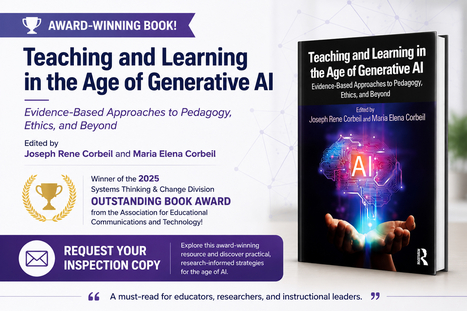
Teaching and Learning in the Age of Generative AI: Evidence-Based Approaches to Pedagogy, Ethics, and Beyond Edited by Joseph Rene Corbeil & Maria Elena Corbeil (2025) 🏆 Winner of the 2025 Systems Thinking & Change Division Outstanding Book Award from the Association for Educational Communications and Technology! If you are designing a course that addresses generative AI in education, this award-winning volume provides a research-driven, classroom-ready foundation. Rather than offering hype or fear, this book helps educators:
- Ground AI integration in learning theory and research
- Address academic integrity with thoughtful, practical strategies
- Redesign assessment for an AI-enabled world
- Explore ethics, bias, privacy, and institutional responsibility
- Leverage AI to enhance critical thinking and digital literacy
Bookended by historical and forward-looking analyses of AI in education, the chapters move beyond surface-level discussions to provide evidence-based approaches for real classrooms—K–12, higher education, and professional learning environments.
This text is ideal for:
- Undergraduate and graduate teacher education programs
- Curriculum & Instruction courses
- Educational Technology programs
- Higher education faculty development
- School technology coordinators and talent development professionals
Adopting a GenAI textbook for an upcoming semester? We invite you to request an inspection copy and explore how this resource can support your students in navigating AI with skill, ethics, and informed judgment.
Request your inspection copy today.

|
Scooped by
EDTECH@UTRGV
November 17, 11:56 AM
|
Profiles of 12 reformers making a difference show it takes hard work to be a hero
|
|
Scooped by
EDTECH@UTRGV
November 17, 11:51 AM
|
"Researchers drew on more than 5,000 human development, education and psychology studies to create a tool that tells educators how using AI may help or hinder learning, depending on a student’s age and other context."
|
|
Scooped by
EDTECH@UTRGV
November 16, 2:20 PM
|
Efekta Education's survey of 850 UK and US teachers found AI adoption reached 86% among 55-64-year-olds, compared with 60% among those aged 18-24. ETIH's edtech news coverage examines regular use, teacher training and findings from the ETIH Innovation Awards winner.
|
|
Scooped by
EDTECH@UTRGV
November 16, 12:51 PM
|
As leaders and parents question whether screen time should be limited in schools, it’s important to make sure we’re looking at outcomes, not minutes.
|
|
Scooped by
EDTECH@UTRGV
November 12, 10:01 AM
|
"A new study has revealed the differences between students and lecturers when it comes to AI use, implying that academics think students are using generative AI too much, whereas students think they’re not using it that much."
|
|
Scooped by
EDTECH@UTRGV
November 12, 9:58 AM
|
AI can help children learn, but teaching kindergarten is about reading a room full of small humans, minute by minute.
|
|
Scooped by
EDTECH@UTRGV
November 12, 9:53 AM
|
When generative AI exposed the flaws in my traditional assignments, I redesigned student learning experiences — turning AI from a cheating tool to a “cognitive sparring partner.”
|
|
Scooped by
EDTECH@UTRGV
November 11, 1:30 PM
|
As a campus leader, you probably know students are using your school's AI agents to find support at all hours. But you may be looking for more insight on the problems that today's students are turning to chatbots to solve.
|
|
Scooped by
EDTECH@UTRGV
November 11, 1:23 PM
|
Unlock the secrets to AI strategy trust by fostering a culture of understanding and collaboration among your workforce.
|
|
Scooped by
EDTECH@UTRGV
November 11, 1:20 PM
|
Unis must ensure degrees demonstrate students’ learning, rather than how well they’ve used artificial intelligence. But it’s an ongoing challenge.
|
|
Scooped by
EDTECH@UTRGV
November 10, 9:41 AM
|
AI tools may be evolving quickly, but we have a deep research base we can draw on to determine how they help meet—or undermine—any particular learning goal. Kathryn Palmer’s recent Inside Higher Ed article “The ‘Nonexistent’ Research on AI’s Benefits for Education” raises an important concern. Colleges and universities are investing heavily in generative artificial intelligence even though evidence about when, how or whether these tools improve student learning remains limited. Some studies even suggest that unguided use could undermine learning.
|
|
Scooped by
EDTECH@UTRGV
November 10, 9:34 AM
|
In a U.S. survey, 39 percent of students say peers' AI use motivates their own.
|
|
|
Scooped by
EDTECH@UTRGV
November 17, 11:59 AM
|
Research released today shows that students across 4,600 schools gained the equivalent of a week of instruction each year after phones were barred from schools.
|
|
Scooped by
EDTECH@UTRGV
November 17, 11:53 AM
|
Students are concerned about their job prospects as rumors mount that AI will greatly alter the workforce.
|
|
Scooped by
EDTECH@UTRGV
November 17, 11:50 AM
|
Once the music industry’s biggest headache, Napster’s next act is bringing AI to the classroom.
|
|
Scooped by
EDTECH@UTRGV
November 16, 2:17 PM
|
As an umbrella term, education technology encompasses everything from learning management systems and student information systems to productivity tools and AI platforms. More specific language clarifying the difference between ed tech and consumer-facing tools would allow state leaders to match the right evidence, expertise, and policy to the right questions.
|
|
Scooped by
EDTECH@UTRGV
November 16, 12:49 PM
|
Artificial intelligence promises to remove repetitive work and accelerate decision-making. Yet emerging evidence suggests that supervising increasingly capable AI systems can create a different form of work, leaving some employees facing cognitive fatigue, information overload and what researchers have termed “AI brain fry”.
|
|
Scooped by
EDTECH@UTRGV
November 12, 9:59 AM
|
AI marking has been around a long time. But it’s not the tech causing outcry – it’s what happens now that it’s readily available.
|
|
Scooped by
EDTECH@UTRGV
November 12, 9:56 AM
|
With AI now making it more difficult for employers to gage a potential employee’s skills, institutions must design curricula around proof of readiness.
|
|
Scooped by
EDTECH@UTRGV
November 12, 9:50 AM
|
"AI was supposed to make work easier, but for the people who use it most, it just became a different kind of work, and a whole lot of exhaustion."
|
|
Scooped by
EDTECH@UTRGV
November 11, 1:28 PM
|
"Microsoft has announced Classroom and changes to Microsoft 365 Education, including Office 365 A1 retirement, new student licenses and storage changes at eligible renewals from 2028."
|
|
Scooped by
EDTECH@UTRGV
November 11, 1:21 PM
|
Hanover Research surveyed nearly 300 parents and teachers to determine how schools are using artificial intelligence and where they can improve.
|
|
Scooped by
EDTECH@UTRGV
November 10, 9:47 AM
|
Instead of banning AI and schools prescribing how students must learn, let's empower students to decide when technology helps, when it doesn't, and how they learn best. We're Asking the Wrong Questions About AI As schools respond to AI, I'm seeing a familiar pattern.
|
|
Scooped by
EDTECH@UTRGV
November 10, 9:39 AM
|
Inside Higher Ed breaks down some of the latest developments regarding AI and ed tech on campus. While many universities have announced more artificial intelligence–focused initiatives this fall, one is creating a space designed to help college students develop their own ideas and express them in an authentic voice with—and without—the use of the technology.
|
|
Scooped by
EDTECH@UTRGV
November 10, 9:32 AM
|
"I was a skeptic. Let the record show, I too, was against it. When Ted Chiang wrote in The New Yorker that AI isn’t going to make art, I felt vindicated. I forwarded it. To people who had not asked (as I often do). His point was that art is the sum of thousands of small choices, and a machine that makes most of them for you has removed the art. I summarized this at dinners as “it’s a vending machine with ambitions,” which got a laugh and some confused looks."
|











Poor visual design in e-learning is a pet peeve of mine. First impressions are important. If a poorly designed UX is the first thing students see, they'll start the course with a bad impression that may last throughout the course.