The Area Agency on Aging (AAA) division of the Three Rivers Regional Commission (TRRC) held a dementia tour in West Point on Friday. At the West Point Technology Building, staff members walked participants through a simulation of what someone with Dementia or other dementia diagnoses goes through.
The simulation was open to the public. Once they signed in, they were taken to a small room and outfitted with devices that limited or heightened their senses. This included, headphones playing static noises and muffled voices, glasses that simulated tunnel vision, inserts for shoes that pricked the bottom of the foot, and large gloves.
I am really enjoying reading your blog. If you want to buy villa in Noida Extension then call on the given number-8375000707 as we give you the best offers for buying villa in Noida Extension. https://www.villasinnoida.com/villas-in-noida-extension.php
Dark empathy allows you to recognize what someone is feeling without emotionally merging with them. You can identify distress, insecurity, or manipulation while staying internally regulated. This emotional distance keeps you from spiraling when others do. It allows you to act strategically instead of reactively.
A 2025 analysis by the Personality Research Institute found that individuals high in cognitive empathy but low in emotional contagion were overrepresented in leadership roles. Researchers noted this group could remain calm under pressure without becoming detached or cruel. This balance helped them make decisions others avoided. Emotional clarity, not emotional intensity, drove effectiveness.
Allison Myers and Dr. Dena Evans, share with us all the details of the film "Nurse: Empathy Heals" that premieres this Thursday evening at Martin Center for the Arts at ETSU! Please watch the video to discover more about this powerful film that tells the narrative and stories of Nurses lived experiences.
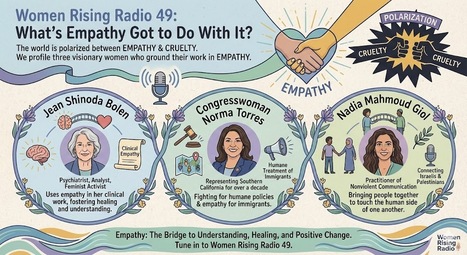
The world is polarized between empathy and cruelty. In this program we profile three visionary women who ground their work in empathy.
Jean Shinoda Bolen is a psychiatrist, analyst and feminist activist who uses empathy in her clinical work.
Congresswoman Norma Torres has represented her southern California district for over a decade, fighting for humane treatment of immigrants.
And Nadia Mahmoud Giol is a practitioner of Nonviolent Communication, bringing Israelis and Palestinians together to touch the human side of one another.
Empathy fatigue often shows up subtly. You might feel irritation when another ‘important issue’ appears on your feed, or guilt for not sharing, donating, or speaking up. Emotional numbness may hide behind humour or memes. Over time, tragedies blur together, losing their human specificity. When everything is framed as equally urgent, the mind flattens it all.
Social media worsens this fatigue by turning care into performance. Silence is read as indifference. Rest is mistaken for ignorance. There is constant pressure to prove compassion through reposts, comments, and visible outrage. Empathy becomes something we display rather than something we practise. When compassion turns into unpaid emotional labour, exhaustion is inevitable.
Join us for a series of Empathy circles using the “Conversations that Matter”, a new way of bringing inspiration for wise and compassionate action based on the 16 Guidelines for Life.
WHEN: Sundays, Jan 18 – Feb 8 TIME: 7:00 – 8.30 PM CET (19:00 – 20:30) WHERE: Facilitators online on Zoom LANGUAGE: English LEVEL: Everyone is welcome. READ MORE: Here.
What are the “16 guidelines for Life”? The 16 Guidelines are simple steps for a happier life, inspired His Holiness by the Dalai Lama and recommended for universal education by Lama Zopa Rinpoche. They teach us to manage our thoughts, actions, and connections positively. They revolve around four key themes: thinking wisely, acting kindly, building strong relationships, and embracing change for deeper meaning. Find out more at: compassionandwisdom.org
What are Empathy Circles? The Empathy Circle provides a structured dialogue process where each person feels fully heard, fostering mutual understanding and connection. It also fosters a range of valuable skills, such as communication and conflict management skills, making it a powerful tool for personal growth, conflict resolutions and meaningful dialogue. Find out more at: theempathycenter.org
The team of faculty members - Leah Cheek, Vinson Carter, Michael Daugherty and Chris Goering - was recognized with the 1909 Conference’s Outstanding Publication Award for their recent publication, “Connecting compassion: Empathy’s role in STEM and literacy integration.”
The article finds that by infusing empathy into classrooms through the use of story grammar and incorporating character experiences into engineering design challenges, students are encouraged to consider a problem’s scale and its impact on both individuals and the broader community. This helps build a direct connection between integrated STEM education and the development of empathy in children.
Canadian conservative philosopher Gad Saad is launching his sixth book, titled Suicidal Empathy: Dying to be Kind. According to an announcement made by Saad himself on X, the book is now available for pre-order.
The bestselling author of The Parasitic Mind: How Infectious Ideas Are Killing Common Sense, a provocative critique of woke culture and related ideological movements, has once again turned his attention to what he describes as ‘empathy politics’, which he links closely to wokeism. In his upcoming book, Saad argues that when a society elevates victimhood into a virtue while treating punishment as cruelty, it becomes infected with what he calls ‘suicidal empathy’—a form of maladaptively irrational altruism that hijacks moral judgement and produces a catastrophic miscalibration of priorities.
Empathy has become a baseline expectation of modern leadership, but practiced without judgment it can backfire, leaving leaders depleted and employees feeling misunderstood. Effective leadership requires a more discerning approach: wise empathy , which recognizes that different emotional moments call for different responses. Sharing in employees’ negative emotions can accelerate burnout, while responding to those with compassion and support can protect both leaders and teams. The opposite is often true for positive emotions, which benefit from shared celebration. If leaders take five steps designed to guide them in the practice of wise empathy, they can strengthen relationships, improve engagement and retention, and support others without losing their own footing.
In a post-pandemic world, empathy is no longer a "soft skill" but a strategic imperative for high-performance leaders and organizations. In an era of rapid change and empowered workforces, empathy has evolved from a "soft skill" to the ultimate competitive edge. The Empathy Advantage is a deep-dive seminar designed for leaders and others who want to move beyond traditional management and unlock the full potential of their people they lead and influence.
The session will begin by exploring the fundamental shift from managing people to cultivating success—viewing the leader not as a taskmaster, but as an expedition leader responsible for the team's psychological safety and growth. Participants will learn how to dismantle silos by moving from competition to collaboration, replacing internal rivalry with a culture of radical support and shared wins.
Introduction: To explore the mediating effect of patient-perceived physician empathy on patient trust and patient satisfaction.
Methods: The data of 834 outpatients in a top-three hospital in Jiangxi province were collected, and the general data questionnaire, diagnosis and treatment relationship empathy scale, patient trust scale and PDRQ-15 scale were used to investigate the relationship between variables, and the mediation effect was analyzed by process.
Results: There was a significant positive correlation between doctors' empathy and patients' trust. Patient satisfaction plays a partial mediating role between perceived physician empathy and patient trust. Physician empathy affects patient trust partly through patient satisfaction.
Discussion: On the basis of ensuring the quality of outpatient treatment, hospitals should strive to improve the doctor's visiting ability and service quality, so as to improve the patient's medical experience and satisfaction level, and thus ease the doctor-patient relationship.
Facilitator: Dr Andy Ward – Director of Education and Training at the Stoneygate Centre for Empathic Healthcare, Leicester Medical School
This 1-hour free webinar is open to all healthcare professionals, educators, and students.
A MS Teams link and joining instructions will be provided to delegates by email before the event.
About the session:
This interactive webinar is designed for clinical educators and healthcare professionals who want to strengthen how they teach empathy in everyday practice. Drawing on evidence-based approaches from the Stoneygate Centre for Empathic Healthcare, the session will explore what therapeutic empathy is, why it matters for patient and practitioner outcomes, and how it can be effectively taught in clinical settings.
Participants will be introduced to key frameworks, including therapeutic empathy and the CARE Measure, and will gain practical strategies to embed empathic practice into clinical teaching and supervision.
Bel Jacobs and The Empathy Project team would like to invite you to the first screening of The Empathy Project film, a documentary about change and compassion in animal activism.
Commissioned by The Empathy Project, directed by Tristan Copley-Smith, the new film explores and uplifts public concern for animals, normalising advocacy by platforming a wide variety of voices from the movement.
On Jan. 8, the film “NURSE: Empathy Heals” premiered at the ETSU Martin Center. The film is the culmination of the Nurse Narratives Initiative, a collaborative effort of ETSU College of Nursing, Ballad Health, the Tennessee Center for Nursing Advancement and StoryCollab. The initiative has worked with nurses, nursing students, faculty and patients to tell their stories through a series of reflective workshops.
Executive Director of StoryCollab Allison Myers said the organization, which is a platform of the ETSU Research Corporation, supports participatory media. In participatory media, StoryCollab works to help individuals and communities tell their stories and focuses on building processes that equip participants to share their own experience the way they feel is best. The storytellers own the rights to their stories, helping establish authenticity and autonomy with respect to their stories.
“NURSE: Empathy Heals” documents a particular workshop from the initiative. Directed by an Emmy Award-winning filmmaker, the documentary uses a narrative style to tell the often-untold story of nurses.
“It’s important that people see nurses as human,” Myers said.
One hundred years ago, the word empathy entered the English language, coined by largely forgotten Cornell psychologist Edward Titchener, a disciple of Wilhelm Wundt. Over the ensuing decades, use of the word empathy exploded beyond the field of psychology, becoming central to how humans discuss understanding one another.
Most therapists understand empathy to be foundational to therapeutic practice and essential to its success. Research has demonstrated that empathy is a primary contributor to the strength of positive therapeutic outcomes. It’s a term so well-researched and operationalized that we rarely even question the origin of this obvious human faculty of fellow-feeling.
Tras acuñar los conceptos de "empatía e intensidad" Titchener, comprendió la atención humana mediante la introspección.
Debido a las características de la sociedad de hoy en día, la atención se ha visto fuertemente mermada, ya que únicamente se queda en lo superficial: escuchar por obligación, mirar un rostro porque toca, pasar por actividades emocionales sin realmente estar ahí... (Burnett, y Mitchell, 2026),
El artículo propone que la verdadera atención es una fuerza humana profunda que nutre la conexión emocional entre personas. Sin embargo, ha sido erosionada por la cultura digital y la lógica de mercado que promueve la distracción constante y la fragmentación de la experiencia humana.
En el contexto educativo, esto tiene un impacto enorme. ¿Cómo acompañamos a un niño o a una niña emocionalmente si no podemos sostener su atención más allá de la vigilancia o la transmisión de contenidos?
Necesitamos recuperar una atención más humana. De aquí debemos partir para crear un aprendizaje tanto formativo, como para enseñar competencias emocionales como el respeto, la empatía y la autorregulación, que nos permitirán alcanzar ese desarrollo integral, que nos permita desenvolvernos en todos y cada uno de los ámbitos, con responsabilidad.
It is worth remembering that these AI chatbots are not displaying real empathy, but rather simulating it based on what they have learned from huge datasets of human interactions.
En este caso, poniendo el foco en la Inteligencia Artificial, cabe tener en cuenta que esta ofrece grandes oportunidades a nivel educativo. Pudiendo hacer uso de ella para mejorar la capacidad de escucha activa, haciéndonos reflexionar sobre nuestra manera de comunicarnos y cómo esta es percibida por el receptor o qué emociones genera en este. De manera que los modelos tecnológicos nos pueden servir de reflejo para identificar aspectos de mejora sobre nuestros actos comunicativos.
Do you ever feel like you’re constantly the one listening, supporting, and showing up for others, until one day you hit a wall and think, I can't do this anymore?
In this episode of But Are You Happy, host Ashani Dante and clinical psychologist Dr Anastasia Hronis unpack empathy fatigue; why being the “strong,” supportive one can leave you emotionally drained, and how to tell the difference between compassion and burnout.
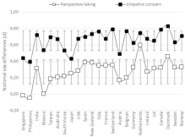
Females tend to score higher than males in the cognitive and emotional components of empathy. Similar to how temperature correlates positively with aggression, national sex differences in self-reported empathy could vary with latitude (i.e., distance from the Equator). Leveraging data from 24 primarily global-north countries (n = 101,137; 39,906 females), we examined whether perspective taking and empathic concern were associated with the distance from the Equator beyond individualism/collectivism and power distance. Across countries, sex differences in perspective taking (mean d = 0.28) were smaller than in empathic concern (mean d = 0.65).
My guest today, Ed Kirwan, is doing exactly that. Ed is the CEO and Founder of Empathy Studios, a creative education organization using the power of film to develop empathy as a real, learnable skill. He’s also the founder of Empathy Week, now the world’s largest empathy festival for schools, reaching more than 1.8 million students across 56 countries since 2020.
In this conversation, we explore why film is such a powerful catalyst for empathy, what Ed has learned from years of working with students around the world, why empathy is becoming a critical skill in the age of AI, and how developing empathy can boost well-being and help create a better world.
This is a hopeful, practical, and deeply human conversation about what empathy looks like when we stop treating it like a soft skill and start treating it like a core capability.
We’ve been sold a cheap version of empathy. A polite, sterile nod from across the street. A social media post with a sad emoji. It’s a hologram of a hug—it looks right, but there’s no warmth, no substance. True empathy doesn't keep a safe distance. It crosses the line. It walks into the room nobody else wants to enter.
Why We Build Walls (And Why They Always Fail) Society loves walls. We build them out of brick and mortar, out of prejudice, out of fear. We create categories: “us” and “them.” The good guys and the bad guys. The successful and the forgotten. These walls make us feel safe, clean, and insulated from the messy reality of the human condition.
But here's the thing they don't tell you about walls: they're an illusion. They don't just keep others out; they trap us inside with our own sanitized, incomplete version of the world. They starve us of the one thing we need to truly grow: genuine connection.
El artículo "La empatía no es agradable. Es revolucionaria". de Sloane Ramsey sostiene que la empatía auténtica va más allá de una respuesta cordial superficial y actúa como una fuerza que derriba barreras sociales y conecta a las personas desde una comprensión compartida de la experiencia humana. A través del ejemplo del concierto de Johnny Cash en la Prisión de Folsom, el texto argumenta que la empatía implica “entrar en la habitación que nadie más quiere entrar”, es decir, participar activamente en la experiencia del otro en lugar de simplemente observarla desde la distancia. La diferencia entre simpatía y empatía se define así: la primera mira desde fuera, mientras que la segunda se sitúa con el otro y comparte su realidad emocional.
Sin embargo, esta visión, aunque inspiradora, carece de una referencia teórica crítica que aborde las limitaciones estructurales o psicológicas de la empatía. La literatura contemporánea, por ejemplo, discute cómo la empatía puede ser selectiva o sesgada, enfocándose en individuos o grupos cercanos y, en algunos casos, exacerbando prejuicios sociales o decisiones irracionales si se la toma como único fundamento moral (como argumenta Paul Bloom en Against Empathy, donde propone la compasión racional como alternativa más equilibrada).
Además, el artículo de Ramsey idealiza la empatía sin considerar cómo su práctica puede verse condicionada por contextos culturales, institucionales o de poder, aspectos que la investigación psicológica y social señala como determinantes para el ejercicio efectivo y ético de la empatía. En suma, aunque el texto promueve una idea valiosa de empatía como acción transformadora, su análisis sería más sólido si integrara marcos teóricos y evidencias que también contemplan sus límites y desafíos en contextos reales.
Referencia Bibliográfica:
Ramsey, S. (2026). La empatía no es agradable. Es revolucionario. Perspectivas hechas en China.
https://insights.made in china.com/Empathy Isn't Nice It's Revolutionary_JtcGxIUOoEHm.html
Health policy is motivated by a variety of factors including moral concerns, values and convictions. Policymakers are motivated to consider how constituents and those directly impacted by policies will react to the policies they enact. Thus, it is advantageous for policymakers to understand the psychological processes that shape constituents' reactions toward health policies. We outline how and when policymakers and constituents are motivated to empathize, moralize, and compromise on divisive health policies, such as opioid-related policies, by considering the motivational frameworks of empathy and the plurality of moral values that inform attitudes.
We offer insight for policymakers balancing tradeoffs between different moral values and concerns, suggesting that policymakers should consider cultivating an active dialogue around the relevant moral emotions felt by both supporters and opponents. For example, when considering syringe services programs, supporters and opponents may both be motivated by the moral concern of harm—as supporters may see services as preventing infections and keeping people healthy, while opponents may see services as promoting drug use and in turn, harmful health outcomes.
We suggest that such a morally pluralistic effort will (1) highlight moral alignment amongst supporters to cultivate collective resolve and (2) acknowledge the competing moral concerns of opponents so that they feel understood and in turn, feel more willing to understand competing perspectives. While leaning into moral emotions may feel like a turn toward divisiveness, we suggest that acknowledging the plurality of moral values at stake sets the foundation for support and compromise.
The social justice mindset has rotted people’s minds to the point where they no longer understand truth, justice, consequences, or personal responsibility. Toxic empathy has replaced biblical realism. We feel bad about outcomes while refusing to acknowledge that actions have consequences.
Christians must stop the insanity of toxic empathy. We need a healthy dose of biblical realism: If you attack law enforcement, if you weaponize your vehicle against federal agents, you may be met with lethal force. That’s not injustice. That’s law enforcement protecting their lives while performing their duty.\
Politicians who win local mayoral elections don’t have the right to make their own laws that contradict the Constitution. They don’t get to set up independent autonomous zones where federal law doesn’t apply. And Christians cannot side with lawlessness — I don’t care who you are — simply because the left frames law enforcement as the enemy.
Should all points of view be heard from? Defending certain values and ideas makes it a bit more complicated than simply listening to all sides.
Listening is not neutrality
One explanation for these differing interpretations comes from a recent series of experiments showing speakers often confuse “active listening” with agreement. Even when they had maintained eye contact and signaled attention using short phrases like “I see,” listeners who disagreed were consistently judged as worse listeners. Because people tend to assume their own views are correct, they often infer that anyone who disagrees must not have listened well.
El artículo “Dar forma a la conversación significa ofrecer contexto a ideas extremas, no solo una plataforma” de Bodie (2025) analiza cómo se deben abordar los discursos extremos en medios y debates públicos. Utilizando como ejemplo la entrevista de Tucker Carlson con Nick Fuentes, Bodie advierte que dar visibilidad sin ofrecer un contexto crítico puede normalizar ideas dañinas, incluso si el entrevistador no las comparte. Propone enfoques de “calling in” y “calling forward”, que combinan curiosidad con responsabilidad, cuestionando afirmaciones extremistas mientras se analiza cómo operaron y cómo enfrentarlas sin otorgarles legitimidad automática (theconversation.com).
Críticamente, aunque el artículo ofrece pautas útiles para enriquecer el debate público y evitar la polarización, carece de marcos teóricos amplios y evidencia empírica sobre la eficacia de estas estrategias, algo relevante según estudios de comunicación y radicalización que muestran que el contexto y la mediación influyen decisivamente en la percepción de mensajes extremos. En definitiva, Bodie enfatiza que la gestión responsable de la conversación importa tanto como quién habla, y que contextualizar ideas extremas es esencial para el pensamiento crítico en sociedad.
Bio: Edwin Rutsch is Founding Director of The Empathy Center, and a leading organizer in the global Empathy Movement. He is a creator and long-time advocate of the Empathy Circle practice—a simple yet powerful tool for building understanding and bridging divides. (LinkedIn) (Facebook) (Website)
Topic: Why The Empathy Circle is the Foundational Practice of the Empathy Movement.
Abstract: "Empathy is often discussed as an abstract feeling, but to become a social reality, it requires a practical, scalable application. In this presentation, I will demonstrate why the Empathy Circle is the essential 'operating system' for this shift.
As the definitive 'gateway practice,' the Circle provides a structured and replicable framework for mutual active listening. It is more than just a tool; it is the primary training ground for the mindset and skills required to scale the Empathy Movement globally."
To get content containing either thought or leadership enter:
To get content containing both thought and leadership enter:
To get content containing the expression thought leadership enter:
You can enter several keywords and you can refine them whenever you want. Our suggestion engine uses more signals but entering a few keywords here will rapidly give you great content to curate.


 Your new post is loading...