This session will describe a company-wide program to generate user empathy among one company's engineering workforce through direct user interaction. Attendees will learn about how the program was designed to address key challenges, the results achieved, and the lessons learned.
I am really enjoying reading your blog. If you want to buy villa in Noida Extension then call on the given number-8375000707 as we give you the best offers for buying villa in Noida Extension. https://www.villasinnoida.com/villas-in-noida-extension.php
This article explores the transformative power of cognitive empathy as an essential skill for navigating modern challenges, highlighting its role in fostering understanding, solving problems, and bridging divides in both personal and professional contexts.
Understanding Perspectives: Cognitive empathy enables individuals to step outside their own worldview and see situations through others’ eyes, fostering connection and clarity.
Problem-Solving Power: Unlike emotional empathy, cognitive empathy focuses on understanding motivations and circumstances, empowering individuals to resolve conflicts and drive action.
Bridging Divides: Its application spans diverse contexts, from improving workplace collaboration to enhancing relationships by addressing core perspectives.
A Survival Tool: In an increasingly polarized world, cognitive empathy acts as a critical tool for cutting through noise, fostering understanding, and creating meaningful connections.
In today’s polarized political landscape, the ability to understand and empathize with those across the aisle has reached concerning lows. New research published in Personality & Social Psychology Bulletin reveals an asymmetry in this empathy deficit: liberals consistently show less empathy toward their conservative peers than vice versa.
This lack of both empathy and fair-mindedness is not foreign to far-right extremists–in fact, it has become a standard to which only the most powerful figures have begun holding themselves to. In an episode of The Joe Rogan Experience which aired in February of 2025, Elon Musk stated “the fundamental weakness of Western civilization is empathy.” Is this notion, one that deems empathy self-destructive and threatening amongst conservative circles, a defense mechanism? Or is this aversion to emotionally connecting with and understanding others an attempt to inflict destruction without consequence?
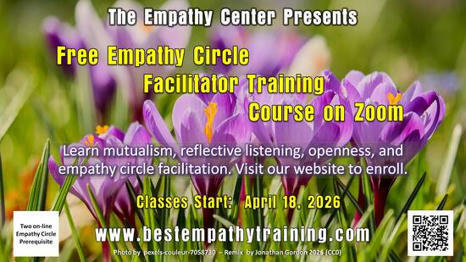
On April 18, 2026 the Empathy Center will be conducting a Facilitator training course on Zoom. The intent of this training is to teach the participant how to organize and conduct Empathy Circles.
The course is experiential and consists of 4 classes taught over 4 consecutive Saturdays. Each class lasts about two and half hours. In addition to attending 4 sessions of 2.5 hours each, there are weekly assignments to complete that may take 1-2 hours. We will also pair you weekly with an empathy buddy to practice empathy.
It's no secret that the U.S. school system is struggling with kids far below where they should be in terms of grade levels and teachers leaving the profession in droves. Former teacher Mike Bonitatibus puts the blame squarely on showing too much empathy in the classroom.
Empathy is an important part of being a good person. We should all be able to understand how others are feeling and be sensitive to their issues. However, as the idiom goes, too much of anything is never good, especially when it comes to kids. But most people think of that in terms of sugar, not empathy.
Another type of empathic response that decreased after the AI intervention was motivational empathy, for example, You are doing the best you can or I think that is a great start. In the figure below from the study, I found it interesting that as motivational empathy, which people naturally expressed a substantial portion of the time, decreased, validating emotions and encouraging elaboration increased after the AI coaching.
I could not help but feel that people’s expressions began to sound quite similar to what I think of as the typical conversational style of common AI chatbots. At the same time, on the receiving end, motivational empathy did not seem to come across as especially empathic or as making people feel heard.
What happens when a society elevates victimhood to a virtue and decides that punishment is cruel? You get the disease Dr. Gad Saad calls suicidal empathy. And the West may be terminally infected.
Saad says "maladaptively irrational altruism" has gripped our culture. He calls it a mind parasite that has hijacked the empathy module of our progressive elite, leading to a catastrophic miscalibration of moral priorities. The results are everywhere: from coddling violent criminals to protecting rapists to branding self-defense as toxic behavior. He says we are witnessing a civilization in rapid decline, with bad policies instituted because we prioritize the feelings of ostensibly marginalized groups over the truth, criminals over victims, and squatters over homeowners. Saad says this is not only not humane—it’s an active dismantling of the pillars that keep us safe and free.
In this episode of The Empathy Edge, people and culture strategist Julia Armet — a workplace facilitator and proud neurodivergent leader — joins Maria Ross to explore how empathy transforms work and inclusion. Julia shares her personal journey navigating neurodivergence and introduces the double-empathy problem — a powerful lens for understanding communication across differences.
This empathy deficit—whether it stems as in Trump’s case from contempt, or as in Democrats’ case from the desire to reduce politics to statistical probabilities—is endemic. An inability to capture the loyalty of skeptics or redirect their ire by understanding what inspires, soothes, scares, and repulses human beings explains Trump's military failures.
It also explains his domestic political failures, the broader authoritarian turn in Republican politics, and even certain technocratic tendencies among Democrats. Whenever leaders treat civilians principally as instruments, they misjudge how those people will respond to events and appeals and affronts. This, unsurprisingly, makes it hard to win any contest in which the masses have a say. Wars, yes. But elections, too.
The Trump administration and the MAGA movement have embraced overt anti-empathy as its defining stance, and the Christian nationalists, eugenicists, business leaders, and proud bigots who have the president’s ear now rail against empathy as a sin and a cancer. Elon Musk believes that “The fundamental weakness of Western Civilization is empathy,” and the idea that Democrats and progressives have made empathy “toxic” has become one of the right’s favorite talking points.
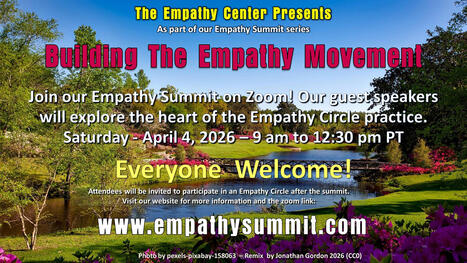
Our summits are comprised of a number of 15 minute presentations on the chosen theme for the quarterly summits. After the presentations the attendees are invited to participate in an Empathy Circle. Past summits have been on conflict resolution, training programs from around the world, and empathy book authors.
In addition the summit is reunion and re-connection of circle trainers, trainees, facilitators, practitioners and supporters.
Our theme for April, 2026, is How Might We Build the Empathy Movement?
by Peter Sear A lack of empathy isn't just a choice; it's a neurological byproduct of power.
A leader who cannot fully "read" the opposition cannot predict their next move.
Strategic empathy allows a leader to sense psychological friction.
We often mistake dominance for leadership. We look at individuals who command rooms and impose their will as being the "best" at what they do. As a psychologist working within elite performance, I have observed a recurring phenomenon: Power can act as a neurological anaesthetic. It deadens the very empathic faculties that are essential for sustainable success.
On May 2nd, we're uniting America with empathy.Thank you for signing up to participate in our Community Empathy Project with the Roslindale Food Collective.
On Saturday, participants will take part in a hands-on session where we will learn about food insecurity in our community and work together to assemble fresh produce bags for local families. This is an active, collaborative experience focused on service, dignity, and community care.
In this episode of the Impostor Syndrome Files, we look at self-empathy as a practical skill you can use in everyday life. My guest, Melissa Robinson-Winemiller, is a former professional musician and university professor who later founded EQ via Empathy where she works today. Melissa shares how a tough career pivot pushed her to study empathy and write the book, The Empathic Leader.
Here we talk about how to build your self-empathy muscles in easy moments first so that you have the skills available to you when the stakes rise. We also explore why high achievers take the blame when things go wrong yet wave away credit when things go well, how empathy and judgment cannot coexist, and a simple practice to interrupt reactivity so you can lead with more clarity at work and at home.
Claire Yorke is an Author, academic and advisor specializing in the role and limitations of empathy and emotions in security, international affairs, politics, leadership, and society. Her doctoral research focused on the role of empathy in diplomacy. How Empathy - can be a tool for navigating complex international transitions and building state relations. Claire is author of Empathy in Politics and Leadership: The Key to Transforming Our World.
Edwin Rutsch and Claire York discuss the importance of empathy in politics and society. Claire, a senior lecturer at Deakin University, emphasizes the need for empathy to connect people and understand their intrinsic dignity. They explore the challenges of empathy, such as dealing with conflict and dehumanization.
Edwin introduces his wholistic empathy definition model, which includes basic, self, imaginative, and mutual empathy. They debate the effectiveness of empathy circles and the importance of active listening.
Empathy can be one of our best qualities ― a force that deepens relationships, builds trust and helps us show up for others. But in some dynamics, that positive instinct can be turned against you.
“Weaponized empathy is a pattern of using empathy, compassion or guilt to influence another person’s behavior, often at the expense of personal boundaries and preferences,” Caitlyn Oscarson, a licensed marriage and family therapist, told HuffPost.
A microphone and oyster shell passed from hand to hand in a circle of folding chairs as neighbors spoke about their own spirituality and listened to others’ without interpretation.
The Natick Freedom Team, a volunteer anti-bias, racism and bigotry organization, gave residents the chance to explore their neighbors’ belief systems at an interfaith listening circle March 25 at the First Congressional Church of Natick.
“Our goal is to listen and help create an opportunity for people to share,” said Don Greenstein, an ombudsperson at Brandeis University and member of the Natick Freedom Team who led and moderated the circle. “It was met and then some.”
Title: Empathy in Action: Strengthening the Patient-Provider Connection - Part I Runtime: 5 min 57 sec Speaker: Tara Harding, DNP Empathy in Healthcare: A new educational initiative,"Empathy in Action," launched this week focusing on how healthcare providers can use specific "active listening" techniques to prevent patient "un-hearing," which is a leading cause of delayed diagnoses in 2026.
Background Therapeutic empathy improves patient and practitioner outcomes, yet existing measures are often lengthy, conceptually inconsistent, and cannot be easily compared across respondent groups. Brief, universal measures (usable by patients, practitioners, students, and observers) are lacking. We therefore developed a universal single-item scale and conducted psychometric testing of the patient-reported version.
Methods Following best-practice, we used a three-phase approach:
(1) item development;
(2) pre-testing the scale by obtaining expert panel feedback (n=9) and conducting cognitive interviews with stakeholders (n=35); and
(3) scale validation in an international patient sample (n=521) assessing convergent, discriminant, and known-groups validity.
Validation involved assessing correlations with the Consultation and Relational Empathy (CARE) measure and clinical neutrality measure, and by assessing differences in scores by patient ethnicity.
This article seeks to clarify and distinguish how phenomenological definitions of empathy may be applied in psychotherapy. It argues that effective therapeutic practice relies not only on narrative engagement but also on embodied attunement, often referred to as empathic resonance. Rather than viewing the therapist’s feelings as passive emotional mirroring of the client, the authors propose a critical and situated perspective in which these feelings are understood as embodied responses that emerge within the therapeutic relationship. In doing so, the authors aim to contribute to the enhancement of clinical training in psychotherapy.
They specifically advocate for a stepwise approach to training, in which narrative tracking and bodily self-awareness are developed and cultivated as separate skills in the early phases of psychotherapy training. The progressive integration of these skills eventually enables therapists to use their feelings as instruments of empathy rather than sources of interference. Thus, empathic therapists do not limit themselves to a purely cognitive, intellectual understanding of a client’s story. Instead, they cultivate a comprehensive form of empathy, allowing themselves to resonate with the client’s experience at a bodily, prereflexive level.
A listening that goes beyond words Highly empathetic people don't just listen to what is said. They also perceive what is not expressed. They pay attention to nonverbal communication, silences, micro-expressions, and subtle changes in attitude. This observational ability often allows them to understand a situation in its entirety, even without hearing everything explicitly.
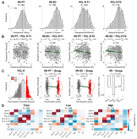
Background Reduced empathy is a hallmark of individuals with high (i.e., clinical) levels of psychopathy, who are overrepresented among incarcerated men. However, a comprehensive, well-powered mapping of cortical structure in relation to empathy and psychopathy is still lacking.
Conclusions Men with high psychopathy had reduced empathic concern, increased SA, and a compressed macroscale organization of CT, indicating selective co-alterations in empathy and cortical structure. Future work should build on these novel insights in both the general and incarcerated populations to inform the treatment of psychopathy.
si estás en el mundo académico o de la investigación, esta plataforma es como esa biblioteca inmensa y elegante a la que te da un poco de miedo entrar, pero donde sabes que está la respuesta a todo.
To get content containing either thought or leadership enter:
To get content containing both thought and leadership enter:
To get content containing the expression thought leadership enter:
You can enter several keywords and you can refine them whenever you want. Our suggestion engine uses more signals but entering a few keywords here will rapidly give you great content to curate.


 Your new post is loading...