


Week 7 of E-Learning 3.0 with Pete Forsyth, Editor in Chief of the Signpost, a community newspaper covering Wikipedia and the Wikimedia movement., an
Via Ana Cristina Pratas

 Your new post is loading...
 Scoop.it! Week 7 of E-Learning 3.0 with Pete Forsyth, Editor in Chief of the Signpost, a community newspaper covering Wikipedia and the Wikimedia movement., an Via Ana Cristina Pratas No comment yet.
Sign up to comment
Scoop.it!

It is actually easier than you thought to recover wiped partition with a wonderful data recovery tool. Via MiniTool Software
Scoop.it!

Our classrooms and our approaches to learning are evolving in fascinating ways, as are the tools that affect our concept of what a classroom is and how we can use it to meet our learners’ needs. Our educational technology tools more and more frequently are offering us previously unimagined opportunities. And we are beginning to embrace—and struggle with—the reality—or mixed reality—of those blended (onsite-online) spaces. Via Nik Peachey 
Nik Peachey's curator insight,
December 13, 2018 5:14 AM
Interesting article with some useful links.
Scoop.it!

Ana Cristina Pratas's curator insight,
December 13, 2018 6:46 AM
AbstractManaging one’s time and setting boundaries while teaching online are essential for continued job satisfaction and effective teaching. Online teaching offers attractive flexibility, but instructors report high teaching workloads, feeling isolated, high stress levels, and a poor work-life balance. By utilizing assumptions about online learners set out in andragogy theory, the practical application of the Community of Inquiry Framework, and considering work-life balance theories, the online instructor can effectively set boundaries that support their own work and simultaneously focus on students’ success. We propose that instructors can define their work and set boundaries on the online classroom by prioritizing engagement, developing assets to help students guide themselves, managing time, and using efficiency strategies. In this practitioner-focused article, we identify common barriers to effective time and task management in online education and, based on both research and practice, we provide additional tips, tools, and strategies for preparing online courses, teaching them, and grading student assignments—all intended to assist online educators in their pursuit of work-life balance.
Scoop.it!

Did you know you can edit images inside Google Docs and Slides? In just a few clicks, you and your students can add some pizazz to your images in Google Docs and Google Slides! Editing images give you the ability to add a professional touch to your presentations and documents. Some of these features are a bit hidden, but once you see the possibilities, your docs and slides will never be the same. No need for fancy Photoshop software to do simple cropping, add a border, a drop shadow, or even mask an image into a shape! Via Dr. Tom D'Amico (@TDOttawa)
Scoop.it!

La base primaria del chatbot es el bot, que es un software que utiliza la Inteligencia Artificial , que tiene como principal característica realizar una serie de tareas sin la ayuda del ser humano. Via Edumorfosis
Scoop.it!

We show you 9 ways for disk cleanup Windows 10. If your computer is running on low disk space, here's how to clean your computer Windows 10. Via MiniTool Software
Scoop.it!
The share of college students taking online courses has grown, up by about 6 percent, even as the overall number of people enrolled in higher education institutions dropped by about half a percent. According to preliminary numbers issued by the U.S. Department of Education's National Center for Education Statistics, of the 20.1 million students enrolled in fall 2017, 6.7 million were taking at least one distance education class, representing 33 percent of the total — a boost from 31 percent in the previous year. Via Peter Mellow
Scoop.it!

"With the surge in classroom technology use, a few edtech companies have stepped up to combat the issues schools are facing on a daily basis. One company that is helping with digital distraction is NetRef. The software allows teachers to control what their students are doing online in the classroom, both on school and with student-owned devices ..." Via Leona Ungerer
Scoop.it!

I find the question – where do deleted files go bothers a lot of people, so I decide to talk about it and then provide solutions for deleted file recovery. Via MiniTool Software
Scoop.it!

What is Live-Tweeting?
Live-tweeters use the hashtag relevant to the event they are tweeting about (which can usually be located on the conference’s website or Twitter profile). Twitter followers who cannot be at the event in person can follow along using the hashtag and this in turn expands the reach of the conference. Live-tweeting enhances personal learningLive-tweeting can also enhance your own personal learning as it requires you to listen more carefully and focus more sharply on the key details of a talk in order to better summarize what the speakers are saying. Furthermore, live-tweeting is a means of amplifying the conference experience, generating global reach and stimulating collaborative potential. This learning is further consolidated with an archive of tweets on which you can reflect further after the event. Sarah Chapman, whose work at the UK Cochrane Centre focuses on disseminating Cochrane evidence through social media, observes how this in-the-moment tweeting captures the immediacy and energy of the event: “Live tweeting can convey the atmosphere generated by a controversial or entertaining presentation in a way that will be lost by the time you get to look at the slides uploaded on the internet”. Many times the original tweet will be supplemented by pertinent comments on Twitter from other conference attendees and also from those listening in online. For example, someone may respond to a tweet by questioning the strength of the clinical outcomes of a study, or a practicing physician might respond with their experiences treating patients. As a review published in J. Clin. Med. states: “The diversity of expertise and backgrounds that can communicate on Twitter is unique, and this exchange of information can be extremely beneficial.” Live-tweeting enhances virtual learningReporting live from a medical conference or event allows you to provide valuable insights to those who are unable to attend in person. Due to rising costs, concern about our carbon footprint and increasing time commitments, virtual attendance is becoming more commonplace at healthcare events – hence the rise in live-tweeting.
Mark Brown, a UK-based mental health advocate, points out that “There have been many recent publications and events imploring us to have a national conversation about mental health. Why then do so many fascinating discussions happen at conferences, uncaptured and inaccessible to people wanting to join them?” Brown believes “this democratisation of access is vital if we want to broaden our mental health discussions and raise the level of sophistication in our arguments and debates. For this to happen we need some brave souls who know how to cover an event via live tweeting and who are prepared to do so out of a sense of public service.” You might also like to read Make Your Mark at Medical Meetings with Social Media This is the first in a two-part guide to live-tweeting. In part 2, I will share my tips for best practice in live-tweeting. Whether you are a conference organizer, a speaker, or an attendee these tips will help you make the most of the opportunity to report live from your next event. Via Plus91
Scoop.it!

There is more happening, in more places, than ever before. A number of efforts have been informed (in good ways) by past failures. That said, others will no doubt attempt to 'reinvent the flat tire' and display a characteristic common to Einstein's definition of insanity: "doing the same thing over and over again and expecting different results". Hopefully none of the groups profiled below will fall into that trap, but I suspect that a few of them might. Via Jim Lerman
Scoop.it!

Move over, LMS; it’s time to share space with a new member of the eLearning ecosystem: the learning experience platform, or LXP. Via Marta Torán 
Marta Torán's curator insight,
December 3, 2018 4:59 PM
Las plataformas de experiencias de aprendizaje están de moda.
Pamela Hogle (@pam_hogle) nos da cuatro razones para usarlas:
Amplifican las oportunidades de aprendizaje – Los empleados son aprendices digitales – Ofrecen opciones y control a los alumnos – Fomentan el aprendizaje social y la colaboración
|
Scoop.it!
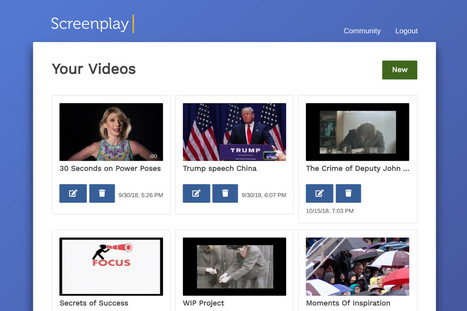
Edit video as naturally as text. Screenplay gives you an auto-generated transcription of all the speech in your whole video file. All you have to do next is use the familiar text editor interface to trim, cut, and rearrange text to create your brand new video! Via Ana Cristina Pratas
Scoop.it!

I provide a comprehensive hard drive disaster recovery plan here to help people rescue data timely when necessary. Via MiniTool Software
Scoop.it!

"The growing use of voice search and virtual digital assistants will have an increasing impact on how we deliver, search for and market higher education ..." ©
Via Leona Ungerer
Scoop.it!

A blog about digital leadership, pedagogy, learning, and transformative change in education. Via Dr. Tom D'Amico (@TDOttawa)
Scoop.it!
Learn Microsoft word:learning how to easily insert an image into the table in the document Microsoft word 2007. Note: To reduce file size, save : PDF file Via Karen Loftus
Scoop.it!
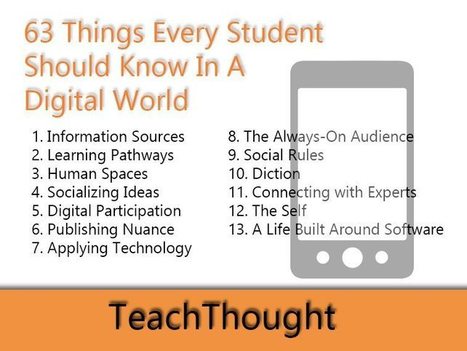
t could be argued—and probably argued well—that what a student fundamentally needs to know today isn’t much different than what Tom Sawyer or Joan of Arc or Alexander the Great needed to know. Via John Evans
Scoop.it!

"Hundreds of apps can follow your movements and share the details with advertisers, retailers and even hedge funds. Here’s how to limit the snooping." Via John Evans, Juergen Wagner
Scoop.it!
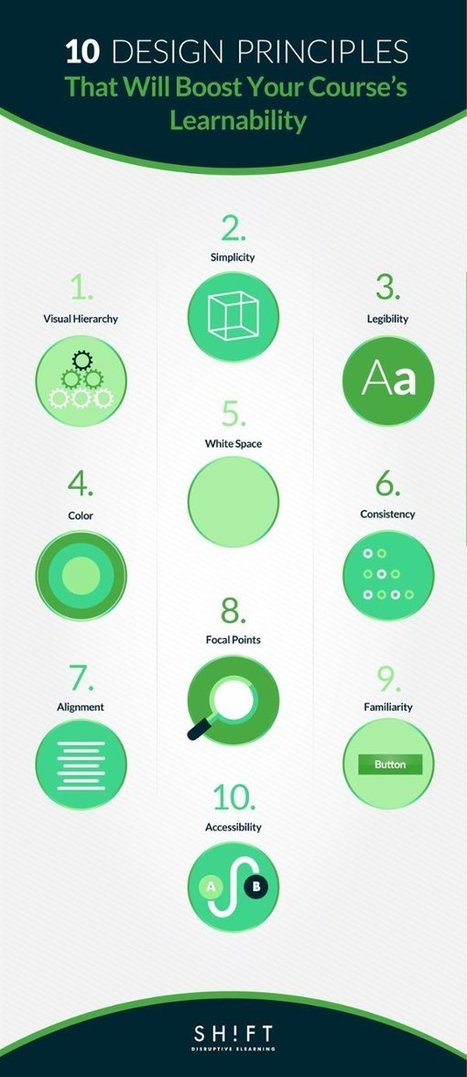
Here are ten eLearning design principles that you simply can’t ignore if you want to create an eLearning course with a high learnability quotient. Via Marta Torán 
Oscar Carrera's curator insight,
December 14, 2018 12:05 AM
A good-looking eLearning course is not a guarantee of its instructional effectiveness. Think of all those magazines with glossy covers that you flip over expectantly only to find that the pages are filled with trash. Unfortunately, many course developers have no clue of how visual design can increase (or decrease) learnability of the material.
Scoop.it!

If you want to recover deleted files in Windows 7 independently, you’d better read this carefully to acquire different methods. Via MiniTool Software
Scoop.it!

A free, online conference for teachers. Sessions on technology, pedagogy and more. Offered annually in December. Hosted by DitchThatTextbook.com. Via Dr. Tom D'Amico (@TDOttawa)
Scoop.it!

Contracts are an essential part of every business. Whether it is a start-up, small scale business or large organization, agreements streamline communications and prevent misunderstandings. Your eLearning business is no exception. You require contracts to administer the employer-employee relationship. eLearning freelancing contracts ensure that the sub-contractors you hire understand the conditions. But they also serve as a legally binding agreement between you and the client. Thus, protecting eLearning freelancers and their eLearning business venture. Here are 9 crucial things that you need to have in your eLearning freelancing contracts. Via Edumorfosis
Scoop.it!

Early learning system award winners, includes best system for gamification, extended enterprise and technology. Via Marta Torán
Marta Torán's curator insight,
November 28, 2018 6:21 PM
Craig Weiss (@diegoinstudio) nos ofrece en este post una magnífica ayuda para seleccionar el mejor sistema de aprendizaje.
Su selección, además de la magnífica herramienta FindAnLMS, nos permite encontrar referencias en función de categorías y necesidades.
Sus comentarios, imprescindibles. |






