Distance Learning, mLearning, Digital Education, Technology
16.6K views | +4 today
Distance Learning, mLearning, Digital Education, Technology
Your new post is loading...
Rescooped by Dennis Swender from Edumorfosis.it
February 21, 2019 11:42 AM
Scoop.it!

Trends in eLearning and Virtual Education

Trends in eLearning and Virtual Education | Distance Learning, mLearning, Digital Education, Technology | Scoop.it

I outline a number of major recent technological trends in e-learning and virtual education, including the use of artificial intelligence and learning analytics, blockchain technology for resources and recognition, and virtual and augmented reality for immersive experiences. I draw examples from corporate, university, and elementary education development projects and implementations. These in turn inform the discussion of wider trends in pedagogy and curriculum, including new critical literacies, community network development and management, and personal learning management and support. Lecture, Jan 28, 2019.


Via Edumorfosis
No comment yet.
Rescooped by Dennis Swender from iPads, MakerEd and More in Education
February 21, 2019 11:38 AM
Scoop.it!

25 Reading Sites and Apps | Tech & Learning

25 Reading Sites and Apps | Tech & Learning | Distance Learning, mLearning, Digital Education, Technology | Scoop.it
As a follow up to my recent list on Math Sites/Apps found here, I've decided to compile a list of my favorite learning tools for reading.  Mobile Learning and BYOD make it easier for any student to learn any core subject, especially that of reading. Finally, this list does includes tools that help with comprehension and language arts as a whole.  This list is in alphabetical order. 

Via John Evans
No comment yet.
Rescooped by Dennis Swender from Social Media, Marketing y Gestión de Comunidades en la Web Social
February 21, 2019 2:18 AM
Scoop.it!

Using Twitter as a data source: an overview of social media research tools (updated for 2017)

Using Twitter as a data source: an overview of social media research tools (updated for 2017) | Distance Learning, mLearning, Digital Education, Technology | Scoop.it
Following his initial post on this topic in 2015, Wasim Ahmed has updated and expanded his rundown of the tools available to social scientists looking to analyse social media data. A number of new …

Via Juan Jesús Baño Egea
No comment yet.
Rescooped by Dennis Swender from E-Learning, Formación, Aprendizaje y Gestión del Conocimiento con TIC en pequeñas dosis.
February 21, 2019 2:09 AM
Scoop.it!

State of the #eLearning Industry 2019. #edtech

State of the #eLearning Industry 2019. #edtech | Distance Learning, mLearning, Digital Education, Technology | Scoop.it
Looking back at the state of the e-learning industry in 2018 and where we are today in 2019.

Via Juan Jesús Baño Egea
No comment yet.
Scooped by Dennis Swender
February 21, 2019 2:06 AM
Scoop.it!

Content recommendations in real life

Phony ‘content recommendations’ are everywhere online, offering insurance you don’t need, ‘funny’ pictures you don’t want, and made up stories about fade
No comment yet.
Scooped by Dennis Swender
February 21, 2019 1:43 AM
Scoop.it!

The corridor of uncertainty: Open learning - back to basics

The corridor of uncertainty: Open learning - back to basics | Distance Learning, mLearning, Digital Education, Technology | Scoop.it
CC0 Photo by chuttersnap on Unsplash The term open in education   can mean almost anything today and should always be taken with a
No comment yet.
Rescooped by Dennis Swender from Educación a Distancia y TIC
February 21, 2019 1:38 AM
Scoop.it!

Learning Goals and Objectives in Course Design | LearnWorlds Blog

Learning Goals and Objectives in Course Design | LearnWorlds Blog | Distance Learning, mLearning, Digital Education, Technology | Scoop.it
Learning goals are broad, general statements of what we want our students to learn and provide: Direction, Focus, and Cohesion Setting goals gives us a real road map to where we want to go. The same when we provide goals to learners. Learning goals are the heart of a course design and need to be … Continue

Via LGA
No comment yet.
Rescooped by Dennis Swender from Information and digital literacy in education via the digital path
February 21, 2019 1:33 AM
Scoop.it!

Digital Transformation and Empowering Technologies in Higher Education –

Digital Transformation and Empowering Technologies in Higher Education – | Distance Learning, mLearning, Digital Education, Technology | Scoop.it

By Professor Grainne Conole.


I recently attended a HEA Future-focus Forum on Digital Transformation and Empowering Technologies in Higher Education. Prior to the meeting a paper was circulated setting the scene for the meeting. This contextualized the topic by referencing various Irish and EU relevant documents, including the Irish Future Jobs Initiative, the Digital Agenda for Europe, the European Digital Education Action Plan, the European Higher Education Area in 2018, etc.


The paper argued that digital transformation is pervasive and can be understood as the changes that digital technology causes or influences in all aspects of human life. In addition, Higher Education will change significantly over the coming years due to digital transformation. Critical questions include: how can higher education Institutions (HEI) provide leadership in ensuring an ethical and responsible use of technology and data? How do we empower people to build a data-first culture and future proof our digital infrastructure? What are the challenges and how do we prepare for them? What international best practice exists to inform a national approach to digital transformation in Higher Education?


Via Elizabeth E Charles
No comment yet.
Rescooped by Dennis Swender from iGeneration - Humane Use of Technology in an AI world (Pedagogy & Digital Innovation)
February 21, 2019 1:32 AM
Scoop.it!

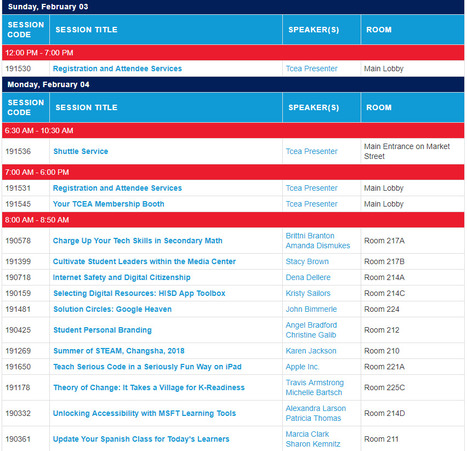
All of the #TCEA handouts and presentations - thanks @lgracey for sharing!

All of the #TCEA handouts and presentations - thanks @lgracey for sharing! | Distance Learning, mLearning, Digital Education, Technology | Scoop.it

Via Dr. Tom D'Amico (@TDOttawa)
No comment yet.
Scooped by Dennis Swender
February 18, 2019 9:30 PM
Scoop.it!

Saab to Further Develop VR Rocket Launcher Simulator

Saab to Further Develop VR Rocket Launcher Simulator | Distance Learning, mLearning, Digital Education, Technology | Scoop.it
Saab, a global defense and security company (and former parent company of the car manufacturer of the same name), says that it will further develop a VR experience designed to demonstrate a shoulder-mounted rocket launcher offered by the company. Saab is the manufacturer of the Carl-Gustaf recoilless rifle (among a wide range of other defense products), …
No comment yet.
Rescooped by Dennis Swender from Educational Technology News
February 18, 2019 9:29 PM
Scoop.it!

Midwest instructors move classes online during polar vortex

Midwest instructors move classes online during polar vortex | Distance Learning, mLearning, Digital Education, Technology | Scoop.it
When temperatures dropped last week, many classes continued using digital learning technology, which is proving useful for more than just bad weather.

Via EDTECH@UTRGV
EDTECH@UTRGV's curator insight, February 11, 2019 5:20 PM

Allowing students to attend classes online during cold weather is fine, but not all students have Internet access at home. Also during extreme cold conditions, electrical and Internet services may go down.

Scooped by Dennis Swender
February 18, 2019 9:28 PM
Scoop.it!

How Facebook Has Changed Computing

How Facebook Has Changed Computing | Distance Learning, mLearning, Digital Education, Technology | Scoop.it
To handle its massive amount of data, Facebook built new hardware and software tools, and shared them through open source.
No comment yet.
Scooped by Dennis Swender
February 18, 2019 9:24 PM
Scoop.it!

Redefining Learning & Teaching using Technology

"Did you know that 16% of 8-11 year olds own five or more media devices and 72% of 12-15 year olds own three or more media devices? 51% of households with a ...
No comment yet.
Scooped by Dennis Swender
February 21, 2019 11:39 AM
Scoop.it!

Flash to HTML5 eLearning Conversion: The 4 'R's That Matter

Flash to HTML5 eLearning Conversion: The 4 'R's That Matter | Distance Learning, mLearning, Digital Education, Technology | Scoop.it
Confused where to start with your Flash to HTML5 eLearning conversion process? Download this eBook to know the four conversion methods, and insights on how to plan for it. Also, get a sneak peek at how forward-thinking companies are doing it.
No comment yet.
Scooped by Dennis Swender
February 21, 2019 2:24 AM
Scoop.it!

The Ultimate Beginner’s Guide to Microsoft PowerPoint: From Newbie to Master

The Ultimate Beginner’s Guide to Microsoft PowerPoint: From Newbie to Master | Distance Learning, mLearning, Digital Education, Technology | Scoop.it
You will need to give a presentation one day. This beginner’s guide to Microsoft PowerPoint should give you a great start to a wonderful slideshow.
No comment yet.
Rescooped by Dennis Swender from Social Media, Marketing y Gestión de Comunidades en la Web Social
February 21, 2019 2:17 AM
Scoop.it!

7 things to do when a blog post goes viral

7 things to do when a blog post goes viral | Distance Learning, mLearning, Digital Education, Technology | Scoop.it
Got viral content? You need a response plan. Here are 7 things to do when a blog post goes viral.

Via Juan Jesús Baño Egea
António Coutinho's comment, October 24, 2017 6:46 AM
Felicitaciones! :)
António Coutinho's curator insight, October 24, 2017 6:47 AM

Check out Juan #52.

Rescooped by Dennis Swender from E-Learning, Formación, Aprendizaje y Gestión del Conocimiento con TIC en pequeñas dosis.
February 21, 2019 2:09 AM
Scoop.it!

The Top 10 #EdTech Tools for Teaching and Learning in 2019. #elearning

The Top 10 #EdTech Tools for Teaching and Learning in 2019. #elearning | Distance Learning, mLearning, Digital Education, Technology | Scoop.it
I trust you have had a well-deserved break and you are ramping up for a great start to 2019 whether it is the beginning of the year or mid-year. I wanted to start 2019 by sharing my current favorit…

Via Juan Jesús Baño Egea
No comment yet.
Scooped by Dennis Swender
February 21, 2019 1:44 AM
Scoop.it!

The Fabrication that is OER

The Fabrication that is OER | Distance Learning, mLearning, Digital Education, Technology | Scoop.it
OER stands for 'Open Educational Resources' and as readers know I have been a long-time proponent of free and open learning resources. So why would I call them a fabrication in the title of this post? It's a response to OER @ 16, "Where are You?" by Gordon Freedman, a column published as a LinkedIn
No comment yet.
Rescooped by Dennis Swender from Social Media and Healthcare
February 21, 2019 1:40 AM
Scoop.it!

Reaching out to millennials on social media

Reaching out to millennials on social media | Distance Learning, mLearning, Digital Education, Technology | Scoop.it

In the September/October 2018 issue of Orthodontic Practice US, I shared important insight from author Maria Bailey and her excellent book Millennial Moms: 202 Facts Marketers Need to Know to Build Brands and Drive Sales(available on Amazon). Millennials (born between 1980–2000) became the largest consumer group in 2015. As a patient, their decision-making process is completely different from what you have previously experienced, as is their ability to pay for treatment. Also, they perceive value, trust, and financial decisions differently than any other prior generation. Traditional marketing won’t reach this group, so you have to think creatively as well.

In a changing landscape of consumer demands, what are some important social media themes to address in your marketing strategy? In this article, I will also address the “elephant in the room” — strategies to counteract the current treatment option available for patients at home.

The recent growth in the last 2 years in at-home aligner treatment shows that over 250,000 patients have chosen one company to start treatment. But on a positive note, there are some takeaways we can learn as an orthodontic industry. Beyond price, why do patients feel this is a good choice? And how do you make a consumer take pause when choosing between DIY options and a licensed orthodontic professional? One main answer is that potential patients are not receiving education on the importance of choosing an orthodontist as they are searching for information on social media and Google. To give these potential patients the facts and information they need, you want not only to integrate education posts with treatment result posts, but also to share some core values of your practice that will make it an easier decision for patients to make the right choice to have their treatment done by an orthodontist.

Further insights from Bailey’s book suggest promoting benefits that are already offered in your practice on your social media. Don’t forget to broadcast this news also on Facebook, Instagram, and YouTube. These sites are important to the “Millennial Moms” and probably to your entire social media community.

Here are some important aspects of your practice to weave into your social media.

No. 1 — Affordability, benefits, and financing

With the rising financial college costs incurred by millennials upon graduation, student loan debt is a huge financial burden.

Millennials are saddled with college debt that pushes them to seek low-cost options for their orthodontic needs. U.S. News and World Report recently published 20 years (1998-2018) of tuition cost increases by the 300 top ranked national universities in its 2019 Best National Universities rankings report.1 Here’s a quick breakdown:

The average tuition and fees at private national universities have jumped 168% since 1998. Out-of-state tuition and fees at public national universities have risen 200%. In-state tuition and fees at public national universities have grown the most, increasing 243%.

A recent article on CNBC.com noted, “The average monthly student loan payment for borrowers in their 20s is $351, and the median monthly payment is $203. That means that Americans in their 20s with student loan debt each have an average balance of about $22,135. Millennials in their 30s may have been dealt the worst hand of all. Twelve million people between the ages of 30 and 39 hold a whopping total of $408.4 billion dollars in debt. So while fewer 30-year-olds still hold debt, those who do have even more to handle.”2 This record-level financial college tuition debt will affect millennials’ decision for treatment.

Figure 2

It’s easy to see why a less expensive and convenient option to orthodontic treatment is intriguing to this millennial patient base that wants to improve their appearance and fit the treatment in their monthly budget. Of course, you cannot compete on the DIY price, but with potential insurance benefits and financing, patients may realize your fee is more affordable than they perceived. Share frequently on your social media untapped orthodontic insurance benefits that can be applied in your practice and affordable financing options for the balance of treatment. Sharing local employer benefits on Facebook and Instagram may also be a good strategy as well as contacting HR departments on specials for their employees.

For the typical consumer, understanding insurance coverage is frustrating and overwhelming. Your treatment coordinator and financial manager sharing those little pieces of knowledge will be enlightening and positive for your community. Share it on your YouTube Channel, occasional Facebook and Instagram posts, and tag the corporation if appropriate (their followers will see your post), and extend the offer to research their benefits for them.

No. 2 — Educate why it’s important to choose an orthodontist

Figure 3A: Stellar Go Live Kit (left) and Figure 3B: LuMee Light-up Phone Cases (right)

In a February 2018 blog post for Delta Dental of Washington, Dr. Kyle Dosch, DDS, Dental Director, wrote the following in an article titled “At-Home Invisible Aligners and Your Dental Coverage”: “The statistics around DIY invisible aligner treatments don’t lie. In 2017, the American Association of Orthodontists (AAO) found that 39% of orthodontists who reported seeing patients after an attempt at DIY therapy had to provide some form of corrective dental treatment to address problems caused by patients trying to straighten their own teeth.

“It’s for these reasons that DIY treatments, orthodontic or otherwise, are not a covered benefit. As a dental benefit carrier, we have an obligation to help protect you. That’s why our dental benefit plans only cover treatment provided and completed by a licensed dental professional. Please keep this in mind when planning orthodontic treatment for yourself and your family.”3

Your office knowledge with your regional insurance providers on their coverage of at home orthodontics would be invaluable with your online followers and dental community.

It’s important to share why your experience and education makes your office the best choice for orthodontic treatment in the online space outside of your website. Educate, educate, educate — it’s easier than ever and almost free on social media. The more “un-produced” a video is, the more authentic it is perceived.

The AAO is taking a more active and aggressive role in educating the public on safety of treatment with an orthodontic professional, but it’s also important that you help the cause. For regional patients, it’s more likely your videos, posts, and blogs will come up in a local organic search. YouTube thumbnails with engaging titles such as “Orthodontics is not a safe DIY treatment,” and a 2-3 minute video will serve your practice well. Share your team’s expertise on insurance research and affordability of treatment with a specialist. Doing so will plant the seeds for when the patient is ready to get started.

One way to educate and to introduce yourself to potential patients is by making a video, which is not such a difficult process. Recording video at a close distance with good sound (no echo) and good lighting is important and easy. Coach Glitter (Instagram @CoachGlitter Facebook pages CoachGlitter1 and website coachglitter.com) has easy tips to record effective live videos. Dr. Dovi Prero (Instagram @PreroOrthodontics — website PreroOrthodontics.com) has one of the most popular orthodontic Instagram accounts with very active engagement. His posts, “likes,” and “comments” are very impressive — you can check out his social media and get some pointers on how you may want to approach your own videos.

Both Coach Glitter and Dr. Prero are great teachers to study from in social media strategy and entertaining video shots. It’s not hard to put your practice on the “live” social media map, and you actually may enjoy your inner celebrity.

Another key to good videos is good lighting and sound. Stellar Lighting Systems out of Los Angeles (stellarlightingsystems.com) has a high quality “go live” kit with an adjustable clip light for your phone and desktop tripod that will make a difference in your videos for $23.99. There are cheaper versions on Amazon, but this is the best light I’ve seen to “up” the quality of your video educating your community. Lumee.com also has a great phone case with lighting built in for selfies on the go both forward facing and on the back of the case for $69.99. Be authentic, educate effectively, and have fun being your true self.

It is also critical to plan a monthly social media and YouTube schedule and rotate topics. Posts should include, but not be limited to, education, treatment success, affordability, philanthropy, experience, office personality, humor, love of patients, family, and community — rinse and repeat. You can also pre-schedule when these posts go live, so it is all done at once, and you are ready for the month. The online free site Canva allows you to create posts in a matter of minutes, and be sure to add your logo to the image (watermark app), so it stays with your page. Also, be sure to reply to comments daily in connecting with your community.

Figure 4 (left) and Figure 5 (right)

No. 3 — Report advances in your dental technology and how this will benefit your millennial patients

Author Bailey notes that millennials “want it now and want it fast” as well as wanting instant gratification. Orthodontic treatment can’t be as fast as an Amazon package at the doorstep, but technology advances put you in the running to promote convenience and efficiencies.

Figure 6

Ease of scheduling and communication: Millennials do not want to make phone calls but prefer online scheduling and text. Invisalign® has a local store in San Jose that offers an online service to schedule appointments much like the OpenTable.com experience on the website for an initial consultation.

Hopefully online patient-facing systems will allow this trend to integrate into your current website and scheduling programs to streamline the new patient process. Ask your providers where they are going with these tools to meet the trends in convenience to the millennial population. In the meantime, consider a dedicated number a patient can text to schedule appointments or ask questions versus email. This saves a lot of time for the Millennial Moms, and they will most likely make an appointment right away. Promote this ease of scheduling and communication in your social media platforms.

Explain how easy and fast the initial consultation has become because of technology in your practice. Ensure the benefits of your new iTero® scanner and the quality of information it produces (versus sending selfies and impression material in patient records to at-home treatment companies), and the importance of full records for evaluation. Preview how long the process will take, and you will make it easy for millennials to understand their treatment plan and financial cost. Share cutting-edge technologies that make treatment more convenient, comfortable, and faster. Some orthodontists are choosing to differentiate their practice through accelerated orthodontics (including MOPs, vibration, or low light level therapy) or lingual brace technologies like SureSmile® and InBrace. Figure 5 is one example of how Dr. Todd Dickerson in Phoenix, Arizona, promotes acceleration on his Facebook page to his patients and referring practices. Dr. Dovi Prero in Figure 6 highlights innovations of InBrace customized lingual brackets to his Instagram audience as another efficient esthetic treatment option.

Ease of scheduling, records and treatment modalities present a huge opportunity to promote on your website, to your referrals, and social media community — and to point out that these innovations are only available with a licensed provider. Technology has changed the landscape completely, and it’s exciting.

Whatever you integrate that benefits the patient experience, convenience, and treatment outcome — promote it and promote it often. Educate your patients as to why specialist orthodontists are important, show your technologies and successful treatment results, and you will have millennials entrusting their smiles to you in the years ahead.


Via Plus91
No comment yet.
Rescooped by Dennis Swender from Educación a Distancia y TIC
February 21, 2019 1:33 AM
Scoop.it!

4 MOOC Trends We Expect to See in 2019

4 MOOC Trends We Expect to See in 2019 | Distance Learning, mLearning, Digital Education, Technology | Scoop.it
Massive Open Online Courses (MOOC) are all set to make a comeback, with greater flexibility, bite-sized lessons, and the all-important business case.

Via LGA
No comment yet.
Rescooped by Dennis Swender from iGeneration - Humane Use of Technology in an AI world (Pedagogy & Digital Innovation)
February 21, 2019 1:32 AM
Scoop.it!

Use Google Slides - Accessible Closed Captions to improve literacy for all learners via Lisa Nielsen

Use Google Slides - Accessible Closed Captions to improve literacy for all learners via Lisa Nielsen | Distance Learning, mLearning, Digital Education, Technology | Scoop.it
Lisa Nielsen

Via Dr. Tom D'Amico (@TDOttawa)
No comment yet.
Rescooped by Dennis Swender from Educational Technology News
February 21, 2019 1:15 AM
Scoop.it!

The Golden Principles of High-Quality Instructional Design

The Golden Principles of High-Quality Instructional Design | Distance Learning, mLearning, Digital Education, Technology | Scoop.it
Follow these five golden principles to help you achieve high-quality instructional design:

Via EDTECH@UTRGV
Marco Bertolini's curator insight, February 23, 2019 3:27 AM

A very interesting article about what good instructional design should be 

Judy Ortega's curator insight, March 31, 2019 8:04 PM
I love this! Short and to the point.
Jeni Hammett's curator insight, July 29, 2019 12:28 PM
Share your insight
Rescooped by Dennis Swender from Education 2.0 & 3.0
February 18, 2019 9:29 PM
Scoop.it!

How to Help Someone Use a Computer by Phil Agre 

How to Help Someone Use a Computer by Phil Agre  | Distance Learning, mLearning, Digital Education, Technology | Scoop.it

Note: This list, written in 1996 by Phil Agre is the best advice I can give people who are helping novice users with computer issues. Phil Agre was a visionary technologist and this list was up on his website forever but has been up and down lately so I am reprinting it.

Computer people are generally fine human beings, but nonetheless they do a lot of inadvertent harm in the ways they “help” other people with their computer problems. Now that we’re trying to get everyone on the net, I thought it might be helpful to write down everything I’ve been taught about helping people use computers.


Via Elizabeth E Charles, Yashy Tohsaku
No comment yet.
Scooped by Dennis Swender
February 18, 2019 9:28 PM
Scoop.it!

ISTE | 3 unexpected ways tech can humanize learning

ISTE | 3 unexpected ways tech can humanize learning | Distance Learning, mLearning, Digital Education, Technology | Scoop.it
Technology allows educators to bring a whole new level of compassion to teaching. Here are three ways you can use technology to personalize learning for all of your students.
No comment yet.
Scooped by Dennis Swender
February 18, 2019 9:27 PM
Scoop.it!

The Real Reason Tech Struggles With Algorithmic Bias

The Real Reason Tech Struggles With Algorithmic Bias | Distance Learning, mLearning, Digital Education, Technology | Scoop.it
Opinion: Humans train the machine-learning and AI systems at Facebook, Google, and Twitter to filter out bias. The problem: they don't know what they're looking for.
No comment yet.