Education 2.0 & 3.0
158.3K views | +32 today
Follow
 
Rescooped by Yashy Tohsaku from Schools + Libraries + Museums + STEAM + Digital Media Literacy + Cyber Arts + Connected to Fiber Networks
onto Education 2.0 & 3.0
December 29, 12:23 PM
Scoop.it!

Studying philosophy does make people better thinkers, according to new research | by Michael Vazquez, UNC Chapel Hill & Michael Prinzing, Wake Forest | TheConversation.com

Studying philosophy does make people better thinkers, according to new research | by Michael Vazquez, UNC Chapel Hill & Michael Prinzing, Wake Forest | TheConversation.com | Education 2.0 & 3.0 | Scoop.it

Philosophy majors rank higher than all other majors on verbal and logical reasoning, according to our new study published in the Journal of the American Philosophical Association. They also tend to display more intellectual virtues such as curiosity and open-mindedness.


Philosophers have long claimed that studying philosophy sharpens one’s mind. What sets philosophy apart from other fields is that it is not so much a body of knowledge as an activity – a form of inquiry. Doing philosophy involves trying to answer fundamental questions about humanity and the world we live in and subjecting proposed answers to critical scrutiny: constructing logical arguments, drawing subtle distinctions and following ideas to their ultimate – often surprising – conclusions.


It makes sense, then, that studying philosophy might make people better thinkers. But as philosophers ourselves, we wondered whether there is strong evidence for that claim.


Via Chuck Sherwood, Former Senior Associate, TeleDimensions, Inc
No comment yet.
Education 2.0 & 3.0
All about learning and technology
Curated by Yashy Tohsaku
Your new post is loading...
Rescooped by Yashy Tohsaku from Educational Technology News
Today, 7:32 PM
Scoop.it!

Learning with AI falls short compared to old-fashioned web search

Learning with AI falls short compared to old-fashioned web search | Education 2.0 & 3.0 | Scoop.it
Doing the mental work of connecting the dots across multiple web queries appears to help people understand the material better compared to an AI summary.

Via EDTECH@UTRGV
EDTECH@UTRGV's curator insight, December 29, 12:58 PM

"Since the release of ChatGPT in late 2022, millions of people have started using large language models to access knowledge. And it’s easy to understand their appeal: Ask a question, get a polished synthesis and move on – it feels like effortless learning."

Rescooped by Yashy Tohsaku from Schools + Libraries + Museums + STEAM + Digital Media Literacy + Cyber Arts + Connected to Fiber Networks
Today, 7:31 PM
Scoop.it!

The Supreme Court Just Opened the Door to a New Era of Book Bans | by Suzette Baker and Amanda Jones | Time.com

The Supreme Court Just Opened the Door to a New Era of Book Bans | by Suzette Baker and Amanda Jones | Time.com | Education 2.0 & 3.0 | Scoop.it

The Supreme Court’s inaction hands governments new power to pull titles, and puts Americans’ First Amendment rights at risk.


Imagine that you decided to go to your local library to check out a book but you couldn’t find it on the shelf. You ask the librarian for help locating it, but they inform you it’s not available—not because someone else has checked it out, but because the government has physically removed it after deciding they don’t want you to read it.


This isn’t the plot of a dystopian novel, it’s the reality that the U.S. Supreme Court has allowed in its recent decision to not hear arguments in the book ban caseLeila Green Little et al. v. Llano County. In leaving the Fifth Circuit ruling in place,


SCOTUS effectively granted state and local governments in Louisiana, Mississippi, and Texas the authority to determine what materials you can and cannot read. This means people in these states do not have the same First Amendment rights as the rest of the country. And that should raise alarm for everyone. 


Via Chuck Sherwood, Former Senior Associate, TeleDimensions, Inc
No comment yet.
Rescooped by Yashy Tohsaku from e-learning-ukr
Today, 7:31 PM
Scoop.it!

From Student Voices to Course Design Choices: What Student Panels Reveal About Engagement | IDDblog: Instructional Design Tips, Advice, & Trends for Online & Distance Learning | Educational Technol...


From Student Voices to Course Design Choices: What Student Panels Reveal About Engagement | IDDblog: Instructional Design Tips, Advice, & Trends for Online & Distance Learning | Educational Technol... | Education 2.0 & 3.0 | Scoop.it
Lisa Gibbons explores how student panels reveal what truly drives engagement and helps faculty turn student voices into smarter course design choices.

Via Vladimir Kukharenko
No comment yet.
Rescooped by Yashy Tohsaku from iGeneration - Humane Use of Technology in an AI world (Pedagogy & Digital Innovation)
Today, 7:30 PM
Scoop.it!

Aura Releases New 2025 State of the Youth Report

Aura Releases New 2025 State of the Youth Report | Education 2.0 & 3.0 | Scoop.it
The report shows how violence appears in AI chats, when roleplay takes hold, what causes digital stress, and why device rules spark conflict at home.

Via Dr. Tom D'Amico (@TDOttawa)
No comment yet.
Rescooped by Yashy Tohsaku from Digital Delights for Learners
Today, 7:29 PM
Scoop.it!

DailyQuiz

DailyQuiz | Education 2.0 & 3.0 | Scoop.it
A daily general knowledge quiz generated by AI.

Via Ana Cristina Pratas
No comment yet.
Rescooped by Yashy Tohsaku from Educational Technology News
December 29, 12:24 PM
Scoop.it!

'Teaching and Learning in the Age of Generative AI' was listed among the 8 AI Books Published In 2025 That Every Educator Needs On Their Shelf by Dan Fitzpatrick at Forbes

'Teaching and Learning in the Age of Generative AI' was listed among the 8 AI Books Published In 2025 That Every Educator Needs On Their Shelf by Dan Fitzpatrick at Forbes | Education 2.0 & 3.0 | Scoop.it

Our book, Teaching and Learning in the Age of Generative AI, was featured by Forbes in an article by Dan Fitzpatrick titled 8 AI Books Published in 2025 That Every Educator Needs on Their Shelf.

The article highlights the book’s value in bringing together diverse scholarly and practical perspectives on generative AI in education. In particular, Professor Jason Gulya of Berkeley College (a contributor to the book) noted the strength of the volume’s range of voices and approaches, emphasizing its balance of theoretical and applied perspectives, as well as its thoughtful treatment of both the promise and the potential perils of AI technologies in teaching and learning.


Via EDTECH@UTRGV
EDTECH@UTRGV's curator insight, December 28, 11:58 AM

It’s encouraging to see conversations around generative AI in teaching and learning reaching a broader audience, and the book being included in that discussion. Preview the book here: https://bit.ly/4jVce93 

Alessandro Cerboni's curator insight, December 29, 12:17 PM
L'articolo sottolinea il valore del libro nel riunire diverse prospettive accademiche e pratiche sull'intelligenza artificiale generativa nell'istruzione. In particolare, il professore Jason Gulya del Berkeley College (uno dei collaboratori del libro) ha sottolineato la forza della varietà di voci e approcci del volume, sottolineandone l'equilibrio tra prospettive teoriche e applicate, nonché la sua attenta analisi sia delle promesse che dei potenziali pericoli delle tecnologie di intelligenza artificiale nell'insegnamento e nell'apprendimento.
Rescooped by Yashy Tohsaku from Schools + Libraries + Museums + STEAM + Digital Media Literacy + Cyber Arts + Connected to Fiber Networks
December 29, 12:23 PM
Scoop.it!

Studying philosophy does make people better thinkers, according to new research | by Michael Vazquez, UNC Chapel Hill & Michael Prinzing, Wake Forest | TheConversation.com

Studying philosophy does make people better thinkers, according to new research | by Michael Vazquez, UNC Chapel Hill & Michael Prinzing, Wake Forest | TheConversation.com | Education 2.0 & 3.0 | Scoop.it

Philosophy majors rank higher than all other majors on verbal and logical reasoning, according to our new study published in the Journal of the American Philosophical Association. They also tend to display more intellectual virtues such as curiosity and open-mindedness.


Philosophers have long claimed that studying philosophy sharpens one’s mind. What sets philosophy apart from other fields is that it is not so much a body of knowledge as an activity – a form of inquiry. Doing philosophy involves trying to answer fundamental questions about humanity and the world we live in and subjecting proposed answers to critical scrutiny: constructing logical arguments, drawing subtle distinctions and following ideas to their ultimate – often surprising – conclusions.


It makes sense, then, that studying philosophy might make people better thinkers. But as philosophers ourselves, we wondered whether there is strong evidence for that claim.


Via Chuck Sherwood, Former Senior Associate, TeleDimensions, Inc
No comment yet.
Rescooped by Yashy Tohsaku from iGeneration - Humane Use of Technology in an AI world (Pedagogy & Digital Innovation)
December 29, 12:21 PM
Scoop.it!

AI in Education: Negotiating for Our Future - A Checklist for K12 Districts -AI Data use and protection (US based ...some good questions for District Leaders and CIOs to ask)

AI in Education: Negotiating for Our Future - A Checklist for K12 Districts -AI Data use and protection (US based ...some good questions for District Leaders and CIOs to ask) | Education 2.0 & 3.0 | Scoop.it
Considerations for the School Districts in Considering Large Scale AI Model DealsAs Artificial Intelligence (AI) and frontier AI models rapidly reshape the educational landscape, school systems face a dual challenge: harnessing these tools' transformative potential while rigorously safeguarding student data, privacy, and well-being. Procurement is no longer just about purchasing; along with AI literacy, it is the first line of defense in responsible AI governance.For years, Project Unicorn has c

Via Dr. Tom D'Amico (@TDOttawa)
No comment yet.
Rescooped by Yashy Tohsaku from Learning & Technology News
December 29, 12:20 PM
Scoop.it!

The Return of the Spoken Word: Why Voice AI Demands We Rethink Oracy in Education –

The Return of the Spoken Word: Why Voice AI Demands We Rethink Oracy in Education – | Education 2.0 & 3.0 | Scoop.it
Wispr Flow and the slew of AI voice-to-text technology are shifting us from written to spoken communication. What does this mean for teaching oracy and literacy in schools? The Technology That Made Me Rethink My Entire Approach to Writing I'm dictating this blog post. Not transcribing a draft I've written by hand, not reading from…

Via Nik Peachey
Nik Peachey's curator insight, December 29, 11:52 AM

Interesting article about the use of AI powered speech to text tools

Scooped by Yashy Tohsaku
December 29, 10:49 AM
Scoop.it!

The 2026 Educator’s Technology Integration Calendar for Simple, Smart, and Strategic Tech Use –

The 2026 Educator’s Technology Integration Calendar for Simple, Smart, and Strategic Tech Use – | Education 2.0 & 3.0 | Scoop.it
Good teaching should always lead and technology should follow, so we've created this 2026 Technology Integration Calendar for educators! Explore this and more at TCEA TechNotes Blog, your go-to source for educational technology and teaching innovation.
No comment yet.
Rescooped by Yashy Tohsaku from Tools for Teachers & Learners
December 27, 7:32 PM
Scoop.it!

Proofread, edit and improve your writing with a powerful AI editor and chat | AI Writing and Grammar Assistant

Proofread, edit and improve your writing with a powerful AI editor and chat | AI Writing and Grammar Assistant | Education 2.0 & 3.0 | Scoop.it
Keep your authentic voice while AI improves clarity and grammar. Control each change, personalized writing profiles, and intelligent suggestions, write faster with premium models. The smart alternative to traditional grammar checkers. Start free.

Via Nik Peachey
Nik Peachey's curator insight, December 27, 2:52 AM

This is an interesting application of AI to editing writing. It keeps the writer in control. There is a useable free subscription: https://www.revise.net/ there is also a free word duplication spotter here: https://duplicateword.com

Rescooped by Yashy Tohsaku from Tools for Teachers & Learners
December 27, 7:31 PM
Scoop.it!

virtualvacation.us - Explore The World From Home

virtualvacation.us - Explore The World From Home | Education 2.0 & 3.0 | Scoop.it
Explore the world/globe from home with virtualvacation.us! View live footage from different cities, or even take a guessing quiz!

Via Nik Peachey
Nik Peachey's curator insight, December 27, 3:06 AM

This is a nice site for bringing the world into the classroom. It has live feeds and video recordings from around the world. There’s a range of different themes and I love the CityGuesser. https://virtualvacation.us/

Rescooped by Yashy Tohsaku from e-learning-ukr
December 27, 7:30 PM
Scoop.it!

Getting to an AI Policy Part 2: A Moving Target

Getting to an AI Policy Part 2: A Moving Target | Education 2.0 & 3.0 | Scoop.it
Congratulations, You Created a Policy…Now Change It!

Via Vladimir Kukharenko
No comment yet.
Rescooped by Yashy Tohsaku from Educational Technology News
Today, 7:32 PM
Scoop.it!

AI Nudges Syracuse Professors Back Toward Blue Books, In-Class Work

AI Nudges Syracuse Professors Back Toward Blue Books, In-Class Work | Education 2.0 & 3.0 | Scoop.it
To prevent students from relying on artificial intelligence to write and do homework for them, many professors are returning to pre-technology assessments and having students finish essays in class.

Via EDTECH@UTRGV
EDTECH@UTRGV's curator insight, December 29, 1:03 PM

"At the three largest educational institutions in Syracuse — Syracuse University, Le Moyne College and Onondaga Community College — many professors are returning to pre-technology assessments while students use AI to study in futuristic ways."

Rescooped by Yashy Tohsaku from 21st Century Learning and Teaching
Today, 7:31 PM
Scoop.it!

Surviving in an #AI-Driven World & a Misunderstood Liberalism | EDU: Digital CitiZENship, CyberSecurity, eSkills, Modern EDU by Gust MEES

Surviving in an #AI-Driven World & a Misunderstood Liberalism | EDU: Digital CitiZENship, CyberSecurity, eSkills, Modern EDU by Gust MEES | Education 2.0 & 3.0 | Scoop.it

From Blind Progress to Responsible Thinking – Why Critical Thinking, Ethics, and Education Matter More Than Ever Image created by ChatGPT, click please to enlarge. Introduction – Why this résumé exists We are living in a time where technological progress is accelerating faster than our collective ability to reflect on its consequences. Artificial Intelligence now…


Learn more / En savoir plus / Mehr erfahren:


https://www.scoop.it/topic/21st-century-learning-and-teaching?tag=Gust-MEES


https://gustmees.wordpress.com/


Via Gust MEES
Gust MEES's curator insight, December 29, 2:02 PM

From Blind Progress to Responsible Thinking – Why Critical Thinking, Ethics, and Education Matter More Than Ever Image created by ChatGPT, click please to enlarge. Introduction – Why this résumé exists We are living in a time where technological progress is accelerating faster than our collective ability to reflect on its consequences. Artificial Intelligence now…


Learn more / En savoir plus / Mehr erfahren:


https://www.scoop.it/topic/21st-century-learning-and-teaching?tag=Gust-MEES


https://gustmees.wordpress.com/


Rescooped by Yashy Tohsaku from e-learning-ukr
Today, 7:30 PM
Scoop.it!

"Hello, World!"... revisited - by Alexandra Mihai

"Hello, World!"... revisited - by Alexandra Mihai | Education 2.0 & 3.0 | Scoop.it
The Educationalist. By Alexandra Mihai

Via Vladimir Kukharenko
No comment yet.
Rescooped by Yashy Tohsaku from Educational Technology News
Today, 7:29 PM
Scoop.it!

Purdue to require all undergrads demonstrate 'AI working competency'

Purdue to require all undergrads demonstrate 'AI working competency' | Education 2.0 & 3.0 | Scoop.it
Starting next fall semester, Purdue University will require all of its incoming students to meet a new AI competency standard.

Via EDTECH@UTRGV
EDTECH@UTRGV's curator insight, Today, 10:28 AM

"The new “AI working competency,” includes five categories: Learning with AI, Learning about AI, Research AI, Using AI and Partnering in AI. After being approved by a university trustee board last week, the new requirement is hoped to ensure that all Purdue students understand a technology that is increasingly influential."

Rescooped by Yashy Tohsaku from Educational Technology News
Today, 7:28 PM
Scoop.it!

How do we define learning in schools? | Tes

How do we define learning in schools? | Tes | Education 2.0 & 3.0 | Scoop.it
Most people would agree there is more to learning than performance on tests, but we need to formalise that definition to make sure it drives policy and practice, says Bernard Andrews

Via EDTECH@UTRGV
EDTECH@UTRGV's curator insight, Today, 10:32 AM

"[A] stable, broad and ordinary understanding of “learning” must anchor educational policy. If we want a fair and accountable education system that works for all, we need to standardise our core “weights” and “measures” in a way that speaks to this ambition."

Rescooped by Yashy Tohsaku from Edumorfosis.it
December 29, 12:24 PM
Scoop.it!

How Big Tech is silently colonizing education

How Big Tech is silently colonizing education | Education 2.0 & 3.0 | Scoop.it

Educators face a growing sense of concern about artificial intelligence. New tools enter classrooms faster than policies can adapt. National authorities release guidance documents that outline principles for safe or ethical use. Universities add statements to their syllabi about transparency and good conduct. Companies offer free training modules that show teachers how to integrate their platforms into lesson plans. These efforts have value, yet they sit on the surface of a deeper problem. Most decisions that shape how AI works occur far from the people who will live with the consequences.


Via Edumorfosis
Marco Bertolini's curator insight, December 29, 2:47 AM

Most decisions that shape how AI works occur far from the people who will live with the consequences. We should demand Tech democracy.

Rescooped by Yashy Tohsaku from Digital Delights for Learners
December 29, 12:22 PM
Scoop.it!

Free Video to Audio Converter - Convert MP4, AVI, MOV to MP3, WAV, AAC Online

Free Video to Audio Converter - Convert MP4, AVI, MOV to MP3, WAV, AAC Online | Education 2.0 & 3.0 | Scoop.it
Convert videos to audio files instantly. Free online video to audio converter supporting MP4, AVI, MOV, MKV to MP3, WAV, AAC, OGG, FLAC, M4A. No registration, no upload, 100% private.

Via Ana Cristina Pratas
No comment yet.
Rescooped by Yashy Tohsaku from 21st Century Learning and Teaching
December 29, 12:20 PM
Scoop.it!

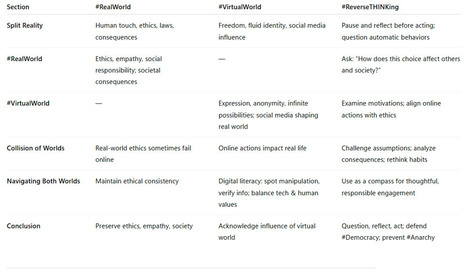
21st Century: A World Confronted With 2 Worlds — #RealWorld and #VirtualWorld | EDU: Digital CitiZENship, CyberSecurity, eSkills, Modern EDU by Gust MEES

21st Century: A World Confronted With 2 Worlds — #RealWorld and #VirtualWorld | EDU: Digital CitiZENship, CyberSecurity, eSkills, Modern EDU by Gust MEES | Education 2.0 & 3.0 | Scoop.it

Understanding, comparing, and navigating two worlds without losing ethics and democracy Image created by ChatGPT, click please to enlarge. Understanding, comparing, and navigating two worlds without losing ethics, responsibility, and democracy We live in an era where reality itself feels split. On one side is the tangible, messy, beautiful #RealWorld—shaped by human touch, emotions, laws,…


Learn more / En savoir plus / Mehr erfahren:


https://www.scoop.it/topic/21st-century-learning-and-teaching?tag=Gust-MEES


https://gustmees.wordpress.com/


Via Gust MEES
Gust MEES's curator insight, December 29, 9:46 AM

Understanding, comparing, and navigating two worlds without losing ethics and democracy Image created by ChatGPT, click please to enlarge. Understanding, comparing, and navigating two worlds without losing ethics, responsibility, and democracy We live in an era where reality itself feels split. On one side is the tangible, messy, beautiful #RealWorld—shaped by human touch, emotions, laws,…


Learn more / En savoir plus / Mehr erfahren:


https://www.scoop.it/topic/21st-century-learning-and-teaching?tag=Gust-MEES


https://gustmees.wordpress.com/


Mari Carmen Robles Aguilar's curator insight, December 29, 12:46 PM
El artículo “21st Century: A World Confronted With 2 Worlds — #RealWorld and #VirtualWorld” es muy relevante para la educación en ciudadanía digital, ya que analiza cómo los individuos navegan entre el mundo real y el virtual. Destaca la importancia de desarrollar competencias digitales, seguridad online y pensamiento crítico para interactuar de manera responsable en entornos digitales. Esto se relaciona directamente con el uso consciente de las redes sociales, donde los jóvenes deben aprender a diferenciar información veraz de fake news, proteger su privacidad y comportarse éticamente. Reflexionar sobre esta dualidad entre realidad y virtualidad ayuda a formar ciudadanos digitales críticos y responsables, capaces de tomar decisiones informadas y de actuar de manera segura en la red. Además, promueve la educación en habilidades digitales y la conciencia sobre el impacto de nuestras acciones online en la sociedad.
Scooped by Yashy Tohsaku
December 29, 10:50 AM
Scoop.it!

L&D In 2026 And A Review Of 2025, A Year Of Acceleration

L&D In 2026 And A Review Of 2025, A Year Of Acceleration | Education 2.0 & 3.0 | Scoop.it
2025 marked a breakthrough year for L&D. In 2026, L&D must embrace learning engineering, adaptive ecosystems, and ethical AI governance.
No comment yet.
Scooped by Yashy Tohsaku
December 29, 10:48 AM
Scoop.it!

Advance Organizers for Deeper Learning –

Advance Organizers for Deeper Learning – | Education 2.0 & 3.0 | Scoop.it
Advance organizers lighten students' mental load, making it easier for them to understand more and remember longer. Explore this and more at TCEA TechNotes Blog, your go-to source for educational technology and teaching innovation.
No comment yet.
Rescooped by Yashy Tohsaku from e-learning-ukr
December 27, 7:31 PM
Scoop.it!

Weaning Students from the Lecture Into Active Learning (Jeremy Murphy)

Weaning Students from the Lecture Into Active Learning (Jeremy Murphy) | Education 2.0 & 3.0 | Scoop.it
Much passionate rhetoric about professors' reliance on lecturing has been published over the decades. Reformers have called for reducing the lecture method and increasing student participation or active learning. Yet the fact remains that most professors and instructors in higher education continue to lecture. The most recent figures I have seen are from a 2018…

Via Vladimir Kukharenko
No comment yet.
Rescooped by Yashy Tohsaku from e-learning-ukr
December 27, 7:30 PM
Scoop.it!

Getting to an AI Policy Part 1: Challenges

Getting to an AI Policy Part 1: Challenges | Education 2.0 & 3.0 | Scoop.it
Why institutional policies are slow to emerge in higher education

Via Vladimir Kukharenko
No comment yet.