


Understand the four stages of competence and how they help in skill development and learning in today's fast-paced workplace.
Via EDTECH@UTRGV

 Your new post is loading...
 Scoop.it! Understand the four stages of competence and how they help in skill development and learning in today's fast-paced workplace. Via EDTECH@UTRGV
Scoop.it!

À mesure que les systèmes d’intelligence artificielle gagnent en puissance et en autonomie, leur fonctionnement devient de plus en plus difficile à saisir. Des chercheurs mettent en garde contre une tendance qui pourrait compliquer notre capacité à garder le contrôle sur ces technologies. Via Intelligence Economique, Investigations Numériques et Veille Informationnelle
Scoop.it!

From
edsurge

"Two school days. That’s all it took. In 2024, I chaperoned field trips two days in a row, for two different grade levels, and came back to roughly 450 ungraded assignments.
I knew what to do, I’ve done it before, mark them credit or no credit and move on. Students get something out of that. They did the practice. But if any of them were practicing it wrong, nobody catches it, nobody tells them, and the misunderstanding rides along into the next unit.
That pile of work led me to build an AI grading assistant. And this past April, I removed its most automated feature: the one that could return an AI-generated grade and comment to a student before I had reviewed it.
Building that feature was easy to justify. Removing it taught me which part of grading a teacher can’t hand off." Via EDTECH@UTRGV 
EDTECH@UTRGV's curator insight,
June 15, 2:49 PM
"[W]hen a student asks, “Why did I get this grade?” the answer cannot be, “Because the system said so.”
Scoop.it!

From
everyone
This mapping was developed within iRAISE under the scientific direction of everyone.AI, in collaboration with Via Dr. Tom D'Amico (@TDOttawa) , Nik Peachey
Scoop.it!

From
edsurge
I am going to start where no good teacher should start, with a $10 word: epistemology. It refers to a branch of philosophy that explores how we know what we know – something scholars like John Dewey argued is deeply tied to experience, not just information. Via Nik Peachey
Scoop.it!

From
evolllution
As AI becomes more integrated into higher education, institutions must address ethics, including representation, sourcing, modeling and accountability. Via EDTECH@UTRGV
EDTECH@UTRGV's curator insight,
June 12, 1:54 PM
"AI has the potential to reflect our existing power structures, but—if used intelligently and critically—it can also be deployed to help disrupt them."
Scoop.it!
From
sup
Portail d'outils collaboratifs, expérimentations et modules de développement de sup.miver.fr
Scoop.it!

The question is no longer whether students will use AI after graduation but to what extent. So, how can universities best ensure that students are workforce-ready? Via EDTECH@UTRGV
EDTECH@UTRGV's curator insight,
June 12, 1:30 PM
"As AI continues to evolve, universities will need to help students develop both technical fluency and critical awareness. The goal is to prepare them to engage with these tools thoughtfully and productively."
Scoop.it!
Scoop.it!
A new survey from Gallup and the Walton Family Foundation finds that the vast majority of teachers have not received formal guidance on how to use AI in their work, and about a third have gotten none. Via EDTECH@UTRGV
EDTECH@UTRGV's curator insight,
June 10, 1:35 PM
"A new report suggests that districts are moving on AI faster than many expected, but the infrastructure needed to do it responsibly is struggling to keep up."
Scoop.it!

Tomado de Universo Abierto Universitat Oberta de Catalunya (UOC). ¿Cómo citar la IA en los trabajos? Barcelona: Biblioteca de la UOC. Disp... Via LGA
Scoop.it!

Teachers and students need agency as they are voicing concern and disagreement over administrators’ edtech purchasing decisions. Via EDTECH@UTRGV
EDTECH@UTRGV's curator insight,
June 8, 12:03 PM
"Teachers are the closest source for identifying what is missing from the classroom, and when school leaders start there rather than at the vendor’s value proposition, the solution space opens up in ways that serve schools better."
Scoop.it!

Campuses are spending big on AV technology and wondering why it still doesn't just work. The answer isn't better gear. It's a better foundation. Via EDTECH@UTRGV
EDTECH@UTRGV's curator insight,
June 5, 11:05 AM
"AV reliability starts with infrastructure: Unreliable classroom technology is often an infrastructure problem, not a hardware problem." |
Scoop.it!

The risk of cognitive outsourcing is real. But there is reason for optimism, if students are taught good AI habits early and often. You have seen it happen: A student opens an AI tool, gets a polished essay outline in minutes, submits the assignment and walks away feeling productive. They do well on the exam. The grade is real. But ask them to explain the same concept three months later, and the room goes quiet. Via EDTECH@UTRGV
EDTECH@UTRGV's curator insight,
June 16, 11:32 AM
"I don’t ban AI tools, nor do I treat them as a shortcut to avoid. Instead, I try to structure AI into the learning process in a way that makes its strengths and limitations visible to students."
Scoop.it!
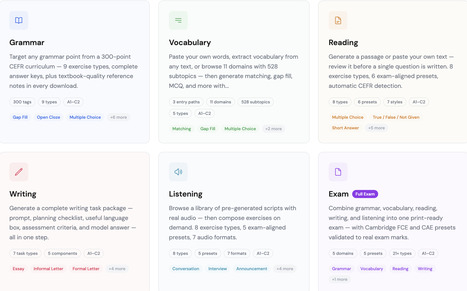
From
teacherforge
Generate ESL and EFL worksheets and exams with AI. Grammar, vocabulary, reading, writing, and listening — 21+ question types, A1 to C2, with answer keys. Free to start. Via Ana Cristina Pratas
Scoop.it!
From
edsurge
The question for educators: How to know when AI supports real learning.
"Information is more easily accessible than ever before. Anyone anywhere can ask an AI tool a question and receive an answer that seems reasonable, at least on the surface. It’s not surprising, then, to see predictions of the demise of traditional schools and colleges." Via EDTECH@UTRGV
EDTECH@UTRGV's curator insight,
June 15, 2:52 PM
"[E]ducation has never been only about access to information. Students need much more to become capable members of society. They need the ability to assess the quality of information, recognize strong work, and connect ideas."
Scoop.it!
Scoop.it!

Blog de la "RIED. Revista Iberoamericana de Educación a Distancia". La Revista Iberoamericana de la Educación Digital. Via LGA
Scoop.it!

Discover why critical thinking often disappears in student writing and how purposeful reading, synthesis, and thesis-driven writing can strengthen academic work. Via EDTECH@UTRGV
EDTECH@UTRGV's curator insight,
June 12, 1:37 PM
"Orally or in discussion postings, students engage complex ideas but struggle to demonstrate comparable reasoning in writing for assignments. The writing describes what authors wrote, more of a regurgitation, rather than effectively synthesizing sources into the context for their writing."
Scoop.it!

"I once had an SVP tell me, “Don’t ever talk to me about a problem unless you have options to solve them.” Fair point. So here’s what actually works.
Real AI governance doesn’t live in a framework. It shows up in how decisions get made, how people work, and more importantly, in what teams no longer have to think about." Via EDTECH@UTRGV
EDTECH@UTRGV's curator insight,
June 12, 1:31 PM
"It doesn't live in a framework. It lives in how decisions get made."
Scoop.it!

Díaz-Noguera, María Dolores, Carlos Hervás-Gómez y Fulgencio Sánchez-Vera (coords.). 2024. Artificial Intelligence and Education. Granada: Editorial Octaedro. https://octaedro.com/libro/artificial-intelligence-and-education/ El libro ofrece una visión amplia y multidisciplinar sobre el impacto de... Via LGA
Scoop.it!
From
uxdesign
Your finger hovering over the “Allow” button.
“Copilot, or Gemini, or ChatGPT with screen recording wants access to:
Via EDTECH@UTRGV
EDTECH@UTRGV's curator insight,
June 10, 1:30 PM
"One click, and it promises to finally understand you. To finish your sentences. To remind you of the name of that actor. To draft emails that sound exactly like you. But as your heartbeat quickens...a question whispers from the back of your mind: Is this freedom…or is this a velvet cage?"
Scoop.it!

While some experts suggest AI integration for teaching and learning, schools still have to figure out how to pay for it. Via EDTECH@UTRGV
EDTECH@UTRGV's curator insight,
June 10, 1:34 PM
"Most conversations about generative artificial intelligence in schools eventually zoom in on using AI in the classroom. Before districts redesign teaching and learning around AI, they may need to answer a more fundamental question: Can schools afford an AI-first future?"
Scoop.it!

From
gesvinromero
🤖📚 ¿Usas IA en tu aula pero no sabes dónde trazar el límite? Este marco te da 4 principios concretos para integrarla sin perder lo más valioso: tu voz docente y la conexión humana con tus estudiantes. Via LGA
Scoop.it!

As AI becomes increasingly abundant and continuously available, institutional governance must evolve accordingly. Via EDTECH@UTRGV
EDTECH@UTRGV's curator insight,
June 8, 12:04 PM
"The challenge is not that institutions are moving too quickly towards AI adoption, but that higher education is approaching AI primarily as a technology implementation problem rather than as a structural transformation of learning, and hence how institutional value is defined and operationalized." |








"The model has four levels: unconscious incompetence, conscious incompetence, conscious competence, and unconscious competence."