 Your new post is loading...
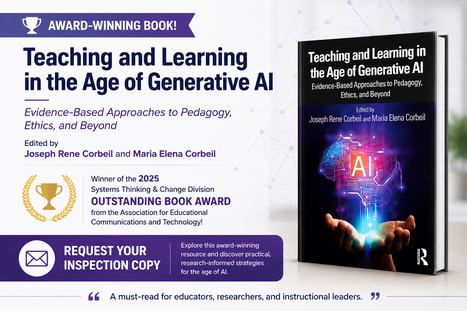
Looking for a Textbook on Generative AI in Education?
Teaching and Learning in the Age of Generative AI: Evidence-Based Approaches to Pedagogy, Ethics, and Beyond Edited by Joseph Rene Corbeil & Maria Elena Corbeil (2025) 🏆 Winner of the 2025 Systems Thinking & Change Division Outstanding Book Award from the Association for Educational Communications and Technology! If you are designing a course that addresses generative AI in education, this award-winning volume provides a research-driven, classroom-ready foundation. Rather than offering hype or fear, this book helps educators:
- Ground AI integration in learning theory and research
- Address academic integrity with thoughtful, practical strategies
- Redesign assessment for an AI-enabled world
- Explore ethics, bias, privacy, and institutional responsibility
- Leverage AI to enhance critical thinking and digital literacy
Bookended by historical and forward-looking analyses of AI in education, the chapters move beyond surface-level discussions to provide evidence-based approaches for real classrooms—K–12, higher education, and professional learning environments.
This text is ideal for:
- Undergraduate and graduate teacher education programs
- Curriculum & Instruction courses
- Educational Technology programs
- Higher education faculty development
- School technology coordinators and talent development professionals
Adopting a GenAI textbook for an upcoming semester? We invite you to request an inspection copy and explore how this resource can support your students in navigating AI with skill, ethics, and informed judgment.
Request your inspection copy today.

|
Scooped by
EDTECH@UTRGV
September 9, 1:06 PM
|
The widespread adoption of AI is changing educator preparation what educators need to know and what they need to be able to do.
|
|
Scooped by
EDTECH@UTRGV
September 9, 1:01 PM
|
"During my time as a User Researcher at Bossa Nova Robotics, I conducted multiple studies in grocery store aisles watching our inventory-assessing robot do its job. My objective was to identify moments when the robot had to pause because of obstructions or human interference. The goal was to find ways for the robot to better navigate the space and indicate what it was doing to nearby humans and, in doing so, optimize its efficiency."
|
|
Scooped by
EDTECH@UTRGV
September 9, 12:57 PM
|
Tools and Trends From Access to Trust: How Online Learning Has Changed Since 2000 August 31, 2026 Tools and Trends Online learning began with one basic promise: Make education available to people who could not come to a campus. Since 2000, online learning has had to do much more than provide access.
|
|
Scooped by
EDTECH@UTRGV
September 8, 11:26 AM
|
CoSN, the professional association for K-12 education technology leaders, has released new guidance to help schools navigate the screen time debate and develop technology policies that protect students while supporting learning.
|
|
Scooped by
EDTECH@UTRGV
September 8, 11:22 AM
|
In an era of abundant digital information, structure is what turns practice into learning evidence and helps teachers and students align.
|
|
Scooped by
EDTECH@UTRGV
September 8, 11:18 AM
|
Workers need just-in-time training that allows them to upskill and reskill quickly to keep pace with disruption and evolving needs.
|
|
Scooped by
EDTECH@UTRGV
September 7, 2:53 PM
|
Anyone who has sat through a curriculum meeting knows that homework is a perpetual battleground.
|
|
Scooped by
EDTECH@UTRGV
September 7, 2:45 PM
|
WGU Labs begins experiments in embedding human connection into AI-first systems, and high-tech systems should take note.
|
|
Scooped by
EDTECH@UTRGV
September 7, 2:37 PM
|
A white paper on why educational preparation is breaking down and what institutions must build beyond 2030.
|
|
Scooped by
EDTECH@UTRGV
September 4, 8:41 AM
|
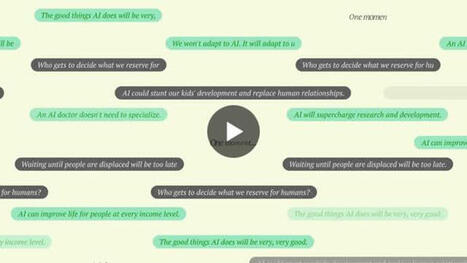
We need a plan to ensure that the good outweighs the bad. The transition to the AI era will be one of the most turbulent times in human history.
|
|
Scooped by
EDTECH@UTRGV
September 4, 8:38 AM
|
A new, cautionary APA report wades into the growing debate around screens, classroom technology, and AI.
|
|
Scooped by
EDTECH@UTRGV
September 4, 8:33 AM
|
How can education truly prepare students for the unpredictability of the working world? Find three ways to encourage students to develop the skills they’ll need
|
|
|
Scooped by
EDTECH@UTRGV
September 9, 1:07 PM
|
This article explores the value of taking human ownership of AI-assisted work to consider whether it is truly ready to use.
|
|
Scooped by
EDTECH@UTRGV
September 9, 1:05 PM
|
A retrieval-augmented generation tool (RAG) helps students move from asking AI for answers to asking it to help them find, examine, and explain evidence
|
|
Scooped by
EDTECH@UTRGV
September 9, 12:59 PM
|
"The cause sits upstream: unread intent, missing oversight, thin context, loose language, unset expectations, no evals, fuzzy outcomes, and the wrong tool for the job. Here’s the AI checklist."
|
|
Scooped by
EDTECH@UTRGV
September 9, 12:55 PM
|
"This report is a call to action. Through five intense months of meetings, research, and outreach across the MIT community, the Ad Hoc Committee on AI Use in Teaching, Learning, and Research Training sought to understand the role of generative AI in the life and educational mission of the Institute and recommend how to navigate its challenges and opportunities. In January 2026, Chancellor Melissa Nobles, Provost Anantha Chandrakasan, and Faculty Chair Roger Levy charged us1 specifically to: - Assess current AI use at MIT.
- Identify innovations in teaching and student assessment.
- Propose an AI use policy."
|
|
Scooped by
EDTECH@UTRGV
September 8, 11:25 AM
|
A brief from Stanford's SCALE initiative examines the existing evidence on using AI in tutoring.
|
|
Scooped by
EDTECH@UTRGV
September 8, 11:20 AM
|
For applicants whose knowledge of AI stops at the name ChatGPT, Nature spoke to academics, employers and early-career researchers to find out what you need to expand your understanding.
|
|
Scooped by
EDTECH@UTRGV
September 8, 11:15 AM
|
To check if paid programs and platforms are producing results, closer attention is needed to what happens after the purchase
|
|
Scooped by
EDTECH@UTRGV
September 7, 2:50 PM
|
Academic leaders can strengthen workforce relevance by creating flexible curricula to respond to change while preserving academic quality and human skills.
|
|
Scooped by
EDTECH@UTRGV
September 7, 2:43 PM
|
When it comes to career readiness, the best prep for an AI-shaped labor market is more practice making decisions when AI is in the room.
|
|
Scooped by
EDTECH@UTRGV
September 7, 2:35 PM
|
After asking four chatbots to rank the 10 jobs that are most at risk of being replaced by AI and taken away from human hands, there was one job they all chose.
|
|
Scooped by
EDTECH@UTRGV
September 4, 8:40 AM
|
"Artificial intelligence chatbots have become the bane of teachers everywhere, but to prepare for the new school year, a group of educators in Charleston, South Carolina, packed into a high school auditorium and talked about inviting AI into the classroom."
|
|
Scooped by
EDTECH@UTRGV
September 4, 8:36 AM
|
Across higher education, conversations among faculty, instructors, and other teaching and learning professionals about generative artificial intelligence (GenAI) often begin with practical questions. How should courses change? What belongs in assessment? How do we as educators discourage inappropriate AI use while preserving academic integrity?
|
|
Scooped by
EDTECH@UTRGV
September 3, 11:05 AM
|
"Just as schools are preparing to open, New York City is putting new limits on technology use. As reported in The New York Times and Chalkbeat, there will be no individual screens before third grade and recommended caps on screen time for grades 3 - 8."
|



























"I don’t ban AI tools, nor do I treat them as a shortcut to avoid. Instead, I try to structure AI into the learning process in a way that makes its strengths and limitations visible to students."