

Discover why critical thinking often disappears in student writing and how purposeful reading, synthesis, and thesis-driven writing can strengthen academic work.


|
Scooped by
EDTECH@UTRGV
onto Educational Technology News June 12, 1:37 PM
|
 Scoop.it!
Discover why critical thinking often disappears in student writing and how purposeful reading, synthesis, and thesis-driven writing can strengthen academic work.

 Your new post is loading...
 Your new post is loading...
Your new post is loading...
Scoop.it!
|
|
|
Scooped by
EDTECH@UTRGV
Today, 12:01 PM
|
Scoop.it!


"As artificial intelligence (AI) reshapes higher education, educators and technologists must rely on ACTUAL intelligence—agency, connection, trust, uniqueness, adaptability, and lifelong learning—to ensure AI enhances, rather than replaces, human judgment, relationships, and learning."
"ACTUAL intelligence...leverages the key human capacities of agency, connection, trust, uniqueness, adaptability, and lifelong learning to guard against becoming overly reliant on AI."
|
|
Scooped by
EDTECH@UTRGV
Today, 11:53 AM
|
Scoop.it!
"In today’s evolving higher education landscape, learner demographics are changing, and more learners want flexible course delivery options [1, 2]. The traditional brick-and-mortar classroom, where learners attend in person on specific days and times, is becoming less appealing. As higher education institutions (HEIs) grapple with the enrolment cliff, HEIs are becoming innovative and even partnering with industries to offer alternative credentials (e.g., massive open online courses (MOOCs), micro-credentials), which are available online and are of shorter duration than the typical 16-week college semester. While the flexibility of online delivery options attracts more learners, they need strong self-regulated learning skills to succeed in online courses."
"Educators can support learners' self-regulation by intentionally designing features into courses that aid learners' goal setting, environmental structuring, task strategies, time management, help-seeking behavior, and self-evaluation."
|
|
Scooped by
EDTECH@UTRGV
Today, 11:45 AM
|
Scoop.it!

"Without clear strategies, AI integration risks widening existing disparities and undermining academic standards. The AI Course Compass: A Seven-Phase Framework for Ethical, Equitable, and Adaptive Course Design (AI Course Compass Framework) addresses the critical gap of higher education’s AI integration through a structured seven-phase model that balances innovation with systemic ethics. While existing frameworks like OLC’s AI Strategy, ETHICAL Principles, and ARCHED offer valuable high-level guidance, they frequently lack phased roadmaps, course-level specificity, model-agnostic adaptability, and integrated ethics assurance."
"A successful AI integration strategy begins with a shared vision and ethical foundation. Leadership, instructional designers, and faculty collaborate to define institutional goals for AI use, align resources, and establish accountability structures."
|
|
Scooped by
EDTECH@UTRGV
June 23, 9:54 AM
|
Scoop.it!

The vast majority of education organizations (98%) expect their AI infrastructure budgets to either increase or hold steady over the next year, according to a recent report from cloud storage provider Wasabi.
"The vast majority of education organizations (98%) expect their AI infrastructure budgets to either increase or hold steady over the next year...Nearly half — 46% — reported planning to increase their AI spending."
|
|
Scooped by
EDTECH@UTRGV
June 23, 9:44 AM
|
Scoop.it!

"A healthy and progressive dialogue about technology, particularly about AI in education, should be based on the best facts available. It isn’t easy to stay current considering how quickly the technology landscape changes. When bad actors come into the mix, it becomes impossible."
"[W]e need to shed the idea that a technology tool flags a student for wrongdoing when its sole purpose is to mark a portion of text for additional attention. Tools do not make decisions. The information they generate should inform a decision, as small bits contributing to the whole."
|
|
Scooped by
EDTECH@UTRGV
June 23, 9:36 AM
|
Scoop.it!

"The technology worked. The training happened. The classrooms changed for about 18 months. Then the grant ended, and so did the innovation. Behind those classrooms, a complex web of scheduling, budgets, and leadership support was always determining whether the innovation would last. This isn’t a story about bad technology, unwilling teachers, or insufficient effort. It’s a story about what happens when systems invest in tools without investing in the conditions that make those tools stick."
"Research on effective professional development finds that short, front-loaded training rarely changes practice; what works is learning that is sustained, collaborative, modeled, coached, and feedback-rich"
|
|
Scooped by
EDTECH@UTRGV
June 22, 6:40 PM
|
Scoop.it!

Higher education often frames recruitment with motivational rhetoric, but adult learners prefer accessibility, certainty, and community over motivation.
"For years, higher education has approached adult learners as though they are standing on the sidelines waiting to be inspired. Marketing campaigns focus on aspiration. Recruitment strategies focus on encouragement...The question is rarely, 'Why should I go back to school?' More often, it is, 'Can I realistically do this?'"
|
|
Scooped by
EDTECH@UTRGV
June 22, 6:32 PM
|
Scoop.it!

In cyber resilience, protect the data layer and build recovery plans around the data and services that keep learning and operations moving.
"[T]he data layer is where schools’ most important information lives and where recovery begins when something goes wrong. It includes the storage, protection, backup, snapshot, and recovery capabilities that keep student records, learning platforms, research data, and administrative systems available and recoverable. If that layer is not protected, schools will struggle to restore operations quickly."
|
|
Scooped by
EDTECH@UTRGV
June 19, 11:32 AM
|
Scoop.it!
"The videos are all over social media, making students an irresistible offer: Go ahead and let A.I. do your homework — with the latest technology, you won’t get caught...
These kinds of tutorials are now pervasive on TikTok and YouTube. They show students how to use tools known as humanizers and autotypers, which make it easier than ever to cheat. The videos — sometimes labeled ads, sometimes not — target college and high school students."
"Big tech companies and small start-ups are using social media to hype new tools that allow students to trick teachers and A.I. detectors."
|
|
Scooped by
EDTECH@UTRGV
June 19, 11:26 AM
|
Scoop.it!

The most powerful belonging practices are built into the weekly routines of teaching, advising, and communication with learners.
"[B]elonging is built through small, consistent practices that reduce uncertainty, increase connection, and help students believe they can persist."
|
|
Scooped by
EDTECH@UTRGV
June 19, 11:20 AM
|
Scoop.it!
"Reading used to come with the guarantee that someone was on the other end. We spent it down, and now you check everything."
"For almost the entire history of written words, you could assume a person was on the other end. You did not have to decide it. The assumption came free, underneath everything, and you spent your attention on what the words said rather than on whether anyone had meant them."
|
|
Scooped by
EDTECH@UTRGV
June 17, 12:36 PM
|
Scoop.it!

More Americans are using chatbots, and some are adopting AI summaries and smart speakers. But views about AI and how fast it’s advancing tilt negative – even for younger adults.
"Americans —including younger adults— are deeply skeptical of AI. More adults predict that AI will have a negative rather than positive impact on them and on society. And majorities think AI is advancing too quickly and will put their personal information at risk."
|
|
Scooped by
EDTECH@UTRGV
Today, 12:04 PM
|
Scoop.it!

"Higher education institutions should stop asking which artificial intelligence (AI) tool to buy and instead develop an integrated "AI for operations" architecture to execute end‑to‑end institutional processes effectively."
"The question many colleges and universities are asking about artificial intelligence (AI) is, 'Which tool should we buy?' That is the wrong question."
|
|
Scooped by
EDTECH@UTRGV
Today, 11:57 AM
|
Scoop.it!

"A recent craze in education that has garnered the attention of students and teachers alike is the ever increasing presence of phone pouches, or more specifically for my school, Yondr pouches, These small, neoprene packs have a firm magnetic seal that can only be released by tapping it against an unlocking base. Their main purpose is quite simple: stop students from accessing their phone during the school day. The rationale is that the less time students spend on their phone, the more time they will spend learning."
"A well-intended policy has unintended consequences."
|
|
Scooped by
EDTECH@UTRGV
Today, 11:48 AM
|
Scoop.it!

Higher ed leaders and employers believe microcredentials sustain student interest and improve workforce readiness for an economy in flux.
"Microcredentials are expected to play a pivotal role as workforce demands shift...About 60% of the global workforce will require reskilling, while 1.2 billion more people are expected to enter the workforce over the next decade."
|
|
Scooped by
EDTECH@UTRGV
June 23, 9:59 AM
|
Scoop.it!

"As policymakers grapple with how artificial intelligence will reshape work, they face the familiar temptation to double down on training. The logic is that, if AI changes the knowledge workers need, then workforce systems should adapt quickly to teach in-demand skills.
However, this framing assumes the main problem is a shortage of skilled workers, when in many high-paying sectors the bigger problem is a shortage of entry-level opportunities."
"The core problem facing policymakers in the AI age is the same: an incentive mismatch. Expanding entry-level opportunities creates enormous social value in the form of higher earnings, stronger families, and a more capable workforce. But for employers, hiring and training new workers remains risky and expensive."
|
|
Scooped by
EDTECH@UTRGV
June 23, 9:53 AM
|
Scoop.it!

AI agents are already in use or pilot at most organizations, but data visibility, governance and precision recovery capabilities have not kept pace, according to Veeam's new Data & AI Trust Gap report.
"Most organizations don't have an AI adoption problem; they have an AI trust problem"
|
|
Scooped by
EDTECH@UTRGV
June 23, 9:38 AM
|
Scoop.it!

"In online learning, 'engagement' is one of the most frequently used words and one of the easiest to flatten into something performative. We say we want engaged students, but too often what we actually build are routines of compliance: post once, reply twice, meet the word count, move on.
That structure may produce activity, but it does not always produce connection, curiosity, or meaningful learning."
"If we want richer online engagement, we need discussion experiences that invite thought rather than routine, and we need reflective feedback practices that help us understand student experience while the course is still unfolding."
|
|
Scooped by
EDTECH@UTRGV
June 22, 6:44 PM
|
Scoop.it!

Wearable AI can help travellers navigate cities, translate menus and fundamentally transform travel. But a weekend in Paris showed me the trade-offs behind the convenience.
"The technology deals with directions, translation, information and recommendations. It reduces issues and increases convenience. But the glasses don't live up to the promise of helping me connect well to the world around me. If anything, they sometimes place another invisible layer between me and the city."
|
|
Scooped by
EDTECH@UTRGV
June 22, 6:35 PM
|
Scoop.it!

This article explores why strong Instructional Design skills matter more than industry experience when hiring Instructional Designers.
"Instructional Designers Are Learning Experts First"
|
|
Scooped by
EDTECH@UTRGV
June 22, 6:29 PM
|
Scoop.it!
"The rise of artificial intelligence (AI) has pushed higher education to a crossroads, and a paradigm shift is required. Universities who expect to lead in this new AI-shaped landscape must reimagine higher education as a hyper-personalized journey for students, enabled by AI, interactive data, predictive analytics, and adaptive technologies from end to end."
"The essence of leadership in the era of AI is to be proactive, not wait for disruption to come our way."
|
|
Scooped by
EDTECH@UTRGV
June 19, 11:30 AM
|
Scoop.it!

Explore two professors' approaches to AI and assignment design, from AI-resistant assessments to AI-integrated learning experiences.
"[A] question has arisen from teachers of every discipline: how do we develop assignments that facilitate learning with AI constantly present? This question does not have a single correct answer. Different instructors have different opinions on the role AI should play in education due to their discipline or personal teaching philosophy."
|
|
Scooped by
EDTECH@UTRGV
June 19, 11:24 AM
|
Scoop.it!
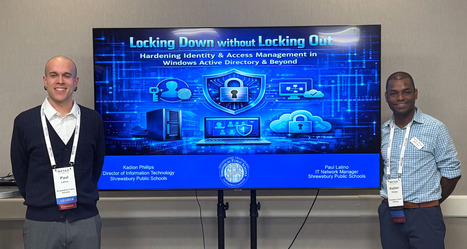
Innovative Leader Award - Director of Information Technology Kadion Phillips discusses implementing AI in a school district as well as how to bolster cybersecurity.
"[T]he skills that we want kids to get with AI is going to be similar to what we did with our portrait of a graduate, such as critical thinking, content mastery, innovation, resilience, collaboration, and even the global citizenship piece.”
|
|
Scooped by
EDTECH@UTRGV
June 19, 11:17 AM
|
Scoop.it!
AI is putting the future of UX designers in jeopardy, unless they are willing to become builders, makers, and system thinkers.
"As AI reshapes product development, design leaders are reassessing what the role of a designer actually means. Responsibilities are converging. The lines between what a designer does and what a PM or a coder owns are blurring. In that blur, the designers who can’t articulate their value beyond their craft will lose strategic relevance."
|
|
Scooped by
EDTECH@UTRGV
June 17, 12:28 PM
|
Scoop.it!

While Gen Z may be advanced at generating quick outputs or using free LLMs for surface-level tasks, they need to develop critical thinking, communication, and analysis skills.
"AI familiarity is not the same as AI literacy: Students may know how to generate quick AI outputs, but still need critical thinking, communication, writing, reading, and analysis skills to evaluate and use those outputs effectively."





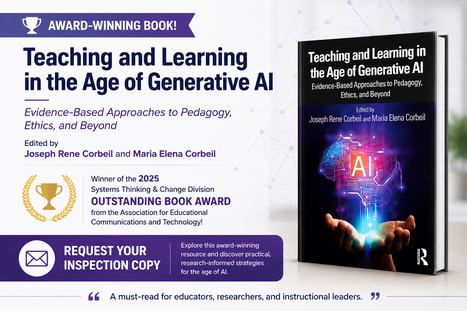




"Orally or in discussion postings, students engage complex ideas but struggle to demonstrate comparable reasoning in writing for assignments. The writing describes what authors wrote, more of a regurgitation, rather than effectively synthesizing sources into the context for their writing."