Your new post is loading...
The OCSB supports students in creating digital identities that positively enhance their lives, community and the world around them.
Via Dr. Tom D'Amico (@TDOttawa)
Virtual escape rooms incorporate riddles, puzzles, math, logic, and literacy skills to create an exciting adventure in education.
Via Dr. Tom D'Amico (@TDOttawa)
Cet article présente la création et l’analyse des effets d’un journal de bord qui reprend les différentes phases d’une séance ARPPEGE (Vacher, 2015, 2022a). Cette innovation pédagogique permet aux étudiant(e)s d’utiliser l’écrit pour construire et développer une pratique réflexive, et ce en partant d’une situation professionnelle vécue qui les interroge. Cet article vise à éclairer les sauts qualitatifs engendrés par l’écriture tout au long du dispositif, témoignant tous d’une analyse multiréfléchie et systémique suscitée par le processus (Vacher, 2015). Les textes produits par les étudiants(e)s sont analysés par une approche de théorisation ancrée. Cette dernière permet de documenter les sauts qualitatifs et ainsi de mieux comprendre les effets du journal de bord sur le développement de la réflexivité chez les étudiants(e)s.
Via Canadian Vocational Association / Association canadienne de la formation professionnelle, juandoming
2022 EDUCAUSE Horizon Report | Teaching and Learning Edition, 2022 Texto completo Este informe perfila las tendencias y las tecnologías y prácticas clave que configuran el futuro de la enseñanza y el aprendizaje, y prevé una serie de escenarios e implicaciones para ese futuro.
Via LGA
As employers recognize that the lack of a four-year college degree doesn't mean a potential worker doesn't have value, the return on investment for university graduates is dropping. Harris Poll found 51% of U.S. adults say costs have impacted their ability to pursue a post-high school education.
Via Edumorfosis, juandoming
Does Your Right Brain Know What Your Left Brain is Doing?
It’s time to bury some myths about creativity.
The notion that the right brain is the source of creativity has become a popular myth extracted from research published in 1969. However, the researchers did not find a brain split for creativity. In fact, they identified both hemispheres as essential for creativity.
Yet, 53 years later, many still accept the “right brain” myth as truth. Human beings love to make complexity seem simple and to make the simple needlessly complex. So, the right-brain myth survives because it’s a simple explanation for a complex and mysterious process. We don’t understand how human beings generate ideas.
Via Chuck Sherwood, Former Senior Associate, TeleDimensions, Inc, juandoming

|
Rescooped by
michel verstrepen
from Into the Driver's Seat
May 15, 2022 3:11 AM
|
After years of coaching and working with teachers, there are two things I consistently encounter that cause imbalance in the classroom and beyond.
First, teachers spend significant time at the front of the room talking. The more time teachers spend at the front of the room transferring information and orchestrating the lesson, the less time they have to work alongside students.
Traditional grading practices rob teachers of the time they need to design dynamic lessons and maintain a healthy work-life balance.
Via Jim Lerman
|
|
Rescooped by
michel verstrepen
from Daily Magazine
May 14, 2022 6:06 AM
|
Contemporary research that looks at self-regulated learning (SRL) as processes of learning events derived from trace data has attracted increasing interest over the past decade. However, limited research has been conducted that looks into the validity of trace-based measurement protocols. In order to fill this gap in the literature, we propose a novel validation approach that combines theory-driven and data-driven perspectives to increase the validity of interpretations of SRL processes extracted from trace-data. The main contribution of this approach consists of three alignments between trace data and think aloud data to improve measurement validity. In addition, we define the match rate between SRL processes extracted from trace data and think aloud as a quantitative indicator together with other three indicators (sensitivity, specificity and trace coverage), to evaluate the “degree” of validity. We tested this validation approach in a laboratory study that involved 44 learners who learned individually about the topic of artificial intelligence in education with the use of a technology-enhanced learning environment for 45 minutes. Following this new validation approach, we achieved an improved match rate between SRL processes extracted from trace-data and think aloud data (training set: 54.24%; testing set: 55.09%) compared to the match rate before applying the validation approach (training set: 38.97%; test set: 34.54%). By considering think aloud data as “reference point”, this improvement of the match rate quantified the extent to which validity can be improved by using our validation approach. In conclusion, the novel validation approach presented in this study used both empirical evidence from think aloud data and rationale from our theoretical framework of SRL, which now, allows testing and improvement of the validity of trace-based SRL measurements.
Via Vladimir Kukharenko, juandoming
|
|
Scooped by
michel verstrepen
May 13, 2022 5:36 PM
|
In a world of messy problems & increasing specialization, no individual can possess all of the knowledge needed to make learning meaningful.
Via Yashy Tohsaku, LGA
|
|
Rescooped by
michel verstrepen
from Connectivism
May 12, 2022 4:44 PM
|
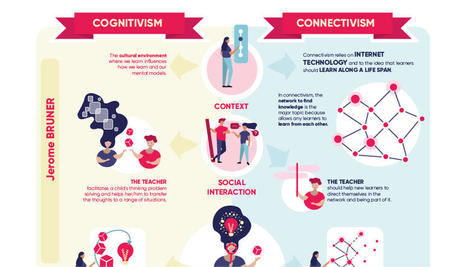
A comparison between Cognitivism and Connectivism and a reflection on the role of learning-community in COVID pandemic.
Via Dr. Susan Bainbridge
Des outils technologiques existent pour limiter et détecter le nombre de mails de phishing arrivant dans votre entreprise. Pourtant, les êtres humains sont la dernière ligne de défense contre ce type d’attaques basées sur l’ingénierie sociale. Vous finirez par être battu en tant qu’employeur ou prestataire de service. Au lieu de tout verrouiller et de ralentir les échanges professionnels, les équipes des cadres dirigeants aux plus humbles employés doivent savoir identifier les mails d’hameçonnage, pour que le pire arrive à l’entraînement et non dans la vie réelle.
Via Intelligence Economique, Investigations Numériques et Veille Informationnelle
|
Blog de la "RIED. Revista Iberoamericana de Educación a Distancia". La Revista Iberoamericana de la Educación Digital.
Via LGA
|
|
Rescooped by
michel verstrepen
from Les outils du Web 2.0
May 16, 2022 6:53 AM
|
Evalisy fournit un outil numérique qui va vous aider à organiser vos jurys, de la collecte des évaluations et notes jusqu'à la synthèse finale par candidat.
Via Fidel NAVAMUEL
La gamificación puede aplicarse en la educación con éxito. Hay ejemplos de gamificación que funcionan y que podrían suponer un cambio en los futuros años.
Via Mariano Fernandez S., juandoming
Practicing microproductivity by breaking large tasks down into smaller, easier-to-complete ones, can save time and help educators and students tackle daunting projects
Via Yashy Tohsaku, John Evans
|
|
Rescooped by
michel verstrepen
from :: The 4th Era ::
May 16, 2022 1:57 AM
|
Launched officially in January 2020, the Education 4.0 Framework proposes eight transformations within learning content and delivery mechanisms in primary and secondary education systems to better prepare the next generation of talent for the future of work and the future of societies. The Framework, codified in Schools of the Future: Defining New Models of Education for the Fourth Industrial Revolution, also showcases examples of schools, school systems and education programmes that are pioneering the way toward Education 4.0 skills and learning experiences. Over the first half of 2020, the workstream developed the Closing the Education Gap playbook—a guide for governments and businesses to set up country-level public-private collaborations to implement the Education 4.0 framework via four key system interventions: teacher empowerment, new skills measurement mechanisms, new education standards, and mainstreaming technology-enhanced education. The workstream is currently exploring the full integration of this work into the Reskilling Revolution’s Country Accelerators. As of August 2020, using a data-driven approach, a list of 15 potential target countries was selected for the implementation of a future Closing the Education Gap country accelerator model. A high-level “Education 4.0 Coalition”—a community of champions in primary and secondary education that includes heads of international organizations, EdTech leaders, experts, education finance leaders and policymakers—was convened in July 2020. The Community strongly supported the implementation of country-level Closing the Education Gap Accelerators. There was also consensus for the community to be convened on a regular basis to align on the post-COVID-19 recovery in education.
Via Edumorfosis, Jim Lerman
|
|
Rescooped by
michel verstrepen
from Art of Hosting
May 15, 2022 4:05 AM
|
|
|
Rescooped by
michel verstrepen
from Art of Hosting
May 15, 2022 4:04 AM
|
LeSS Matters is a community to help people understand how to achieve multi-team, organisational agility using Scrum...
Via F. Thunus
|
|
Rescooped by
michel verstrepen
from Freewares
May 14, 2022 10:38 AM
|
PhotoRoom est une application en ligne qui se compose de 2 outils basés sur l'intelligence artificielle (IA) pour détourer facilement une image ou pour supprimer rapidement des objets, des personnes ou des filigranes sur des photos, le tout gratuitement.
Via Freewares&Tutos
Fresco enables real-time collaboration for teams and brings people together on a shared digital workspace. Whether you’re facilitating a brainstorming session, evaluating possible solutions, or conducting a virtual workshop
Via Nik Peachey
"Creativity is a major source of innovation, growth, adaptability, and psychological resilience, making it a top priority of governments, global corporations, educational institutions, and other organizations that collectively invest hundreds of millions of dollars annually into training. The current foundation of creativity training is the technique known as divergent thinking; yet for decades, concerns have been raised about the adequacy of divergent thinking: it is incongruent with the creative processes of children and most adult creatives, and it has failed to yield expected downstream results in creative production. In this article, we present an alternative approach to creativity training, based in neural processes different from those involved in divergent thinking and drawing upon a previously unused resource for creativity research: narrative theory. We outline a narrative theory of creativity training; illustrate with examples of training and assessment from our ongoing work with the U.S. Department of Defense, Fortune 50 companies, and graduate and professional schools; and explain how the theory can help fill prominent lacunae and gaps in existing creativity research, including the creativity of children, the psychological mechanisms of scientific and technological innovation, and the failure of computer artificial intelligence to replicate human creativity." Jim Lerman's insight: This is a deep, scholarly article that maintains a more effective means to encourage and develop creativity lies in an approach focused on narrative theory as opposed to divergent thinking.
Via Jim Lerman, juandoming
En février 2022, Réseau Canopé a annoncé qu’il devenait totalement dédié à la formation tout au long de la vie des enseignants.
Via CECI Jean-François
le site a été élaboré « dans le cadre d’un partenariat national visant à fédérer les acteurs publics et privés, [et] propose des outils, des conseils et des ressources pratiques pour mieux informer et accompagner les parents afin qu’ils protègent leurs enfants ». Deux grandes entrées s’affichent sur le portail : « Je protège mon enfant dans son usage des écrans » et « Je protège mon enfant de la pornographie ». Le premier axe souligne les risques et les enjeux liés à la précocité de l’exposition aux écrans et à des contenus inappropriés pour la santé mentale et physique des mineurs. Un quizz permet en particulier de cibler les besoins et de faire émerger des outils de contrôle parental, faciles à installer ou à configurer, pour accompagner l’enfant dans ses pratiques, « en filtrant notamment les contenus accessibles et/ou en limitant son temps d'utilisation ». Le second axe vise la lutte contre l’exposition aux contenus pornographiques en ligne et les effets néfastes en matière de développement psychologique et de représentation de la sexualité chez les enfants. Le besoin d’information est également déterminé en fonction des réponses formulées au quizz.
Via CECI Jean-François
|