Your new post is loading...

|
Rescooped by
michel verstrepen
from :: The 4th Era ::
May 21, 2022 1:53 PM
|
In the last week, the Virtual Human Interaction Lab at Stanford University published its recent findings on the measured effects of time on various measures within a collaborative virtual environment, using ENGAGE as its VR platform of choice.
“Overall, the results showed that all measures, including self, social, and spatial presence, enjoyment, entitativity, and realism increased over time. This underscores the critical role that time plays in how people’s experience in VR evolves. Given this, it is possible that once participants adapt to the medium and are no longer uncomfortable with the novelty of the technology, they are able to reap the advantages that VR and CVEs provide and feel more presence and connectedness.”
Via Edumorfosis, Jim Lerman
|
|
Rescooped by
michel verstrepen
from Freewares
May 21, 2022 7:00 AM
|
Phideo est un outil en ligne gratuit et sans inscription qui permet de créer facilement des vidéos à partir de photos. Vous pouvez annoter vos photos avec du texte, des formes et des images, puis enregistrer votre diaporama sous forme de fichier vidéo (MP4 ou Webm) ou de GIF animé. De plus, il est possible d'ajouter une musique de fond.
Via Freewares&Tutos
Ever wonder what will happen when technology takes over the corporate world entirely? Will it destroy the job market leading to higher levels of unemployment or aggravate the economic crises? Or, on the other hand, could it lead to a progressive and healthier society?
Via EDTECH@UTRGV
Blockchain has gotten plenty of attention lately as a new mode of exchange, allowing experimental cryptocurrencies like Bitcoin and the sale of NFTs in ways that leave an unalterable, fully transparent public record that tracks the transfer and ownership of digital things.
Via EDTECH@UTRGV
Virtual reality is a game-changing tool in education. Using VR systems and content, here's how teachers can create truly in-depth learning.
Via David W. Deeds, LGA
|
|
Rescooped by
michel verstrepen
from Daily Magazine
May 19, 2022 10:20 PM
|
|
|
Rescooped by
michel verstrepen
from Daily Magazine
May 19, 2022 10:19 PM
|
Desktop software was formerly the only workable option for designing rapid eLearning courses. Recent technology has seen the development of cloud-based alternatives. In this blog, we discuss the top 4 reasons to choose cloud-based authoring tools for rapid eLearning.
Via CommLab India, juandoming, THE OFFICIAL ANDREASCY
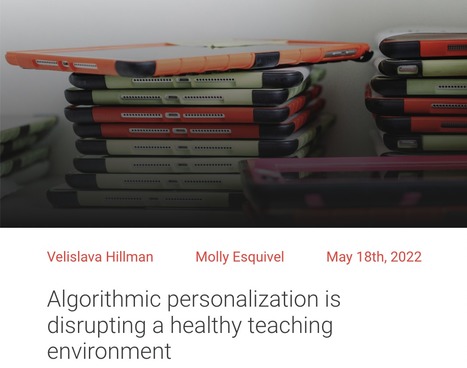
The UK government has given no sign of when it plans to regulate digital technology companies. In contrast, the US Federal Trade Commission will tomorrow consider whether to make changes on the Children’s Online Privacy Protection Act to address the risks emanating from the growing power of digital technology companies, many of which already play substantial roles in children’s lives and schooling. The free rein offered thus far has so far led many businesses to infiltrate education, slowly degrading the teaching profession and spying on children, argue LSE Visiting fellow Dr Velislava Hillman and junior high school teacher and Doctor of Education candidate Molly Esquivel. They take a look here at what they describe as the mess that digitalized classrooms have become, due to the lack of regulation and absence of support if businesses cause harm. "Any teacher would attest to the years of specialized schooling, teaching practice, code of ethics and standards they face to obtain a license to teach; those in higher education also need a high-level degree, published scholarship, postgraduate certificates such as PGCE and more. In contrast, businesses offering education technologies enter the classroom with virtually no demonstration of any licensing or standards.
The teaching profession has now become an ironic joke of sorts. If teachers in their college years once dreamed of inspiring their future students, today these dreamers are facing a different reality: one in which they are required to curate and operate with all kinds of applications and platforms; collect edtech badges of competency (fig1); monitor data; navigate students through yet more edtech products.
Unlicensed and unregulated, without years in college and special teaching credentials, edtech products not only override teachers’ competencies and roles; they now dictate them. Figure 1: Teachers race to collect edtech badges [See original article for image] Wellbeing indexes and Karma Points “Your efforts are being noticed” is how Thrively, an application that monitors students and claims to be used by over 120,000 educators across the US, greets its user. In the UK, Symanto, an AI-based software that analyses texts to infer about the psychological state of an individual, is used for a similar purpose. The Thrively software gathers metrics on attendance, library use, grades, online learning activities and makes inferences about students – how engaged they are or how they feel. Solutionpath, offering support for struggling students, is used in several universities in the UK. ClassDojo claims to be used by 85% of UK primary schools and a global community of over 50 million teachers and families. Classroom management software Impero, offers teachers remote control of children’s devices. The company claims to provide direct access to over 2 million devices in more than 90 countries. Among other things, the software has a ‘wellbeing keyword library index’ which seeks to identify students who may need emotional support. A form of policing: “with ‘who, what, when and why’ information staff members can build a full picture of the capture and intervene early if necessary”.
These products and others adopt the methodology of algorithm-based monitoring and profiling of students’ mental health. Such products steer not only student behavior but that of teachers too. One reviewer says of Impero: “My teachers always watch our screens with this instead of teaching”. When working in Thrively, each interaction with a student earns “Karma Points”. The application lists teacher goals – immediately playing on an educator’s deep-seeded passion to be their best for their students (fig2). Failure to obtain such points becomes internalized as failure in the teaching profession. Thrively’s algorithms could also trigger an all-out battle of who on the teaching staff can earn the most Points. Similarly, ClassDojo offers a ‘mentor’ program to teachers and awards them ‘mentor badges’.
Figure 2: Thrively nudges teachers to engage with it to earn badges and “Karma points”; its tutorial states: “It’s OK to brag when you are elevating humanity.” [See original article for image] The teacher becomes a ‘line operator’ on a conveyor belt run by algorithms. The amassed data triggers algorithmic diagnostics from each application, carving up the curriculum, controlling students and teachers. Inferential software like Thrively throws teachers into rabbit holes by asking them not only to assess students’ personal interests, but their mental state, too. Its Wellbeing Index takes “pulse checks” to tell how students feel as though teachers are incapable of direct connection with their students. In the UK, the lax legislation with regards to biometric data collection, can further lead to advancing technologies’ exploitation of such data into developing mental health prediction and psychometric analytics. Such practices not only increase the risks of harm towards children and students in general; they dehumanize the whole educational process.
Many other technology-infused, surveillance-based applications are thrust into the classroom. Thrively captures data of 12-14-year-olds and suggests career pathways besides how they feel. They share the captured data with third parties such as YouTube Kids, game-based and coding apps – outside vendors that Thrively curates. Impero enables integration with platforms like Clever, used by over 20 million teachers and students, and Microsoft, thus expanding the tech giant’s own reach by millions of individuals. As technology intersects with education, teachers are merely a second thought in curriculum design and leading the classroom. Teachers must remain central in children’s education, not businesses The digitalization of education has swiftly moved towards an algorithmic hegemony which is degrading the teaching profession. Edtech companies are judging how students learn, how teachers work – and how they both feel. Public-private partnerships are giving experimental software with arbitrary algorithms warrantless titles of “school official” to untested beta programme, undermining teachers. Ironically, teachers still carry the responsibility for what happens in class.
Parents should ask what software is used to judge how their children feel or do in class and why. At universities, students should enquire what inferences are made about their work or their mental health that emerges from algorithms. Alas, this means heaping yet more responsibility on individuals – parents, children, students, teachers – to fend for themselves. Therefore, at least two things must also happen. First, edtech products and companies must be licensed to operate, the way banks, hospitals or teachers are. And second, educational institutions should consider transparency about how mental health or academic profiling in general is assessed. If and when software analytics play a part, educators (through enquiry) as well as policymakers (through law) should insist on transparency and be critical about the data points collected and the algorithms that process them.
This article represents the views of the author and not the position of the Media@LSE blog, nor of the London School of Economics and Political Science. For original post, please visit: https://blogs.lse.ac.uk/medialse/2022/05/18/algorithmic-personalization-is-disrupting-a-healthy-teaching-environment/
Via Roxana Marachi, PhD
The Federal Trade Commission is planning to scrutinize educational technology in its enforcement of children’s online privacy rules. By Andrea Vittorio
"The Federal Trade Commission is planning to scrutinize educational technology in its enforcement of children’s online privacy rules. The commission is slated to vote at a May 19 meeting on a policy statement related to how the Children’s Online Privacy Protection Act applies to edtech tools, according to an agenda issued Thursday. The law, known as COPPA, gives parents control over what information online platforms can collect about their kids. Parents concerned about data that digital learning tools collect from children have called for stronger oversight of technology increasingly used in schools.
The FTC’s policy statement “makes clear that parents and schools must not be required to sign up for surveillance as a condition of access to tools needed to learn,” the meeting notice said.
It’s the first agency meeting since George University law professor Alvaro Bedoya was confirmed as a member of the five-seat commission, giving Chair Lina Khan a Democratic majority needed to pursue policy goals. Bedoya has said he wants to strengthen protections for children’s digital data.
Companies that violate COPPA can face fines from the FTC. Past enforcement actions under the law have been brought against companies including TikTok and Google’s YouTube.
Alphabet Inc.‘s Google has come under legal scrutiny for collecting data on users of its educational tools and relying on schools to give consent for data collection on parents’ behalf.
New Mexico’s attorney general recently settled a lawsuit against Google that alleged COPPA violations. Since the suit was filed in 2020, Google has launched new features to protect children’s data.
Via Roxana Marachi, PhD
EdTech is here to provide smarter options with a wider reach, using technology and integrating innovative solutions, to the existing education system, and so enhancing the pedagogy and learning process. How can we be sure we are utilizing it fully to be more productive and for better learning experiences?
Via EDTECH@UTRGV, juandoming
Do you need to assess knowledge of people related to your business, agency, school or university?
Do you need to provide proof of certification?
Do you need to track and reward attendance for an event?
Via Nik Peachey
La palabra que sale en el nuevo currículo que nace a partir de la LOMLOE: SITUACIONES DE APRENDIZAJE, no eres profe si no la has escuchado…
Via Angel Acción Lamas, LGA
|
|
|
Rescooped by
michel verstrepen
from Veille Réseaux sociaux
May 21, 2022 1:53 PM
|
Get the ultimate workspace for creative people that combines the best from note-taking apps, text editors and whiteboards. Start now!
Via Nik Peachey, André Gentit ✔
|
|
Rescooped by
michel verstrepen
from Art of Hosting
May 21, 2022 1:40 AM
|
Statistics show that if you make a one percent improvement today, you'll be 37 times more improved by 2023...
Via F. Thunus
Are you looking to harness the power of microlearning videos for your employee training program? Here are the top 7 ways to incorporate microlearning videos with your corporate training program.
Via EDTECH@UTRGV
Juan Domingo Farnós Como decimos: Los aprendices no solo deben intervenir en la creación de cualquier escenario de aprendizaje que ellos necesiten, quieran (controlar todo el proceso, hasta su valoración-evaluación- del proceso, elementos,…… si no en actividades de aprendizaje constructivistas que ayudarán a crear y dar un sentido de comunidad necesaria para la participación del…
Via juandoming
|
|
Rescooped by
michel verstrepen
from EduTek
May 20, 2022 5:35 AM
|
"AI tools are available today that can write compelling university level essays. Taking an example of a sample essay produced by the GPT-3 transformer, Mike Sharples discusses the implications of this…"
Via Leona Ungerer, Kumuda Gururao
|
|
Rescooped by
michel verstrepen
from Daily Magazine
May 19, 2022 10:20 PM
|
Content curation is nothing new and has always been a coveted skill. It has been this way for hundreds of years — think of art galleries, museums, or newspapers.
Educators, too, have always been curators— bringing together the most valuable materials to help their learners learn. However, in the past, this might have been limited to books, posters, concrete materials, guest speakers, etc. However, as of now, we are in a world of information overload.
So, to help you hone your digital content curation skills, we decided to list some tips.
Via EDTECH@UTRGV, THE OFFICIAL ANDREASCY
EdTech is here to provide smarter options with a wider reach, using technology and integrating innovative solutions, to the existing education system, and so enhancing the pedagogy and learning process. How can we be sure we are utilizing it fully to be more productive and for better learning experiences?
Via EDTECH@UTRGV, LGA
|
|
Rescooped by
michel verstrepen
from Into the Driver's Seat
May 18, 2022 2:11 AM
|
This page contains tutorials for using Google tools. The tutorials that I've created you are welcome to use in your own blog, website, or professional development session. Before using the tutorials created by others, please contact their creators.
Via Jim Lerman
|
|
Rescooped by
michel verstrepen
from Fab-Lab
May 17, 2022 2:07 PM
|
La réflexion sur l’apprentissage par les tiers-lieux s’inscrit dans un contexte de montée des incertitudes, d’augmentation de la complexité et de transformation des modes de vie. L’article explore de manière interdisciplinaire la notion de tiers-lieux en s’interrogeant sur les configurations apprenantes qui peuvent y prendre forme.
Via Laurence
Organizations seeking to develop engaging rapid eLearning solutions while also not overloading their learners have turned to microlearning. This article looks at the importance of microlearning and its top 5 best practices.
Via CommLab India, juandoming
|
|
Rescooped by
michel verstrepen
from Daily Magazine
May 17, 2022 5:31 AM
|
Certain practical strategies which teachers, educationalists and school social workers can adapt for a successful interface between evaluation, education and technology in remote student assessment.
Via EdTechReview.in, THE OFFICIAL ANDREASCY
|