
AI tools can undercut learning, true, but the real question is why would anyone choose to use them this way? We need to examine the motivating factors that drive people to want to take short cuts.
Via EDTECH@UTRGV
Get Started for FREE
Sign up with Facebook Sign up with X
I don't have a Facebook or a X account


|
Rescooped by
Dennis Swender
from Educational Technology News
onto Educational Pedagogy March 20, 2025 12:38 PM
|
 Scoop.it!
AI tools can undercut learning, true, but the real question is why would anyone choose to use them this way? We need to examine the motivating factors that drive people to want to take short cuts.

 Your new post is loading...
 Your new post is loading...
Your new post is loading...
Scoop.it!

From
www

First, it was no phones in schools. Now, amid the debate around edtech, schools are looking to go screen free. Via EDTECH@UTRGV

EDTECH@UTRGV's curator insight,
March 10, 2:09 PM
"Some legislators and advocates are pushing to roll back the reliance on devices, particularly at a younger level when children are more susceptible to distractions." 
Marco Bertolini's curator insight,
March 11, 4:58 AM
Will school forbid screens like they banned smartphones? Some movements think so.
Scoop.it!

Asssessment in education is now enabled by AI to become low-stakes and continuous, applying proven cognitive science principles. Via EDTECH@UTRGV
EDTECH@UTRGV's curator insight,
February 17, 11:15 AM
"What was once a final checkpoint is becoming a continuous learning engine, as AI enables education platforms to apply proven cognitive science principles–retrieval, spacing, and formative feedback–at scale."
Scoop.it!

This has been designed to be used as a kind of emotional journal, so you can click on the one you are feeling and write a sentence or two about it and why you are feeling that way. Via Nik Peachey, Yashy Tohsaku
Scoop.it!
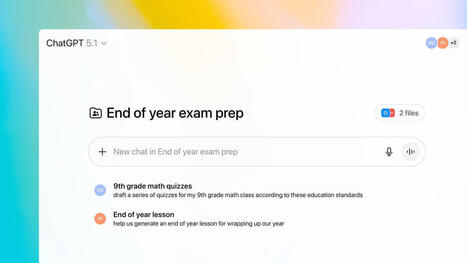
The service is customized for teachers' needs and includes added security and privacy, a collaborative workspace, and more. Via EDTECH@UTRGV
EDTECH@UTRGV's curator insight,
November 20, 2025 10:30 AM
"Educators can now try ChatGPT for Teachers, a version of ChatGPT specifically designed to meet the needs of teachers, which OpenAI launched on Wednesday. The biggest differences between it and the original ChatGPT are the added education-grade security and compliance measures, admin controls, and the ability to collaborate with other educators."
Scoop.it!
"This preregistered study tested whether explaining and drawing activities are most effective when they require learners to translate across verbal and visual representations—what we refer to as the translation hypothesis." Ref: Fiorella, L., Capobianco, A., & Jaeger, A. J. (2025). Benefits and boundaries of learner-generated explanations and drawings. Journal of Educational Psychology. Advance online publication. https://doi.org/10.1037/edu0000995
Scoop.it!

"Employers and societies demand graduates who can evaluate information and make sound judgments ..." Via Leona Ungerer, Nik Peachey

Nik Peachey's curator insight,
October 6, 2025 5:03 AM
This is why I published my book - Developing Critical Thinking Skills With AI https://payhip.com/b/NqAto
Scoop.it!
Scoop.it!
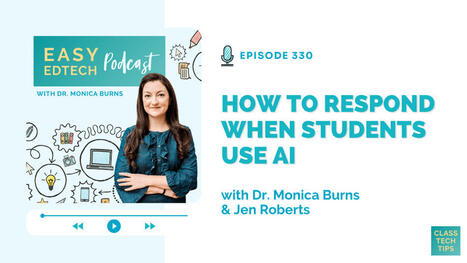
Learn what to do when students use AI! Jen Roberts shares quick tips to spark curiosity and respond with confidence in your classroom.
Via Yashy Tohsaku
Scoop.it!

Discover how starting class with paradoxes—not content—ignites curiosity, deepens learning, and transforms classroom engagement. Via Ana Cristina Pratas

Dennis Swender's comment,
August 9, 2025 1:15 PM
Using real paradoxes to undo the hierarchy of certainty. Thanks for "The Art of Change" reference..
Scoop.it!

Nabila bruno's curator insight,
April 26, 2023 2:20 AM
acquista subutex online acquista subutex online
Scoop.it!

The 2025 EDUCAUSE Horizon Report profiles key trends and emerging technologies and practices shaping the future of teaching and learning, and envision Via Peter Mellow
Scoop.it!

Our mainstream education systems are obsessed with measurement, but they measure the wrong things. Schools track test scores, attendance,… Via EDTECH@UTRGV
EDTECH@UTRGV's curator insight,
March 11, 2025 12:23 PM
The big takeaway: Education should prioritize meaningful learning over high-stakes testing, which fosters anxiety, stifles critical thinking, and undermines true innovation.
Scoop.it!
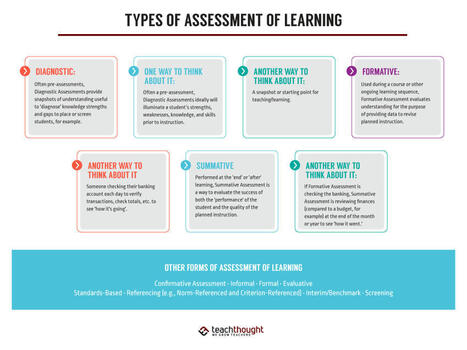
From formative and summative assessment to criterion-referenced and benchmark assessment, each type of assessment has a unique function.
Via Yashy Tohsaku
|
Scoop.it!

Listen The promise of artificial intelligence in higher education isn't to replace human work but to create space for the human interaction students value most. Cue the irony: Students love and actively use artificial intelligence (AI), but they still want humans in charge. Via EDTECH@UTRGV
EDTECH@UTRGV's curator insight,
February 16, 1:24 PM
"Cue the irony: Students love and actively use artificial intelligence (AI), but they still want humans in charge."
Scoop.it!

Time-to-competency is an operationally aligned metric by which to guage the success of an eLearning course. Via EDTECH@UTRGV
EDTECH@UTRGV's curator insight,
January 30, 2:19 PM
"Although many metrics provide some superficial answers, they have not addressed the most significant business-related question: 'How quickly can learners carry out their tasks?' This is where time-to-competency or TTC adds significant value."
Scoop.it!

Have you ever wished for a personalized teaching assistant to help with your workload? Transform your teaching with these custom GPTs! Explore this and more at TCEA TechNotes Blog, your go-to source for educational technology and teaching innovation.
Via Yashy Tohsaku
Scoop.it!

Discover how grading for growth and competency-based assessment can shift education from point-chasing to meaningful learning, empowering students to focus on mastery, reflection, and continuous improvement. Via Ana Cristina Pratas
Scoop.it!
" "University students (N = 208) were trained on argumentation strategies and studied a dual-position argumentative text on a controversial topic using one of three learning methods: notetaking, correct teaching, or misteaching."
Scoop.it!

Learn how to build a supportive, engaging classroom community where students feel confident, connected, and excited to learn together. Via Nik Peachey
Scoop.it!

The problem is not AI or technology; it’s that educators and systems continue prioritizing finished products over messy learning processes. Via EDTECH@UTRGV
EDTECH@UTRGV's curator insight,
August 26, 2025 11:48 AM
"[A]s long as education rewards predetermined answers over curiosity, students will find shortcuts."
Scoop.it!

A flood of AI-generated content It’s a fact that AI is capable of producing convincing and often useful text and other content. Yes, there are concerns about the quality, accuracy and even the environmental impact of that content, but there’s no doubt AI can produce it and that it is already widespread. It is legitimate to ask now whether any piece of content was authored Via Ana Cristina Pratas
Scoop.it!

Learn 5 practical steps to update college assignments for the AI age—boosting critical thinking, authentic learning, and academic integrity. Via Ana Cristina Pratas
Scoop.it!

Emerging from a rich tapestry of educational theory, practical advice, and personal narrative, Joy-Centered Pedagogy in Higher Education introduces joy as a Via Ana Cristina Pratas
Scoop.it!
AI tools can undercut learning, true, but the real question is why would anyone choose to use them this way? We need to examine the motivating factors that drive people to want to take short cuts. Via EDTECH@UTRGV
EDTECH@UTRGV's curator insight,
March 7, 2025 3:35 PM
While many AI tools enhance learning by supporting thinking and feedback, some overlook the cognitive processes essential for deep understanding.
Scoop.it!
From
phys
"A study by Michael Gerlich at SBS Swiss Business School has found that increased reliance on artificial intelligence (AI) tools is linked to diminished critical thinking abilities. It points to cognitive offloading as a primary driver of the decline." Via EDTECH@UTRGV
EDTECH@UTRGV's curator insight,
March 17, 2025 12:16 PM
"Statistical analyses demonstrated a significant negative correlation between AI tool usage and critical thinking scores (r = -0.68, p < 0.001). Frequent AI users exhibited diminished ability to critically evaluate information and engage in reflective problem-solving." |




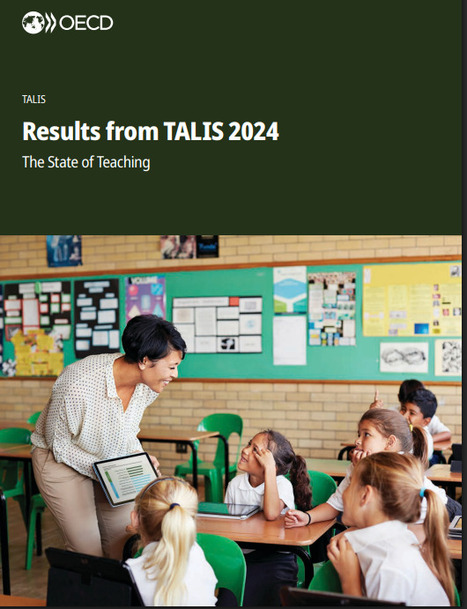





While many AI tools enhance learning by supporting thinking and feedback, some overlook the cognitive processes essential for deep understanding.