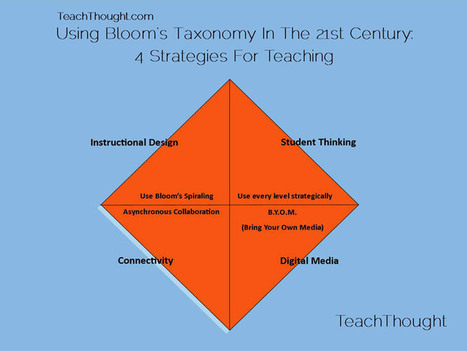
What is the purpose of K-12 schooling? Think for a moment before coming up with an answer. Consider what you believe truly matters. Is it preparation for college? Preparation for a career? Support ...

 Your new post is loading...
 Your new post is loading...
Your new post is loading...
 Scoop.it!
What is the purpose of K-12 schooling? Think for a moment before coming up with an answer. Consider what you believe truly matters. Is it preparation for college? Preparation for a career? Support ... 
No comment yet.
Sign up to comment
Scoop.it!
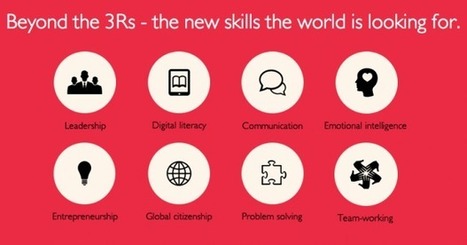
"So what are the things that are becoming just as important as the ever-traditional ‘Reading, Writing, and Math’? Take a look below. Do you already incorporate these ideas into all of your classes? Which do you find hardest?" Via EDTECH@UTRGV

Kirsten Wilson's curator insight,
July 30, 2014 12:04 AM
Great infographic that truly shares what must be taught for Students in the 21st Century to be "Future Ready."
Scoop.it!

“We can’t turn back,” Wolf said. “We should be simultaneously reading to children from books, giving them print, helping them learn this slower mode, and at the same time steadily increasing their immersion into the technological, digital age. It’s both. We have to ask the question: What do we want to preserve?” Via Nik Peachey

Eric de Beauvoir's curator insight,
April 11, 2014 2:34 AM
Humans seem to be developing digital brains with new circuits for skimming through the torrent of information online.
Scoop.it!
In this talk, Sugata Mitra will take us through the origins of schooling as we know it, to the dematerialisation of institutions as we know them. Thirteen years of experiments in children's education takes us through a series of startling results – children can self-organise their own learning, they can achieve educational objectives on their own, they can read by themselves. Finally, the most startling of them all: groups of children with access to the internet can learn anything by themselves. From the slums of India, to the villages of India and Cambodia, to poor schools in Chile, Argentina, Uruguay, the USA and Italy, to the schools of Gateshead and the rich international schools of Washington and Hong Kong, Sugata's experimental results show a strange new future for learning. Via Nik Peachey

Leonardo Alves's curator insight,
June 6, 2014 7:17 PM
Um novo e estranho futuro da aprendizagem. Crianças que aprendem por si mesmo, com recurso a Internet.
Scoop.it!
A PERIODIC TABLE OF INSTRUCTIONAL DESIGN: A unique, graphical presentation of Instructional Design Concepts in a concise and structured manner. We hope this is useful for the Instructional Design and Elearning Community.
Scoop.it!

Victoria Marín's curator insight,
December 9, 2013 5:30 AM
I would like to highlight the following from this article:
Let’s take the focus off the tool; Instead, let’s focus on: the pedagogy behind the tool and use it because it addresses our students’ cognitive needs, not because it is available or exciting. developing critical thinkers with the ability to find, reflect on, curate and synthesise information. developing lifelong learners who will be able to create and use their Personal Learning Networks to self-educate and grow. educating digital citizens, that is, responsible members of an increasingly global and interconnected world who know their rights and responsibilities; people who can make informed decisions about the content they create or share and its impact on themselves and on the other members of a digital community. 
Pamela Perry King's curator insight,
December 9, 2013 10:39 AM
So true, so many tools so little time. We must remember our first objective is to be a teacher. 
Sandrine Meldener's curator insight,
December 10, 2013 3:46 PM
Soyons centrés sur la pédagogie et non sur la technique.
Scoop.it!

Do multiple-choice tests get a bad portrayal? Are they actually ineffective or are they something ripe for innovation? Socrative's Natalie Bartlett weighs in.
Scoop.it!
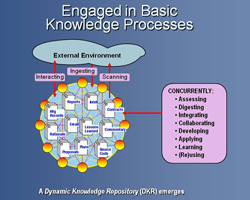
"In Doug Engelbart's words, Collective IQ is a measure of how well people can work on important problems and opportunities collectively – how quickly and intelligently they can anticipate or respond to a situation, leveraging their collective perception, memory, insight, planning, reasoning, foresight, and experience into applicable knowledge. Collective IQ is ultimately a measure of effectiveness. It's also a measure of how effective they are at tackling the complex, urgent problem of how to raise their Collective IQ to the highest potential, so they will be that much more effective at solving complex, urgent problems. As the rate and scale of change around the world increases exponentially, so must our collective ability to dramatically increase our Collective IQ to stay ahead of the curve and thrive." Via Howard Rheingold

Muriel Flanagan's curator insight,
July 23, 2013 8:48 AM
Engelbart's Collective IQ should resonate with all of us who are interdependant in our workflows - and that means all of us. Individuals need to be able to work as effectively as possible with others, as that allows for leveraging the collective intelligence. As important as individualism is, one cannot underscore the power and importance of collaborating to the most appropriate conclusion in an increasingly fast-paced world. 
Marilyn Korhonen's curator insight,
July 23, 2013 9:42 AM
Interesting concept. This is definitely relevant to collaborative research.

Jan Schwartz's curator insight,
July 23, 2013 10:40 AM
Not necessary about technology, but certainly about education. Thanks to Howard Reingold for the scoop.
Scoop.it!
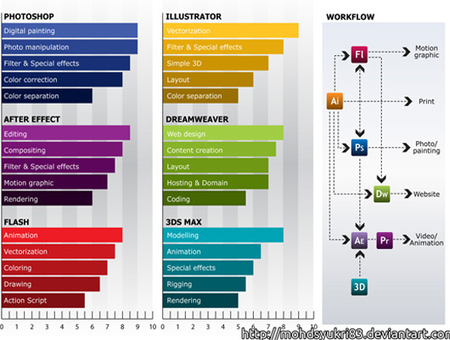
Infographics have become quite popular nowadays since they help people find the right path in the chaos of the crowded online world. So, it is understandable why designers appreciate this trend so much. However, it's always useful to learn a few tips and pieces of advice. In this infographic and related article, you will get more details about design, typography, content, color and more... Via Lauren Moss
Scoop.it!
In the Networked Society, connectivity will be the starting point for new ways of innovating, collaborating and socializing. INSPIRATIONAL VIDEO. Via Dr. Susan Bainbridge
Scoop.it!
Education setbacks
Scoop.it!

PowerPoint is a powerful presentation tool that has stood the test of time. There appeared several other presentation tools with more or less varying functionalities and some of them are even web...
|
Scoop.it!
http://www.ted.com In our louder and louder world, says sound expert Julian Treasure, "We are losing our listening." In this short, fascinating talk, Treasur...
Scoop.it!
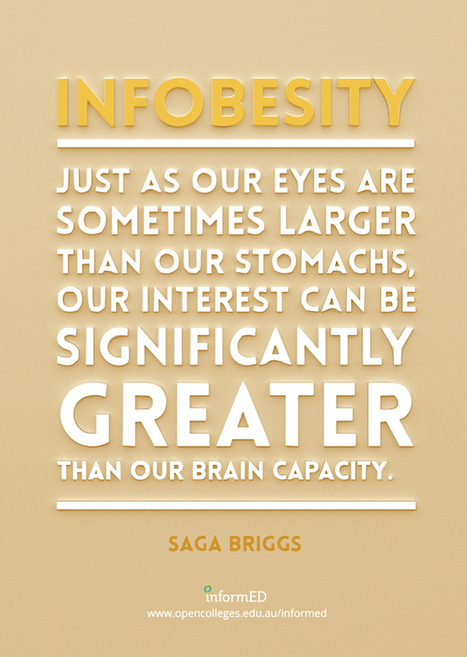
Researchers tend to agree that it’s not the volume of information that is the problem; it’s our inability to organize and process it all without experiencing “information overload, or what neuroscientists like to call “cognitive overload. In recent years, technology strategists have even compared information overload to physical obesity, dubbing it “infobesity. Just as our eyes are sometimes larger than our stomachs, our interest can be significantly greater than our brain capacity. Via Nik Peachey

Nik Peachey's curator insight,
April 18, 2014 4:29 AM
Some great tips towards the end for information management and how to help students with this.
Scoop.it!

In our emerging digital world, a new medium of exchange has developed: online engagement, especially via social media. Effectively engaging online requires a myriad of skills that we strive to foster in school – effective written communication, brevity and civility. These components are often highlighted in Digital Citizenship programs, but in tradition-bound K12 education, we often deride social media as trite or ineffective. Via Nik Peachey

LibrarianLand's curator insight,
April 7, 2014 2:53 PM
Many students still do not understand the limitations of finding information on the free web. Google is about the extent of it and if it isn't found in the first few results, it does not exist or is too hard to find (or worse still, what is found must be "it.").
From article: "We need to ensure that they know how to evaluate a website, a blog post, a tweet, a Facebook entry. These evaluative skills transfer cross curricularly and prepare students for the broader world of online communication."
Scoop.it!

Most parents prefer that their children pick up a book rather than a game controller. But for kids with dyslexia, action video games may be just what the doctor ordered. Via Josué Cardona

Brian Romero Smith's curator insight,
March 1, 2014 11:30 AM
I have noticed that many of the Dyslexia students on our campus are more of strategic gamers than most other students. I think I will consider more console options in the classroom. Their attention to detail in some games are phenomenal.
Scoop.it!

The Robert Marzano's 9 Effective Instructional Strategies Infographic summarizes the 9 instructional strategies to improve students' learning.

ozziegontang's curator insight,
February 21, 2014 3:50 PM
For those that are lifelong learners and in the learning mode as opposed to the knowing mode. Let me count the ways to get a message across no matter what the age of the student is. 
Rocio Watkins's curator insight,
February 22, 2014 10:34 PM
Marzano's famous "Nine" continue to be the topic of many professional development agendas, and continue to deliver research-based and improved student outcomes. A "must-know" for the teaching vocation.
Scoop.it!

Jim Lerman's insight: Davis is one of my favorite go-to people in ed tech. She always shares great resources and offers tons of creative and thoughtful ideas to not just integrate tech with ed, but to improve learning across the board.
Davis offers a descriptive paragraph for each of the top 10, highlighting what appeals to her about each one. Click on the headline or the image above to go to the article's webpage. Links to all blog posts are located there.
Titles of the blog posts:
1. 6 Scaffolding Strategies to Use with Your Students 2. Teach with Your iPhone: Apps to Use in the Classroom 3. Doing it Differently: Tips for Teaching Vocabulary 4. Say What? 5 Ways to Get Students to Listen 5. Kids Speak Out on Student Engagement 6. 20 Ideas for Engaging Projects 7. 8 Tips and Tricks to Redesign Your Classroom 8. Top 5 iPad Apps for Teaching Across All Content Areas 9. 5 Quick Classroom Management Tips for Novice Teachers 10. Bell Ringer Exercises Via Jim Lerman
Scoop.it!

Bloom's Taxonomy and digital tools creates an innovative learning environment where students are engaged in their assignments.
Scoop.it!

From
ieet

Virtually all talk of cognitive enhancement focuses exclusively on the enhancement of individual intelligence. But what about enhancing group intelligence? Via Howard Rheingold

Howard Rheingold's curator insight,
May 30, 2013 9:14 PM
The author adds some provocative insights to reports of the early work on the collective intelligence of groups. In particular, if social sensivitiy among at least some of the group members can be individually augmented, then the collective intelligence of the group might thereby also be augmented. h/t Ted Newcomb 
Lia Goren's curator insight,
June 1, 2013 4:13 AM
Inteligencia del grupo, mejora y mentes amplidas (si hay mucho error de traducción, acepto el aviso). La investigación a la que se refiere el post contradice la concepción intuitiva de que la inteligencia de las personas, cuando trabajan colaborativamente en un grupo, equivale a la adición del IQ de cada integrante del grupo. No es así. Fenómenos interesantes suceden cuando trabajamos en grupo.
Lia Goren's curator insight,
June 1, 2013 4:15 AM
Inteligencia del grupo, mejora y mentes amplidas (si hay mucho error de traducción, acepto el aviso). La investigación a la que se refiere el post contradice la concepción intuitiva de que la inteligencia de las personas, cuando trabajan colaborativamente en un grupo, equivale a la adición del IQ de cada integrante del grupo. No es así. Fenómenos interesantes suceden cuando trabajamos en grupo.
Scoop.it!

"Top performers in any field have one common characteristic: they are always trying to get better. If given a box to check on whether they are “finished products” or “works in progress,” they would check the latter. Carol Dweck’s research would refer to this difference as a fixed and growth mindset.
These top performers accept and embrace performing before an audience because most of their real work is not done in the spotlight; it is done in practice and rehearsal. These top performers are able make sure they are ready and prepared before they step into the spotlight of a performance or event. They are “works in progress” who at a given time, perform publicly as 'finished products.'" Via EDTECH@UTRGV
Scoop.it!
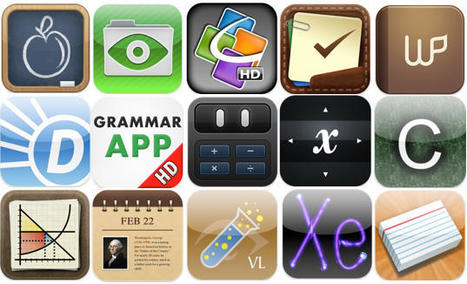
Katie and I can't cover the entire education app industry by ourselves. Luckily, there are dozens of other sites specifically devoted to education app reviews for teachers and students. Via Ana Cristina Pratas, Pascual Pérez-Paredes

Nuno Magalhães Ribeiro's curator insight,
July 17, 2013 2:44 PM
Uma revisão muito interessante de um conjunto de apps especialmente concebidas para a organização de professores e estudantes.
Scoop.it!

“@Larryferlazzo: Great Student Hand-Out On Learning & The Brain http://t.co/rJQdG52zMM #edchat #esl
|