 Your new post is loading...
Looking for a Textbook on Generative AI in Education?
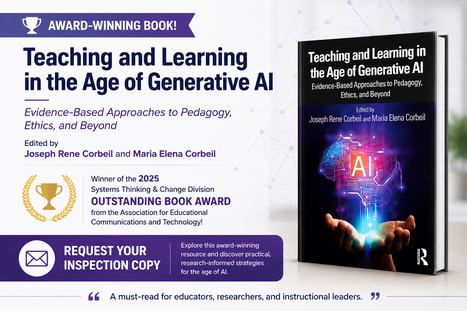
Teaching and Learning in the Age of Generative AI: Evidence-Based Approaches to Pedagogy, Ethics, and Beyond Edited by Joseph Rene Corbeil & Maria Elena Corbeil (2025) 🏆 Winner of the 2025 Systems Thinking & Change Division Outstanding Book Award from the Association for Educational Communications and Technology! If you are designing a course that addresses generative AI in education, this award-winning volume provides a research-driven, classroom-ready foundation. Rather than offering hype or fear, this book helps educators:
- Ground AI integration in learning theory and research
- Address academic integrity with thoughtful, practical strategies
- Redesign assessment for an AI-enabled world
- Explore ethics, bias, privacy, and institutional responsibility
- Leverage AI to enhance critical thinking and digital literacy
Bookended by historical and forward-looking analyses of AI in education, the chapters move beyond surface-level discussions to provide evidence-based approaches for real classrooms—K–12, higher education, and professional learning environments.
This text is ideal for:
- Undergraduate and graduate teacher education programs
- Curriculum & Instruction courses
- Educational Technology programs
- Higher education faculty development
- School technology coordinators and talent development professionals
Adopting a GenAI textbook for an upcoming semester? We invite you to request an inspection copy and explore how this resource can support your students in navigating AI with skill, ethics, and informed judgment.
Request your inspection copy today.

|
Scooped by
EDTECH@UTRGV
September 30, 1:22 PM
|
Explore alternative grading strategies that support student learning, reduce anxiety, foster growth, and better prepare students for life beyond school.
|
|
Scooped by
EDTECH@UTRGV
September 30, 1:16 PM
|
"For decades, digital products competed for our attention. The web put information everywhere, social networks turned it into a constant stream, and smartphones made it always accessible, making attention the scarce resource. Entire industries were built around capturing it: feeds, notifications, recommendations, autoplay. The basic logic was simple. If information is everywhere but attention is scarce, the product that wins is the product that gets our attention."
|
|
Scooped by
EDTECH@UTRGV
September 29, 9:54 AM
|
AI is making instructional designers think harder, iterate faster, and build the adaptive learning they only used to imagine.
|
|
Scooped by
EDTECH@UTRGV
September 29, 9:49 AM
|
AI can recommend the decision, and while it may increasingly execute the decision, leaders still own the outcome.
|
|
Scooped by
EDTECH@UTRGV
September 29, 9:44 AM
|
Social learning online encourages participation, knowledge sharing, and continuous development as well as effective knoweldge transfer
|
|
Scooped by
EDTECH@UTRGV
September 29, 9:40 AM
|
"One after another, the people building the most powerful AI in the world have asked to be regulated. Dario Amodei, who runs Anthropic, published a 3,800-word essay calling for the industry to slow down and submit to outside oversight. Sam Altman of OpenAI agreed within the day. So did Elon Musk. So did Demis Hassabis, who runs Google DeepMind. Kevin Roose put it bluntly, “The platforms should be absolutely begging Congress to regulate them, because the alternative is they get sued into oblivion by a bunch of law firms.” Congress, in response, said no."
|
|
Scooped by
EDTECH@UTRGV
September 28, 11:42 AM
|
Corporate training rarely teaches AI judgment, yet that is the skills gap the WEF's 2025 report is actually describing.
|
|
Scooped by
EDTECH@UTRGV
September 28, 11:37 AM
|
Higher education must defend the meaning of learning--and ensure that whatever intelligence AI acquires does not come at the cost of our own.
|
|
Scooped by
EDTECH@UTRGV
September 28, 11:32 AM
|
Learn how to integrate AI into teaching while preserving deep learning, authentic assessment, social connection, equity, and the pedagogical principles that support student learning.
|
|
Scooped by
EDTECH@UTRGV
September 28, 10:00 AM
|
Learn how an e-portfolio can complement your résumé by showing employers what you can do and how UTRGV Educational Technology students build one throughout their graduate program.
|
|
Scooped by
EDTECH@UTRGV
September 25, 8:25 AM
|
"What does a "Portrait of a Graduate" look like in the age of AI? As the future workplace grows increasingly unpredictable, district leaders must rethink how they equip students for success."
|
|
Scooped by
EDTECH@UTRGV
September 25, 8:19 AM
|
People remember the moment they had to decide. Four rules for building scenarios that teach — and a 30-second mini scenario you can try inside the post.
|
|
|
Scooped by
EDTECH@UTRGV
September 30, 1:24 PM
|
Learn the critical role of human skills in building AI value and why they cannot be overlooked in the age of AI dependency.
|
|
Scooped by
EDTECH@UTRGV
September 30, 1:19 PM
|
I am an advocate for AI and the vast possibilities for advancement it can bring across the world. Yet, these advancements must not be rushed lest we risk unintended consequences. In the high-tech, high-competition AI field, we are seeing new versions of models rolled out by the frontier companies (OpenAI, Google and Anthropic) every month and a half. I included a Release Cadence Breakdown report by Google Gemini in the “Online: Trending Now” column just a few weeks ago.
|
|
Scooped by
EDTECH@UTRGV
September 30, 1:13 PM
|
Moderate parents who support some screen time could be important people to consider, as big school districts start to pass limits on ed tech.
|
|
Scooped by
EDTECH@UTRGV
September 29, 9:52 AM
|
Rather than replacing workers, one opportunity AI offers is to strengthen the handoffs between them.
|
|
Scooped by
EDTECH@UTRGV
September 29, 9:47 AM
|
While pacing AI development might sound like a quick fix, it is far from an easy solution.
|
|
Scooped by
EDTECH@UTRGV
September 29, 9:42 AM
|
"A panel of artificial intelligence experts discusses the difficulties of governing the rapidly growing technology as part of Johns Hopkins University's Next Conversations series"
|
|
Scooped by
EDTECH@UTRGV
September 28, 11:43 AM
|
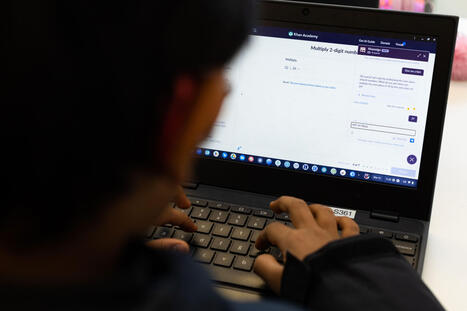
Giving students access to an AI assistant Khanmigo did not improve math performance above Khan Academy practice alone.
|
|
Scooped by
EDTECH@UTRGV
September 28, 11:41 AM
|
This article discusses the disclosrure standards for AI-voiced and generated training videos, necessary to retain workforce trust.
|
|
Scooped by
EDTECH@UTRGV
September 28, 11:35 AM
|
New report finds educators want better vetting, more input, and greater classroom oversight rather than strict technology limits.
|
|
Scooped by
EDTECH@UTRGV
September 28, 11:30 AM
|
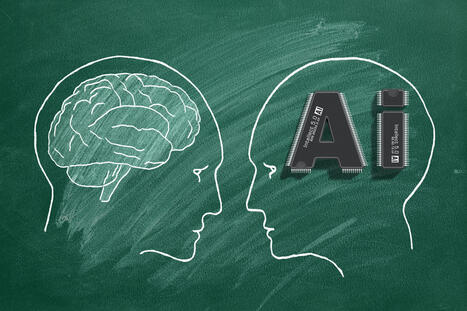
Teachers are using AI to develop lesson plans, and in some districts, AI chatbots give students feedback on their work. Meanwhile, the research around how AI can help students is extremely limited.
|
|
Scooped by
EDTECH@UTRGV
September 25, 8:26 AM
|
Here are five ways to open up your assignments and make student thinking, creativity, and judgment matter more in the age of AI.
|
|
Scooped by
EDTECH@UTRGV
September 25, 8:22 AM
|
As hiring falls across 20 top college majors, new LinkedIn data shows which degrees work best for versatility, with liberal arts such as English in the lead.
|
|
Scooped by
EDTECH@UTRGV
September 24, 8:44 AM
|
One school even offers pupils a semiconductor qualification to help them get into the industry.
|



























Will school forbid screens like they banned smartphones? Some movements think so.