Your new post is loading...

|
Rescooped by
Dennis Swender
from Into the Driver's Seat
January 28, 2018 1:28 PM
|
"Search is the new literacy. When I was a kid, “Googling” something was not really an option. Now, I literally speak to my phone and it tells me the answers to things I want to know. Not only does the ability to Google things exist, I pretty much have access to it 24/7. That technology is not going to go away, it is only going to get better.
Part of our teaching responsibilities is now to reach digital literacy and digital citizenship. This is the job of every teacher, regardless of subject area expertise. We may take for granted that students know how to “Google” something. They know how to type stuff into a search box, but likely they do not know how to do a good keyword search."
Via Jim Lerman
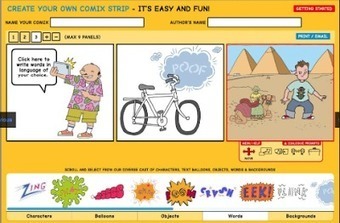
Comic strips and cartoons are two effective instructional tools to use in class with students from different grades. They are effective because they engage students in meaningful learning experiences where they get to practice key skills such as writing, reading, speaking and communicating. By definition, a comic strip is "an open-ended dramatic narrative about a recurring set of characters told in a series of drawings, often including dialogue in balloons and a narrative text, published serially in newspapers" (Inge, p. 631 cited in Snyder, 1997). In today's post, we are sharing with you a some very good resources to help you make the best of comic strips in your teaching.
Via John Evans
|
|
Rescooped by
Dennis Swender
from Learning & Mind & Brain
January 27, 2018 1:58 PM
|
Tweet I recently wrote a guide for my library's blog on the best sites for high quality, free, and public domain images. I've recreated part of it below. These sites are hugely useful for marketing purposes, as you can use them in websites, posters, slides, on social media (but NOT insta! That nee
Via Elizabeth E Charles, Miloš Bajčetić
|
|
Scooped by
Dennis Swender
January 27, 2018 12:58 PM
|
Social media can be a big part of students' lives, and teachers across the country are finding ways to use popular platforms as teaching tools.
|
|
Rescooped by
Dennis Swender
from iSchoolLeader Magazine
January 27, 2018 12:32 AM
|
|
|
Scooped by
Dennis Swender
January 26, 2018 12:27 AM
|
Free resource of educational web tools, 21st century skills, tips and tutorials on how teachers and students integrate technology into education
|
|
Rescooped by
Dennis Swender
from Leading Schools
January 26, 2018 12:24 AM
|
Online education helps school districts that need to save money make do with fewer teachers. But there is mounting evidence that struggling students suffer. ”A single teacher can reach thousands of students in an online course, opening up a world of knowledge to anyone with an internet connection. This limitless reach also offers substantial benefits for school districts that need to save money, by reducing the number of teachers. But in high schools and colleges, there is mounting evidence that the growth of online education is hurting a critical group: the less proficient students who are precisely those most in need of skilled classroom teachers. Online courses can be broken down into several categories, and some are more effective than others.”
Via Mel Riddile
|
|
Rescooped by
Dennis Swender
from Edumorfosis.it
January 26, 2018 12:21 AM
|
Today, several organizations are planning to convert their Instructor-Led Training (ILT) to online training (eLearning or mLearning). There are several factors that are triggering the conversion of ILT to eLearning or mLearning, notably:
Via Edumorfosis
|
|
Rescooped by
Dennis Swender
from The EFL SMARTblog Scoop.it Page
January 26, 2018 12:12 AM
|
Machines with artificial intelligence have performed better than human beings in a high-level test of reading and reading comprehension. Two natural language processing tools received higher scores than humans in the tests.
Via David M
A team of researchers studied student reactions to a large online course designed using the Quality Matters standards, with results that validated the
Via Peter Mellow
|
|
Rescooped by
Dennis Swender
from Educational Technology News
January 25, 2018 6:29 PM
|
"Online courses tend to better meet the needs of working adults, who now make up 40 percent of college enrollments, and many colleges are adding or expanding digital programs to attract older students."
Via EDTECH@UTRGV
|
|
Rescooped by
Dennis Swender
from Daily Magazine
January 25, 2018 6:27 PM
|
In this post, there’s lots of stuff to cover across a wide and wildly changing landscape. It’s also a topic that covers everyone’s favorite: The JS Framework of the Month™.
Via THE OFFICIAL ANDREASCY
|
|
Rescooped by
Dennis Swender
from Digital Delights for Learners
January 24, 2018 1:56 AM
|
A collaborative platform for your conferences and your training sessions. Intuitive and simple, Wooclap makes your presentations interactive. Sign up for free.
Via Ana Cristina Pratas
|
Purposeful play is an essential component in children’s cognitive, emotional, physical, and social development. Through play kids get to discover and explore the world around them. As Maslow stated ’almost all creativity involves purposeful play’. Several studies, see visual below, confirmed the importance of play and recess in building healthy environments that are conducive to optimal learning experiences for kids. Some of the advantages of free play for kids, students, and even adults include: it boost one’s moral and energizes their sense of optimism; develops kids communicative, social and cultural competences; enables children to practice learning by doing; provides kids with an outlet to express their emotions and build social relationships; play develops kids self-esteem and confidence; it is also ‘an opportunity for kids to really see the best in themselves’.The visual below from Playground Equipment, features 50 reasons why play is important in kids social and scholarly life. Check it out and share with us your feedback in our Facebook page.
Via John Evans
|
|
Rescooped by
Dennis Swender
from Edumorfosis.it
January 28, 2018 1:24 PM
|
The Bad News: When technology is used to replace a teacher, it has a very small positive effect size on student achievement. Hattie’s research includes studies on the use of CAI programs across curriculum and contexts, as well as other approaches that mistake the transmission of information for authentic knowledge generation (Powerpoint use by teachers, for example). The graph below indicates with a black arrow the average of all of Hattie’s researched initiatives, programs, and strategies in education to be a 0.4 effect size. When we look at the effect size for how technology has been implemented over the last 50 years, including using computers for passive absorption of information transmitted by a CAI teaching robot, it falls below the average at 0.34. In short, Skinner’s Teaching Machine wasn’t particularly effective and neither is your school’s CAI program.
Via Edumorfosis
|
|
Scooped by
Dennis Swender
January 27, 2018 12:59 PM
|
We asked teachers, professors, a psychiatrist and a technologist for their thoughts, and we heard a range of opinions on one of the most "weirdly divisive" issues in education.
|
|
Scooped by
Dennis Swender
January 27, 2018 11:29 AM
|
This infographic from knowledge sharing platform Zeqr reveals some interesting stats about e-learning trends and most popular e-learning platforms.
|
|
Rescooped by
Dennis Swender
from E-learning
January 26, 2018 12:29 AM
|
How do you encourage your blog visitors to not only start reading your posts but also stick around to the end? We offer you ten tips to enhance the readability of your blog posts.
Via paul rayner
A wave of concern about the ill effects of smartphones and their apps echoes fears of earlier innovations, including TV, the printing press, and writing itself.
Via John Evans
First define what you mean by digital literacy: The definition I most frequently use is this one: digital literacy = digital tool knowledge + critical thinking + social engagement. Then it's worth knowing its main characteristics:
Via Elizabeth E Charles
|
|
Scooped by
Dennis Swender
January 26, 2018 12:16 AM
|
You may be a teacher searching for free technology tools for teachers which enable them to watch and share YouTube videos with students in classroom in a safe and friendly way without any distractions or offensive comments that may scatter their attention, and in that case, Safe YouTube is for you.
Educators are constantly challenged to find ways to keep kids’ attention in class when, outside of school, their world is full of all kinds of highly compelling and visually stimulating media. Many educators find that gamifying learning keeps students engaged. BreakoutEDU, for example, is an educational game platform that includes a curated set of physical materials—think padlocks, boxes and invisible ink—and activities across a wide range of subjects and grade levels. Students might sort images annotated with letters by state of matter (solid, liquid, or gas), for instance, revealing a secret code word that gets them one step closer to the goal. BreakoutEDU is a physical game platform, requiring a significant amount of planning and manual configuration—setting combinations locks, writing clues on hint cards, hiding clues around the classroom—and then supervising the activity as the teams go about their game play.
Augmented reality tools, however, reduce the time and effort required to set up gaming activities while allowing teachers to break through the noise and engage students with the type of immersive content they find in their daily lives. For example, after watching a 10-minute tutorial, Yvonne Rodriguez was able to create her own AR Experience by arranging components—which she describes as “digital LEGOs”—on her computer screen. “It’s just so easy,” says Rodriguez. “I am not a tech-savvy teacher at all. So if I can do it, anyone can do it.”
Via John Evans
|
|
Rescooped by
Dennis Swender
from Digital Delights for Learners
January 26, 2018 12:09 AM
|
Jacqui Murray shares how we can encourage an improvement in writing using technology. These creative ways will help you think about how to help children, particularly those who struggle with handwriting and typing. Screencastify is the screencasting tool I recommend for Google Chrome and Chromebooks. Built for Chromebooks, it saves all of your recordings directly […]
Via Dr. Tom D'Amico (@TDOttawa)
Embedding in Google Sites has evolved within the past few months to allow full websites displays as well as embedding media feeds such as your Twitter. Here are a few steps on getting your Twitter feed embedded on your new Google Site! Step 1: Accessing your Twitter Settings Within Twitter locate your profile image and…
Via Dr. Tom D'Amico (@TDOttawa)
|