 Your new post is loading...

|
Rescooped by
Dennis Swender
from Energy&Environment
February 5, 2018 10:00 AM
|
"Looking for some interesting free documentaries to use in your class or probably use for your own professional and intellectual growth? This list from Open Culture has you covered. It features around 200 free documentaries spanning a wide range of topics from history to arts and science. All of these documentaries are provided with a short description about their content together with a link to the page where you can watch them and read more about the contextual information surrounding the topic they cover. It will take you awhile to sift through the entire list but we are pretty sure you will come out with some good documentaries to share with your class."
Via John Evans, Agron S. Dida
|
|
Rescooped by
Dennis Swender
from Education Adds
February 5, 2018 9:57 AM
|
|
|
Rescooped by
Dennis Swender
from Learning & Technology News
February 5, 2018 9:52 AM
|
As educators, we have a singular responsibility to prepare all students for a rapidly changing job market, and to educate them to be architects of the world in which we live. In today’s economy, when the future of work is changing faster than our old models of education can accommodate, this is no easy task.
Via Nik Peachey
|
|
Rescooped by
Dennis Swender
from Learning & Technology News
February 5, 2018 9:51 AM
|
On the one hand, those sleek little supercomputers promise to connect us to all human knowledge. On the other hand, they are also scientifically designed by some of the world’s top geniuses to feel as compelling as oxygen.
Via Nik Peachey
|
|
Scooped by
Dennis Swender
February 3, 2018 2:34 AM
|
"in the old centre of Berne, visitors to the Kornhausplatz are greeted with a very strange sight in the form of the sixteenth-century Kindlifresserbrunnen statue (Bernese German for 'child eating fountain'). This is a bizarre landmark consisting of a man apparently eating infant children. Its meaning and historical significance has been lost over the centuries, and continues to be debated, especially amongst the Swiss children it has presumably terrified for 500 years. For the purposes of this book, this somewhat alarming statue provides a useful image as we consider the confused and often ambivalent relationships between childhood, identity, and technology in the modern age."
|
|
Rescooped by
Dennis Swender
from Social Media and Healthcare
February 2, 2018 6:14 PM
|
A recent paper published in JAMIA, Journal of the American Medical Informatics Association, illustrates the success of an improved system that tracks foodborne illness via online Yelp restaurant reviews developed by the Columbia University Department of Computer Science. Since 2012 this system has been used by the New York City (NYC) Department of Health and Mental Hygiene (DOHMH) to identify instances of foodborne illness in NYC restaurants. The system identifies Yelp reviews that indicate a foodborne illness and reviews that suggest multiple people experienced foodborne illness. To achieve this, the system identifies key words within reviews such as use of the words "sick" and "multiple." Since this system was introduced in the DOHMH, epidemiologists have identified 8,523 reviews consistent with food poisoning, which helped to identify 10 outbreaks of foodborne illness associated with NYC restaurants. The work illustrated in this paper describes the evaluation of methods to increase the sensitivity and specificity to improve system performance. Foodborne illness is major health problem in the United States. The Centers for Disease Control and Prevention estimates that there are 48 million illnesses and over 3,000 deaths caused by contaminated food in the United States each year. When these instances are related to restaurants, they have traditionally been identified via health department complaint registration systems. However, social media now provides a public platform to disclose incidents that may not have been reported through established complaint systems. Younger people are less likely to report foodborne illness via traditional channels. The popularity of online reviews and the incorporation of social media data into public health surveillance systems are, however, becoming more common. Data from internet search engines and social media has been used to monitor outbreaks of various infectious diseases, such as influenza, and an evaluation comparing the use of social media and internet data against traditional methods of detecting outbreaks of infectious diseases found that these new methods were the first to report outbreaks in 70% of cases. In line with this, the initial pilot study of the DOHMH system, from July 1 2012 to March 31 2013, found that only 3% of illness incidents discovered via online reviews had been reported via NYC's established complaint system. Due to the success of the pilot study, DOHMH has integrated Yelp reviews into its foodborne illness complaint surveillance system and continues to mine Yelp reviews and investigate those pertaining to foodborne illness. DOHMH looks forward to implementing the improved system and continues to work with Columbia University to integrate new data sources, including Twitter, into the foodborne illness complaint system. "We find that the application of machine learning, specifically in the form of document classification techniques, can contribute greatly to public health surveillance in social media, said lead researcher Thomas Effland. "Our future work will improve upon these techniques and target their application to foodborne illness surveillance in other forms of social media, such as Twitter, as well as other key indicators in public health."
Via Plus91
|
|
Rescooped by
Dennis Swender
from University-Lectures-Online
February 1, 2018 11:40 PM
|
Michael Kearns Penn University of Pennsylvania Start: September 2012 (10 weeks)
Information, Technology, and Design
Computer Science: Artificial Intelligence, Robotics, Vision Networked Life will explore recent scientific efforts to explain social, economic and technological structures -- and the way these structures interact -- on many different scales, from the behavior of individuals or small groups to that of complex networks such as the Internet and the global economy. Networked Life looks at how our world is connected -- socially, strategically and technologically -- and why it matters. The answers to the questions above are related. They have been the subject of a fascinating intersection of disciplines, including computer science, physics, psychology, sociology, mathematics, economics and finance. Researchers from these areas all strive to quantify and explain the growing complexity and connectivity of the world around us, and they have begun to develop a rich new science along the way. Networked Life will explore recent scientific efforts to explain social, economic and technological structures -- and the way these structures interact -- on many different scales, from the behavior of individuals or small groups to that of complex networks such as the Internet and the global economy. This course covers computer science topics and other material that is mathematical, but all material will be presented in a way that is accessible to an educated audience with or without a strong technical background. The majority of the course is grounded in scientific and mathematical findings of the past two decades or less (often much less). Networked Life is the flagship course of the new Market and Social Systems Engineering Program at the University of Pennsylvania.
Via Dr. Stefan Gruenwald
|
|
Rescooped by
Dennis Swender
from University-Lectures-Online
February 1, 2018 11:38 PM
|
Lada Adamic University of Michigan Start: September 2012 (8 weeks long)
Workload: 5-7 hours/week (8-10 if completing additional programming exercises)
Information, Technology, and Design
Computer Science: Artificial Intelligence, Robotics, Vision This course will use social network analysis, both its theory and computational tools, to make sense of the social and information networks that have been fueled and rendered accessible by the internet. Everything is connected: people, information, events and places, all the more so with the advent of online social media. A practical way of making sense of the tangle of connections is to analyze them as networks. In this course you will learn about the structure and evolution of networks, drawing on knowledge from disciplines as diverse as sociology, mathematics, computer science, economics, and physics. Online interactive demonstrations and hands-on analysis of real-world data sets will focus on a range of tasks: from identifying important nodes in the network, to detecting communities, to tracing information diffusion and opinion formation.
Via Dr. Stefan Gruenwald
|
|
Rescooped by
Dennis Swender
from University-Lectures-Online
February 1, 2018 11:34 PM
|
Proving that they are still the leader in offering massive open online courses (MOOCs), Coursera has released a beautiful native iPad app that provides access for learners on the move. The internet continues to change education and freely available MOOCs are just one example of a thriving open community. Coursera is not alone but is [...]
Via Dr. Stefan Gruenwald
In this list we're sharing some of our favorite websites that offer free resources for presentation design such as templates, icons, images, fonts and more.
Via Baiba Svenca
INPRES is a service of interactive presentations includes polling, questioning, sharing files, getting feedback and audience’s questions by means of using participants’ smartphones.
Via Baiba Svenca
PowerPoint is awesome, but here's the truth: some of the default features of PowerPoint can lead you down the path of creating horrible PowerPoint slides
Via Baiba Svenca
So how can AI help?
Communication: Students and teachers will be able to communicate instantly with one another as well as to connect with other forms of AI around the world. Students instantly paired with peers, helping each student to expand their own personal learning networks, with personalized and more authentic connections that will meet the students’ interests and needs at any given moment. Think of the benefits for being able to converse with AI or a virtual peer, which has been located based on an assessment of student needs and error analyses. Build foreign language skills, talk to someone about school, family, life in a country being studied, possibilities are endless for language learning.
Differentiation: With the availability of AI, students and teachers will be able to connect with resources they need exactly when they need them. The entire internet of resources accessible within seconds, deliverable to each student saving valuable time for more interaction between teacher and student, and students and students. Through AI, students can have access to one to one tutors, creating more authentic learning experiences by pairing students with an expert or a virtual peer to learn with. Think of the benefits if each student could have instant access to a tutor wherever and whenever they needed one.
Personalization: What better way to offer more personalized learning opportunities for students than to have AI be able to analyze student responses, determine areas of need and interest, and find resources or create new questions to help students to greater understanding of the content. What about the potential for informing the classroom teacher, and working together to create new learning opportunities for students, but in a faster way, that relates directly to the student needs and offers authentic and timely feedback.
Exploration: With the rise of augmented and virtual reality, and the benefits of bringing these into the classroom for students to have a more immersive learning experience and to see places and explore things that otherwise they would not, AI can be a tremendous benefit for this. Through AI, resources could be found instantly based on student responses, or for the entire classroom to experience. Capabilities such as these are not something that will be limited by the time and place of the classroom setting. AI could show students want they want to explore, find ways to bring the content to life instantly.
Assessments: AI could help teachers to assess students and streamline the grading process, with the added benefit of being able to quickly take the data, provide an analysis for teachers, so that time can be saved for more classroom interactions. It can help with student achievement, making sure that each student has the opportunity to learn and grow, benefitting from the faster responses through AI.
Learn more / En savoir plus / Mehr erfahren: https://www.scoop.it/t/21st-century-learning-and-teaching/?&tag=AI https://www.scoop.it/t/21st-century-innovative-technologies-and-developments/?&tag=AI
Via Gust MEES
|
|
|
Rescooped by
Dennis Swender
from Education Adds
February 5, 2018 9:57 AM
|
|
|
Rescooped by
Dennis Swender
from Education Adds
February 5, 2018 9:56 AM
|
Because creativity is so critical to success in the 21st century, alongside online education Morgridge says more schools are exploring the maker movement, using 3D printers and allowing students hands-on interactive experiences to “learn by doing.” “Kids learn when they want to learn,” says Morgridge. “In this maker space, kids are learning deeper because it’s relevant to them. Learning is personalized.”
Via Nik Peachey, Agron S. Dida
|
|
Rescooped by
Dennis Swender
from Learning & Technology News
February 5, 2018 9:51 AM
|
Twenty years ago, at the beginning of the dot.com bubble, it seemed as though the advent of the internet would quickly lead to the rise of unstoppable new global online education providers, able to enrol hundreds of thousands of students in courses led by the biggest names in each discipline.
Via Nik Peachey
|
|
Rescooped by
Dennis Swender
from Learning & Technology News
February 5, 2018 9:51 AM
|
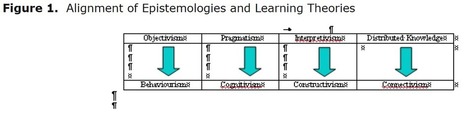
The three broad learning theories most often utilized in the creation of instructional environments are Behaviorism, Cognitivism, and Constructivism. These theories, however, were developed in a time when learning was not impacted through technology. In other words, they do not address learning that occurs outside of people, that is stored and manipulated by technology. Nowadays…
Via Nik Peachey
|
|
Rescooped by
Dennis Swender
from Into the Driver's Seat
February 2, 2018 6:16 PM
|
"SiriControl is a Python framework which provides a simple way of using Siri voice commands to add fantastic voice control to any project. The possibilities for SiriControl are endless, and as no extra hardware is required: you can get started right away."
Via Jim Lerman
|
|
Rescooped by
Dennis Swender
from University-Lectures-Online
February 1, 2018 11:44 PM
|
Jeremy Knox, Sian Bayne, Hamish Macleod, Jen Ross, Christine Sinclair University of Edinburgh Start: January 2013 (5 weeks)
Workload: 3-5 hours/week
Education This course will explore how digital cultures and learning cultures connect, and what this means for e-learning theory and practice. E-learning and Digital Cultures is aimed at teachers, learning technologists, and people with a general interest in education who want to deepen their understanding of what it means to teach and learn in the digital age. The course is about how digital cultures intersect with learning cultures online, and how our ideas about online education are shaped through “narratives”, or big stories, about the relationship between people and technology. We’ll explore some of the most engaging perspectives on digital culture in its popular and academic forms, and we’ll consider how our practices as teachers and learners are informed by the difference of the digital. We’ll look at how learning and literacy is represented in popular digital-, (or cyber-) culture. For example, how is ‘learning’ represented in the film The Matrix, and how does this representation influence our understanding of the nature of e-learning? On this course, you will be invited to think critically and creatively about e-learning, to try out new ideas in a supportive environment, and to gain fresh perspectives on your own experiences of teaching and learning. The course will begin with a ‘film festival’, in which we’ll view a range of interesting short films and classic clips, and begin discussing how these might relate to the themes emerging from the course readings. We will then move on to a consideration of multimodal literacies and digital media, and you’ll be encouraged you to think about visual methods for presenting knowledge and conveying understanding. The final part of the course will involve the creation of your own visual artefact; a pictorial, filmic or graphic representation of any of the themes encountered during the course, and you‘ll have the opportunity to use digital spaces in new ways to present this work. E-learning and Digital Cultures will make use of online spaces beyond the Coursera environment, and we want some aspects of participation in this course to involve the wider social web. We hope that participants will share in the creation of course content and assessed work that will be publicly available online.
Via Dr. Stefan Gruenwald
|
|
Rescooped by
Dennis Swender
from University-Lectures-Online
February 1, 2018 11:38 PM
|
J. Alex Halderman University of Michigan Start: 3 September 2012 (5 weeks long)
Information, Technology, and Design
Computer Science: Systems, Security, Networking In this course, you'll learn what every citizen should know about the security risks--and future potential — of electronic voting and Internet voting. Computer technology has transformed how we participate in democracy. The way we cast our votes, the way our votes are counted, and the way we choose who will lead are increasingly controlled by invisible computer software. Most U.S. states have adopted electronic voting, and countries around the world are starting to collect votes over the Internet. However, computerized voting raises startling security risks that are only beginning to be understood outside the research lab, from voting machine viruses that can silently change votes to the possibility that hackers in foreign countries could steal an election. This course will provide the technical background and public policy foundation that 21st century citizens need to understand the electronic voting debate. You'll learn how electronic voting and Internet voting technologies work, why they're being introduced, and what problems they aim to solve. You'll also learn about the computer- and Internet-security risks these systems face and the serious vulnerabilities that recent research has demonstrated. We'll cover widely used safeguards, checks, and balances — and why they are often inadequate. Finally, we'll see how computer technology has the potential to improve election security, if it's applied intelligently. Along the way, you'll hear stories from the lab and from the trenches on a journey that leads from Mumbai jail cells to the halls of Washington, D.C. You'll come away from this course understanding why you can be confident your own vote will count — or why you should reasonably be skeptical.
Via Dr. Stefan Gruenwald
|
|
Rescooped by
Dennis Swender
from University-Lectures-Online
February 1, 2018 11:35 PM
|
Sensing the excitement from online education tools like edX, Google has just unveiled a (very beta) version of its own course building software. If you’ve ever wanted to run your own online courses, this might be worth your time.
Via Dr. Susan Bainbridge, Dr. Stefan Gruenwald
|
|
Scooped by
Dennis Swender
February 1, 2018 1:08 AM
|
Google Translate is so overflowing with features, you might not even realize everything it can do.
If you want to quickly create a dazzling summary of your presentation that will surely wow your audience, look no further than creating a Summary Zoom slide in
Via Baiba Svenca
Academic Presenter is professional presentation software designed by academicians for academicians to elevate presentations’ quality to the next level
Via Baiba Svenca
Each year, states, districts, schools, and classrooms across the United States and around the world hold thousands of events to celebrate Digital Learning Day. If you’re planning to participate in …
Via Dr. Tom D'Amico (@TDOttawa)
|





























Catro boas ferramentas recomendadas.
Four good tools recommended
Open education est en train d'arriver et mettra des discussion sur le droit d'auteur au placard (au moins un peu). Voici des ressources gratuites à utiliser en classe.