Your new post is loading...
The internet doesn’t come with an instruction manual, but it should—to give users the skills to separate truth from falsehood so they can distinguish between propaganda and the indisputable and confirmable. And colleges should be the place leading students through this reference book.
That’s the argument of Michael Caulfield, director of blended and networked learning at Washington State University Vancouver, and it isn’t just some “hot take” designed to be provocative. He actually wrote the manual. And he has already convinced more than a dozen colleges to adopt it (and more than 100 college libraries to prominently link to it). Recently, he’s started research in an effort to prove that it works (and can help preserve American democracy).
Caulfield’s instruction manual—called Web Literacy for Student Fact-Checkers—explains how to avoid ending up down in these infotraps. It describes what it terms Four Moves and a Habit for evaluating any online article by going upstream to track claims or quotes to their original sources. The actual site of the Washington football team had no mention of this monumental mascot change, so I could have disproven the article in a couple of seconds.
Via Jim Lerman, Elke Höfler

|
Rescooped by
Dennis Swender
from cfdezmunin
April 6, 2018 11:20 AM
|
Here are some good applications high school students can use to help them with their math. The apps are arranged into three main categories: Algebra, Geometry and graphing and calculation apps. We invite you to check them out and share with your students
Via John Evans, Concepción Fernández
|
|
Rescooped by
Dennis Swender
from All digital
April 6, 2018 11:18 AM
|
Connect to your students in a lasting and meaningful way with the help of the following 7 classroom engagement strategies.
Via Stephania Savva, Ph.D
|
|
Rescooped by
Dennis Swender
from Edumorfosis.it
April 6, 2018 11:16 AM
|
Traditional education tracks have been the most common way to further your career for decades, but recently online learning has begun to compete in that space.
Common career advice to young adults graduating high school is to get a degree, because you can only go so far without one. However, there are exceptions to every rule. With so many millennials carving their own path lately, it’s misleading to say a degree is necessary for success.
One way that millennials are finding success is by expanding their skill set via online learning. I don’t mean Youtube, though that can be a starting point to learn the basics of plenty of topics. By online learning, I mean formal learning platforms like Skillshare.
Via Edumorfosis
|
|
Rescooped by
Dennis Swender
from Edumorfosis.it
April 6, 2018 11:09 AM
|
School originated to train obedient factory workers but hasn't evolved much since then.
Coursera and the University of Phoenix paved the way for people to digitally learn from a distance. Next, traditional and leading colleges began offering online courses--sometimes for free. Then institutions allowed degrees to be completed online, for example, Georgia Institute of Technology partnered with Udacity and AT&T to offer the first online Master of Science in Computer Science from an accredited university that students can earn exclusively online for a fraction of the normal cost.
But are these education changes too little too late for Generation Z who has their sights on more innovative and agile education alternatives?
Via Edumorfosis
"Not everyone is a Microsoft Word fan. Here are fresh alternatives to Microsoft Word that you might not know about ..." JarteAbleWordWordGraphFocusWriterPage FourShaxpir 4LyXThinkfree Online EditorHemingwayDraft,
Via Leona Ungerer
|
|
Rescooped by
Dennis Swender
from Into the Driver's Seat
April 5, 2018 8:02 PM
|
Tour of Google Classroom "This site is created by Alice Keeler and Libbi Miller to provide a look at Google Classroom. Scroll down to review each section of Google Classroom. We have outlined the elements you will find for each part of the Google Classroom platform." Jim Lerman's insight: Very complete, free overview. Well done.
Via Jim Lerman
|
|
Scooped by
Dennis Swender
April 5, 2018 12:16 PM
|
"Online learning has been part of higher education for almost 30 years now. Students studying either fully or partially online make up 31% of U.S. undergraduate enrollment (as of fall 2016), and 37% of graduate enrollment. But what does “online learning” really mean? The term masks a range of styles and features."
Webinars with multiple presenters have never been so easy. Just connect to a person who is ready to speak while the rest can still easily prepare for their performance
Screen sharing in original quality
Attendees can easily read any text on your screen. They will see even the smallest elements so be careful with message notifications
Show text and media files
Whether it's a document, presentation, picture, video or audio - you can easily show it to your audience
Via Nik Peachey
Over the weekend I shared the news that Google is shuttering the Goo.gl service. In that post I shared a handful of alternatives to Goo.gl. This morning someone emailed me to ask about an alternative to Goo.gl for creating QR codes. My suggestion is to use QR Droid Zapper. With that tool you can create QR codes to direct people to websites, to share contact information, to share files, or to just share a chunk of text. In the following video I demonstrate how to create QR codes with QR Droid Zapper.
Via John Evans
|
|
Rescooped by
Dennis Swender
from Into the Driver's Seat
April 2, 2018 12:20 AM
|
The demand for online courses is exploding right now. Here's why completion rates in online courses are so low, and why they don't matter.
Via Miloš Bajčetić, Jim Lerman
|
|
Rescooped by
Dennis Swender
from Effective Education
April 2, 2018 12:17 AM
|
"Online education is popular. So why do so many learners drop out? Enrollment in online education continues to rise, with more and more learners each year signing up as part of their college program, for professional training, or simply for personal fulfillment. Yet despite its popularity, many learners fail to complete their courses."
Via EDTECH@UTRGV, Mark E. Deschaine, PhD
|
|
|
Rescooped by
Dennis Swender
from cfdezmunin
April 6, 2018 11:20 AM
|
As teachers we frequently promote ourselves in our modern role as facilitators rather than knowledge owners and yet when we get into the classroom so much of what we do tends to be telling rather than asking.
Crowdsourcing information is about doing the opposite. It’s about collecting information from the room and beyond and enabling our students to share what they already know and develop their knowledge together.
Via Nik Peachey, Concepción Fernández
We rely on expensive computer programs to edit photos and video, deal with office work, and protect our computers from malware. But they're not our only options. Often, commercial studios will offer the most basic versions of their products free of charge. In other cases, volunteers who believe that software should be free will develop open-source alternatives. Between them, you can find free programs to cover just about any computing task.
However, not all free apps are created equal. We've narrowed down the plethora of options to highlight 10 of the finest free alternatives to pricey computer programs.
Via John Evans
|
|
Rescooped by
Dennis Swender
from Educational Technology News
April 6, 2018 11:17 AM
|
Check out these teacher-approved apps and lesson plans for teaching with AR and VR.
Via EDTECH@UTRGV
|
|
Rescooped by
Dennis Swender
from E-learning
April 6, 2018 11:10 AM
|
If you don't own an appropriate picture then look for images that are in the public domain. While Google Docs does have a built-in image search tool, Google Images is far from the best place to find images that are in the public domain.
Via paul rayner
|
|
Rescooped by
Dennis Swender
from Edumorfosis.Work
April 6, 2018 11:01 AM
|
Nowadays we can see that there are a ton of places that you can utilize as an office space for you and employees on a month to month basis. There are clear benefits to having office space based on the short term, especially for growing businesses. Market leaders such as WeWork have opened coworking spaces in major cities across the United States, while newer entrants to global markets like Christie Spaces have open up as a sort of pop shop to your small business or entrepreneurial idea off the ground. The proliferation of coworking space providers offer different business amenities that could better help your business growth. With the plethora of spaces opening up on a global level, how does one compete?
Via Edumorfosis
|
|
Rescooped by
Dennis Swender
from Best
April 5, 2018 8:04 PM
|
Can I repartition my hard disk without formatting it? Yes, but first, when it comes to re-partitioning and resizing your hard disk, it is important to backup all the files in the drive onto an external hard disk. Mistakes can be made due to human error or software, either way, it is good to be safe than sorry. Recovering lost files is expensive, time consuming and sometimes it is as good as impossible. Therefore, always backup everything in the hard drive. Without further ado, here are 5 Norton PartitionMagic alternatives for repartitioning your USB flash drive, SSD, hard disk, SD Card and more.
Via Dr. Stefan Gruenwald
moving from individual projects to investing in collective capacity of communities
Via june holley
|
|
Rescooped by
Dennis Swender
from Edumorfosis.it
April 5, 2018 7:59 PM
|
My 22-year-old is a student at Portland State University. He’s a bright, committed student studying anthropology and linguistics. For as long as I’ve been teaching -- more than half his life -- he has watched, listened to and most recently participated in discussions, rants and revelations about critical and digital pedagogies. He’s keenly aware of the limitations and affordances, for example, of the learning management system, and he’s invested in the social justice side of education, in “education as the practice of freedom,” as bell hooks would say (Teaching to Transgress). So it was with some distress on his part that he reported to me that one of the spring 2018 classes he’d registered for had been moved entirely online.
But it wasn’t the move itself that bothered him. “They made it an online class because the teacher will be too busy to teach it.”
Too busy to teach. So put the class online. Because … that’s easier? The course will run itself? Students don’t need teachers to be present online?
What are the assumptions behind this rationale? At the very least, putting this course online because “the teacher will be too busy to teach it” betrays a belief in an inherent, marked difference between learning and teaching that happens in the classroom and learning and teaching that happens online.
This marked difference -- bias? -- has been present since online learning first came into play in higher education, with many institutions refusing to accept online classes for transfer credit in those early years.
Via Edumorfosis
|
|
Rescooped by
Dennis Swender
from Edumorfosis.it
April 5, 2018 12:09 PM
|
When instructional designers are involved in online course design, student-to-student interaction goes up, according to a new survey of online education leaders from Quality Matters and Eduventures Research. The survey compared reported student interaction levels at institutions where instructional design support is required for online course development vs. those where such support is absent or optional. Perhaps not surprisingly, respondents perceived interactivity to be significantly higher for the former.
Via Edumorfosis
If you have never used Microsoft Office or just need help with the basics, there are plenty of resources scattered around the internet. But which is the best way to learn Microsoft Office? Is it free training, a paid class, or a video tutorial?
For beginners as well as those brushing up on their Microsoft Office application skills, here is a big list of options worth checking out.
Via Elizabeth E Charles
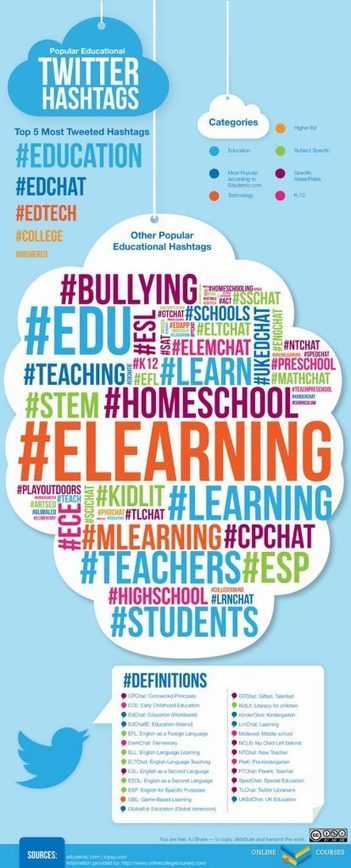
If you want to be a successful digital marketer, then you should be aware of the latest updates related to social media. Being one of the most widely used social media platforms out there, Twitter keeps on redefining itself. A while back, it announced the latest update regarding the 280 character limit for tweets. The update was certainly a big relief to many as almost all the marketers used to struggle with the previous 140 character limit.
Now, you can easily level up your social media marketing game on Twitter and reach out to a wider audience for sure. To make things easier for you, I have come up with some expert suggestions that will help you make the most of the Twitter’s latest update.
Details of Twitter’s new update (in a nutshell)
For almost a year now, there have been speculations about the Twitter’s new character limit. It was in the last quarter of 2017 when Twitter finally announced the 280-character update for posting tweets. For languages except Chinese, Japanese, and Korean, Twitter has increased the character limit for tweets from 140 to 280 characters. The attached photos, GIFs, polls, etc. won’t be counted as characters. Though, if you will include a URL, then it will increase the character count. Therefore, it is still recommended to use a URL shortening service while including website links in tweets.
12 ways to make the most of Twitter’s new update
Now when you can tweet in 280 characters, you don’t need to double-check every word you write. Furthermore, it can help you answer customer queries or explain a product to your audience. Here are some interesting ways to use Twitter’s new update. Learn more / En savoir plus / Mehr erfahren: https://www.scoop.it/t/21st-century-learning-and-teaching/?&tag=press
Via Gust MEES
|
|
Rescooped by
Dennis Swender
from :: The 4th Era ::
April 2, 2018 12:19 AM
|
|