


3D Virtual Learning Environments for Distance Education on cool stuff from research curated by Amy Cross (3D Virtual Learning Environments for Distance Education | @scoopit via @AnaCristinaPrts http://t.co/Safv1BJ89w)...
Via Martha Figueroa

 Your new post is loading...
 Scoop.it! 3D Virtual Learning Environments for Distance Education on cool stuff from research curated by Amy Cross (3D Virtual Learning Environments for Distance Education | @scoopit via @AnaCristinaPrts http://t.co/Safv1BJ89w)... Via Martha Figueroa No comment yet.
Sign up to comment
Scoop.it!

"The way you design your writing assignments can help detect and correct writing issues before they evolve into serious academic conduct issues ..." Via Leona Ungerer
Scoop.it!
The University System of Maryland is experimenting with the use of massive open online courses to accelerate the path to an advanced degree — and the work has shed light on surprising new benefits of the MOOC format. Via Peter Mellow
Scoop.it!
Christy Tucker, tells (and shows) you how she made the move from teacher to ID.
Scoop.it!

It's time for enterprises to define their artificial intelligence strategies, and they have to consider embarking on mass experimentation to achieve success.
Scoop.it!

At the turn of the century, seeing obesity, cardiovascular illnesses and type II diabetes rates that were skyrocketing within the population, th Via Ben Clune, Educational Peaks 
Ben Clune's curator insight,
May 28, 2017 3:54 AM
Pedagogical model that can facilitate differentiation and higher order thinking
Scoop.it!

This article was written by Nichole Dobo Many people are seeking the “secret sauce” for digital learning. As educators expand the use of education technology, they often face a tricky balance. These tools offer the possibility for innovation – trying something new in a quest to improve teaching and learning. But technology isn’t cheap, and the risk of failure looms. To assure success, many educators try to find and follow a recipe for digital learning. But many crucial ingredients can’t be found in a case study about “best practices,” said Julie Evans, the CEO of Project Tomorrow, a nonprofit organization that advocates …
Via Educational Peaks 
Jillian Schaibly's curator insight,
July 25, 2017 5:08 PM
How do you implement technology without trying it out first? Using technology or trying out new things can be expensive for school, so finding something that can be tested first is the best option. This resource talks about how there is no right way for digital learning, but there are best practices by some teacher which can help. This could help a principal by having teachers collaborate with the technology they use and share and teach other staff on what they know.
Scoop.it!

The power of video conferencing tools lies in their ability to engage audience through the use of visuals, interactive features and synchronous communication. The most popular free tools in this regard are Google Hangout and Skype. Both of these applications are easy to use and offer a variety of decent features for hosting online meetings and organizing seminars. However, if you are looking for some advanced alternatives, you should definitely consider the tools below. These are premium softwares that schools , universities, and individuals can use to conduct formal online conferences, webinars, and seminars. From document upload to sharing slides and web co-browsing these tools offer a plethora of powerful functionalities ideal for e-conferencing. Via Elizabeth E Charles
Scoop.it!

You have probably never heard of GPT-2 but it is a breakthrough in AI that has astonishing implications for us all, especially in learning. GPT-2 is an AI model that can predict the next word from a given piece of text. Doesn't sound like much but it's odd that an OpenAI, an open-source site, would close access to their software. In practice, this means it is a powerful model for: Via Elizabeth E Charles
Scoop.it!

These 4 benefits will help organizations realize the impact that Social Learning in online training can have on learners as well as organizations.
Scoop.it!

"Many people love that cool app on the Mac that enables you to create little sticky notes on their desktop. While I actually like Google Keep and Google Tasks better since they are now integrated into all Google Apps, others might want the sticky note type of app ..." Via Leona Ungerer
Scoop.it!

When you think about Google services, apps such as Gmail, Docs, and Photos may be the first things that come to mind. I’d be willing to wager, though, that the Google service you use more than any other is one you rarely think about—because it’s woven so tightly into your life that it doesn’t even feel like a service anymore. It just feels like a utility, something that’s always there—like a faucet for metaphorical water. Via John Evans, Yashy Tohsaku 
Marco Bertolini's curator insight,
March 3, 2019 3:37 AM
40 very useful things you can do with Google Search |
Scoop.it!

This talk looks at the impact of new technologies – specifically, open data, cloud technologies, AI and distributed ledgers (blockchain) – on the future shape of OER – what they will look like, how they will be used, and what skills and knowledge will be needed to develop and use them. Seminar, Mar 05, 2019. Via Edumorfosis
Scoop.it!

Online Learning is the official journal of the Online Learning Consortium
Scoop.it!

In this view below we share North American (US and Canada combined) total enrollment for LMSs that are primary - that is, available for the entire institution. It is important to note that during an LMS transition there is often a period of time (6 - 18 months) where two systems overlap, with both available to the school. Therefore the total market share enrollments will be somewhat higher than actual total enrollments, as a subset of LMS-transitioning institutions will be counted twice.
Scoop.it!

Christopher Pappas: "The famous philanthropist and steel magnate, Andrew Carnegie, once said: "Teamwork is the ability to work together toward a common vision. The ability to direct individual accomplishments toward organizational objectives. It is the fuel that allows common people to attain uncommon results." Seamless collaboration, a strong work ethic, and shared goals are the hallmarks of an effective eLearning project. In order to achieve this, however, you need a carefully selected eLearning team on your side. Each professional must play their part in the process to deliver an eLearning course that exceeds expectations and achieve learning objectives, on time and on budget. Here are the 9 key players of the eLearning Dream Team."
Scoop.it!

In the world of Silicon Valley, there are few books held in higher esteem than "The Art of Computer Programming," a multivolume set by Stanford professor emeritus Donald Knuth. "If you think you're a really good programmer... read (Knuth's) Art of Computer Programming ... You should definitely send me a résumé if you can read the whole thing," read a quote from Bill Gates on the cover of the third edition of the first volume. Via Andreas Christodoulou, Educational Peaks 
Andreas Christodoulou's curator insight,
May 23, 2017 3:37 AM
Leaders are READERS. What are you reading right now?

THE OFFICIAL ANDREASCY's curator insight,
May 23, 2017 3:37 AM
It's known for being tremendously challenging to read.
Scoop.it!

Let’s redesign homework. When’s the last time your students got excited to do homework? Or said things like, “Wow…just WOW. It is amazing how much is out there that we just don’t know about”? What if every homework assignment could expand a student’s worldview while engaging a kid’s natural curiosit Via Shane Symonds, Lynn Heere, Deanne Davies, Tea Vella, Educational Peaks 
Ben Nell's curator insight,
May 30, 2018 3:26 PM
This article has provided me with so much vision and inspiration on the possibilities that I as a future maths and business teacher am able to incorporate in order to both make classes less confusing, more enjoyable, and more efficient. Not only does this technology need to be used to provide homework, but it also provides the perfect means for educators to go through topics with students, as well as re visit aspects students struggled with. Since the platform is online, by incorporating this, we as teachers also save time on checking homework during class time as we are able to see exactly which students completed their homework and at what time. Not only this, but the platform allows us to see which students struggled and which students had a firm grasp on the concept, so that we can decide whether or not to spend more time on topics. The format is also great for giving students a more exciting outlook on mathematics and is able to both expand a student’s worldview and engage their natural curiosity. In accordance to the unit lesson plan, this article will support my thinking and activities, as it conveyed to me that when teaching a particular topic, especially in maths, it may be a great idea to both make it more exciting so that students are more engaged, as well as make it far more efficient so that students have more time to practice. What this article made me realise was that it would be far more effective if I was to take out all the wasting of time writing on a board and getting students to copy down, which is both disengaging to students and time consuming. I came up with the idea that instead of following this structure that takes up so much time writing notes, that students often have inadequate time to finish let alone start the exercises, leaving them for homework, I would instead give students lesson videos for homework that were far more fun and engaging than writing notes. I find it flawed that a lot of the time students are attempting questions from home, due to not finishing them in school, and a lot of the time students who do not finish are struggling, and from home they do not necessarily have adequate support. Instead by using the lesson structure I am proposing we are able to eliminate students from struggling at home, as they are only watching videos educating them and preparing them for the topic at school. Moreover, by watching the lessons at home, we as a group are able to discuss what we learned for more extended periods of time, and are able to clarify any misconceptions. The advantage this has to writing notes would be that although students write notes, many of them are disengaged, and it is hard for an educator to tell whether or not students actually understand the topic, where as by providing fun videos, students are likely to be more engaged, and also have opportunity to have class discussions to clarify their problems. Moreover, the video lessons also allow students to tackle the information without any class distractions, and also are online for the entirety of the year, meaning students are able to look back and revise topic easily, where by writing notes the lesson will be forgotten and all a student has to remember the topic is their notes. This comes even more in handy when students are away for the day, as it is easy to catch up. Lastly, by having extra time to perform exercises in class, student will be benefiting as unlike at home, they are able to call upon help whenever needed. I am also able to use this opportunity to go around the class and really get an understanding of student capabilities.

Blake Quinn's curator insight,
May 31, 2018 9:52 AM
I think this scoop and the teacher who created this idea have done a fantastic job. As for me when I was going through school a few years ago. I did not enjoy the homework at all, as I found it boring and not interesting at all. As more often than not, the teachers had made the homework up on the spot at the end of the lesson because they ran out of time. The theory of this scoop that suggests pre-planning homework, using videos, and investing five-ten minutes in the class to explain what needs to be done. Would make a dramatic change to the way students see homework, and would help the students better their learning. What I thought was the best aspect of the scoop, was how the teacher had a range of choices so the students could pick what interested them. Overall, I think this theory of teaching would work well in all subjects of teaching.

Emma Faint's curator insight,
June 7, 2018 1:15 AM
This article aspires to inspire students to extend not only their knowledge on the world wide web but to broaden their ICT capabilities. Students in contemporary society, are subjected to digital technology than any other generation and just like most adolescences they despise homework, especially if it is to be handwritten with using resources like hard copy books. This article assists the teacher by providing suggestions and examples to create homework that utilises technology to support their learning. Encouraging educators to ask feedback from students emphasises the point that learning works from engagement from both parties. More specifically, it enhances student based learning. By assigning tasks like this, students are directed on what and how to effectively search, collect and collate resources and information. Also, parents can be involved at home. However, a limitation to this digital homework is that some students may come from low socioeconomic families that do not have access to technology or live in black spots. All in all, this is a fantastic method to engage students and improve their learning and technological experiences.
Scoop.it!

The report and data from the fifth ALT Annual Survey have now been published and shared openly in the ALT Repository. As with previous years the Annual Survey is designed to: understand current and future practice; show how Learning Technology is used across sectors; and help map the ALT strategy to professional practice to better meet the needs of and represent our Members. With the survey in its fifth year we are able to record and report and number of changes and the results provide a useful oversight of priorities for our Members and the sector in general. Responding to the survey is an important way for Members to inform the priorities for ALT as part of the wider aims set out in ALT’s Strategy 2017-2020 and we are grateful to everyone who took some time to complete the survey. The survey highlights very good awareness of the Senior and Associate CMALT pilots, which have been announced as launching on 28 February 2019. In terms of ALT activities that support research, practice and policy there is greatest awareness of day events and webinars run by local Member Groups, which were also indicated as one of the top priorities for 2019. This area will in part be supported by the new ALT Assembly which met for the first time on 20 February 2019. Via Elizabeth E Charles
Scoop.it!

Poll Animal is a web tool that enables you to easily create and share surveys and polls. Poll Animal is simple and easy to use and provides a wide variety of interesting features that will definitely enhance your survey creation experience. Via Elizabeth E Charles
Scoop.it!
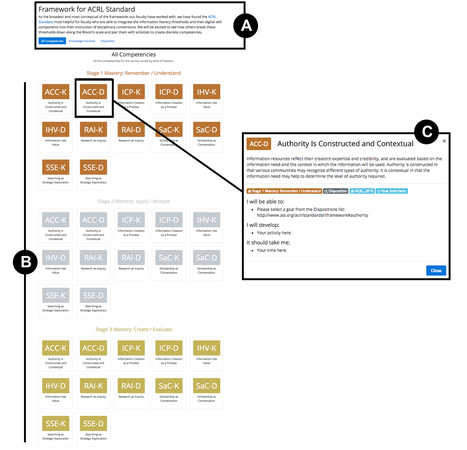
The Digital Literacy Competency Calculator (DLCC) is a web-based tool for representing the connection between digital literacy competencies and the teaching and learning practices that produce them. Via Elizabeth E Charles
Scoop.it!

This article portrays how the approach of Virtual Reality in eLearning can be used to create immersive learning experiences for induction and onboarding purposes. Via EIDesign eLearning
Scoop.it!

Students at Bethel Middle were recently put through the paces of an hour-long social media etiquette and internet safety training. Via Mel Riddile
Scoop.it!


Ana Cristina Pratas's curator insight,
February 28, 2019 8:04 AM
"The report provides the reader a comprehensive overview of the changes in the learning-to-employment landscape, why it has happened, highlighting the dramatic increase in working learners and learning workers. These two populations – one pursuing traditional degrees while holding down jobs, and the other pursuing small increments of education to advance within their jobs – are responsible for the tremendous gains seen in online learning (520% in 10 years), MOOCs (910% in 5 years), micro-credentials, and more. The ecosystem changes drill all the way down to assessment within courses, which is starting to focus much less on “how much of the material do you remember?” and much more on demonstrations of skill mastery –i.e., “prove to us how well you know this, by what you can do with it.” The report then calls out the need for improvements in assessment to that will enable automated systems to consistently recognize and calibrate the “know” and “do” skills across the future worlds of learning and work. In response to the report Dr Edan Jorgensen, Industrial-Organizational Psychologist, reflected, ”The world is not stagnant. Hiring practices have been. Its time to shift from traditional methods that do not predict success, and look towards the future. The future is an emerging workforce that is more dynamic than degree and [job] references. They are about change and making a difference through their employment.”
|





