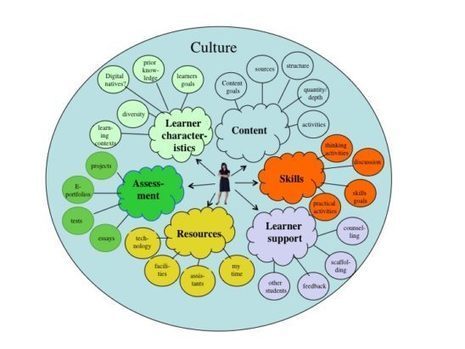
Becker of NMC says just as the role of the teacher is switching from “sage on the stage” to one of a coach or guide, there is a shift from rote to active learning. To foster skills of teamwork and collaboration, online education is incorporating group projects and hands-on labs to help students think more critically and retain the content.
Building on the concept of “learn by doing,” online education is expanding to connect students from around the world to learn together and meet professionals. Morris is also executive director of the Center for Interactive Learning and Collaboration, which partners with more than 200 cultural organizations, such as art museums, to offer real-time interaction with experts in various fields.
This exposure can help answer student questions about the relevance of a geometry class, for instance. “To answer the questions of why you are doing it is key,” says Morris. “[Students] are motivated when they understand and have a reason to understand the material.”
N'hésitez pas à lire les contenus proposés dans le déroulé du jeu : ce sont les plus intéressants, notamment sur les pratiques de commercialisation des données...
Compliquée à faire financer, inutile dans sa recherche d’ emploi, inaccessible et uniquement pour les seniors… la formation professionnelle est source de nombreux clichés. Cependant, 53% des salariés en poste depuis moins d’un an ont déjà suivi une formation ! Découvrez la suite des réponses à ces idées reçues en infographie.The post TOP 10 des idées reçues en formation appeared first on La Digital Learning Academy .
Via Xavier Van Dieren, Juergen Wagner
David Plumel, professeur de technologie au collège « Les Allières » de Saint-Pierre-le-Moûtier (58), utilise Minecraft depuis deux ans en classe de 5ème et de 3ème ce qui lui permet de travailler autrement en classe et hors la classe et d’avoir des projets beaucoup plus aboutis. « Minecraft est un bac un sable dans lequel on […]
Via Xavier Van Dieren
“This ebook was designed with English language teachers in mind but should have some value for any teacher who is interested in developing their students’ digital literacy and critical thinking skills.The book contains a wide range of suggested activitie”
Via Nik Peachey, T@T lab
There are six parts to Solution Fluency—Define, Discover, Dream, Design, Deliver, and Debrief. All these steps, along with the skills they develop, are outlined in the Solution Fluency Quickstart Guide. It’s a terrific companion as you dive into Solution Fluency and connect it to any project-based learning challenges in your own classroom. It’s important to remember that the 6Ds are a non-linear cyclical process. That means that as Solution Fluency is applied to project based learning, its very common to revisit any or all of previous stages as new information and insights are obtained and applied to the solution. This kind of revision is a very proactive part of the 6Ds process, because problem solving isn’t always a straightforward journey.
Campus Junior est une sorte de mini mooc en ligne qui se donne comme ambition d’initier les enfants de 7 à 13 ans aux bases de la programmation avec le langage Scratch.
As educators, we are tasked with the weighty responsibility of helping prepare students to be successful in life. And as wide a swath as life may cut, students must be prepared for whatever challenge it unfolds. Despite many state standardized tests following the cookie-cutter approach of one-size-f
Le digital, une opportunité pour personnaliser la formation Depuis quelque temps, un jargon de termes plus techniques les uns que les autre ont fait leur apparition : Data, persona, personnalisation, assistant virtuel, réalité virtuelle, intelligence artificielle, machine Learning , Adaptive learning…. Mais quel est le point commun véritablement entre ces différents concepts ? Il s’agit […]
Via Xavier Van Dieren
"La pratique de l’inclusion est aujourd’hui considérée, à l’Université de Montréal, comme une clé afin de permettre la réussite des étudiants. C’est qu’un constat s’est imposé ces dernières années : les étudiants qu’accueille l’université ont des parcours scolaires des profils socioculturels de plus en plus diversifiés et, de ce fait, ils présentent des besoins également variés."
So, the “2017 Predictions” posts are starting to flow, and while I’m certainly interested in the education prognostications, I’m more interested in what people are saying outside of our field. (I’m somewhat pessimistic that anything will significantly shift in edu next year, especially in terms of our penchant for trying to do “the wrong thing right.”) To that end, I came across an interesting Deloitte paper that makes a number of interesting forecasts. I’m just going to pull a few out, but the whole report is pretty interesting reading if you have the time. Remember, these are for business, but they’re for us as well.
"eLearning is being extensively utilized by harnessing technology to provide learners the opportunity to learn anytime and anywhere. eLearning can include a variety of learning opportunities – self-paced training, just-in-time information, as well as guidance from experts."
e-learning, web2.0, web 2.0, aprendizaje, formación online, formación virtual, capacitación virtual, comunidad eLearning, technology, edublog, weblog, e-Learning, elearning, formación corporativa
Via LGA
"In our innovative classrooms across America, students are using technology in ways that were unheard of just ten short years ago. In a small elementary school in Northwest Baltimore, students use their Makerspace to create 3D printed materials, learn to code and engage in other making activities. In another school in Philadelphia, a student fulfills his senior capstone project requirement by creating a “Smart Beehive” that uses sensors and a camera to track the health of a bee colony.
While there are some schools of education that prepare pre-service teachers to excel in these types of technology-rich environments on their first day of in-service teaching, there is still room for growth in our teacher preparation programs as a whole, particularly as more schools shift towards digital learning.
This is why the 2016 National Educational Technology Plan (NETP) asks us to refine educational technology’s place in teacher preparation programs. It makes the bold statement that “no new teacher exiting a preparation program should require remediation by his or her hiring district.”"
Ingisht on how to utilize best practices for EPP's. While there are some schools of education that prepare pre-service teachers to excel in these types of technology-rich environments on their first day of in-service teaching, there is still room for growth in our teacher preparation programs as a whole, particularly as more schools shift towards digital learning.
Technological innovations have the potential to transform education, but only if they encourage a more active learning environment that fosters critical thinking.
Via F. Thunus
Sur la toile en 2016, la vidéo en direct a fait un grand pas en avant, le marketing vidéo également… En bref, les contenus évoluent et se font d
Via Stéphanie Sellier
To get content containing either thought or leadership enter:
To get content containing both thought and leadership enter:
To get content containing the expression thought leadership enter:
You can enter several keywords and you can refine them whenever you want. Our suggestion engine uses more signals but entering a few keywords here will rapidly give you great content to curate.


 Your new post is loading...