Your new post is loading...

|
Rescooped by
michel verstrepen
from eLearning at eCampus ULg
December 28, 2016 8:08 PM
|
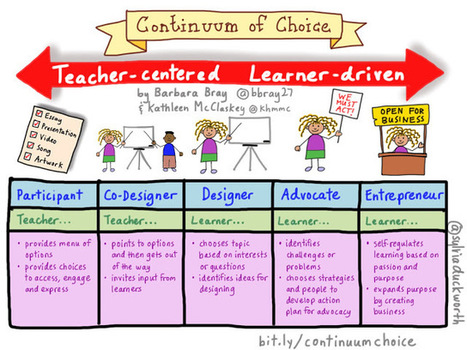
As the clock ticks down to the end of 2016, it's a perfect time to reflect on the past 12 months. I derive a huge pleasure in creating drawings related to education and then sharing them on social media. A question I often get is, "What are your most popular sketchnotes?". Well, thanks to Twitter, it's…
Via Filomena Gomes, elearning at eCampus ULg
Mastery learning is the idea that students should adequately comprehend a given concept before being expected to understand a more advanced one. This idea has a long tradition in educational theory and research. In 1919, superintendent Carleton W. Washburne in Winnetka, Illinois, showed that students could advance at their own pace if they mastered a concept before moving on to something more complicated. Years later, building on Washburne’s work, educational psychologist Benjamin Bloom coined the term “mastery learning.” In 1984, in Bloom’s seminal study, “The 2 Sigma Problem,” he showed that mastery-based one-on-one tutoring is two standard deviations more effective than conventional instruction. (That means it would take the average for a cohort of students from the 50th percentile to the 98th percentile!). Ever since, educators have sought ways to make mastery learning available to all students. Learn more / En savoir plus / Mehr erfahren: http://www.scoop.it/t/21st-century-learning-and-teaching/?tag=modern-education http://www.scoop.it/t/21st-century-learning-and-teaching/?tag=Learning+by+doing http://www.scoop.it/t/21st-century-learning-and-teaching/?tag=Practice
Via Gust MEES
|
|
Rescooped by
michel verstrepen
from PBL
December 28, 2016 7:51 PM
|
Modern educational process undergoes regular changes and one of the main reasons of that is technological development.
Not only the technology develops nowadays, children and teachers do too. This fact contributes to the constant enhancement of the approaches, methods of teaching let alone accommodation, devices, and facilities. Though there are many disagreements on this topic, classrooms also change their look getting much more technologically advanced. Soon modern students will not see customary for us classrooms as schools will adopt completely new requirements to them and up-and-coming technologies located there. Let us see what innovative technologies that have recently appeared will soon reside in the future classrooms.
Via Mel Riddile, Alfonso Gonzalez
|
|
Rescooped by
michel verstrepen
from EdTechReview
December 28, 2016 2:54 AM
|
Open Educational Resources (OER) have gained a lot of attention in recent years and the educators have acknowledged it worldwide.
Via EdTechReview (@etr_in)
|
|
Scooped by
michel verstrepen
December 25, 2016 11:37 AM
|
La mise en place de pratiques pédagogiques inclusives permet de répondre aux besoins et aux styles d’apprentissage variés des étudiants et favorise leur réussite.
|
|
Scooped by
michel verstrepen
December 25, 2016 11:36 AM
|
Le répertoire des plates-formes 2016 comporte une liste de plates-formes open-source, une liste des services en ligne qui offrent de l'hébergement gratuit, une liste de plates-formes de partage et de gestion éducative et enfin une liste des sites qui tentent de garder des listes de plates-formes à jour, car on en compte maintenant plus de 650 !
|
|
Scooped by
michel verstrepen
December 25, 2016 4:11 AM
|
Selon les enseignants, de l’école primaire à l’enseignement supérieur, on voit émerger une large variété de classes inversées. État des lieux.
|
|
Rescooped by
michel verstrepen
from Bazaar
December 25, 2016 3:19 AM
|
In this article, Let’s talk about how to write HELLO WORLD program in 25 different programming languages. You’ll also know the difficulty and simplicity of these programming languages after looking at their syntax.
Via Club de TeleMatique
|
|
Scooped by
michel verstrepen
December 25, 2016 3:17 AM
|
Et si vous ajoutiez un peu de hasard dans vos formations ? Fluky est un outil en ligne qui permet de lancer une roue virtuelle pour arbitrer entre plusieurs options que vous aurez préalablement renseignées. Vous pourrez l’utiliser pour choisir le thème que vous allez aborder en premier, pour attribuer un sujet à un groupe... Voir l'article
|
|
Rescooped by
michel verstrepen
from :: The 4th Era ::
December 24, 2016 9:45 PM
|
In 2013 Oxford University published what is now regarded as a seminal paper that concluded that up to 47 percent of all of todays jobs would be automated in the next twenty years and similarly the new White House report also forecasts the loss of tens of millions of jobs with no sector, and very few jobs immune from the march of technology.
Fears of widespread unemployment driven by automation have helped popularize the idea of paying everyone, irrespective of their background and circumstances, a regular lump sum of money to either complement or replace their earnings – UBI. A concept that’s already being trialled in countries including Canada, Finland, the Netherlands and Scotland, and which is also gaining favour in Norway, Sweden, the UK and the US, UBI is being pushed by conservative thinkers like Milton Friedman and Silicon Valley investment firms like Y Combinator who think that, under the circumstances, it might be cheaper and easier to administer than other more complex forms of social welfare. But Obama’s White House prefers to focus on education and job training rather than guaranteed income.
Via Jim Lerman
|
|
Rescooped by
michel verstrepen
from Keeping up with Ed Tech
December 24, 2016 9:43 PM
|
Throughout the year I offer webinars on a variety of educational technology topics. But I also publish a tutorial or two on my YouTub
Via WebTeachers
|
|
|
Rescooped by
michel verstrepen
from Games and education
December 28, 2016 8:08 PM
|
By Bob Hand - Gamification has had good and bad effects on education. In order to understand these effects, let's take a look at examples of both.
Via Maria Margarida Correia
|
|
Rescooped by
michel verstrepen
from Games and education
December 28, 2016 7:52 PM
|
Datak, c’est le nom d’un serious game (jeu sérieux) sur la protection des données personnelles mis en ligne en décembre 2016 par la Radio Télévision Suisse (RTS).
Ce jeu vidéo disponible en français, allemand, italien et anglais, est l’aboutissement d’une enquête ouverte participative Donnez-moi vos données lancée en juin 2015 par l’émission On en parle sur RTS La Première.
...
Via David Vergnon
L'objectif de ce MOOC est de faire le point sur les questions d'éducation aux médias et à l'information à l'heure d'Internet et des réseaux sociaux.
Via veroni
This free online course will provide a comprehensive introduction to programming, designed for non-subject-specialist primary or K-5 teachers.
Over four weeks, we’ll introduce you to key programming concepts. You’ll have the chance to apply your understanding of them through projects, both unplugged and on a computer, using Scratch as the programming language. You’ll discover common mistakes and pitfalls, and develop strategies to fix them."
Via John Evans
|
|
Scooped by
michel verstrepen
December 25, 2016 11:36 AM
|
Aujourd’hui, les formations professionnelles à distance sont de plus en plus facilement accessibles. Si vous avez choisi d’en suivre une en plus de votre activit
|
|
Scooped by
michel verstrepen
December 25, 2016 4:11 AM
|
|
|
Scooped by
michel verstrepen
December 25, 2016 3:18 AM
|
Le digital, une opportunité pour personnaliser la formation Depuis quelque temps, un jargon de termes plus techniques les uns que les autre ont (...)
|
|
Rescooped by
michel verstrepen
from Into the Driver's Seat
December 25, 2016 1:21 AM
|
It's not uncommon to see popular education strategies become muddied by people who don't understand them well.
Via Nancy Jones, Jim Lerman
|
|
Rescooped by
michel verstrepen
from :: The 4th Era ::
December 24, 2016 9:45 PM
|
Large platform companies like Amazon, Apple, Google, Samsung, and Microsoft want to provide the operating system for our lives, and they will fight hard in 2017 to establish their foothold in the emerging technologies we will likely come to rely on in the future.
Who will succeed? Those with the most complete product offerings have an advantage. Since people like to buy products that play well with the other products they already own, a platform company risks losing customers by not having a product in a hot category. These large companies already have an advantage over smaller companies due to their massive R&D budgets and their ability to hire the best people to build the stuff we want now and to anticipate the technology we’ll want in the future. And if a hot product is developed by some ambitious startup, these giants can easily swoop in and acquire both the product and the people who created it.
These categories, while not new, will be the front lines of the platform wars in 2017." Jim Lerman's insight: Nice overview
Via Jim Lerman
|
|
Rescooped by
michel verstrepen
from Into the Driver's Seat
December 24, 2016 9:44 PM
|
In School Climate Change: How Do I Build a Positive Environment for Learning (ASCD. 2014) Sean Slade and I wrote that, "We believe there are four critical elements to school climate which are:
Engagement
Empowerment and Autonomy
Inclusivity and Equity
Environment"
In looking at environment, there are many simple and complicated ways to improve the school climate. One of the simple ways to improve the school climate is through smiling more or welcoming people at the door, whether we are talking about students, teachers or parents. One of the more complicated ways is to focus on school climate is through the use of school climate surveys, like the one provided by the National School Climate Center, and discussing the results with staff and then taking actionable steps toward improving it.
There are at least 7 other ways to improve school climate, and help turn around some of the negativity that we seem to be hit with on a daily basis. Those 7 ways are:
Focus on creativity more than compliance - We all have compliance issues we have to deal with but they don't have to always get in the way of our creativity. Try having a no testing week, which you can read about here. Or, encourage the use of makerspaces and innovative learning like that. Flip faculty meetings or schedule an edcamp.
Via Jim Lerman
|