


Many of us can recall scratchy, static-muddled murmurs of elementary and high school administrators making announcements over the public address system, accepting such antiquated technologies as th…
Via EDTECH@UTRGV

 Your new post is loading...
 Scoop.it! Many of us can recall scratchy, static-muddled murmurs of elementary and high school administrators making announcements over the public address system, accepting such antiquated technologies as th… Via EDTECH@UTRGV No comment yet.
Sign up to comment
Scoop.it!

Physical campuses are closed, and students have moved online—here are tips from online educators to help adjust to live virtual teaching. Via EDTECH@UTRGV 
Virtual Teaching and Learning News by Melissa Ruiz's curator insight,
February 4, 2021 10:18 PM
Ten tips for teachers who are making the switch to virtual teaching: prepare links in advance, use breakout rooms for engagement, make use of the polls and chat features, provide directions both verbally and in writing, have rules for how students can ask questions, and empathize with students' everyday domestic needs.
Scoop.it!

Find learning sequences purpose-written to support the Australian Curriculum: Digital Technologies. Via Dr. Tom D'Amico (@TDOttawa)
Scoop.it!

"Ten years is a long time. Longer still when that decade welcomes the most noticeable technological change of most of our lifetimes. So, what effect has that had on learning content and what it looks like in 2020?" Via EDTECH@UTRGV
Scoop.it!

"Information flies by in our social media feeds, pops into our private messages and invades our inboxes. Sometimes I feel like I can’t even keep up. On more than one occasion, I’ve shared something, then had to walk it back. I know better, and yet I still fail to be a critical consumer of information." Via EDTECH@UTRGV
Scoop.it!

In 2010, I wrote a short post about “Nine Roles of Great Leadership.” When I had just started creating sketchnotes in 2015, I created a very rough visual interpretation of the article in form of Via Marta Torán, juandoming
Scoop.it!

"Richard Mayer is one of the most influential educational researchers: His theory of multimedia learning is widely cited, and his resulting principles for how to design learning materials have become a kind of gold standard in the instructional design world. The journal Contemporary Educational Psychology ranks Mayer as the No. 1 most productive educational psychologist in the world." Via EDTECH@UTRGV
Scoop.it!
Let school become something that works for children—something that visibly improves the arc of their lives. Via LGA
Scoop.it!
Scoop.it!

Free resource of educational web tools, 21st century skills, tips and tutorials on how teachers and students integrate technology into education... Via LGA
Scoop.it!

Via Elena Pérez
Scoop.it!

“Example isn't another way to teach, it is the only way to teach.” A. Einstein Here're 6 ways to start incorporating examples into your eLearning courses. Via EDTECH@UTRGV
Scoop.it!

Training is too often the proverbial hammer in search of nails. It’s an easy check mark to show that action has been taken, assuming that improving individual skills is the core issue that needs to be addressed. But training does not improve diversity. Firms have long relied on diversity training to reduce bias on the job, hiring tests and performance ratings to limit it in recruitment and promotions, and grievance systems to give employees a way to challenge managers … The positive effects of diversity training rarely last beyond a day or two, and a number of studies suggest that it can activate bias or spark a backlash. … That’s why interventions such as targeted college recruitment, mentoring programs, self-managed teams, and task forces have boosted diversity in businesses. Some of the most effective solutions aren’t even designed with diversity in mind. —HBR 2016-07 In another experiment with 10,000 employees of large global corporations, diversity training had little impact where it mattered. We found very little evidence that diversity training affected the behavior of men or white employees overall—the two groups who typically hold the most power in organizations and are often the primary targets of these interventions. —HBR 2019-07-09 Neither does training address unconscious bias, as shown by Donald Clark, even though it continues to be sold and used in many organizations. Unconscious is the wrong target — Apart from the dedicated racist, few will admit to being racist in surveys … As Tony Greenwald, one of the creators of IAT (Implicit Association Test) said, “I see most implicit bias training as window dressing … After 10 years working on this stuff and nobody reporting data, I think the logical conclusions is that if it was working, we would have heard about it.” … Even the people who work in this area warn against the inference that reducing unconscious bias reduces racist or sexist behaviour. Training does not change attitudes. For example, a mandatory education class in Ontario, Canada — complete with videos and health care professionals as advisors — has been useless in getting parents to accept vaccinations for their children. But since it was introduced in 2017, thousands of mothers and fathers have dutifully watched the video, collected their ‘Vaccine Education Certificate — then continued to duck the shots. As one public health manager put it: “We had a zero percent conversion rate.” — National Post 2019-03-15 Training advisors today need a comprehensive view of the performance systems they are supporting. For example, in the case of preparing pilots to fly the Boeing 737 Max, simulator training was likely only part of the issue. Classroom training that promoted rote learning tended to result in rote pilots. Changes in aircraft design needed an understanding of all the resulting effects and perhaps required changes in the regulations for simulation time, checklists, and procedures, which was not done. Yes, the pilots were trained, but was their ability to safely fly this aircraft fully supported by the entire aviation system? Removing barriers to learning should be the role of learning & development professionals. For instance, many organizations block access to resources, reserving critical information to certain departments or levels of authority. Some do not promote time and space for reflection. Often there is little accommodation to actually learn lessons from our collective actions. Increasing the speed of organizational learning should be the new focus. Promoting self-directed learning, supporting social learning, and removing barriers to working and learning, should replace most course development and delivery. The focus should be on increasing insights. So what about diversity training? Improving diversity is not really a learning issue. All the L&D department can do is work to improve diversity in knowledge-sharing, which is just one part of the solution. Related Posts Via LGA |
Scoop.it!

"Even when students have devices and internet connections, they must have training to develop the digital skills necessary to make virtual learning a success" Via EDTECH@UTRGV 
EDTECH@UTRGV's curator insight,
October 23, 2020 2:00 PM
It takes years to develop the skills to effectively teach online. Every course is an experiment of what works and what doesn't.
Virtual Teaching and Learning News by Melissa Ruiz's curator insight,
February 2, 2021 1:06 PM
Wow! This article is so important because we think by providing students with laptops or Ipads that we are closing the digital divide but we are not. We have to make sure students and their families do have the devices and Internet capability to log in, but we also have to train them on how to use the device they have. Low income families stated that during the spring lockdown many of their children could not complete their assignment at home due to lack of Internet access. The next step is making sure digital skills are taught to these students and families who need it in order to complete assignments and log in to virtual classrooms.

Alejandra Parra's curator insight,
June 5, 2021 1:05 PM
I can agree that virtual learning cannot succeed without first training students on how to use devices. Learners need digital skills training in order to use technology effectively. When delivering training to their students' educators need to take learner ages into consideration. In some instances, parents might need training as well in order to take full advantage of virtual learning. I have seen firsthand the frustration students and parents experience in learning new technology . Not everyone has the capacity to learn without training.This is something that administration and educators need to take into consideration before implementing new changes.
Scoop.it!

Discover three more evidence-based strategies and accompanying digital tools for learning. We explore teacher credibility, jigsaw, and reciprocal teaching. Via Dr. Tom D'Amico (@TDOttawa) , juandoming
Scoop.it!

L'équipe de sécurité de WordPress a pris une mesure qu'elle utilise rarement la semaine dernière, en utilisant une capacité interne peu connue qui permet de forcer une mise à jour de sécurité pour un plug-in populaire.
Learn more / En savoir plus / Mehr erfahren:
https://www.scoop.it/t/securite-pc-et-internet/?&tag=WordPress
Via Gust MEES 
Gust MEES's curator insight,
October 22, 2020 12:41 PM
L'équipe de sécurité de WordPress a pris une mesure qu'elle utilise rarement la semaine dernière, en utilisant une capacité interne peu connue qui permet de forcer une mise à jour de sécurité pour un plug-in populaire.
Learn more / En savoir plus / Mehr erfahren:
https://www.scoop.it/t/securite-pc-et-internet/?&tag=WordPress
Scoop.it!

" Content is the most important element in a virtual classroom but the curation process can be quite demanding. It is vital to understand how and why this process is so important."
Via EDTECH@UTRGV
Scoop.it!

La crise sanitaire rend le quotidien de nombreux entrepreneurs difficile. La peur de l'échec encore plus forte. Comment éviter qu'elle ne nous paralyse et comment rebondir malgré tout ? Un d Via ORSYS Formation
Scoop.it!
Scoop.it!

Learn from Dr. Doug Fisher and Dr. Nancy Frey's research into what works best when distance teaching to effectively engage all of your students. Via David W. Deeds
Scoop.it!
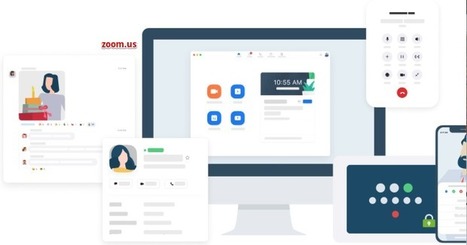
Free resource of educational web tools, 21st century skills, tips and tutorials on how teachers and students integrate technology into education Via Dr. Tom D'Amico (@TDOttawa) 
reuvenwerber's curator insight,
October 19, 2020 4:48 AM
Free resource of educational web tools, 21st century skills, tips and tutorials on how teachers and students integrate technology into education

Joseph Aguilar's curator insight,
September 12, 2023 10:28 AM
COVID-19 impacted the way we meet professionally and educationally. With this article, you can use it as a reference guide to be successful in an online video conferencing environment. It lists all the main features of Zoom and how-to videos on implementing its features. This article is extremely helpful, but some features vary depending on whether you have a BASIC license or a LICENSED account of Zoom.
Scoop.it!

Run Arduino library code examples in your browser, using advanced simulation technology. Via F. Thunus
Scoop.it!

Isolating? Boring? Not so fast. We debunk four myths about distanced, online learning, speaking with Athabasca University's president Neil Fassina. Via John Evans
Scoop.it!

This interactive timeline focuses on nine key theories for designing blended and online learning in Higher Education from 1885-2020. Via Nik Peachey
Scoop.it!

Est-il encore utile de présenter C'est pas sorcier, l'émission de vulgarisation scientifique (mais qui en réalité a abordé tous les sujets, avec la même rigueur) produite par France Télévision de 1993 à 2014? Via Gábor Kántor, Pilar_Mun 
blasco IA's curator insight,
October 20, 2020 9:20 PM
Gratuit 2020 : C'EST PAS SORCIER: l'intégrale! 559 vidéos en visionnage gratuit 
Bernadette Cassel's curator insight,
November 16, 2020 11:12 AM
"Présentée par Jamy et son compère Fred, puis, à partir de 1999, avec Sabine, l'émission C'est pas sorcier, qui comptabilise 559 épisodes, reste une référence pédagogique et didactique encore aujourd'hui."
|






