


|
Rescooped by
michel verstrepen
from Educación a Distancia y TIC
October 29, 2020 6:20 AM
|


No comment yet.
Sign up to comment

 Your new post is loading...
 Scoop.it! No comment yet.
Sign up to comment
Scoop.it!

Dans un webinaire de Campus Matin et son partenaire, le réseau des Inspé, quatre intervenants spécialisés sur la formation enseignante apportent leurs réponses.
Via Sandrine Decamps
Scoop.it!

La formation va-t-elle devenir exclusivement digitale ? Définition, avantages, limites… Nous vous partageons des pistes de réflexion ! Via ORSYS Formation
Scoop.it!

"Through the secure and controlled exchange of data, interoperability establishes a seamless network of communication across distinct technology platforms. Put more simply, systems that are interoperable speak to one another." Via EDTECH@UTRGV
Scoop.it!
Instrument to measure the quality of didactic material for long distance education | Ribeiro | RIED.
Scoop.it!

Making cybersecurity a part of the school culture and understanding cloud computing risks can help schools and districts deliver safe learning experiences virtually. Via EDTECH@UTRGV
Scoop.it!

Google Apps are collaborative, which makes them highly powerful. Here are 30 ideas for using some popular G Suite apps with your class. Via Dr. Tom D'Amico (@TDOttawa)
Scoop.it!

Noté /5. Retrouvez Je crée mon site avec WordPress. Le guide complet, de l'hébergement à la promotion
Scoop.it!
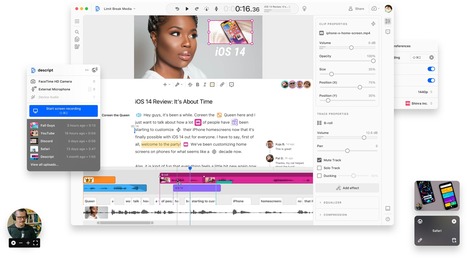
Record, edit, mix, collaborate, and master your audio and video with Descript. Download for free →. Via Philou49
Scoop.it!

I have heard from multiple educators across schools and districts that there is more collaboration than ever to design new models, practices, and support students. And yet, still too many are designing and teaching in isolation without having seen others teach in these new models. This means that teachers are limited by what they have seen or experienced in staff meetings, collaborations, or their own imaginations. This is the time to increase collaboration and open our virtual classroom doors to observe, learn, and improve. Via Edumorfosis, juandoming
Scoop.it!

Our rapidly evolving world forces us to adopt distinct patterns of behavior, and in the process, paves the way for new cognitive biases to emerge. Via Philippe Vallat
Scoop.it!

This template can serve as a home for generating, capturing, and mapping out project concepts as a team. With both whiteboarding and mindmapping spaces, this file helps foster ideation and effective collaboration! Via F. Thunus |
Scoop.it!

If there’s any silver lining to working in the education sector during a pandemic, it’s that the problems we knew existed all along have been made even more blatantly obvious. Remote learning has only exacerbated the divides among parents, teachers and students, across racial, economic and geographic lines. Via Nik Peachey
Scoop.it!

"Digital literacy means being literate in digital tech. The idea is that a person using tech or, more specifically, web technologies must be aware of the right way to utilize them. The abundance of resources, tools, and apps makes it easy for anyone to fall prey to the ill effects of the web. Being digitally literate helps one to find and avoid practices that are not ethical." Via EDTECH@UTRGV 
aidezg13@gmail.com's curator insight,
May 24, 2025 8:34 PM
I like that this article was in a list format and was straight to the point. The article does a great job of breaking down what digital literacy actually looks like in the classroom (not just knowing how to use tech, but understanding how to use it ethically and responsibly). I work with high school students who are constantly online, but many still struggle with things like evaluating sources, avoiding plagiarism, or recognizing fake information. One area I see this come up a lot is with scholarships, students are often searching on their own, and without the right digital literacy skills, they risk sharing personal or financial info with fake sites. We even offer a workshop on spotting scholarship scams because it’s such a common issue. I really connected with the part of the article that talks about digging deeper than the first page of Google and encouraging students to question their sources. These habits matter, especially when students start navigating college on their own.
Scoop.it!
Quality assessment dimensions in virtual education: a review of reference models | Marciniak | RIED.
Scoop.it!

Eve,Martin Paul ; Gray,Jonathan.“Reassembling Scholarly Communications: Histories, Infrastructures, and Global Politics of Open Access" MIT Press, 2020 Texto completo El Movimiento de Acceso Abierto propone eliminar las barreras de precio y de permiso para acceder a trabajos de investigación revisados... Via LGA, juandoming
Scoop.it!
"In these unprecedented times, the expectations for education technology solutions have never been higher. They must meet the pedagogical standards of experienced educators, and also be easy enough to use by a grandmother and kindergartener at a dining room table. They must elegantly integrate with—yet also stand out from—the myriad other tools schools are juggling. And as budgets shrink in a time of decreasing tax revenue, school leaders are forced to prioritize their “need to haves,” over their “nice to haves.” The edtech solutions they invest in must address their most critical and pressing problems." Via EDTECH@UTRGV
Scoop.it!

eLearning or electronic learning is the delivery of education and training through digital resources. While it's not a brand new method, its inclusion across various sectors has been hugely accelerated due to the Covid-19 pandemic. Via Edumorfosis, juandoming
Scoop.it!

Giggl Un outil pour naviguer sur le web en mode collaboratif. Un outil pour parcourir ensemble des pages web, visionner une vidéo ou participer à une réunion. Via Fidel NAVAMUEL
Scoop.it!

Scoop.it!

Celebrate, renew, or activate your school's commitment to digital citizenship. Via Dr. Tom D'Amico (@TDOttawa) 
Arlyna Garza's curator insight,
February 6, 2021 5:35 PM
This article is from the Common Sense Website, which did a feature on Digital Citizenship for an entire week. In the website, there are many ideas for students to learn about being a digital citizen.
Scoop.it!

Nine months into the COVID-19 pandemic, the university professor, author and lecturer credited with inventing the term e-learning says distance learning’s worldwide embrace is widening the gap between privileged and underprivileged children. Badrul H. Khan, a world-renowned speaker, author, educator and e-learning consultant and whose 1997 book “Web-Based Instruction” heralded the rise of distance learning, … Via EDTECH@UTRGV
Scoop.it!

These engaging activities can spark conversations about oversharing, digital footprints, cyberbullying, and more. Via Dr. Tom D'Amico (@TDOttawa) 
Dikeledi's curator insight,
June 9, 2021 7:06 PM
Talks about digital footprint and digital citizenship.
|






