



Teaching constantly meets new challenges. If frontal lessons were the norm decades ago, things have changed significantly. The focus is now on students and making classes interactive by encouraging student participation.
Via EDTECH@UTRGV, LGA

 Your new post is loading...
 Scoop.it! Teaching constantly meets new challenges. If frontal lessons were the norm decades ago, things have changed significantly. The focus is now on students and making classes interactive by encouraging student participation. Via EDTECH@UTRGV, LGA No comment yet.
Sign up to comment
Scoop.it!

By Kyle M. L. Jones (MLIS, PhD) Indiana University-Indianapolis (IUPUI) "The COVID-19 pandemic changed American higher education in more ways than many people realize: beyond forcing schools to transition overnight to fully online learning, the health crisis has indirectly fueled institutions’ desire to datafy students in order to track, measure, and intervene in their lives. Higher education institutions now collect enormous amounts of student data, by tracking students’ performance and behaviors through learning management systems, learning analytic systems, keystroke clicks, radio frequency identification, and card swipes throughout campus locations. How do institutions use all this data, and what are the implications for student data privacy? Are the technologies as effective as institutions claim? This blog explores these questions and calls for higher education institutions to better protect students, their individuality, and their power to make the best choices for their education and lives. When the pandemic prevented faculty and students from accessing their common campus haunts, including offices and classrooms, they relied on technologies to fill their information, communication, and education needs. Higher education was arguably better prepared than other organizations and institutions for immersive online education. For decades, universities and colleges have invested significant resources in networking infrastructures and applications to support constant communication and information sharing. Educational technologies, such as learning management systems (LMSs) licensed by Instructure (Canvas) and Blackboard, and productivity tools such as Microsoft’s Office365 are ubiquitous in higher education. So, while the transition to online education was difficult for some in pedagogical terms, the technological ability to do so was not: higher education was prepared. Datafication Explained: How Institutions Quantify Students The same technological ubiquity that has helped higher education succeed during the pandemic has also fueled institutions’ growing desire to datafy students for the purposes of observing, measuring, and intervening in their lives. These practices are not new to universities and colleges, who have long held that creating education records about students supports administrative record keeping and instruction. But data and informational conditions today are much different than just 10 to 20 years ago: the ability to track, capture, and analyze a student’s online information behaviors, communications, and system actions (e.g., clicks, keystrokes, facial movements), not to mention their granular academic history, is possible. In non-pandemic times, when students are immersed in campus life, myriad sensors (e.g., WiFi, RFID) and systems (e.g., building and transactional card swipes) associated with a specific location also make it possible to analyze a student’s physical movements. These data points enable institutions to track where a student has been and with whom that student has associated, by examining similar patterns in the data. How are institutions and the educational technology (edtech) companies they rely on using their growing stores of data? There have been infamous cases over the years, such as the Mount St. Mary’s “drown the bunnies” fiasco, when the previous president attempted to use predictive measures to identify and force out students unlikely to achieve academic success and be retained. Then-president Simon Newman, who was eventually fired, argued, “This is hard for [the faculty] because you think of the students as cuddly bunnies, but you can’t…. You just have to drown the bunnies…. put a Glock to their heads.” At the University of Arizona, its “Smart Campus research” aims to “repurpose the data already being captured from student ID cards to identify those most at risk for not returning after their first year of college.” It used student ID card data to track and measure social interactions through time-stamp and geolocation metadata. The analysis enabled the university to map student interactions and their social networks, all for the purpose of predicting a student’s likelihood of being retained. Edtech has also invested heavily in descriptive and predictive analytic capabilities, sometimes referred to as learning analytics. Common LMSs often record and share descriptive statistics with instructors concerning which pages and resources (e.g., PDFs, quizzes, etc.) a student has clicked on; some instructors use the data to create visualizations to make students aware of their engagement levels in comparison to their peers in a course. Other companies use their access to real-time system data and the students who create the data, to run experiments. Pearson gained attention for its use of social-psychological interventions on over 9,000 students at 165 institutions to test “whether students who received the messages attempted and completed more problems than their counterparts at other institutions.” While some characterize Pearson’s efforts as simple A/B testing, often used to examine interface tweaks on websites and applications, Pearson did the interventions based on its own ethical review, without input from any of the 165 institutions and without students’ consent. Is Datafication Worth It? Privacy Considerations The higher education data ecosystem and the paths it opens for universities, edtech, and other third-party actors to use it raises significant questions about the effects on students’ privacy. The datafication of student life may lead institutions to improve student learning as well as retention and graduation rates. Maybe studying student life at a granular, identifiable level, or even at broader subgroup levels, improves institutional decision making and improves an institution’s financial situation. But what are the costs of these gains? The examples above, many of which I have more comprehensively summarized and analyzed elsewhere, point to clear issues. Chief among them is privacy. It is not normative for institutions—or the companies they contract for services—to expose a student’s life, regardless of the purposes or justifications. Yet, universities and colleges continue to push the point that they can do so and are often justified in doing so if it improves student success. But student success is a broad term. Whose success matters and warrants the intrusion? Often an analytic, especially a predictive measure, requires historical data, meaning that one student’s life is made analyzable only for another student downstream to benefit months or years later. And how do institutions define success? Student success may be learning gains, but education institutions often construe it as retention and graduation, which are just proxies. When institutions datafy student life for some purpose other than to directly help students, they treat students as objects—not human beings with unique interests, goals, and autonomy over their lives. Institutions and others can use data and related artifacts to guide, nudge, and even manipulate student choices with an invisible hand, since students are rarely aware of the full reach of an institution’s data infrastructure. Students trust that institutions will protect identifiable data and information, but that trust is misplaced if institutions 1) are not transparent about their data practices and 2) do not enable students to make their own privacy choices to the greatest extent possible. Student privacy policy is often difficult for students to understand and locate.
Moreover, institutions need to justify their analytic practices. They should provide an overview of the intention of their practice and explain the empirical support for that justification. If the practice is experimental, institutions must communicate that they have no clear evidence that the practice will produce benefits for students. If science supports the practice, institutions should provide that science to students to review and summarize. Many other policy and practice recommendations are relevant, as the literature outlines ethics codes, philosophical arguments, and useful principles for practice. The key point here is that the datafication of student life and the privacy problems it creates are justified only if higher education institutions protect students and put their interests first, treat students as humans, and respect their choices about their lives."
To view original post, please visit: Via Roxana Marachi, PhD 
paul's curator insight,
August 23, 2022 9:28 PM
<a rel=nofollow target= _blank href=” https://209primersglock.com/contact-us / ” rel=”dofollow”>209 primers glock shop </a>
Scoop.it!

Are you a higher education leader who is in charge of planning campus innovation? Do you need a little help getting started? Well, look no further, as we have created an article that lists the three steps for strategically planning campus innovation. Via EDTECH@UTRGV, LGA
Scoop.it!

Learning produces long-term and often invisible results--few of which are illuminated with the most common learning outcomes and artifacts. Via LGA
Scoop.it!

La mémoire est cette fonction cérébrale essentielle qui nous permet de développer un sentiment de soi, d’emmagasiner des souvenirs, de raisonner, de comprendre, et bien sûr d’apprendre. On en parle au singulier, mais il serait plus juste de l’évoquer au pluriel. Nous savons en effet maintenant qu’elle se compose de différents systèmes qui, bien qu’en constantes interrelations, sont distincts et autonomes de par la nature des informations qu’ils emmagasinent et des réseaux cérébraux auxquels ils font appel. Via Vedrenne Guy
Scoop.it!

-Awareness of OER has grown in recent years, with some institutions throwing their full support behind such materials for their ability to drive down college costs for students. In the new report, Achieving the Dream argued that using OER can also lead to the development of innovative teaching strategies centered on equity and inclusion.The report calls these methods open educational practices, or OEP. Researchers identified five common characteristics associated with this type of education: Via Peter Mellow, LGA
Scoop.it!

CiteSeerX - Document Details (Isaac Councill, Lee Giles, Pradeep Teregowda): One thing that concerns me about the current excitement and interest in appreciative inquiry (AI) is that many of the consultants and managers I talk to who claim to be doing AI don’t seem to understand the importance of... Via F. Thunus
Scoop.it!

How students are assessed is among the most totemic issues in pedagogy. Debbie McVitty finds out what it takes to make assessment change happen Via Peter Mellow, THE OFFICIAL ANDREASCY
Scoop.it!

Le dossier présente une grande variété de pratiques pédagogiques, de méthodes recourant à des outils numériques pour mieux faire apprendre, dans un cadre collectif comme dans l’accompagnement individuel. Via Anne-Cécile MARCHAND
Scoop.it!

The COVID-19 pandemic forced schools all over the world to close their doors. This left school administrators scrambling to implement elearning and distance learning as a way to educate their students. What ensued was a melee of edtech companies jockeying for position in an attempt to garner market share. Via EDTECH@UTRGV
Scoop.it!
Digital project explores how artificial intelligence can help university staff reduce their workload
Jisc’s national centre for AI launches pilot of Graide, a digital assessment platform developed by students at the University of Birmingham. Via LGA
Scoop.it!

The 2022 EDUCAUSE Horizon Report profiles key trends and emerging technologies and practices shaping the future of teaching and learning, and envision Via juandoming
Scoop.it!

From
jarche

“the future of work will be based on hacking uncertainty” —Esko Kilpi
Esko Kilpi passed away in early 2020 and his work had informed my own for many years. He published a number of essays on Medium and I would like to curate some of the highlights from 2019. “Instead of thinking about the organization let’s think about organizing as an ongoing thing. Via LGA, THE OFFICIAL ANDREASCY 
THE OFFICIAL ANDREASCY's curator insight,
April 18, 2022 6:43 AM
"Change is not special. It's expensive."
- Andreas Christodoulou |
Scoop.it!
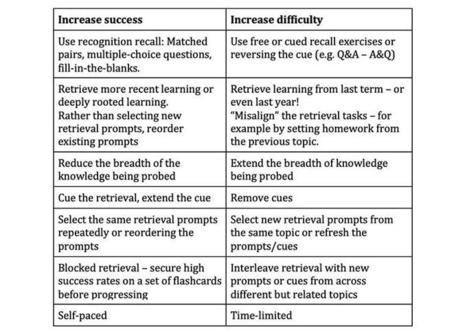
Continuing his series on the potential of retrieval practice, spaced learning, successive relearning, and metacognitive approaches in the classroom, this time Kristian Still focuses on the ‘spaced’ element, looking at the underpinning research and drawing out important lessons for teachers Via Nik Peachey
Scoop.it!

The most notorious oracle predicting the coming death spiral of academia was the late Harvard University professor Clayton Christensen, who in 2011 famously forecast that “50 percent of the 4,000 colleges and universities in the U.S. will be bankrupt in 10 to 15 years.” His prophecy was based on the notion that digital alternatives to face-to-face education—in his view, much cheaper and friendlier than conventional instruction—would convince millions of college students to turn their backs on stodgy, old campuses to earn degrees in internet alternatives instead. Via Edumorfosis, LGA 
Edumorfosis's curator insight,
April 20, 2022 9:15 PM
Lo que nuestras universidades no quieren, no pueden y no saben hacer, lo harán en otros lugares. Aquí están los resultados. Con lo CARA que está la vida en 2022, llevar la educación a los estudiantes será la opción más humana. Sacar del seno familiar a los estudiantes que cursarán estudios universitarios para pagar hospedaje, auto, gasolina, alimentos, vestimenta, materiales educativos y tarifas de peaje, es un acto INSENSIBLE. Qué sentido tiene invertir en tanta infraestructura tecnológica digital para seguir operando de manera presencial. Simplemente, muchos jóvenes optarán por no estudiar y conformarse con empleos de bajos salarios o de convertirse en una carga para la sociedad... (Adaptado de la entrada original del Dr. Jose Ferrer)
Scoop.it!

Today’s influential voices in education and tech are bringing advice and new ideas to their audience in the form of podcasts. Here are some to check out. Via EDTECH@UTRGV 
EDTECH@UTRGV's curator insight,
April 22, 2022 12:44 PM
Check out Alfonso Mendoza's 'My EdTech Life' podcast. His podcast features some of the most influential people in the EdTech world.
Scoop.it!

Drawing on their own research, HolonIQ (2021) claims that micro-credentials are set to play a critical role in the reshaping of the higher education landscape. They propose four scenarios to explore a range of possible futures. As illustrated in the diagram below, the scenarios fall into four quadrants based on the two axes of ‘market’ versus ‘government’ led initiatives, and the extent to which learning is aggregated or available in unbundled forms. Via Inovação Educacional, juandoming
Scoop.it!

A new study finds that open educational resources are a big hit with some community college students and faculty, but that these textbook alternatives won't reach their full potential until administrators embrace them. Via LGA
Scoop.it!

Discover how the metaverse will affect L&D (Learning and Development) in the future. Learn about technologies that are empowering the Metaverse, as well as the importance and relevance of the metaverse to corporate training. Via CommLab India, juandoming
Scoop.it!

Beyond the potential benefits, we also need to consider any challenges that might be faced if companies, schools, and organizations decide to move forward with the metaverse. Via Nik Peachey
Scoop.it!
Droits auteur. Ce qu’il faut savoir – Culture Numérique de l'enseignant – Droits et obligations. RGPD. Exception pédagogique.Numerique responsable 2 sept 2020... Via Anne-Cécile MARCHAND
Scoop.it!

Comme toute institution, l’enseignement supérieur est régulièrement traversé par un ensemble de changements, de mutations (Guibault & Viau-Guay, 2017). Parmi les plus récentes, l’accessibilité à la... Via Anne-Cécile MARCHAND
Scoop.it!

City Guesser is an online geography game where you are provided with a short video of a particular location and you are to find its place in the map. Via Dr. Tom D'Amico (@TDOttawa)
Scoop.it!

Publicación que integra los principales hallazgos en materia de evaluación y acreditación de competencias básicas en población adulta, resultantes del Proyecto Europeo para el diseño de un modelo de evaluación y acreditación de competencias básicas que el MEFP, a través de la Secretaría General de Formación Profesional, ha realizado contando con la asistencia técnica de la Dirección General de Reformas de la Comisión Europea y la Asociación Europea de Educación de Adultos. Via LGA
Scoop.it!

It is notable that even in 2020 the World Bank introduced targeted teacher support only after a key indicator declined. More concerning is that it’s not an isolated case. Via LGA |






