 Your new post is loading...

|
Rescooped by
Dennis Swender
from Tools for Teachers & Learners
November 3, 2020 2:47 AM
|
Focus, Commit stay productive and meet your goals. How it works what will you get ? pomodoro timer personal kanban smart analysis Benefits Increase your productivity instead of trying to do bunch of things at once, commit to one task only with this app.
Via Nik Peachey
|
|
Rescooped by
Dennis Swender
from Strictly pedagogical
October 20, 2020 2:59 AM
|
From The National Council Of Teachers Of English: Writing is an important part of life. It helps us communicate and work with each other, supports our learning, and helps us remember. The National …
Via Filomena Gomes
|
|
Rescooped by
Dennis Swender
from Learning with Technology
October 16, 2020 6:22 AM
|
From science databases to document collections and more, here are 100 of the best search engines for academic research.
Via NextLearning
|
|
Scooped by
Dennis Swender
October 15, 2020 5:34 AM
|
Sentence Clauses: What is a clause in a sentence? What if there is no subject and verb? Learn about what a sentence clause is and why it is important to know for IELTS.
|
|
Rescooped by
Dennis Swender
from college and career ready
October 8, 2020 5:41 AM
|
Dragan Gasevic looks at how learning analytics can be used to support the student experience as a tool for learning gain.
Understanding what satisfaction means in the context of learning is also key. Happiness is not necessarily an indicator of “good” learning. I refer to the concept “desirable difficulties”, which is well established in educational psychology, including spaced practice or self-testing. It relates to the effective approaches to learning that can be promoted by in-course expectations. Learning analytics can offer a way to understand the complex interplay between learning gains, effective study and teaching practices, and student satisfaction.
However academics and students choose to use the data that are increasingly available on their student journey, context is key. You can’t separate the data from the organisational culture, national and regional differences, pedagogical differences between courses, and the political context. Rather than applying the same data rules across all providers and courses to reach a neat set of answers, we must look at the context in which we’re operating.
Even within an institution, one size absolutely does not fit all. The approach we’ve taken with our science and technology students would not work with, say, English or history students, although we’re following with interest the development of writing analytics that some of our global partners are working on, where analytics are being used to gather evidence of, for example, the coherence and summary of an argument.
Via Miloš Bajčetić, Dean J. Fusto, Elizabeth E Charles, Lynnette Van Dyke
|
|
Rescooped by
Dennis Swender
from college and career ready
October 8, 2020 5:34 AM
|
Is the pen mightier than the laptop?
The latest business craze seems like a throwback to a bygone era. Basically, it's writing stuff down. Google "Bullet Journals" and you'll see that within a few years of Rydell Carroll introducing "BuJos," they've become all the rage. People are "discovering" the power of a neatly organized notebook to jot down notes, remind themselves of appointments, and create task lists. It's an "analog system for a digital age."
After years of filling legal pads, a few years back, I decided to go digital, putting my life into a software application that promised to sync my tasks, notes, and calendar into one giant, color-coded system. Instead, it became a monster to feed—never there when I needed it but pestering me with incessant reminders of overdue tasks. So, I recently came crawling back to the analog fold, finding new religion with my Bullet Journal. Now, my mind feels sharper, my days more focused, and my stress lessened as I put the messiness of my life back into in neatly lined pages. This led me to wonder—does something magical happen when we write stuff down? Should we encourage students to embrace handwritten notes?
Via John Evans, Lynnette Van Dyke
|
|
Rescooped by
Dennis Swender
from Papers
October 3, 2020 6:10 AM
|
(...) But as the pandemic forced many conferences to adopt virtual formats, the option to attend from home—often with discounted or free registration—led to surges in participation. A survey by Science Careers of 10 U.S.-based meetings of scientific societies across a variety of disciplines showed that most saw higher—and perhaps more diverse—attendance than in previous years. The Conference on Lasers and Electro-Optics (commonly referred to as “CLEO”) and the American Association for Cancer Research Annual Meeting—both of which offered free access—showed the greatest attendance increases, growing approximately fivefold to about 20,000 and 100,000 attendees, respectively.
But virtual conferences may not serve the needs of all scientific communities. The Joint Statistical Meetings (JSM), for example, was smaller than it had been in previous years, despite offering a registration discount of about 70%. “Some might still value face-to-face interactions,” (...)
Via Complexity Digest
|
|
Rescooped by
Dennis Swender
from Education 2.0 & 3.0
September 26, 2020 11:02 PM
|
Last week I hosted a Practical Ed Tech webinar titled Ten Search Strategies Students Need to Know. Afterwards I had many requests for accessing the recording of the webinar. The webinar is now available on demand. If you missed it, the webinar is available as an on-demand webinar right here on Practical Ed Tech.
Via Elizabeth E Charles
|
|
Rescooped by
Dennis Swender
from Educación a Distancia y TIC
September 14, 2020 11:58 PM
|
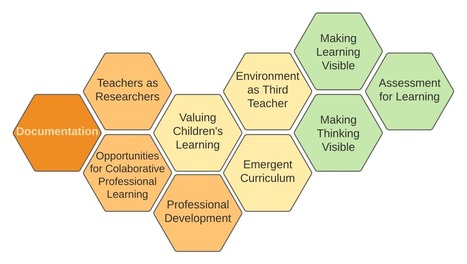
What place does documentation play in our learning environments? What roles might it play? We probably should begin by considering what we mean by documentation.When we talk documentation, we are describing the process of capturing evidence both of the learning progress of our students a...
Via LGA
|
|
Rescooped by
Dennis Swender
from Learning Blend
September 1, 2020 7:00 AM
|
|
Decisions, decisions, decisions.As customer experience professionals, we have decisions to make; we need to help our executives make decisions; and prioritization is an important part of our decision-making process. Tools to be more efficient and effective with our time and our efforts are priceless!
Via Stefano Principato
What's so important about asking students questions while teaching, and why is it so hard for teachers to do this consistently? What are some of the most time-efficient ways to check all students' understanding, and what's at stake when we fail to formatively assess students?
Via Peter Mellow
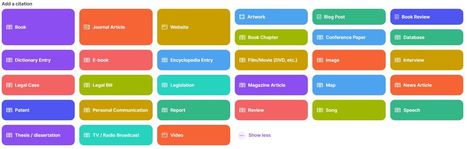
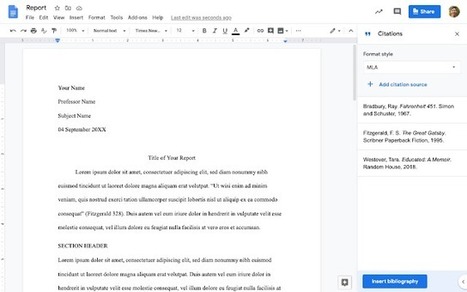
When I was in high school we had to learn how to create bibliographies by working from a template that my history teacher, Mr. Diggs, provided to us. When I went to college, I referred to that template and an early version of The Student Writer to make bibliographies. Today, students have a wealth of online tools that can help them properly structure citations and bibliographies. I've featured a handful of them over the last couple of years. Here they are.
Via Elizabeth E Charles
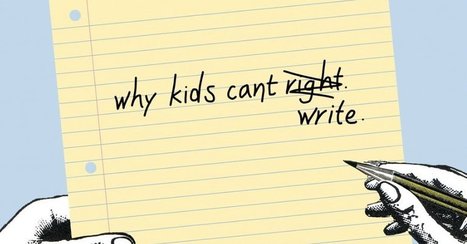
If you read through text composed by inferior writers, rife with spelling errors, grammar problems, fractured syntax and haphazard punctuation and you aren’t appalled, then you might be the target …
Via Charles Tiayon
|
|
Rescooped by
Dennis Swender
from college and career ready
October 8, 2020 5:42 AM
|
An analytical or persuasive essay is a capsule thesis, and, like its more substantial analogue, it requires a thesis statement. Here are some notes about how to
Via Sharrock, Lynnette Van Dyke
|
|
Rescooped by
Dennis Swender
from college and career ready
October 8, 2020 5:40 AM
|
Some say English instruction must get back to basics, with a focus on grammar. But won’t that stifle a student’s personal voice?
Via Lynnette Van Dyke
|
|
Scooped by
Dennis Swender
October 3, 2020 6:13 AM
|
|
|
Rescooped by
Dennis Swender
from Educación a Distancia y TIC
October 3, 2020 6:06 AM
|
|
|
Rescooped by
Dennis Swender
from The Student Voice
September 20, 2020 6:51 AM
|
|
|
Rescooped by
Dennis Swender
from Educación a Distancia y TIC
September 16, 2020 6:53 AM
|
Why don't facts change our minds? This article explains the logic of false beliefs and proposes a better system for constructive conversation.
Via LGA
|
|
Scooped by
Dennis Swender
September 9, 2020 11:52 PM
|
Start by making sure you practice what you preach.
|
|
Rescooped by
Dennis Swender
from Learning Blend
September 1, 2020 6:56 AM
|
|



























I've never been too sure about the pomodoro technique, but combined with the kanban board it may be useful.