ED 262 KCKCC Su '26
5.8K views | +8 today
ED 262 KCKCC Su '26
Your new post is loading...
Scooped by Dennis Swender
July 5, 2015 4:08 PM
Scoop.it!

Botswana auctions diamonds at home

Botswana auctions diamonds at home | ED 262 KCKCC Su '26 | Scoop.it

Botswana, the world's largest diamond producer, starts to auction its own diamonds for the first time instead of selling them in Europe.

No comment yet.
Scooped by Dennis Swender from Collaborationweb
July 3, 2015 12:58 PM
Scoop.it!

Networks, Organizations and Movements

Networks, Organizations and Movements | ED 262 KCKCC Su '26 | Scoop.it
When thinking about social change movements, networks teach us that it all comes down to the human connection.

Via David Hain
No comment yet.
Scooped by Dennis Swender from Learning & Technology News
July 3, 2015 12:44 PM
Scoop.it!

Virtual Debate: 7 Advantages of Online Discussions

Virtual Debate: 7 Advantages of Online Discussions | ED 262 KCKCC Su '26 | Scoop.it

How to facilitate such discussions is confusing to many teachers, and online discussion threads and chatrooms may be seen as a poor substitute for the “real” thing, an evil necessity of the online class. However, although there are some barriers such as its more decontextualized nature, in comparison to face-to-face discussion, there are advantages that are unique to the online discussion that can be built on by the instructor while the drawbacks are minimized.


Via Nik Peachey
Olga Boldina's curator insight, July 3, 2015 7:28 AM

добавить ваше понимание ...

Emilycanfield's comment, July 4, 2015 2:08 AM
Its grand
Carol Askin's curator insight, July 18, 2015 4:55 PM

In this blog post, the article discusses why online discussions are important. Connivence and increased student participation are two advantages the author lists. Concise, core information.

Scooped by Dennis Swender from :: The 4th Era ::
June 16, 2015 10:52 AM
Scoop.it!

Introducing this work

Introducing this work | ED 262 KCKCC Su '26 | Scoop.it

For the purposes of this Scoop.it site, the history of human interaction with information may be divided into 4 eras. The first (spoken) era ended with the invention of writing around 3000-4000 BC. The second era ended with the invention of the printing press in 1440. The third era ended, and the fourth began, with the invention of the Internet (depending how one defines its operational beginning) somewhere between 1969 and 1982. We now exist early, but decidedly, in the fourth era.


All readers may not agree with this interpretation of the history of information, especially with the division and numbering of the eras. That is not the main point. Rather, it is that humankind is presently existing in an era distinctly different from the one that preceded it -- that in fact, this new era is accompanied with, and characterized by, a new - and quite different - information landscape. This new Internet information landscape will challenge, disrupt, and overpower the print-oriented one that came before it. It will not completely obliterate that which preceded it, but it will render it to a subsidiary, rather than primary, level of influence.


Just as the printing press altered humanity's relationship with information, thereby resulting in massive restructuring of political, religious, economic, social, educational, cultural, scientific, and other realms of life; so too will the Internet occasion analogous transformations in the corresponding universe of present and future human activity.


This site will concern itself primarily with how K-20 education in the US, and the people who comprise its constituencies, may be affected by this transformative movement from one era to the next. All ideas considered here appear, to me at least, to impact the learning enterprise in some way. Accordingly, this work looks at the present and the future through a lens that is predominantly, but far from entirely, a digital one. -JL


Opinions expressed, scooped, or copied in this Scoop.it topic are my choice, and are in no way to be connected with my employer.


Via Jim Lerman
reliablephd's comment, October 18, 2023 4:07 AM
nice
anxietyanon's comment, October 31, 2023 3:52 AM
good
anxietyanon's comment, October 31, 2023 3:52 AM
good
Scooped by Dennis Swender from Educational Technology in Higher Education
June 4, 2015 1:59 AM
Scoop.it!

For Once and for All: College Students Are Not Customers

For Once and for All: College Students Are Not Customers | ED 262 KCKCC Su '26 | Scoop.it
In what is apparently a vogue of Republican state legislators exercising misplaced vendettas against college professors, Iowa Sen. Mark Chelgren recently made headlines when he introduced Senate File 64, “an Act relating to the teaching effectiveness and employment of professors” at Iowa public institutions. Each year, the bill stipulates, any...

Via Mark Smithers
No comment yet.
Scooped by Dennis Swender
May 31, 2015 1:54 AM
Scoop.it!

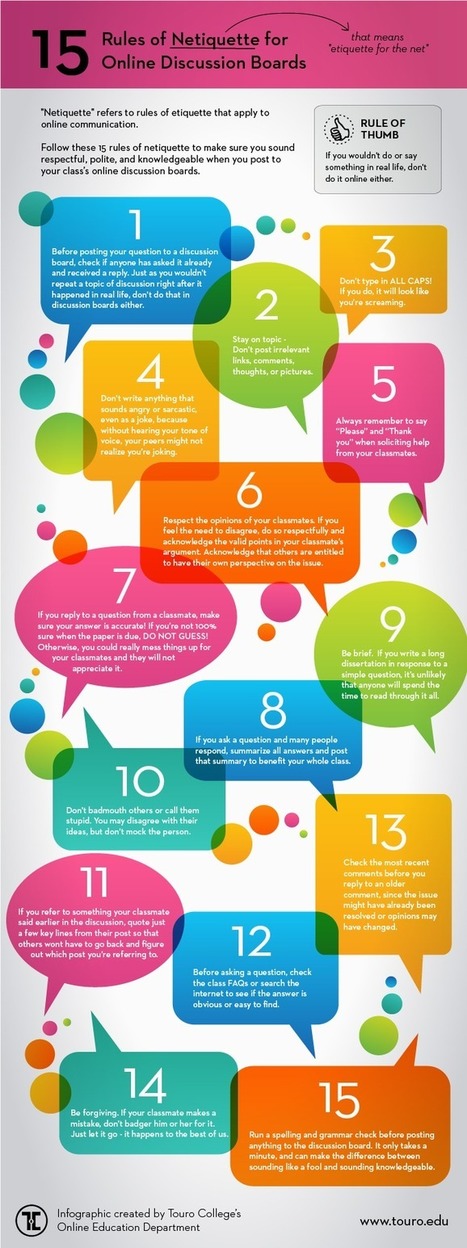
15 Rules of Netiquette for Online Discussion Boards [INFOGRAPHIC] - Online Education Blog of Touro College

15 Rules of Netiquette for Online Discussion Boards [INFOGRAPHIC] - Online Education Blog of Touro College | ED 262 KCKCC Su '26 | Scoop.it
“Netiquette” refers to rules of etiquette that apply to online communication.

Follow these 15 rules of netiquette to make sure you sound respectful, polite, and knowledgeable when you post to your class’s online discussion boards.
Ajo Monzó's curator insight, March 29, 2015 8:04 AM

Thanks!!!

Ellen Comito McKeown's curator insight, June 24, 2015 11:15 AM

Spells out rules for netiquette.  Good way to start out with students who are used to posting on social networks and ranting.  In the comments, the college stated that teachers can reprint this for their classrooms as long as they give credit to Touro College. 

Ness Crouch's curator insight, June 17, 2017 5:53 PM
Another useful classroom resource
Scooped by Dennis Swender from Effective Education
May 28, 2015 9:51 AM
Scoop.it!

Core of the Matter: What Does an Equitable Classroom Look Like? (#CoreMatters)

Core of the Matter: What Does an Equitable Classroom Look Like? (#CoreMatters) | ED 262 KCKCC Su '26 | Scoop.it
The following blog post is another in the Alliance’s “Core of the Matter” blog series focusing on the...

Via Cindy Riley Klages, Mark E. Deschaine, PhD
No comment yet.
Scooped by Dennis Swender from Supports for Leadership
May 22, 2015 12:22 PM
Scoop.it!

The Act of Empowering Others Changes Lives

The Act of Empowering Others Changes Lives | ED 262 KCKCC Su '26 | Scoop.it
When you empower people, you’re influencing not only them, but also all the people they will influence in turn through their leadership. That is empowering.

Via Anne Leong, Mark E. Deschaine, PhD
No comment yet.
Scooped by Dennis Swender from Leading Schools
May 22, 2015 12:11 PM
Scoop.it!

Could smartphone bans help students achieve more? (+video)

Could smartphone bans help students achieve more? (+video) | ED 262 KCKCC Su '26 | Scoop.it
A study from the London School of Economics found that banning smartphones in classrooms can assist in learning. Are kids plugging in too early?

Via Mel Riddile
No comment yet.
Scooped by Dennis Swender from All things communication
May 21, 2015 1:59 AM
Scoop.it!

The Future of News Is Not About Facts: It's About Context, Relevance and Opinion

The Future of News Is Not About Facts: It's About Context, Relevance and Opinion | ED 262 KCKCC Su '26 | Scoop.it

"News sources can't just give us the facts. They must tell us what those facts mean."


Via Robin Good, aufaitLibrarian
Robin Good's curator insight, February 24, 2014 4:55 PM


Here's a refreshing look at the future of news that highlights the importance of going deeper into creating value for readers by providing more focus, relevance, context and opinion.

These are the characters that properly define what we now refer to as "curation" when it comes to content and news.


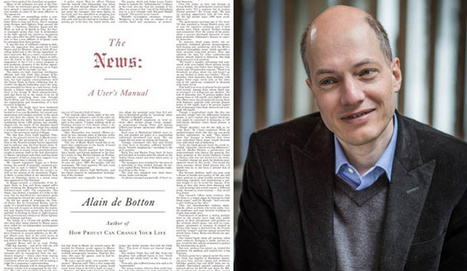
The following passages, extracted from the book, The News: A User's Manual, are by Alain de Botton, and have been excerpted from a lengthy article on The Week entitled "The Future of News".


"News organizations are coy about admitting that what they present us with each day are minuscule extracts of narratives whose true shape and logic can generally only emerge from a perspective of months or even years — and that it would hence often be wiser to hear the story in chapters rather than snatched sentences.


They [news organizations] are institutionally committed to implying that it is inevitably better to have a shaky and partial grasp of a subject this minute than to wait for a more secure and comprehensive understanding somewhere down the line.


...


We need news organizations to help our curiosity by signaling how their stories fit into the larger themes on which a sincere capacity for interest depends.


To grow interested in any piece of information, we need somewhere to "put" it, which means some way of connecting it to an issue we already know how to care about.


A section of the human brain might be pictured as a library in which information is shelved under certain fundamental categories. Most of what we hear about day to day easily signals where in the stacks it should go and gets immediately and unconsciously filed.


... the stranger or the smaller stories become, the harder the shelving process grows. What we colloquially call "feeling bored" is just the mind, acting out of a self-preserving reflex, ejecting information it has despaired of knowing where to place.


...We might need help in transporting such orphaned pieces of information to the stacks that would most appropriately reveal their logic.


...it is news organizations to take on some of this librarian's work. It is for them to give us a sense of the larger headings under which minor incidents belong."


The call for understanding how much greater value can be provided by curating news and information in depth, rather than by following the shallow, buzzy and viral path beaten by HuffPo, Buzzfeed and the rest of the gang, is clear.


But beyond context and depth, real value can only be added if we accept the fact that going beyond the classic "objective fact reporting", by adding opinion and bias in a transparent fashion, can actually provide greater value in many ways, as Alain de Botton clearly explains:


"Unfortunately for our levels of engagement, there is a prejudice at large within many news organizations that the most prestigious aspect of journalism is the dispassionate and neutral presentation of "facts."


...


The problem with facts is that there is nowadays no shortage of sound examples. The issue is not that we need more of them, but that we don't know what to do with the ones we have...


...But what do these things actually mean? How are they related to the central questions of political life? What can they help us to understand?


...The opposite of facts is bias. In serious journalistic quarters, bias has a very bad name. It is synonymous with malevolent agendas, lies, and authoritarian attempts to deny audiences the freedom to make up their own minds.


Yet we should perhaps be more generous toward bias.


In its pure form, a bias simply indicates a method of evaluating events that is guided by a coherent underlying thesis about human functioning and flourishing.


It is a pair of lenses that slide over reality and aim to bring it more clearly into focus.


Bias strives to explain what events mean and introduces a scale of values by which to judge ideas and events. It seems excessive to try to escape from bias per se; the task is rather to find ways to alight on its more reliable and fruitful examples. 


There are countless worthy lenses to slide between ourselves and the world." 


Overall, these ideas offer a truly refreshing look at the future of news and at the relevance that context and opinion could play in transforming this medium from a vehicle of mass distraction to one of focused learning and understanding for those interested. 


Must read. Rightful. Insightful. 9/10


Full article: http://theweek.com/article/index/256737/the-future-of-news 


Reading time: 10':20"


Javier Antonio Bellina's curator insight, February 25, 2014 2:36 PM

El futuro de las Noticias no es sobre los Hechos, sino sobre contexto, relevancia y opinión.

Catherine Pascal's curator insight, March 3, 2014 5:12 AM

 Intéressant 

Scooped by Dennis Swender from Educational Technology News
May 20, 2015 12:55 PM
Scoop.it!

Data That Will Vex Online Education Critics

Data That Will Vex Online Education Critics | ED 262 KCKCC Su '26 | Scoop.it

"Two weeks ago I wrote about the overwhelming research evidence that community college students aren’t doing as well in online classes as they are in face-to-face traditional classes. Students are failing in higher numbers and getting lower grades. That remains true, but it isn’t the whole story."


Via EDTECH@UTRGV
No comment yet.
Scooped by Dennis Swender from Ana Cristina Pratas - E-Portfolio
May 20, 2015 3:49 AM
Scoop.it!

The Point Of The Journey Is Not To Arrive: Cristina SkyBox

The Point Of The Journey Is Not To Arrive: Cristina SkyBox | ED 262 KCKCC Su '26 | Scoop.it

Via Ana Cristina Pratas
Ana Cristina Pratas's curator insight, April 24, 2013 12:36 PM

This is the blog from a lifelong learner (Ana Cristina) who truly cares about education.  Be prepared to be overwhelmed (in a good way) with tons of resources and posts!  I found out about her on Twitter and have been enjoying her posts every day since.  Spread the word!!


Michael Scott

Scooped by Dennis Swender from Into the Driver's Seat
May 16, 2015 10:26 AM
Scoop.it!

Teacher spends two days as a student and is shocked at what she learns ~ Washington Post: by Valerie Strauss

Teacher spends two days as a student and is shocked at what she learns ~ Washington Post: by Valerie Strauss | ED 262 KCKCC Su '26 | Scoop.it
Do teachers really know what students go through? To find out, one teacher followed two students for two days and was amazed at what she found. Her report is in following post, which appeared on the blog of Grant Wiggins, the co-author of “Understanding by Design” and the author of “Educative Assessment” and numerous articles on education. A high school teacher for 14 years, he is now the president of Authentic Education, in Hopewell, New Jersey, which provides professional development and other services to schools aimed at improving student learning. You can read more about him and his work at the AE site.

Via Jim Lerman
Luciano Lampi's curator insight, May 16, 2015 8:43 PM

And you, are you shocked?

Sample Student's curator insight, May 17, 2015 9:09 PM

How relevant is this to our current task of writing a narrative? Put yourself in the shoes of your students, and write their 'story'. What do they do in your classes? How do they think in your classes? How much autonomy and challenge do they have? What options do we have to replace a focus on listening and note-taking?


Without writing a narrative that helps us understand every learner's experience, we often become so busy ourselves as teachers that we forget their lived experience in our classrooms

Scooped by Dennis Swender
July 5, 2015 4:07 PM
Scoop.it!

The map that shows where America came from: Fascinating illustration shows the ancestry of EVERY county in the US

The map that shows where America came from: Fascinating illustration shows the ancestry of EVERY county in the US | ED 262 KCKCC Su '26 | Scoop.it
For decades, Lady Liberty, mother of exiles, stood watch as millions of immigrants arrived in the U.S. in hope of a better life.
No comment yet.
Scooped by Dennis Swender from Learning & Technology News
July 3, 2015 12:46 PM
Scoop.it!

Why Online Students Succeed

Why Online Students Succeed | ED 262 KCKCC Su '26 | Scoop.it
Improving online student success can be overwhelming, but findings from a recent Eduventures study suggest that it is not as complicated as it seems.

Via Nik Peachey
Nik Peachey's curator insight, June 17, 2015 4:46 AM

An interesting read with a useful tick list of things  to check for in your online offering.

Alexandra Koukoumialou's curator insight, June 18, 2015 2:00 AM

Loved the checklist!


ERBRAINS MICROSOFT DYNAMICS's curator insight, June 18, 2015 2:07 AM

Real Time and the conversation

Scooped by Dennis Swender from Multiliteracies
June 16, 2015 11:16 AM
Scoop.it!

Maria's blog: Learn with Passion

Maria's blog: Learn with Passion | ED 262 KCKCC Su '26 | Scoop.it

Via Vance Stevens
Vance Stevens's curator insight, July 4, 2014 8:41 AM

For some reason I like this post. Maria Bossa talks about how KEY educators have impacted her teaching and ability to learn through interaction and collaboration, heuristics she can pass on to her students

Scooped by Dennis Swender from Educational Technology in Higher Education
June 4, 2015 2:16 AM
Scoop.it!

Teaching assistants, adjunct faculty and online learning

Teaching assistants, adjunct faculty and online learning | ED 262 KCKCC Su '26 | Scoop.it

Via Mark Smithers
No comment yet.
Scooped by Dennis Swender
June 1, 2015 12:39 PM
Scoop.it!

Supporting Cultural Diversity in e-Learning - YouTube

short presentation video
Character Minutes's curator insight, June 2, 2015 11:20 AM

Greay food for thought thT relates to online classes that reach students outside the USA.


Scooped by Dennis Swender
May 29, 2015 5:10 PM
Scoop.it!

Study: Online community college courses found to be ineffective

Study: Online community college courses found to be ineffective | ED 262 KCKCC Su '26 | Scoop.it
Students gravitate toward online classes because of their flexibility and because they’re perceived to be less difficult.
No comment yet.
Scooped by Dennis Swender from Mentoring New Special Education Teachers
May 28, 2015 9:32 AM
Scoop.it!

The 6-Step Guide To Becoming A Better Learner

The 6-Step Guide To Becoming A Better Learner | ED 262 KCKCC Su '26 | Scoop.it

““Education is what people do to you and learning is what you do for yourself,” said Joi Ito in his TED2014 talk. “You’re not going to be on top of mountain all by yourself with a #2 pencil …”What we need to learn is how to learn.” Indeed, traditional education may not be for everyone, but learning is.===> Education is not a place or a deadline. It’s a practice, a habit, a part of your daily diet. <===


Via Gust MEES, David Baker, Trude Burnett
David Baker's curator insight, July 6, 2014 1:38 AM
A great list for professional teacher learning and goals for student learning.
Trude Burnett's curator insight, July 9, 2014 10:57 AM

An excellent reminder to ourselves as adult learners: find your passion and go learn about it.  The concept of "cross-pollination" of ideas is so VERY important for everyone.

Scooped by Dennis Swender from Effective Technology Integration into Education
May 22, 2015 12:13 PM
Scoop.it!

Mobile phone bans improve school exam results, research shows

Mobile phone bans improve school exam results, research shows | ED 262 KCKCC Su '26 | Scoop.it
A study by the London School of Economics found pupils at phone-free schools performed better in GCSE exams, especially those in bottom 60% of KS2 tests

Via Mark E. Deschaine, PhD
No comment yet.
Scooped by Dennis Swender from Design, Science and Technology
May 21, 2015 2:26 AM
Scoop.it!

Internet Replacing Radio: Norway Will Be the First Country to Turn Off FM Radio in 2017

Internet Replacing Radio: Norway Will Be the First Country to Turn Off FM Radio in 2017 | ED 262 KCKCC Su '26 | Scoop.it

Norway’s Minister of Culture announced this week that a national FM-radio switch off will commence in 2017, allowing the country to complete its transition over to digital radio. It’s the end of an era.


As Radio.no notes, Digital Audio Broadcasting (DAB) will provide Norwegian listeners more diverse radio channel content than ever before. Indeed, DAB already hosts 22 national channels in Norway, as opposed to FM radio’s five, and a TNS Gallup survey shows that 56% of Norwegian listeners use digital radio every day. While Norway is the first country in the world to set a date for an FM switch-off, other countries in Europe and Southeast Asia are also in the process of transitioning to DAB.


requency modulation, or FM, radio was patented in 1933 and has been recording and sharing the human story for nearly a century. But its days are clearly waning. According to a 2012 Pew Study, while over 90% of Americans still listen to AM/FM radio at least weekly, more people are choosing to forgo analog radio for Internet-only services each year. It seems like it’s only a matter of time before many countries follow Norway’s example, although I’m not so sure I’m ready to part with my 80’s-era Grundig. Thing still sounds like a dream.


Via Dr. Stefan Gruenwald, Antonios Bouris
No comment yet.
Scooped by Dennis Swender
May 20, 2015 1:20 PM
Scoop.it!

Through the Eyes of the Diaspora

Through the Eyes of the Diaspora | ED 262 KCKCC Su '26 | Scoop.it
When Jean Muteba Rahier teaches his African Civilizations course, he already knows the common stereotypes he will have to break down throughout the semester.
No comment yet.
Scooped by Dennis Swender from Digital Delights - Digital Tribes
May 20, 2015 4:01 AM
Scoop.it!

5 Team Building Games That Promote Critical Thinking

5 Team Building Games That Promote Critical Thinking | ED 262 KCKCC Su '26 | Scoop.it
Here are 5 team building games to try out with your students that also develop critical thinking skills.

Via Ana Cristina Pratas
No comment yet.
Scooped by Dennis Swender
May 20, 2015 3:08 AM
Scoop.it!

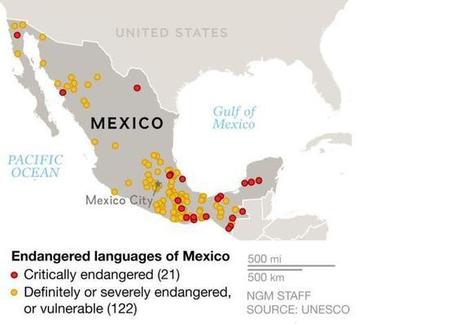
Sixty Languages at Risk of Extinction in Mexico—Can They Be Kept Alive?

Sixty Languages at Risk of Extinction in Mexico—Can They Be Kept Alive? | ED 262 KCKCC Su '26 | Scoop.it
Sixty of Mexico's native languages are at risk of being silenced forever—but many people are working to keep them alive, experts say.
Mark Hathaway's curator insight, September 22, 2015 8:29 AM

The demise of a language is a truly tragic event. I am heartened to see that there are efforts being undertaken to preserve these historic languages. New technologies  will hopefully aid us in this effort. I imagine that the United States probably faces similar issues when it comes to language loss. We should coordinate some sort of national policy in how to deal with the issue. The current state of political affairs will probably hamper  the cause, but it is still worth a shot. I am in full support of all efforts that might preserve these classic languages.

Gene Gagne's curator insight, December 2, 2015 9:29 AM

This is one of the reasons that when immigrants come into this country its important they keep their native language going as well as learning to speak English. The sharing of culture, and language is indeed very important. Lots of people come to America and are told to speak English and eventually they lose their native language as well as culture. The English speaking only citizens of this country lose out on a good education about someone's native country. Its too bad. Just think music, language, food, values etc...there is a lot to learn.

Genesis Orellana Cabrera's curator insight, January 24, 2018 10:45 PM
Languages are greatly important which is why I see the urgency in wanting to keep those endangered languages alive. Globalization through this article shows to be affecting cultural geography as Mexicans no longer see the need to know any other language but Spanish since it domains. This is causing the culture of Mexico to be forgotten. Just like Harrison said, "Each of the Mexican indigenous languages contains millennia of human experience, wisdom, and practical knowledge about the natural environment." The many languages are one of the things that shape Mexico and its people.