ED 262 KCKCC Su '26
5.8K views | +9 today
ED 262 KCKCC Su '26
Your new post is loading...
Scooped by Dennis Swender
August 7, 2015 11:06 AM
Scoop.it!

GeoGuessr - Let's explore the world!

GeoGuessr - Let's explore the world! | ED 262 KCKCC Su '26 | Scoop.it
GeoGuessr is a geography game which takes you on a journey around the world and challenges your ability to recognize your surroundings.
No comment yet.
Scooped by Dennis Swender from Effective Education
August 4, 2015 10:05 AM
Scoop.it!

How Conflict Makes Us Better

How Conflict Makes Us Better | ED 262 KCKCC Su '26 | Scoop.it
Conflict. The very word sends negative and fearful thoughts through even the most hardy leaders.

None of us like conflict. If we had our way, each one of us would steer away from it and navigate towards the less painful, smoother waters.

However, where would any one of us be if we avoided conflict altogether?

We must admit that while uncomfortable, and even painful, conflict helps us become better leaders. Like an intense workout, the benefits that are received through times of resistance and pressure give us wonderful opportunities to grow and become stronger.

With the opportunities to grow in mind,  I offer some benefits for us to keep in mind on how conflict makes us better overall:

Makes Us Understand Others – Conflict is usually the stark differing of viewpoints, values, or vision. When we get outside of our views to see the other side, or as Stephen R. Covey stated “seek first to understand,” we will find out what the other party holds close to and begin to work towards a more common ground.

Via Marc Wachtfogel, Ph.D., Mark E. Deschaine, PhD
Ivan Ang's curator insight, August 3, 2015 10:33 PM

As a leader, how do you deal with conflicts?

Scooped by Dennis Swender from Susan Bainbridge - ePortfolio
August 2, 2015 5:16 AM
Scoop.it!

DMZ: Tensions high at knife-edge of Korean conflict

DMZ: Tensions high at knife-edge of Korean conflict | ED 262 KCKCC Su '26 | Scoop.it
Just ahead of the demilitarized zone (DMZ) that separates North and South Korea, the world's most tense border, South Koreans take their last chance to protest -- behind them lies no-man's land.

Via Dr. Susan Bainbridge
Dennis Swender's insight:

My son and daughter-in-law and their soon to be born baby sit in Seoul wondering what will happen next! Shouldn't be happening in this day and age!

Dr. Susan Bainbridge's curator insight, April 10, 2013 12:07 PM

My son and daughter-in-law and their soon to be born baby sit in Seoul wondering what will happen next! Shouldn't be happening in this day and age!

Scooped by Dennis Swender from #BetterLeadership
July 30, 2015 1:47 PM
Scoop.it!

The Education Economy: America's Next Big Thing? Do We Care?

The Education Economy: America's Next Big Thing?  Do We Care? | ED 262 KCKCC Su '26 | Scoop.it
Integrating the country's educational system, employers, and job creators can reshape -- and reignite -- the American economy. An expert on education explains.

Via AlGonzalezinfo
Dennis Swender's insight:

While I am happy to be working with teachers and students to help develop #FutureLeaders, the findings of this Gallup report are alarming.


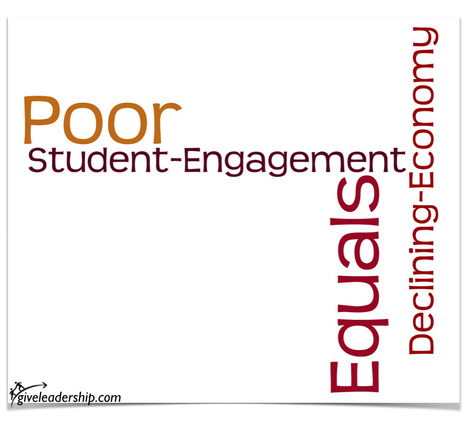
Here are a few facts that tell the tale of our poor student engagement in schools and its relationship to  our declining economy:


Student engagement in school drops precipitously from fifth grade through 12th grade. About three quarters of elementary school kids (76%) are engaged in school, while only 44% of high school kids are engaged. The longer students stay in school, the less engaged they become. If we were doing this right, the trend would be going in the opposite direction.
 About four in 10 students in grades five through 12 (43%) say they plan to start their own business, yet only 7% currently have an internship or job in a real organization where they can apply that energy. News flash: Schools and colleges don't have jobs and internships -- employers do. If we don't get schools and businesses working together to give students these opportunities, everyone will lose.
 Only 14% of Americans say they are confident that college graduates are well-prepared for success in the workplace. And business leaders are even more skeptical, with only 11% saying that college graduates are well-prepared for success at work. Yet despite this, 96% of chief academic officers of colleges and universities are either somewhat or very confident that they are preparing college students for success in the workplace. It's hard to imagine a gap -- or moat -- bigger than that. 
 And if you think our schools and colleges will be able to test our way out of this mess, that's a big mistake too. Perhaps the most important education-related news story of the entire year was Google -- the world's most admired brand -- announcing that it found almost no correlation between the grades and test scores of its employees and their success on the job. So the company no longer asks all its applicants to provide these things. This is a canary in the coal mine. As goes Google, so goes the rest of the business world.


AlGonzalezinfo's curator insight, September 11, 2014 7:20 AM

While I am happy to be working with teachers and students to help develop #FutureLeaders, the findings of this Gallup report are alarming.


Here are a few facts that tell the tale of our poor student engagement in schools and its relationship to  our declining economy:


  • Student engagement in school drops precipitously from fifth grade through 12th grade. About three quarters of elementary school kids (76%) are engaged in school, while only 44% of high school kids are engaged. The longer students stay in school, the less engaged they become. If we were doing this right, the trend would be going in the opposite direction.
     
  • About four in 10 students in grades five through 12 (43%) say they plan to start their own business, yet only 7% currently have an internship or job in a real organization where they can apply that energy. News flash: Schools and colleges don't have jobs and internships -- employers do. If we don't get schools and businesses working together to give students these opportunities, everyone will lose.
     
  • Only 14% of Americans say they are confident that college graduates are well-prepared for success in the workplace. And business leaders are even more skeptical, with only 11% saying that college graduates are well-prepared for success at work. Yet despite this, 96% of chief academic officers of colleges and universities are either somewhat or very confident that they are preparing college students for success in the workplace. It's hard to imagine a gap -- or moat -- bigger than that. 
     
  • And if you think our schools and colleges will be able to test our way out of this mess, that's a big mistake too. Perhaps the most important education-related news story of the entire year was Google -- the world's most admired brand -- announcing that it found almost no correlation between the grades and test scores of its employees and their success on the job. So the company no longer asks all its applicants to provide these things. This is a canary in the coal mine. As goes Google, so goes the rest of the business world.


Scooped by Dennis Swender from Educational Technology News
July 30, 2015 11:40 AM
Scoop.it!

Internet and Technology: Are digital natives really equipped?

Internet and Technology: Are digital natives really equipped? | ED 262 KCKCC Su '26 | Scoop.it

"We have come a long way digitally from the time when shorthand and typing were considered essential skills to fetch a job based on your speed. Today, we are in an era where a primary school student – a ‘digital native’ – can type faster than even a professional."


Via EDTECH@UTRGV
No comment yet.
Scooped by Dennis Swender from Educational Technology News
July 30, 2015 11:35 AM
Scoop.it!

School saves 150 failing students with quickie online courses

School saves 150 failing students with quickie online courses | ED 262 KCKCC Su '26 | Scoop.it
Flushing HS put 150 flunking students in quickie online “credit recovery” courses and pressured teachers to reverse failing grades to boost a lower-than-50 percent graduation rate, a stunning inter...

Via EDTECH@UTRGV
No comment yet.
Scooped by Dennis Swender from Community Village Daily
July 23, 2015 1:55 PM
Scoop.it!

61 Years After Brown v. Board Of Education, Many Schools Remain Separate And Unequal

61 Years After Brown v. Board Of Education, Many Schools Remain Separate And Unequal | ED 262 KCKCC Su '26 | Scoop.it


The following excerpt is taken from the Huffington Post’s May 17, 2015 article titled, “61 Years After Brown v. Board Of Education, Many Schools Remain Separate And Unequal.” 


Decades after the U.S. Supreme Court’s Brown v. Board of Education ruling declared segregated schooling of black students unconstitutional, many American schools with high minority populations continue to receive fewer resources and provide an education that’s inferior to schools with large white populations.


The following graphs show some of these disparities:


Continue reading


Via Community Village Sites
No comment yet.
Scooped by Dennis Swender from Community Village World History
July 23, 2015 1:20 PM
Scoop.it!

Manifest Destiny

Manifest Destiny | ED 262 KCKCC Su '26 | Scoop.it


Manifest Destiny (1845) is the idea that God meant for the US to have all of North America. Its roots go back to the 1600s to Puritan ideas of being God’s chosen people in a promised land, just like the Jews in the Bible.


Manifest Destiny makes wars of naked conquest against Mexicans and Natives in the 1800s seem just, as the way it had to be.


- Click through for more - 


Via Community Village Sites
shelby's curator insight, March 31, 2015 1:25 PM

Manifest Destiny occurred in 1845, it was the idea that God wanted the United Sates to have all of North America. This made war against Mexicans and Natives. They were thrown off their lands and if they refused then they would be raped or massacred.

Scooped by Dennis Swender from Oppression Monitor
July 23, 2015 12:40 PM
Scoop.it!

Racism in Grade School And Its Damaging Long-Term Effects

Racism in Grade School And Its Damaging Long-Term Effects | ED 262 KCKCC Su '26 | Scoop.it

By Kaitlyn D'Onofrio


According to a March 2014 report released by the U.S. Department of Education Office for Civil Rights, more Black students are severely punished at school than white students – despite the fact that more white students are enrolled in schools.

The study reveals that this begins as early as preschool: “Black children represent 18% of preschool enrollment, but 48% of children receiving more than one out-of-school suspension; in comparison, white students represent 43% of preschool enrollment but 26% of preschool children receiving more than one out of school suspension.”


Via Community Village Sites
Scooped by Dennis Swender from Social Justice Museums
July 23, 2015 12:25 PM
Scoop.it!

The rise of the civil rights museum

The rise of the civil rights museum | ED 262 KCKCC Su '26 | Scoop.it
The National Center for Civil and Human Rights in Atlanta opens June 23, just one of many civil rights museums in the works around the United States.

Via Community Village Sites
No comment yet.
Scooped by Dennis Swender
July 15, 2015 11:47 AM
Scoop.it!

Time Management Tips for Working Students Online

Time Management Tips for Working Students Online | ED 262 KCKCC Su '26 | Scoop.it
Developing solid time management skills is crucial for online students juggling studies, a job and life.
No comment yet.
Scooped by Dennis Swender from Educational Technology News
July 15, 2015 11:04 AM
Scoop.it!

Do You Speak Millennialish? Traditional Training vs. eLearning for a New Generation

Do You Speak Millennialish? Traditional Training vs. eLearning for a New Generation | ED 262 KCKCC Su '26 | Scoop.it
Resources spent hiring and training new employees often walk right out the door because the new generation of millennials is unsatisfied with their training

Via EDTECH@UTRGV
EDTECH@UTRGV's curator insight, July 14, 2015 12:30 PM

Is it Millennialish or Millennialese?

Scooped by Dennis Swender from Neuroanthropology
July 5, 2015 4:15 PM
Scoop.it!

College Education in America: “Learning to Be Stupid in the Culture of Cash” | Global Research

College Education in America: “Learning to Be Stupid in the Culture of Cash” | Global Research | ED 262 KCKCC Su '26 | Scoop.it

Via Greg Downey
Greg Downey's curator insight, February 27, 2013 8:40 PM

This education is a vast waste of the resources and potential of the young. It is boring beyond belief and useless–except to the powers and interests that depend on it. When A Ukranian student, a three-week arrival on these shores, writes the best-organized and most profound essay in English of the class, American education has something to answer for–especially to our youth.

Scooped by Dennis Swender from Effective Education
August 4, 2015 10:05 AM
Scoop.it!

A Difficult Fact: Public Schools Are Political Institutions

A Difficult Fact: Public Schools Are Political Institutions | ED 262 KCKCC Su '26 | Scoop.it
By training, education, and experience school practitioners have a hard time with the simple fact that tax-supported public schools are political institutions. I have worked with teachers, principa...

Via Mark E. Deschaine, PhD
No comment yet.
Scooped by Dennis Swender from Educational Technology News
August 2, 2015 3:40 PM
Scoop.it!

A Learner-Centered Syllabus Helps Set the Tone for Learning

A Learner-Centered Syllabus Helps Set the Tone for Learning | ED 262 KCKCC Su '26 | Scoop.it
A learner-centered syllabus can take many forms, but often includes shared decision-making, a rationale for course objectives and tips for staying on track.

Via EDTECH@UTRGV
Dennis Swender's insight:

Good point. All to often, the Syllabus becomes a monster of a document to read because it is developed to satisfy multiple audiences (faculty, administration, accreditors, etc.).

EDTECH@UTRGV's curator insight, August 1, 2015 1:55 PM

Good point. All to often, the Syllabus becomes a monster of a document to read because it is developed to satisfy multiple audiences (faculty, administration, accreditors, etc.).

Kim Flintoff's curator insight, August 2, 2015 7:35 PM

Good point. All to often, the Syllabus becomes a monster of a document to read because it is developed to satisfy multiple audiences (faculty, administration, accreditors, etc.).

florence kevers's curator insight, August 5, 2015 4:42 PM

Good point. All to often, the Syllabus becomes a monster of a document to read because it is developed to satisfy multiple audiences (faculty, administration, accreditors, etc.).

Scooped by Dennis Swender from Current Events from an Intercultural Viewpoint
August 2, 2015 3:23 AM
Scoop.it!

Caricaturing cultures: The dangers of appropriation

Caricaturing cultures: The dangers of appropriation | ED 262 KCKCC Su '26 | Scoop.it
For centuries, America’s story has been one of immigration. At the heart of our power struggles and ...

Via Dianne Hofner Saphiere
No comment yet.
Scooped by Dennis Swender from Human Resources and Education Law
July 30, 2015 11:49 AM
Scoop.it!

The Internet in Real Time: Web Usage Stats Per Second

The Internet in Real Time: Web Usage Stats Per Second | ED 262 KCKCC Su '26 | Scoop.it
By the time you finish reading this sentence, there will have been 219,000 new Facebook posts, 22,800 new tweets, 7,000...

Via Dr. Tom D'Amico (@TDOttawa)
No comment yet.
Scooped by Dennis Swender from Educational Technology News
July 30, 2015 11:40 AM
Scoop.it!

Fighting The ELearning Stereotypes

Fighting The ELearning Stereotypes | ED 262 KCKCC Su '26 | Scoop.it

"For as long as elearning has been around there is often a negative stereotype that instructional designers. In my opinion, the behavior that results from this stereotype leads to the biggest challenges in the field."


Via EDTECH@UTRGV
No comment yet.
Scooped by Dennis Swender from Educational Technology News
July 30, 2015 11:34 AM
Scoop.it!

Quit Telling Me to Get off My Phone. I have “Device Dependency”

Quit Telling Me to Get off My Phone. I have “Device Dependency” | ED 262 KCKCC Su '26 | Scoop.it
Just because adults want kids to put away their mobile devices, doesn’t mean there is something wrong with the kids (or you!). Every parent and teacher who has kids of the cell phone age-limit (how old do kids have to be to get a phone? 10? 12?) knows that kids are often glued to their […]

Via EDTECH@UTRGV
No comment yet.
Scooped by Dennis Swender from Community Village World History
July 23, 2015 1:20 PM
Scoop.it!

The Holocaust - Podcast Lecture Series #1

The Holocaust - Podcast Lecture Series #1 | ED 262 KCKCC Su '26 | Scoop.it


Students love learning about the Holocaust because they hear bits and pieces of this tragedy for ever and ever but seldom hear any depth. I have prepared a two hour podcast that I have students listen to (there, sadly, isn’t enough time to do it face-to-face) that is mostly about the Holocaust but also includes information about other human atrocities of the era. 


- Click through for more and [AUDIO] podcast with slide show -


Via Community Village Sites
No comment yet.
Scooped by Dennis Swender from Community Village World History
July 23, 2015 1:14 PM
Scoop.it!

Black History: Brown v Board of Education

Black History: Brown v Board of Education | ED 262 KCKCC Su '26 | Scoop.it

...
 

"This case changed the face of America in away, unlike any other decision. The Brown case, as it is known, was not the first such case regarding civil rights argued before the court it is worth mentioning. It was just the most significant of what some would say was the final battle in the courts that had been fought by African American parents since 1849, which started with Roberts v. City of Boston in Massachusetts. It is also important to note that Kansas was the site of eleven such cases spanning from 1881 to 1949.


The case was named after Oliver Brown one of 200 plaintiffs. The Brown case was initiated and organized by the National Association for the Advancement of Colored People (NAACP) leadership who recruited African American parents in Topeka, Kansas for a class action suit against the local school board. The Supreme Court combined five cases under the heading of Brown v. Board of Education: Delaware, Kansas, South Carolina, Virginia, and the District of Columbia. The ultimate goal sought by the NAACP was to end the practice of “separate but equal” throughout every segment of society, including public transportation, dining facilities, public schools and all forms of public accommodations.


The Brown Supreme Court ruling determined racial segregation in public education was unconstitutional in Brown I, the first opinion. The court’s implementation mandate of “with all deliberate speed” in 1955 is known as Brown II. In 1979, twenty-five years later, there was a Brown III because Topeka was not living up to the earlier Supreme Court ruling, which resulted in Topeka Public Schools building three magnet schools to comply with the court’s findings. As had been the case since Homer Plessy, the subject in Plessy v. Ferguson in 1896 when the U.S. Supreme Court decided that a Louisiana law mandating separate but equal accommodations for blacks and whites on intrastate railroads was constitutional. This decision provided the legal foundation to justify many other actions by state and local governments to socially separate blacks and whites."


- Click through for more - 


Via Community Village Sites
Community Village Sites's curator insight, February 25, 2015 1:33 PM

This is an interesting topic. 


On the one hand, students may fair better with peers of a feather and teachers of a feather. I’ve read reports about children of color being discriminated against by TEACHERS within majority white schools. 


However, we should have the freedom to go to any school we like, but due to the existence of private schools many cannot afford to go the them which creates class segregation. Is a good option to ban all private schools? Even though that is limiting freedom – I think that might be better for society as a whole. 


There’s a book that describes how de-segregation never really took root. It’s called Dismantling Desegregation: The Quiet Reversal of Brown V. Board of Education 


This topic ties in with housing segregation because children are only allowed to go to public schools within their local school district – at least in the Bay Area, California. 


I’ve been asking myself also about segregated communities. 


We fought for de-segregation, then we got the by-product. Gentrification. 


My questions: 
Can we have de-segregation without having gentrification? 
What is worse, de-facto segregation or gentrification? 


My guess is that most people want freedom to move anywhere ALONG with respect for ALL people in both communities. 


I think the main complaint with gentrification is that when new money moves in, disrespect and intolerance often moves in with it. Hence the never ending need for racial justice studies and racial justice campaigns. 


Scooped by Dennis Swender from Social Justice Museums
July 23, 2015 12:27 PM
Scoop.it!

The International Civil Rights Center & Museum

The International Civil Rights Center & Museum | ED 262 KCKCC Su '26 | Scoop.it

The The International Civil Rights Center & Museum has turned the F.W. Woolworth building in Greensboro, N.C. into a monument to the power of human courage and its ability to bring about social change.


Via Community Village Sites
No comment yet.
Scooped by Dennis Swender from The Future of Corporate Training; Blended Learning, Flipped Learning and eLearning
July 23, 2015 7:19 AM
Scoop.it!

Corporate eLearning vs Higher Ed. eLearning - eLearning Brothers

Corporate eLearning vs Higher Ed. eLearning - eLearning Brothers | ED 262 KCKCC Su '26 | Scoop.it
This post will identify the differences between corporate eLearning and higher ed. eLearning. Read more to know the differences and how to harness both.

Via Lucas Gruez, Debbie Cottrell
Dennis Swender's insight:

The influence of business adds to the imposed unum (Banks) of K-12 public education (Kozol's "Shame of the Nation"). 

elearning at eCampus ULg's curator insight, March 3, 2015 11:00 AM

Il existe certainement des échanges fructueux  à mettre en oeuvre entre ces deux domaines de plus en plus reliés par l'adoption de démarches en lien avec une approche par compétences. Mais attention, les liens doivent être aussi réfléchi et il est important que l'enseignement supérieur maintienne sa dimension pluraliste et indépendante.

Debbie Cottrell's curator insight, July 23, 2015 9:02 PM

Great comparisons between corporate and higher ed eLearning.  There is much to be learned from each other.

Scooped by Dennis Swender from Educational Technology News
July 15, 2015 11:10 AM
Scoop.it!

Online Learning: Bending the Cost Curve in Higher Education

Online Learning: Bending the Cost Curve in Higher Education | ED 262 KCKCC Su '26 | Scoop.it
Are online models of learning bringing down costs across the entire sector?

Via EDTECH@UTRGV
No comment yet.
Scooped by Dennis Swender from Healing Racism
July 10, 2015 1:58 AM
Scoop.it!

Is school diversity a benefit or burden? #tellusatoday - USA TODAY

Is school diversity a benefit or burden? #tellusatoday - USA TODAY | ED 262 KCKCC Su '26 | Scoop.it

As the USA becomes more diverse, communities are adjusting to change. A firestorm erupted in Eden Prairie, Minn., over redrawing school boundaries.


Via Kelli McLoud Schingen
No comment yet.