Your new post is loading...

|
Scooped by
Dennis Swender
May 16, 2015 10:25 AM
|
Online learning has been hailed as a faster, cheaper way to provide education -- but it doesn't do half of what administrators think it will.
With the help of a few experts, we've compiled a list of major myths that administrators believe, how they match up against reality and why administrators believe them.
|
|
Scooped by
Dennis Swender
from Teach and tech
May 11, 2015 11:18 AM
|
|
|
Scooped by
Dennis Swender
from Neuroanthropology
April 28, 2015 2:04 AM
|
American scientist and author Jared Diamond was recently in Australia promoting his 5th book The World Until Yesterday: What can we learn from traditional societies?
Via Greg Downey
|
|
Scooped by
Dennis Swender
April 9, 2015 4:12 PM
|
Wikimedia/The Atlantic In a speech delivered at the 1894 dedication of the Manassas Industrial School for Colored Youth, which was founded to provide technical education for African Americans, Frederick Douglass argued that learning and liberty...
|
|
Scooped by
Dennis Swender
from Culture in Education
April 9, 2015 3:50 PM
|
With many parts of the world moving away from direct learning towards discovery learning, research suggests this may not be the right decision.
Via Cultural Infusion
|
|
Scooped by
Dennis Swender
from Culture in Education
April 9, 2015 3:48 PM
|
Across America, public-education systems struggle with a lack of racial and economic diversity. How should that factor into families' choices when deciding where to send their children?
Via Cultural Infusion
|
|
Scooped by
Dennis Swender
from Culture in Education
April 9, 2015 3:46 PM
|
|
|
Scooped by
Dennis Swender
April 4, 2015 11:25 AM
|
"Company shocked at a lady getting up to ring the bell"—London, 1805. (Wikimedia) “In its everyday operation,” sociologist James Loewen wrote, “segregation consists of a pervasive system of etiquette.”
That’s a counter-intuitive definition.
|
|
Scooped by
Dennis Swender
April 4, 2015 10:28 AM
|
Demographics vs psychographics - why both are critical aspects of consumer research that marketers use to better understand the the culture of their ideal
|
|
Scooped by
Dennis Swender
March 15, 2015 2:41 PM
|
Funding inequities between poor and rich school districts across state has reached record levels under Cuomo, report says.
|
|
Scooped by
Dennis Swender
March 15, 2015 2:29 PM
|
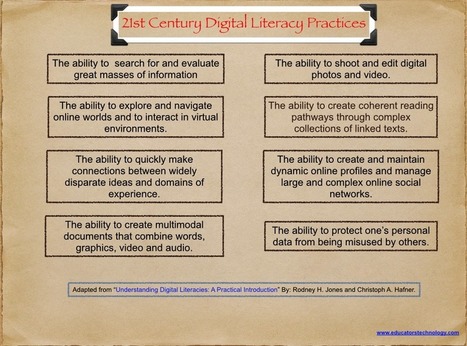
The second major shift emerges with the uptake of the social networking sites and participatory technologies. Now, we no longer talk about a single literacy but multiple literacies. Literacies take many forms and encompass a varied body of social skills and cultural competencies. In their popular white paper "Confronting The Challenges of Participatory Cultures" Jenkins et al talked at length about the development of these new literacies and how they come to shape the new learning forms that take place in the virtual space. According to Jenkins et al, these new literacies involve several social skills that are developed through collaboration and networking.
The overwhelming majority of published scholarship on urban high schools in the United States focuses on problems of inadequacy, instability, underperformance, and violence. Similarly, across all schooling contexts, most of what has been written about young men of color continually reinforces deficit narratives about their educational possibility. Taken together, images of Black and Latino male students in inner-city schools often manufacture dark, hopeless visualizations of imperiled youth and educational environments. Using photographic data from a study of 325 college-bound juniors and seniors attending 40 public New York City high schools, this article counterbalances one-sided mischaracterizations of young men of color and the urban schools that educate them. Specifically, visual sociology and critical race methodologies are used to construct anti- deficit counternarratives about boys of color and urban education.
Via diane gusa, Jocelyn Stoller
|
|
|
Scooped by
Dennis Swender
May 16, 2015 10:09 AM
|
A new study finds that Gen Y is more focused on cognitive diversity, as opposed to demographic diversity. Here's why that perspective could be good for your business, too.
|
|
Scooped by
Dennis Swender
from Neuroanthropology
April 28, 2015 2:07 AM
|
For decades anthropologist Napoleon Chagnon has incited uproar with his claims of genetically-rooted violence among Venezuela's Ya̧nomamö Indians.
Via Greg Downey
|
|
Scooped by
Dennis Swender
April 18, 2015 10:18 AM
|
When the economy heads south, the first targets are foreigners, who are blamed for job losses, crime and an assortment of other societal challenges that locals can rattle off.
|
|
Scooped by
Dennis Swender
from Culture in Education
April 9, 2015 3:52 PM
|
Democracy, opportunity, and shared responsibility are core, if sometimes contested, and not yet realized, aspirational American values. We need a society in which there is not just more equal opportunity, but more lived equity....
Via Cultural Infusion
|
|
Scooped by
Dennis Swender
from Culture in Education
April 9, 2015 3:49 PM
|
|
|
Scooped by
Dennis Swender
from Culture in Education
April 9, 2015 3:47 PM
|
Check out these questions to guide you in reflecting on how much the learning environment you have designed promotes student voice and choice.
Via Cultural Infusion
|
|
Scooped by
Dennis Swender
April 4, 2015 12:06 PM
|
Five years ago, I jokingly said that adjuncts are the face of the new poor, but now the joke is a reality in many cases. While adjunct professors are the backbone of many colleges and universities, they are severely underpaid, under-insured, under-respected, and exploited. They earn a pittance of what full-time instructors or tenure-track professors make, but are expected to perform in the classroom with the same amount of vigor and accountability. I argue that adjuncts are held to standards that are more rigid than full time professors are in some regards. In turn, it places adjuncts in powe
|
|
Scooped by
Dennis Swender
from Papers
April 4, 2015 10:56 AM
|
In modern states, mobilization policy has been used to awaken people to new ideas such as national identity, industrial capitalism, and civic society. However, it has long been debated whether mobilization in new countries or in countries under reconstruction creates an integrated identity or results in fragmentation of various ethnic groups. Although the idea that identity is not immutable but malleable is now widely accepted in political science, sociology, and other social sciences, the degree to which identity can be reconstructed once it has been mobilized remains unclear. This study employs an agent-based model to address questions regarding the relationship between governments' mobilization and the integration of identity in countries. The analysis suggests that more rapid mobilization by governments stabilizes a greater ethnic cleavage. This result is found to be robust by changing parameters and by modifying the specifications of the model. In addition, the analysis presents two other implications. The first is that a spiraling fragmentation of identity might occur if governments fail to accommodate people. The second is that in an age of advanced communication, governments need more assimilative power than before in order to secure integration. The analysis suggests that future research about identity formation in countries should consider the rigidity as well as the flexibility of identity. Mobilization, Flexibility of Identity, and Ethnic Cleavage
by Kazuya Yamamoto
http://jasss.soc.surrey.ac.uk/18/2/8.html
Via Complexity Digest
Creating a digital culture in any organisation is less about technology (much of that is shared, and the best is intuitive to use), but it is about culture. That culture is about a willingness to experiment, to take responsibility for new approaches, to support people as they learn new skills, but to be firm about where the boundaries are.
There’s three ways you can start to create such a culture:
Via John Evans
|
|
Scooped by
Dennis Swender
March 15, 2015 2:40 PM
|
An Antioch University Seattle class has spent the last quarter analyzing what's causing the city's homeless problem.
|
|
Scooped by
Dennis Swender
March 3, 2015 12:31 PM
|
|