


Not all types of social media are created equal. As the social media marketing industry matures, so do the various types of content that marketers need to learn and master. No matter what platform yo…
Via Stefano Principato, massimo facchinetti

 Your new post is loading...
 Scoop.it! Not all types of social media are created equal. As the social media marketing industry matures, so do the various types of content that marketers need to learn and master. No matter what platform yo… Via Stefano Principato, massimo facchinetti No comment yet.
Sign up to comment
Scoop.it!

Pros and Cons of Proprietary, Open-Source, and Cloud-Based LMSs Infographic What are the types of learning management systems for business organizations? What are the good things about each of them? What about the not so good things? Proprietary LMS This type of LMS may not have all the bells... http://elearninginfographics.com/proprietary-open-source-cloud-based-lmss-infographic/
Via elearninginfographic
Scoop.it!

Tim Merel is managing director of Digi-Capital. More posts by this contributor: We’ve been saying for the last couple of years that augmented/virtual reality is the fourth wave of consumer technology, and that AR could become much bigger than VR. But AR itself is not one giant wave, it’s a set of four big ones: mobile AR Via Connect-Up Support Services 
Connect-Up Support Services's curator insight,
July 19, 2017 11:39 AM
A very interesting overview of the future of AR...
Scoop.it!

From
www

Doctors and nurses are using WhatsApp and Snapchat to share information about patients "across the NHS", health professionals have told the BBC. GP Alisdair MacNair said he was aware of a number of medical groups using WhatsApp to discuss patients. Use of internet-based messaging apps to send patient information is banned under current NHS guidelines. NHS England told the BBC that it had no comment on the matter. Dr MacNair said: "I have also seen chat on Facebook groups that sails pretty close to the wind in terms of discussing medical information. "I've definitely seen stuff which is one step away from being patient identifying. "I'm very wary of going near anything like that because of the risk of breaching data laws, but it would appear others don't seem to be aware of the risks." The healthcare body needed to act swiftly to address the issue, or potentially face huge fines for data breaches, said Forrester analyst Kate McCarthy. She likened current practices to the "wild west", adding that the NHS was "incredibly far behind" in the adoption of digital sharing systems. "I am empathetic with doctors because there is a need and desire among healthcare professionals to share this information and the fact that nothing exists for them to to do so is a huge problem," she said. "But that doesn't make it OK to share patient data on Snapchat. "The reality is that doctors are responding to the inadequacy of what the NHS is providing. "They are creatively trying to find better ways to provide care, but they are using non-compliant tools." Quick and easyThe way that the UK's health service looks after data is in the spotlight following an Information Commissioner's Office (ICO) investigation into how 1.6 million patient records were shared with Google's DeepMind. The artificial intelligence company said it wanted to develop an app to alert doctors and nurses about patients at risk of kidney injury. The ICO found that the NHS had been in breach of data laws in the way it had allowed DeepMind to access the records. A subsequent report from an independent panel set up by DeepMind to assess its work suggested that the NHS's use of technology was in a dire state. It said it was the UK's largest purchaser of fax machines, adding that was a "dubious" position to hold. Image copyrightGETTY IMAGESImage captionThe NHS is "incredibly far behind" in adopting digital sharing technologies, one analyst has saidGeorgie Gould, a junior doctor who last year conducted her own study of how doctors were communicating, found 30% of surgeons at St Peter's Hospital in Chertsey, Surrey, were using WhatsApp as part of their day-to-day communication. It bears out similar findings published in the British Medical Journal, which found that of 2,000 doctors across five hospitals, a third were using web-based apps to send clinical information. An NHS consultant trauma surgeon, who did not wish to be named, told the BBC: "We use WhatsApp because it's the quickest and easiest way to communicate with a whole team or group of clinicians. "So, if you're responding to a major incident, you can have the whole team involved and see what's coming [in terms of patient injuries] so teams can be ready." "It can also be really helpful for junior clinicians to communicate with senior colleagues - send images of X-rays and get quick advice on the best course of action. "However, we only use initials or bed number information, we don't identify patients." HIV statusAccording to NHS England's guidelines, the use of WhatsApp is strictly banned for the purposes of sending patient data. Instead, doctors are required to contact each other by pager or fax. "The process is lengthy," said Dr Gould. "If you want to send images, you have to fill in a form and give it in by hand." Contacting colleagues by pager - which involves locating a landline, dialling a four-digit number and waiting for a reply - was equally cumbersome, she said. Dr Gould said clearer guidelines could solve the problem. She said: "Most doctors know that it is not OK to use full names, but is initials OK? "Is it OK to say, 'The lady in Bed 2 is running a temperature'? Image copyrightEPAImage captionUsing apps such as WhatsApp to discuss medical information is banned in the NHS"The benefits of WhatsApp go beyond communication, it is about connecting teams and reducing hierarchies. "I think that the problems of it could be easily solved without throwing huge amounts of money at it. "It needs a separate app for medical conversations, with its own password," she said. Dr Felix Jackson, who runs MedCrowd, a digital messaging service for health workers, told the BBC he saw use of WhatsApp while he was working as an anaesthetist. "Such platforms are used extensively, but it is against the law," he said. Anonymising data meant doctors might "just about get away with it", he added, but that would not continue forever. "No major error has come to light yet, but it is only a matter of time before a senior doctor leaves his or her phone on the train and someone gets hold of the all the conversations about patients and suddenly someone's HIV status is made public," he said. Via Plus91
Scoop.it!

Scoop.it!

Perhaps the main reason for this disappointing impact is that the inclusion of technologies has done little to change the “tell and practice” approach to teaching and learning — the predominant pedagogical practice of our time. In this model, teachers tell students what knowledge is and what knowledge is worth knowing; students meanwhile invest their vast capacity for creativity, critical thinking, and collaboration by memorizing and practicing what they were told. The overarching goal of this model is simply for students to accurately repeat the information they were told. Via Nik Peachey
Scoop.it!

Today, the blackboard has become a whiteboard; chalk has become a magic marker; the slates that students used have been replaced by notebooks; and classes have sometimes gotten smaller. Little else has changed. True, some schools are providing their students with laptops, and teachers are increasingly using technology and encouraging collaboration. But the methods are essentially the same—with the teacher dictating learning. Via Nik Peachey 
Willem Kuypers's curator insight,
July 15, 2017 2:41 AM
J'aime entre autres la conclusion : le digital tutor arrive seulement dans 5 à 10 ans

Norton Gusky's curator insight,
July 15, 2017 4:43 PM
Insightful article that provides great recommendations

Lon Woodbury's curator insight,
July 21, 2017 4:14 PM
Its a change that is being forced onto our public education. -Lon
Scoop.it!

The book examines the underlying principles that guide effective teaching in an age when all of us, and in particular the students we are teaching, are using technology. A framework for making decisions about your teaching is provided, while understanding that every subject is different, and every instructor has something unique and special to bring to their teaching.The book enables teachers and instructors to help students develop the knowledge and skills they will need in a digital age: not so much the IT skills, but the thinking and attitudes to learning that will bring them success. Via Nik Peachey 
Ricard Garcia's curator insight,
July 13, 2017 3:59 AM
Looks like a Bible to me... but there are always believers! Good as a reference!

Carlos Fosca's curator insight,
July 14, 2017 12:25 AM
El último libro de Tony Bates sobre educación en la era digital. Lo puede descargar sin costo alguno. 
Geemik Maria Açucena Da Silva's curator insight,
July 17, 2017 5:16 AM
"Although the book contains many practical examples, it is more than a cookbook on how to teach. It addresses the following questions: is the nature of knowledge changing, and how do different views on the nature of knowledge result in different approaches to teaching? what is the science and research that can best help me in my teaching? how do I decide whether my courses should be face-to-face, blended or fully online? what strategies work best when teaching in a technology-rich environment? what methods of teaching are most effective for blended and online classes? how do I make choices among all the available media, whether text, audio, video, computer, or social media, in order to benefit my students and my subject? how do I maintain high quality in my teaching in a rapidly changing learning environment while managing my workload? what are the real possibilities for teaching and learning using MOOCs, OERS, open textbooks?"
Scoop.it!

Over 90 free tutorials in technology, Microsoft Office, reading, math, career, and more. Via Ana Cristina Pratas
Scoop.it!

Users behave differently on different social media platforms. When a news story breaks it moves across social media in different pulses depending on what the news is and how it travels through these platforms like Twitter, Facebook and WordPress. Via Marcia Conner
Scoop.it!
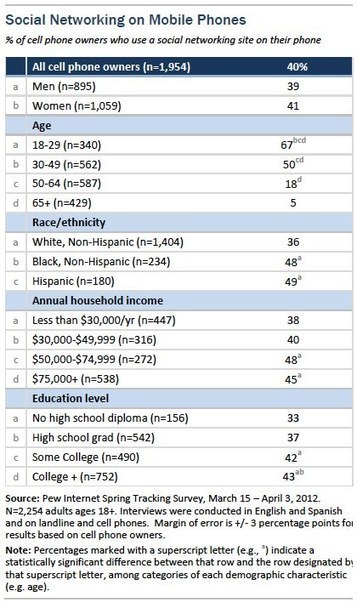
Key data points on social networking use from the Pew Research Center's Internet and American Life Project Via Marcia Conner |
Scoop.it!

When you think of higher education, chances are that virtual reality is not something that immediately comes to mind. In recent years, online learning has changed the face of education by becoming a supplement to traditional methods, allowing people to learn at a distance, on their own time and at their own pace. It has become a powerful tool for educators to expand their reach while providing students with a way to get an education without having to step foot into a classroom.
Despite these advantages, online education has proven to be a double-edged sword. At some point in their learning, every student needs personal help that interactive workbooks and textbooks alone cannot provide. Relying solely on asynchronous communication with a faceless professor stifles the kind of momentum that a classroom setting promotes. Via MiniTool Software, Edumorfosis
Scoop.it!

Results and impressions from my short experience with Slate Desktop as a local machine translation service for medical translations in a real-world setting. Via Stanislav Okhvat 
Stanislav Okhvat's curator insight,
July 19, 2017 9:52 AM
Tiago Neto reviews Slate Desktop machine translation software and how it can be used to boost translation productivity.
Scoop.it!

It’s no secret: technology is revolutionizing the way rehab therapy providers deliver care to their patients. With things like EMR and RCM software becoming mainstays in therapy practices, providers are spending less time documenting and more time treating. It should go without saying that this development has also benefited patients. From intake to discharge, technology can help cultivate meaningful patient experiences—and there’s a whole lotta data out there to prove it. As noted in this article from the WebPT Blog, “a 2011 white paper from The Beryl Institute revealed that hospitals using interactive technology showed a 10% increase in general satisfaction.” So, why should providers put so much focus on catering to—and satisfying—the patient-consumer? Well, happy patients mean higher retention rates, and higher retention rates mean more consistent revenue—a key ingredient to your practice’s long-term success. The good news is you can immediately start leveraging the technology tools you’re probably already using every day. Here’s how: 1. Get a head start on intake.Send an email.Like most rehab therapists, you probably don’t look forward to paperwork. But if you use an EMR, you’re already familiar with the benefits of technology that streamlines your documentation process. And if your documentation platform includes a patient intake tool, your patients can reap those benefits, too. Picture this: your patient signs in at the front desk, and instead of spending the next 15 minutes filling out paperwork, he or she gets to enjoy a cup of coffee and chat with your front office staff. And because your staff already has the patient’s information on file, you have time to prepare for the appointment in advance—which means the patient can get started quicker. With a patient intake tool that’s integrated directly with your EMR software, this picture is a reality. And let’s not forget about patient-reported outcomes. You already know that PROMs are valuable to you as a provider, but they can be just as valuable to your patients as well. After all, these tests allow patients to truly weigh and evaluate their own level of function, which helps them take control of their experience. And, as with patient intake information, your office can collect PROM scores via email before the patient ever steps foot in your clinic. This not only cuts down on the patient’s in-office paperwork, but also allows you to prepare to discuss—and incorporate—the patient’s outcomes scores in advance. Set up a kiosk.Email isn’t the only means of streamlining your practice’s intake process. And if you work with a largely geriatric client base that isn’t super tech-savvy, you might want an alternative—although it may surprise you to know how many senior citizens are logging on these days (88% according to the Pew Research Center). Fortunately, some EMR systems provide a kiosk option for both patient intake forms and outcomes reporting. This allows users to load up questionnaires and forms on an in-office tablet or computer that patients can use to fill their information quickly and seamlessly. 2. Send documents through a secure, HIPAA-compliant patient portal.PROMs and patient intake forms aside, there are other ways to boost patient trust and engagement through secure data-sharing. HIPAA has given patients the right to obtain copies their own medical records, and many savvy, health-focused patient consumers will do just that. But there’s a better way to provide patients with sensitive medical documentation than simply handing over hard copies: the patient document portal. According to this infographic from HIMSS, “Facilitating ongoing communication between patients and physicians via apps and online portals can improve engagement rates by 60% or higher.” With online document portals, patients can easily receive documents from their provider and safely store them on their computers. No more filing away stacks of documents from the therapist’s office, or worse—losing track of sensitive PHI. 3. Automate patient appointment reminders.We’ve written about the effectiveness of appointment reminders in the past, and it’s easy to understand why they work so well. Automated phone, text, and email appointment reminders provide a convenient way to keep patients on track for their upcoming visits, and they’re far more effective than handwritten reminder cards. Don’t get me wrong, reminder cards are a nice touch, but there’s always a chance they’ll get stashed away in a coat pocket or tossed into the trash. 4. Engage patients with an interactive home exercise program (HEP).It can be tough for patients to remember exactly how to do every single home exercise, and while they can always call your office for a refresher, there’s a chance you’ll be with another patient. And if it’s after-hours, you might be on your couch with slippers and a good book. Why subject your patients to a frustrating game of phone tag when you can instead provide them with an interactive home exercise program that they can access 24 hours a day? Computer-based programs are not only convenient, but also engaging, as they typically allow patients to view videos of each exercise (because 2D images are so ten years ago). And the more convenient it is for your patients to remain compliant with their home exercise programs, the more likely they are to do so. 5. Email patient satisfaction surveys.Much like patient-reported outcomes, patient satisfaction and NPS surveys can tell you a lot about how you and your staff measure up. And with more and more payers using pay-per-performance payment models, keeping your patients happy and healthy can have a direct impact on your bottom line. But these surveys aren’t just for your benefit. When your practice measures patient happiness and success, patient experience becomes a priority. And that leads to happier, healthier patients. While you could provide patients with an in-office exit survey that includes satisfaction questions, doing so may skew their responses. Alternatively, emailing exit surveys affords patients a degree anonymity, which often yields more honest responses. Additionally, this method of survey distribution allows the patient to complete the questionnaire on his or her own time instead of rushing through it before heading back to the office, school, or home. 6. Keep in touch online.A patient’s experience doesn’t stop when he or she leaves your care. And if it does, then you’re missing out on a serious opportunity to increase engagement and win patient loyalty. Whether you use a patient engagement platform, release a monthly newsletter to a patient email list, or encourage your patients to follow your clinic on social media, staying in touch with patients after discharge not only keeps you informed on their continued progress, but also reminds the patient to come back to you should he or she ever require additional therapy services. If you’re ready to get serious about boosting your patients’ satisfaction, then it’s time to consider whether your clinic’s current technology is up to the challenge. When you prioritize the patient experience, other facets of your business evolve in step. Whether it enhances the experience at the front desk or keeps patients engaged after discharge, technology can help improve your patients’ views on not only you—but also the entire rehab therapy profession. Via Plus91 
anaTorrente's curator insight,
December 28, 2017 7:20 AM
La tecnología es un gran aliado a la hora de mejorar la experiencia de nuestros pacientes. De hecho un informe del Instituto Beryl (EEUU) ha demostrado que el uso de la tecnología mejora notablemente la experiencia y la satisfacción general de los pacientes. Compartimos un artículo que nos aporta 6 formas sencillas de utilizar la tecnología para mejorar la experiencia de nuestros pacientes.
Scoop.it!

While educational standards may differ from school to school there is one thing that is always nearly the same: the classroom set out. Desks are arranged in rows or groups, and the teacher stands at the front and teach. This set out has changed very little in a hundred years even with all the technological advancements that have been made. Edtech not only changes the way that children learn but changes the way they interact with one another, the classroom space and their teacher. Things need to change if classrooms are to meet the needs of the modern learner. Below are ten ways to create the classroom of the future. Via Carlos Fosca
Scoop.it!

Using virtual or augmented reality at just the right teachable moment can create a powerful, even moving, experience for students. Via Nik Peachey
Scoop.it!

Yes, the chalkboard is a white board and paper and pencils have been replaced with laptops, but other than that? Beyond the physical differences we see in classrooms, the other changes we have seen are minimal – despite the opportunities technology presents to transform learning. Via Nik Peachey 
itsmspalma's curator insight,
December 18, 2018 3:09 PM
Embracing technology in the EFL classroom can give us wonderful opprotunities to enhance both our performance as teachers and our students' language skills.
Scoop.it!

With VR there is no coasting option of just sitting and listening. Students have to interpret and examine, in real time, the subject matter that is portrayed in front of them. In this way, VR is helping educators recapture class interest, boosting their efforts in the process. Via Nik Peachey 
Nik Peachey's curator insight,
July 16, 2017 1:46 AM
This is a bit evangelical and focuses rather too much on the motivational aspect of VR, but still worth a quick read.
Scoop.it!


donhornsby's curator insight,
June 2, 2017 9:20 AM
These Twitter tips can help you turbo-boost your audience and take your brand to the next level. 
CCI VAL D'OISE's curator insight,
June 3, 2017 9:53 AM
These Twitter tips can help you turbo-boost your audience and take your brand to the next level.
Scoop.it!

We've committed many social media mistakes that have cost us reach, engagement, fans, and customers! Here's what we've learned and how you can avoid them. Via Daniel Watson 
Gust MEES's curator insight,
July 13, 2017 9:48 AM
We've committed many social media mistakes that have cost us reach, engagement, fans, and customers! Here's what we've learned and how you can avoid them.
Let’s get started…
Learn from These 10 Social Media Mistakes We’ve MadeHere’s a quick overview of the social media mistakes we’ve been making until recently:
Learn more / En savoir plus / Mehr erfahren:
http://www.scoop.it/t/21st-century-learning-and-teaching/?&tag=Marketing
Scoop.it!

This week, Google Senior Vice President, Engineering Vic Gundotra announced that 400 million Google users have now upgraded to Google+.
Here are the rest of the social stats of the week:
Facebook: 955 million monthly active users via Facebook
Twitter: over 500 (140 active monthly) million users via Twopcharts / WebProNews
Qzone: 599 million monthly active users via ResonanceChina
Google+: 100,000,000 monthly active users via Google
Sina Weibo: over 368 (36.5 active daily) million users via China Daily
Renren: 140 million active monthly users via TechInAsia
LinkedIn: 175 million members via LinkedIn
Tumblr: 73 million blogs via Tumblr
Instagram: 100 million users via TechCrunch
Tagged: 330 million members, 20 million monthly users via Tagged
Foursquare: over 20 million users via Foursquare
Pinterest: 20 million users via Forbes
Posterous: 15 million monthly users via Posterous
[The original articles has links to each of the sources] Via Marcia Conner
Scoop.it!

The millennial generation might be a complex demographic, they are growing up and have increasingly more buying power. Data from ShareThis we shows us just how much influence millennials have with each other when it comes to social shopping. Via Marcia Conner |






