


Free resource of educational web tools, 21st century skills, tips and tutorials on how teachers and students integrate technology into education
Via Dr. Tom D'Amico (@TDOttawa)

 Your new post is loading...
 Scoop.it! Free resource of educational web tools, 21st century skills, tips and tutorials on how teachers and students integrate technology into education Via Dr. Tom D'Amico (@TDOttawa) No comment yet.
Sign up to comment
Scoop.it!

Neil Patel from Quicksprout provides us with an "animated" take on the intricacies of how Google works with his mesmerizing and informative infographic. Via GwynethJones
Scoop.it!

10 Free Browser Extensions for Online Students Infographic Being online while studying can be very distracting. Between all the social media postings, pop-up ads, and all the notifications on the devices students use daily, being focused can be quite an endeavor. So what can one do? Well, hats... http://elearninginfographics.com/free-browser-extensions-online-students-infographic/
Via elearninginfographic
Scoop.it!

Scoop.it!

Scoop.it!

Download thousands of media files including stock footage, images, songs, and more for FREE from Pond5's Public Domain Project. Via Nik Peachey 
Nik Peachey's curator insight,
July 14, 2017 8:17 AM
Lots of useful free media for student projects.
Scoop.it!

New research by National Centre for Student Equity in Higher Education Equity Fellow Dr Cathy Stone from The University of Newcastle has informed comprehensive new guidelines for improving student outcomes in post-secondary online learning, with a focus on undergraduate retention and course completion. Via Kim Flintoff
Scoop.it!

Scoop.it!

Google is opening up its Classroom educational service to allow anyone to create and teach a class on its platform. Via Kim Flintoff 
Kim Flintoff's curator insight,
April 29, 2017 3:07 AM
Google Classroom now available for everyone... https://classroom.google.com/
Scoop.it!

Time to give course text some breathing room! Accordion interactions let you break long content into shorter pieces that learners then click to reveal. That way, you can comfortably fit lots o
Scoop.it!

Companies should look for lessons in other industries, create products that are tailored to population subsets, develop synergistic partnerships, and understand the performance characteristics of products in the real world.
Despite years of hype in the field of digital health products — a term that we use here to describe technologies that are designed to have clinical impact on disease — fewer products than expected are being deployed in real-world clinical settings. Many digital health products that demonstrate impressive results in clinical trials often fail to do so in real-world settings. Why? Much of the success of digital health products is predicated on patient engagement, and clinical trials are among the most engaging environments in health care. Clinical trials involve the use of a variety of tools (e.g., training, close monitoring, payments) to ensure that patients use the technologies appropriately, but few of these tools are used in the real world. In order to cross the chasm from success in clinical trials to success in practice, digital health companies need to focus on patient engagement. Digital Health Hinges on Engagement Engagement is so important because many digital health products are designed to achieve behavioral changes for the purpose of preventing or treating chronic diseases. For patients who are at risk for, or are living with, a chronic disease, successful prevention or management requires minute-to-minute, day-to-day changes in decision-making. Patients need to be highly motivated to make behavioral changes, they need to be praised when they follow through, and they need guidance when they slip up. The process needs to be sticky and self-reinforcing in order to maintain patient interest. In a nutshell, patients need to be engaged. Patients need to be highly motivated to make behavioral changes, they need to be praised when they follow through, and they need guidance when they slip up. The process needs to be sticky and self-reinforcing in order to maintain patient interest. In a nutshell, patients need to be engaged.” Engagement is important not only for clinical results, but also for the business models of many digital health companies, which frequently incorporate pay-for-performance contracts. Digital health companies need to track data continuously in order to demonstrate their value to the purchaser or user. Products that do not engage patients drag down performance metrics and reduce the viability of the company. Contrast this with pharmaceuticals: payors pay for drugs before patients take them, and pay-for-performance contracts are the exception; this is part of the reason why nearly 50% of medications for chronic disease are not taken as prescribed. The Gap Between Clinical Trials and Real-World Results Successful clinical trials of both digital health products and pharmaceuticals are engaging by definition. In order for a trial to demonstrate significant results — and in order for the results of the trial to be published — the attrition rate for participants needs to be very low. The entire endeavor is designed around ensuring that patients use the product or service appropriately and follow up regularly. A clinical trial is designed as follows: an artificial scenario is crafted, willing participants volunteer, participants are carefully selected on the basis of optimal criteria, staffers are thoroughly trained, measurements are taken like clockwork, and participants are induced (by means of monetary payments or a barrage of phone calls, emails, and texts) to use the product or service as directed. As a result, the experience of individuals who are involved in a clinical trial typically is much more engaging than that of patients who use the technology in real-world scenarios. Tools to Drive Engagement Extending the engagement-boosting practices from a clinical trial to a much larger population of patients in the real world is not feasible because of cost and logistical complexity. As a result, different approaches are needed to facilitate engagement. Maintain engagement-first thinking. Digital health products need to be designed to drive engagement from the ground up. Focusing on an exciting technology or a massive need is not enough. Companies should consider employing principles from behavioral economics, which have been shown to increase engagement and product stickiness by using sophisticated implementations of financial incentives, loyalty points, social structures, and other techniques.Simply learning that an intervention was successful in a clinical study is not enough. Real-world validation is also important as digital health companies own the validation process from product development to scale.” Social media also have been shown to be a powerful force in patient engagement, with applications ranging from open patient support resources such as PatientsLikeMe to the patient-only social media networks used by Omada Health to drive weight loss. Companies also should think about employing strategies from video games and sports. While “gamification,” as this approach is known, has been mostly met with a tepid response from the physician community, don’t forget that Pokémon GO has performed better than many digital health tools at increasing the physical activity levels of its users. Embrace real-world data to drive real-world evidence. Real-world data (RWD) and real-world evidence (RWE) are topics of increasing interest in the medical community and have even garnered the attention of the FDA. While RWD and RWE typically are used to supplement clinical trials, these information sources are increasingly important for digital health companies because they provide critical evidence of user engagement. Digital health companies can design studies to capture RWD and build RWE by crafting scenarios that mirror how products will be used by real patients.While ‘gamification,’ as this approach is known, has been mostly met with a tepid response from the physician community, don’t forget that Pokémon GO has performed better than many digital health tools at increasing the physical activity levels of its users.” Companies can look to Omada Health’s diabetes prevention study for an example of how to design a study to collect RWD and RWE. Omada recruited participants on Craigslist, participants relayed weight measurements to the company with use of a digital scale equipped with cellular data-transmitting capabilities, and HbA1c measurements were obtained with use of home kits that were mailed to participants. The study was performed in a similar way to how Omada interacts with real patients and thus provided the company with a good understanding of the real-world performance characteristics of its product. Develop product variations. Engagement is not one-size-fits-all. Different tactics will work well for different populations, and digital products may be more successful if the manufacturer is able to develop variations to serve different segments of the market. For example, Propeller Healthhas developed sensors that can track inhaler use, with the goal of improving outcomes and reducing costs for patients with asthma and chronic obstructive pulmonary disease (COPD). Although patients with both conditions often use inhaled medications, the demographics, etiology, prognosis, and medication regimens for these conditions differ substantially. Product variations specific to the different patient populations using the inhaler will be critical to Propeller’s success in the treatment of these diseases. Companies must think through how to engage each subset of the population that the product is serving.Seek partnerships to reap synergies. Digital health companies are uniquely positioned to develop synergistic partnerships to drive patient engagement. Many digital health companies — particularly those operating outside of FDA or HIPAA jurisdiction — have unique data and insights about specific populations. This information can translate into powerfully engaging products. For example, Mango Health, a medication adherence app, partners with consumer products companies to offer real-world rewards like gift cards as incentives for patients to increase adherence. Similarly, Under Armour, an athletic apparel company, is investing significant resources to develop synergistic digital health products for fitness and weight loss, thereby combining products with technologies that help users to meet their health goals.Making the Leap from Novelty to Necessity Clinical trials are a critical process in the evolution of digital health products. Evidence is an important means for convincing health care executives to buy these products. However, simply learning that an intervention was successful in a clinical study is not enough. Real-world validation is also important as digital health companies own the validation process from product development to scale. Once clinical validation is achieved, real-world evidence must be gathered to justify success at scale. In order for digital health products to make the leap from novelty to necessity, manufacturers will need to focus on driving patient engagement in real-world settings. Engagement will require taking lessons from other industries, creating products that are tailored to population subsets, developing synergistic partnerships, and understanding the performance characteristics of products in the real world. Via Plus91
Scoop.it!
Sam Robinson uses Google Earth to empower his students to follow in the footsteps of Sarah Parcak, Space Archaeologist, and National Geographic Explorer. Via Dr. Tom D'Amico (@TDOttawa) |
Scoop.it!

This article was written by Nichole Dobo At a California school, 20 Facebook employees built a software program that could eventually be used in any public school that wants it — free If an education technology solution is to have any chance of success, it must first be embraced by teachers, students and parents. A logical way to achieve this is to allow educators to take the lead on the development of high-tech tools. That’s what happened at Summit Public Schools, a California-based charter network, where teachers created a prototype of a new tool that would enable them to customize …
Scoop.it!
Scoop.it!

Research helps us understand that engagement, like attention, is hard to measure directly. So, like attention, we measure engagement by what is occurring. Vicki Trowler, in the Department of Educational Research at Lancaster University, describes three dimensions of instructional engagement:
Via Edumorfosis, Nik Peachey
Scoop.it!

Free resource of educational web tools, 21st century skills, tips and tutorials on how teachers and students integrate technology into education Via WebTeachers, Mark E. Deschaine, PhD
Scoop.it!

The Online College Students 2017: Comprehensive Data on Demands and Preferences report surveyed 1,500 current, prospective and recently graduated online college students to learn about developing trends in online learning. This sixth annual report reveals how students feel about the value that online learning provides, how mobile technology affects online learning, the most popular fields of study and more.
Via ColinHickie
Scoop.it!

With Pear Deck, bring interactive, engaging slide presentations to your classroom. Real-time formative assessments and discussions enhance understanding and empower your students’ learning process. Via Nik Peachey
Nik Peachey's curator insight,
July 9, 2017 1:57 AM
Interesting tool for projecting your presentation onto the students' devices and making the slides interactive. The free version can be found at: https://www.peardeck.com/pricing/comparison/
Scoop.it!
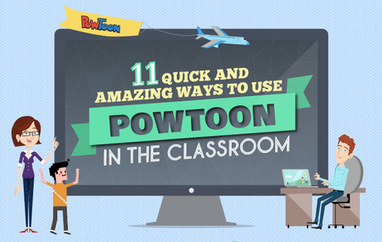
Classroom learning can be AWESOME! Check out these 11 killer tips for quick and amazing ways to use PowToon in your classroom. Via Nik Peachey
Nik Peachey's curator insight,
July 18, 2017 7:57 AM
Some nice examples and templates for using PowToon with students. 
Ashley Mendez Martinez's curator insight,
February 4, 2024 5:27 PM
PowToon is another presentation tool to create videos that are made for your students' target objectives. It already provides different presentation themes that are fun to watch. This platform is known to be the common content videos on YouTube along with Prezi and Animaker. The animation of the presentation is what make the content fun and engaging.
Scoop.it!

Over the last few months I’ve had a series of meetings with Chief Learning Officers, talent management leaders, and vendors of next generation learning tools. My goal has been simple: try to make sense of the new corporate learning landscape, which for want of a better word, we can now call “Digital Learning.” In this article I’d like to share ten things to think about, with the goal of helping L&D professionals, HR leaders, and business leaders understand how the world of corporate learning has changed. Via Kim Flintoff
Scoop.it!

The most popular article on eCampus News is a surprising one to the editors: “6 apps that block social media distractions.” This story, which seemed a bit counter-intuitive for us to write (being a tech-cheerleading publication in nature), has held the top spot by a massive margin for almost three years now; which had the editors considering the question, “Are there technologies that should simply be avoided in the college classroom?” Via Kim Flintoff
Kim Flintoff's curator insight,
April 24, 2017 8:40 PM
I suspect in some cases there is the issue of how things are used - especially in the discussion about games. Collaborative approaches to game-play are very useful active learning processes.
Scoop.it!

Designing an e-learning course means doing the fun yet time-consuming work of creating or sourcing tons of graphic assets. One approach is to use icon sets, which are a fast and easy way t
Scoop.it!

AI-powered personal assistant apps are spreading in certain parts of the market while others take a downward turn. Via Jeff Domansky, Mark E. Deschaine, PhD 
Jeff Domansky's curator insight,
July 16, 2017 10:34 PM
Chuck Martin looks at what's up and down with the top digital assistants.
Scoop.it!

According to the Direct Marketing Association (DMA) and Demand Metric surveys of US marketers, email had a median ROI of 122 percent in 2016. By the end of 2017, the number of email users will rise to 244.5 million. This statistic in itself is sufficient to highlight the importance of email marketing. Thus, it is imperative to utilize the power of email marketing to grow your practice. Here are some tips on conducting an effective healthcare email marketing campaign: Catchy subject line The most crucial thing for an email is to have the correct subject line. The instant decision of marking the email as spam or opening and reading the email depends largely on the subject line. It should be specific enough to catch the receiver's attention and be safe from getting dumped in the spam folder. Think of the best way to appeal when finalizing the subject line. Don't hesitate to display your intensions with words like "Sorry," "Congratulations," or "Welcome." The subject line should not be too long or too short. Use call to action phrases like "Get it now," "Hurry," "Last chance," "Save up to," and "Still time," to increase your email open rate. Personalization Reports say that personalized emails receive 27 percent higher click rates and 11 percent higher open rates than non-personalized emails. But, personalization does not offer positive results all the time. Thus, avoid sending personalized emails to people who are not your existing patients. Emailing too frequently will alienate consumers. For most people, personalized healthcare emails show unwarranted familiarity that annoys them and leads to an increased number of unsubscribes. Rather than using people's names, you can segment the email marketing list of customers according to gender or age. This segregation will help send content to the relevant audience. For instance, a campaign launched for women's health should only be sent to women. Content clarity Your healthcare email campaign should be precise, clear, and communicate your service in the most concise way possible. Lucid, simple text offers better understanding of content to a layman. Lucidity and simplicity are key factors that lead to additional clicks and a higher open rate. In today's world where everything is replaced with images and info graphics, it is best to have minimal text because "a picture is worth a thousand words." Creative design If content is not designed creatively, it will go to waste. None of us like monotony. Whether it's vibrant or subtle, the design should be in sync with the message of your healthcare campaign. Creative designs help you spotlight the offer that's being promoted in the email. Clear Instructions An email should be concise but structured so that the reader understands what to do next. For all process-oriented messages, an email should have necessary steps mentioned clearly to help the customer reach the described destination. For example, if you are launching an email campaign to convince a consumer to subscribe to your healthcare YouTube channel or follow you on social media, the email should display the steps with images. Provide a call to action button that takes the reader to your YouTube channel or social media page where they can subscribe to videos and posts. Make consumers feel special It's good to work on acquiring new patients, but you also need to take time for your existing patients, who provide reviews to your service and do word-of-mouth marketing for you. You need to make them feel special and above any other patient for the loyalty and trust they show by continuing business with you. In addition to health tips, offer them something extra, such as a discount, free visit, etc. These acts of appreciation build trust and establish long-term relationships. This will make your existing patients bring their family and friends to you and the new patients will want to establish long-term relationships with you for such benefits. Compatible on all devices Most people prefer checking emails on their mobile phones. In 2016, according to a survey, emails opened on mobile devices were 54 percent, webmail ranked second with 30 percent and desktop email opens dropped to 16 percent. Thus, your email design should be readable on any device, especially mobile phones. Mobile phones allow people to stay in touch with the internet all the time and access their email or social media accounts on-the-go. So, even if a consumer is not a frequent searcher of healthcare services, they can find you whenever they need to. Sending frequency Frequency is one of the most important factors of your healthcare email marketing campaign. Over-mailing leads to a high level of unsubscribes, if not numerically then emotionally. The recipients will ignore the email if it isn't relatable. Conversely, not sending enough will reduce opportunities to promote your healthcare services, inform patients about what's new in healthcare, and sell products. On average, you should send a minimum of six to eight emails per month. Additionally, don't miss opportunities for launching email campaigns during holidays and other major events. Remember, emails should be interesting and helpful for the reader and concise at the same time. A couple of irrelevant emails can annoy the receiver and they can mark you as a spammer. Manish Chauhan is Digital Marketing Manager at myPracticeReputation which is an easy-to-use reputation management solution for physicians to help monitor, protect and promote their medical practices at all times in the simplest way possible. Via Plus91 |






