Your new post is loading...
In today’s changing world, more and more dominated by millennials, social media for therapists is a necessity. Word of mouth is one, but a limited way of attracting potential patients to your practice. And, wait for it…. PsychologyToday is not the only site you need to be listed on. As therapists, it’s time to face the fact that more and more potential patients research their medical providers online and usually sign up for services that way. I’m sure most of you reading this article now do the same thing. So how come you are expecting your potential patients to do something different? The times of purely relying on referrals via networking at conferences, parties, and giving free talks is over. And, when you take the time to think about it those older ways of attracting referrals, although still helpful, limit the scope of potential patients you could actually reach. In an effort to increase the scope of your potential patient reach us therapists need to change what we include in our marketing arsenal. Now you’re probably wondering how do you go about choosing which social media platform is best for you without feeling overwhelmed? Choosing the Right Type of Social Media The easy answer is that you should be on all social media platforms, right? No, simply put my advice to therapists is to choose a social media platform that best suits the population you are attempting to attract and your expertise. The top four social media platforms are Facebook, Pinterest, Twitter, and Instagram. Pinterest Each social media platform has a lot of potential for therapists again depending on your population and expertise. For example, let’s take a closer look at Pinterest. Pinterest is a great platform. With over 200 million monthly users, mostly women, and over half of the users are millennials. This is a great platform for those both in private and group practices. As well as those that work with children, parents, and families. And those mental health professionals with a more creative bent. So take some time amongst the multitude of tasks you have to accomplish and reflect on which social media platform would be best for you and the patient population you are aiming to obtain. The greatest thing of all you don’t have to do it all alone. There are so many sites out there where you can get folks to help you with social media content posting. A great resource is to reach out to your local colleges and universities and hire a social media intern to do that work for you. So, what’s stopping you now? Go get started!
Via nrip

|
Rescooped by
Dennis Swender
from Education 2.0 & 3.0
May 2, 2019 11:09 AM
|
"Augmented Reality (AR) technologies have opened up an entire world of possibilities for teachers and educators. From organizing virtual field trips to setting up simulated virtual laboratories, AR is reshaping teaching and learning in unprecedented ways ..." Google Spotlight Stories Waypoint EDU 3D Bear AR
Via Leona Ungerer, Juergen Wagner, Yashy Tohsaku
Education has changed. No longer is it contained within four classroom walls or the physical site of a school building. Students aren’t confined by the eight hours between school bells or the strug…
Via Dr. Tom D'Amico (@TDOttawa)
|
|
Rescooped by
Dennis Swender
from Data Visualisation
April 25, 2019 11:25 AM
|
Excel Dashboard Reporting System, Excel Dashboard Templates, Excel Dashboard Downlad. The New and Updated Business Reporting Bundle by Mr Dashboard - Ready to use Excel Dashboard...
Via Yves Mulkers
|
|
Scooped by
Dennis Swender
April 25, 2019 11:21 AM
|
Mark Boyle turned off his phone two years ago and has been living off-grid in east Galway since then.
|
|
Rescooped by
Dennis Swender
from Edumorfosis.it
April 25, 2019 11:12 AM
|
Virtual reality displays, such as head-mounted displays (HMD), afford us a superior spatial awareness by leveraging our vestibular and proprioceptive senses, as compared to traditional desktop displays. Since classical times, people have used memory palaces as a spatial mnemonic to help remember information by organizing it spatially and associating it with salient features in that environment. In this paper, we explore whether using virtual memory palaces in a head-mounted display with head-tracking (HMD condition) would allow a user to better recall information than when using a traditional desktop display with a mouse-based interaction (desktop condition). We found that virtual memory palaces in HMD condition provide a superior memory recall ability compared to the desktop condition. We believe this is a first step in using virtual environments for creating more memorable experiences that enhance productivity through a better recall of large amounts of information organized using the idea of virtual memory palaces.
Via Edumorfosis
|
|
Rescooped by
Dennis Swender
from Edumorfosis.it
April 25, 2019 11:09 AM
|
It’s a race between education and technologies. Blockchain, AI and advanced biosciences promise new efficiencies and growth opportunities at a time when leading economies are struggling with weak productivity gains and, in some cases, slow GDP growth. But it’s easier said than done. Industrial age education and training systems put these economic opportunities at risk. If skill-building doesn’t catch up with the rate of technological progress, the G20 economies could lose up to US$11.5 trillion in cumulative GDP growth in the next ten years. That’s equivalent to losing more than an entire percentage point from the average annual growth rate every year over that period. For this report, we look through the lens of the future worker – from the shop floor to the boardroom, from the shop front to the back office – and we identify their evolving skills demand. We analyze the changing importance of skills to different roles and the impact of intelligent technologies. Contrary to conventional wisdom, this is not about technological skills. It is about cultivating the full range of skills, from the creative to the complex cognitive capabilities that the future workforce will need. Our diagnosis: Current education and corporate learning systems are not equipped to address the coming revolution in skills demand. The challenge is especially urgent for roles that are more vulnerable to dislocation through intelligent automation. The impact is uneven across economies and industries, demanding targeted interventions. Our proposed solutions: Learning with experiential techniques, shifting the focus from institutions to individuals and empowering the most vulnerable people to learn. Advances in the science of learning, paired with new technologies, allow pioneering businesses to offer new approaches to learning. The challenge? Accelerating their adoption across all organizations, large and small, and throughout education systems in the G20 economies.
Via Edumorfosis
|
|
Scooped by
Dennis Swender
April 25, 2019 11:03 AM
|
During the first two weeks of class, most faculty work to build a learning community among their learners. Cultivating swift trust should be part of those activities, too. This might be happening serendipitously, but it is important to take a deliberate approach. Because online students do not have the same chances to make small talk before class starts and in between activities, the opportunity to get to know each other in the same ways as their brick and mortar peers do is much less likely or even non-existent. Informal and purely social interactions are hard to come by in most online courses, which erodes the chance of trust being built naturally (Carroll, 2007).
|
|
Scooped by
Dennis Swender
April 25, 2019 11:02 AM
|
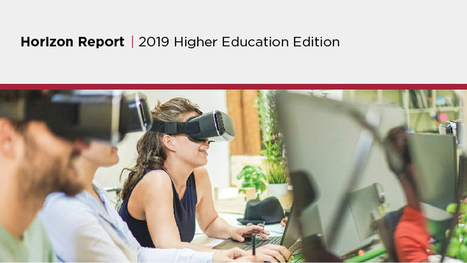
This report profiles six key trends, six significant challenges, and six important developments in educational technology as ranked by an expert panel of leaders from across the higher education landscape.
|
|
Rescooped by
Dennis Swender
from Learning & Technology News
April 25, 2019 10:35 AM
|
Taken together, these recent findings show that the means by which notes are taken (longhand or laptop) seem not to matter much – and for delayed tests and when opportunities for studying the notes are given, not at all. The original explanation that a longhand-superiority may be due to the notes having less verbatim overlap does not hold because despite finding that indeed verbatim overlap is larger in laptop notes this did not lead to a reliable decrease in test performance later on.
Via Nik Peachey
|
|
Rescooped by
Dennis Swender
from Learning & Technology News
April 25, 2019 10:34 AM
|
In recent years, there has been widespread excitement around the transformative potential of technology in education. The hype around education technology is rapidly outpacing evaluation of ed tech programs. How do we ensure that these innovative tools are actually helping our students learn? And how do we know the massive investment in education technology is well-spent?
Via Nik Peachey
|
|
Rescooped by
Dennis Swender
from MiniTool Software Solution
April 19, 2019 12:01 PM
|
It is reported that hackers could read users’ Hotmail, MSN, and Outlook emails to access the information by abusing Microsoft Support.
Via MiniTool Software
|
|
Rescooped by
Dennis Swender
from MiniTool Software Solution
April 19, 2019 12:00 PM
|
You will definitely do whatever you can to restore document after system clean if the files lost during system clean are really significant.
Via MiniTool Software
|
|
|
Scooped by
Dennis Swender
April 29, 2019 3:25 PM
|
From AI to VR, African Edtech is revolutionising learning across the continent, delivered through mobile, tablets and digital games. The AppsAfrica.com Awards celebrate the best in mobile across Africa and we take a look at nominations for the Best African Edtech Solution. BeBlocky BeBlocky harnesses the power of Augmented Reality to project a programmable friendly robot, BlockyBot, into the real […]
"What is Flipgrid?
In short, Flipgrid is a free, education-focused platform to create and share short videos.
Quick Overview: How Flipgrid Works
The embedded guide further below provides a much more detailed overview of how Flipgrid works, but the short version is that users create videos around topics, then upload those videos to a ‘Grid’ for sharing, feedback, and topic-based ‘response videos.’
But what features make Flipgrid it unique? It’s really about ease of use (through ‘Topics’) and privacy (through ‘Grids’)."
Via John Evans
|
|
Rescooped by
Dennis Swender
from Data Visualisation
April 25, 2019 11:25 AM
|
David McCandless shares how journalists can 'add a bit of punch' to stories using data visualisation
Via Yves Mulkers
|
|
Scooped by
Dennis Swender
April 25, 2019 11:20 AM
|
Digital twins—virtual replicas of a physical product, process, or system—bridge physical and digital worlds.This article guides you through some of the most promising current and fu...
|
|
Rescooped by
Dennis Swender
from Edumorfosis.it
April 25, 2019 11:11 AM
|
Administrators purchase the latest and greatest edtech, hoping that this next program will be the panacea, the silver bullet that improves scores and helps the campus meet accountability goals. Teachers want this program to assist in helping their students who learn differently. Parents look for immediate feedback on their children’s progress.
All of these goals take second place to the real issue: are students getting what they need to become productive citizens?
The real risk of edtech-based personalized learning exists in relying on it to the exclusion of everything else.
Personalized learning = privileged learning
Via Edumorfosis
|
|
Rescooped by
Dennis Swender
from Edumorfosis.it
April 25, 2019 11:08 AM
|
Social learning is a key theme of mine because imitation is how we learn as a species. Social learning is best explained by Albert Bandura, recognized as the most eminent psychologist of the modern era.
“Learning would be exceedingly laborious, not to mention hazardous, if people had to rely solely on the effects of their own actions to inform them what to do. Fortunately, most human behavior is learned observationally through modeling: from observing others one forms an idea of how new behaviors are performed, and on later occasions this coded information serves as a guide for action.” —Albert Bandura
Via Edumorfosis
|
|
Scooped by
Dennis Swender
April 25, 2019 11:02 AM
|
Henry Kronk | IBL News: "Professor Emeritus Ray Schroder finds it difficult to stop working. As the Associate Vice Chancellor for Online Learning at the University of Illinois Springfield and the founding director of the National Council for Online Education at the University Professional and Continuing Education Association (UPCEA), he has a lot on his plate."
|
|
Scooped by
Dennis Swender
April 25, 2019 10:42 AM
|
Don’t worry about supersmart AI eliminating all the jobs. That’s just a distraction from the problems even relatively dumb computers are causing.
|
|
Rescooped by
Dennis Swender
from Learning & Technology News
April 25, 2019 10:34 AM
|
We cannot overlook the fact that education is a politically, socially and culturally mediated project. So as education becomes globalized through access to online learning, this becomes even more contentious because the internet is dominated by Western narratives and discourse.
Via Nik Peachey
|
|
Rescooped by
Dennis Swender
from Learning & Technology News
April 25, 2019 10:30 AM
|
Remote Teaching is a collection of articles, research papers and case studies that offer practitioners and policymakers insight into live online language teaching and teacher training.
Via Nik Peachey
|
|
Rescooped by
Dennis Swender
from MiniTool Software Solution
April 19, 2019 12:00 PM
|
Want an alternative to Time Machine for Windows 10/8/7 to back up your PC? MiniTool ShadowMaker is the best alternative to keep your PC safe.
Via MiniTool Software
|