What is a Fever Chart? How to use and how to read the Fever Chart. This chart is an essential tool of Critical Chain Project Management. The Fever Chart helps to track the project status based on two indicators: - The percentage of progress of the Critical Chain - The percentage of Buffer consumption
The ratio of these two indicators will enable to update the Fever Chart and will therefore be translated into a project status. The project is either "on-time", "at risk" or "late". This can be identified easily with the use of the three areas of the chart: - Green = on-time - Orange = at risk - Red = late
If a project is late, the project manager, the management and the team have to find solutions together to enable the project to finish on time.
Led by world expert Philip Marris, this course is designed to empower you with the knowledge and skills to excel in the realm of CCPM. During this training, you will delve into topics such as project scheduling, portfolio management, and the techniques specific to CCPM. Additionally, you will have the opportunity to hear directly from Marris Consulting clients through numerous testimonies and case studies. These real-world examples will showcase how organizations have successfully implemented Critical Chain Project Management and its positive impact on their projects. Learning from their mistakes and their tips and tricks applied in their environment will enhance your learning experience and enable you to apply the Critical Chain principles to your own environment/challenges.
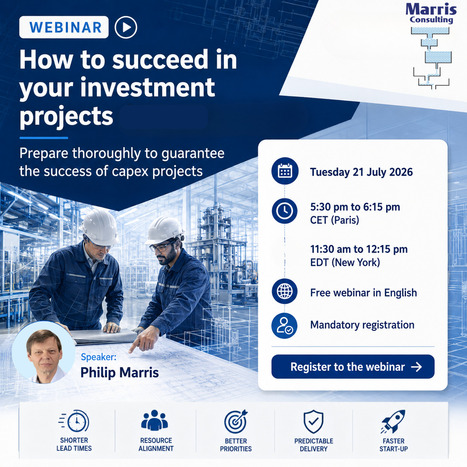
Today, many industrial companies are considering the reorganization of their workshops, the relocation of equipment, or significant investments aimed at expanding capacity and reinforcing operational capabilities. Whether the project involves a full redesign, the deployment of a new production line, or the transfer of assets from one site to another, such transformations require disciplined planning and precise execution.
These initiatives often involve major constraints: moving heavy machinery, coordinating infrastructure works, aligning internal and external stakeholders, and, […] all under highly compressed timelines. In many situations, every hour matters, as interventions on production facilities frequently require production to be stopped or disrupted.
To address these constraints, manufacturers need a proven way to reduce project timelines, ensure the reliability of key stages, and limit deviations that could generate significant unplanned costs. […] It is with this in mind that Marris Consulting supports industrial sites facing this type of challenge, notably by leveraging Critical Chain Project Management. Derived from the Theory of Constraints, this approach […] During this webinar, Philip Marris explains how Marris Consulting deploys this method several times a year all over the world. […] The presentation combines the fundamental principles of the TOC and CCPM with feedback from assignments carried out in different sectors, including aeronautical parts manufacturing, chemical industries, medical devices and pharmaceutical production and logistics warehouses.
La Gestión de Proyectos por la Cadena Crítica es uno de los componentes de la Teoría de las Restricciones, aplicada a la gestión de proyectos.
El objetivo es eliminar los márgenes individuales de cada tarea y mutualizar esta protección necesaria al final del proyecto, en un amortiguador (o buffer). ...
When managing projects the Critical Chain way you you manage uncertainty explicitly and transparently. You do not try to impose certainty on uncertainty as many top managers try and do. For each task you admit that the duration is unknown and you ask for 2 durations: an optimistic duration and a pessimistic duration. You must not ask people to commit to one duration because if you do that they will add padding or a buffer to be able to honour their commitment in an uncertain environment.
.... Sanjeev Gupta, explains how this new approach delivers radical results. This video explores a different approach to project execution based on Theory of Constraints (TOC) and Critical Chain Project Management (CCPM). Instead of adding more complexity, detailed plans, and heavy coordination, this approach focuses on simplifying execution, managing flow, and handling resource constraints effectively. [...] The idea is simple. Projects don’t improve with more control. They improve when execution is structured differently
Test your understanding about Critical Chain Project Management thanks to our 10-question quiz. Results and explanations are directly available at the end of the quiz.
Lightning fast factory layout change using Critical Chain Project Management. 6.5 days instead of 8 weeks. A client testimonial by Safran. [...] they then decided to change the layout of the machines to improve the flow even more, simplifying the production flow and re-organizing the production lines by product families. The target of the new layout was to help reduce lead times even further, simplifying the flow of parts, and increasing productivity… Guillaume Brethenoux, Maintenance Manager in charge of this project used the Critical Chain Project Management Principles to challenge the initial planning of 8 weeks and eventually achieve the layout change of the shop floor in… 6.5 days!
This is a short extract of Philip Marris' presentation during the TOCICO Critical Chain 2026 annual conference: "Service industries boosted by Critical Chain Project Management".
The extract discusses the phenomena of managing project portfolios by hydraulic pressure.
Sanjeev Gupta, founder and CEO of Realization Technologies, presents Critical Chain Project Management, Results and Lessons Learned during the 38th TOCPA Conference in Paris, France.
Mukhtar Kadiri hosts "PM Therapy Podcast" where project and program managers have candid conversations about the challenges they face, what it truly takes to succeed, and the lessons that are often overlooked.
In this session he interviews Philip Marris. They discuss: why projects nearly always finish late, Critical Chain Project Management (CCPM), the Theory of Constraints (TOC), how and why combine Agile + CCPM + Lean + Waterfall, different types of projects, the importance of planing and when it is futile to plan, what kinds of capacity constraints (bottlenecks) are most common, and many other aspects of project management.
“PM Therapy” podcast by Mukhtar Kadiri. Mukhtar was recently ranked N° 1 as the most influential actor in Project Manager in Canada. During the podcast on Thursday the 5th of March at 12:15 Toronto time (UTC-5) or 6:30pm Paris time (CET) we will discuss many aspects of project management. I will be emphasizing how it is quite easy to manage projects differently and significantly […] We plan to cover among other things:
What is Critical Chain Project Management (CCPM) and how it differs and fits with Agile, Waterfall, SAFe, etc.?
A few real-world examples
If CCPM is so powerful why to so few PMs know about it?
Critical Chain Project Management (CCPM) is part of the Theory Of Constraints. So, what are the capacity constraints (bottlenecks) that one usually find in project environments? …
ProChain’s Virtual Mini-Conference. January 29, 2026, 11:00 am. U.S. Eastern Time (UTC-5).
From Chaos to Critical Chain: Delivering the First Modular Pharmacy Ecosystem in 9 Months When a Bold Vision Meets Systemic Issues. Julie Moore, Senior Director of Healthcare Quality & Affordability Information Technology (HQA IT), Stellarus. Julie will talk about how Stellarus reliably delivers large, high-value IT projects using Critical Chain. She will show how they use Fusion Online with Agile, leveraging what-if analysis and bottleneck identification to improve visibility and decision-making.
Task Management with Fusion Online. ProChain Consultants. Get an inside look at how you can use Fusion Online to manage tasks and use the My Team view to give extra value to functional managers.
Philip Marris, CEO of Marris Consulting describes briefly the Critical Chain Project Management (CCPM) approach. [...] Critical Chain Project Management (CCPM) has shown over the last 20 years (1997) that performance can be significantly improved. The Critical Chain is defined by the longest chain of dependencies between tasks, but it also takes into account resources availability. [...] Critical Chain is used both for individual projects and for entire project portfolios.
Amdocs Customer Experience Systems Customized SW Development for Telecommunications. By Shalom Passy, Executive VP Before: -Market pressure to reduce cost and cycle time. -8 projects in crisis requiring CEO level attention in 2007. After: -14% increase in revenue/man-month. -20% reduction in cycle time. -8 projects were in crisis in 2007 then improved to 0 projects in crisis in 2008.
This presentation seeks to explain the TOC solution of critical chain project management (CCPM) for use in modern software engineering. Key learning points include: 1. How to use drum buffer rope (DBR) with software engineering; 2. How to use throughput accounting (TA) with software engineering; 3. Understanding useful variation in software engineering; 4. Provide a TOC enabled maturity model for software organizations; 5. Identifying what’s fundamentally wrong with the SEI CMMI and SW-CMM; 6. The integration points of a TOC software solution with six sigma, Deming, and Toyota Production System (TPS) principles and lean thinking. Benefits to attendees: 1. Benefits of applying DBR, CCPM and TA to technology development; 2. Contrast of the TOC approach with traditional approaches; 2. Benefits of using lean cumulative flow diagrams for the DBR solution.
This is a short extract of Philip Marris' presentation during the TOCICO Critical Chain 2026 annual conference: "Service industries boosted by Critical Chain Project Management".
The extract discusses the phenomena of managing project portfolios by hydraulic pressure.
What is a Fever Chart? How to use and how to read the Fever Chart. This chart is an essential tool of Critical Chain Project Management. The Fever Chart helps to track the project status based on two indicators: - The percentage of progress of the Critical Chain - The percentage of Buffer consumption
The ratio of these two indicators will enable to update the Fever Chart and will therefore be translated into a project status. The project is either "on-time", "at risk" or "late". This can be identified easily with the use of the three areas of the chart: - Green = on-time - Orange = at risk - Red = late
If a project is late, the project manager, the management and the team have to find solutions together to enable the project to finish on time.
Aeronautical industry: How to master your ramp-up with the Theory Of Constraints. How to produce more despite a stressed-out Supply Chain. Watch the video recording of my recent webinar on the subject. A 22-minute executive summary. This is our point of view based on the 40% of our assignments that are in the aeronautical industry.
The Theory Of Constraints is all about finding what element prevents you reaching your goal. In this case the goal is to produce more. So, the approach is simple: find the “bottleneck” and focus on how it can produce more.
Often, but not always, another important thing that needs to be done in parallel is to reduce the level of inventory. We do this using the “2 for 1 rule”.
I talk not only about producing more but also how to accelerate project portfolios since ramp-ups often require Capex projects, production transfers from one plant to another, new product industrialization, etc.
Mukhtar Kadiri the host of the "PM Therapy Podcast" invited Philip Marris to discuss the challenges of project management. This is an extract where they discuss the main reasons why projects are late. - The management of uncertainty - The local safety in individual tasks - The development of micro-management - The lack of reliable data on portfolio capacity - The hydraulic pressure solution used by most organizations - The chaos generated by trying to keep everybody busy.
The Critical Chain Conference is the leading event for professionals applying Critical Chain Project Management (CCPM) and the Theory of Constraints to improve project delivery.
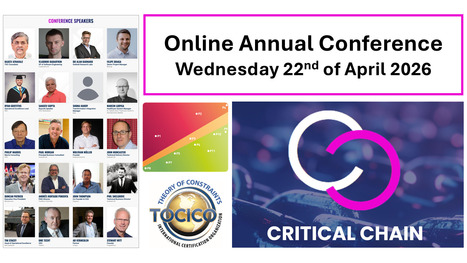
Critical Chain Annual Conference - April 22nd, 2026. Critical Chain 2026 brings together practitioners and leaders for a focused, one-day online event dedicated to improving how projects are executed. The event features practitioner-led sessions, peer-level discussion, and applied insight centered on improving execution performance across complex project environments.
Philip Marris explains the problems of managing the capacity of an organization in project environments. How long does it take to write a piece of software code or find a new supplier? All the numbers are wrong. So management work on the principle of hydraulic pressure: the more projects I force into the system the more will come out. As a result the organization goes into multitasking madness and very little work gets finished.
Critical Chain Project Management (CCPM) is a project management approach developed in the late 90s that aims to finish your projects faster. This video explains the basic principles of Critical Chain project management through an Engineering to Order (ETO) project. However, Critical Chain Project Management can be applied to any projects: new product development, MRO, software development, ... How to build a Critical Chain ...
Shop for your moonrocks at bigsouth511cookies shop. At bigsouth511cookies we offer the quality A1 products. moonrocks etc all ours lows are on fire; sherbert, caramel gelato, gush runtz, icc runtz,kushmintz, animal cake, icc, purple runtz, tea rose, potty mouth, phantom og, gelato melon etc. we have the best deals ever. animal cake Direct order @bigsouth511s https://t.me/bigsouth511
Age combined with excessive flight hours had put much of a legendary Naval aircraft fleet on the ground. The US Navy needed a better way to keep their older and overworked F/A-18 jets properly maintained and on the job. Realization's Focus & Finish approach to managing workload and resources helped the Navy radically improve efficiency and keep the jets flying.
A testimonial by Managing Director Frédéric Grehal, together with Raphael Ensinger and Michael Benmoussa, of Circor Aerospace & Defense. They faced significant challenges in their New Product Development projects. On-time delivery performance was below expectations, [...] capacity constraints in the Qualification Laboratory.
To address these issues, Circor Aerospace & Defense decided to implement Critical Chain Project Management (CCPM), starting with three pilot projects. During this phase, they increased the ...
To get content containing either thought or leadership enter:
To get content containing both thought and leadership enter:
To get content containing the expression thought leadership enter:
You can enter several keywords and you can refine them whenever you want. Our suggestion engine uses more signals but entering a few keywords here will rapidly give you great content to curate.


 Your new post is loading...
![[Video in Spanish] Gestión de proyectos por la Cadena Crítica | Dailymotion | Critical Chain Project Management | Scoop.it](https://img.scoop.it/6we8rwZoe-3D5Kv6NcQXADl72eJkfbmt4t8yenImKBVvK0kTmF0xjctABnaLJIm9)