Your new post is loading...

|
Rescooped by
Dennis Swender
from Language news
October 15, 2019 5:43 AM
|
Bengaluru residents often speak a variety of languages, including Kannada, Tamil, Telugu, Dakkani, English and Hindi .One of the city’s biggest gifts to its residents is the confidence to speak whatever language they want to badly, without caring
Via Lingua Translations Limited - Language News
|
|
Rescooped by
Dennis Swender
from Psychology Matters
October 15, 2019 5:42 AM
|
For many years, studies have shown that being bilingual has a raft of cognitive benefits: better concentration, improved interpersonal skills and even the ability to experience time differently. And new research has uncovered yet another advantage of speaking more than one language.
Via Lingua Translations Limited - Language News, Stewart-Marshall
|
|
Scooped by
Dennis Swender
October 11, 2019 2:07 AM
|
From finding a partner to talking to yourself, use 10 tips to learning a foreign language and gain a competitive advantage in the employee market.
|
|
Rescooped by
Dennis Swender
from Digital Delights for Learners
October 8, 2019 5:22 AM
|
|
|
Rescooped by
Dennis Swender
from Learning & Technology News
October 8, 2019 5:18 AM
|
The creators of the channel have taken clips of world famous gamers playing the games, transcribed them, analysed the vocabulary and interaction between the players and turned them into instructional videos that help students to learn English with the aim of enabling them to play their favourite games in English.
Via Nik Peachey
|
|
Rescooped by
Dennis Swender
from Education 2.0 & 3.0
October 2, 2019 2:27 AM
|
Free resource of educational web tools, 21st century skills, tips and tutorials on how teachers and students integrate technology into education
Via Yashy Tohsaku
|
|
Rescooped by
Dennis Swender
from Box of delight
September 30, 2019 12:14 PM
|
Create and view language learning content with interactive text reconstruction activities and quizzes based on short videos.
Via Nik Peachey, Elizabeth E Charles
Free resource of educational web tools, 21st century skills, tips and tutorials on how teachers and students integrate technology into education
Via Dr. Tom D'Amico (@TDOttawa)
|
|
Rescooped by
Dennis Swender
from Digital Delights for Learners
September 26, 2019 2:21 AM
|
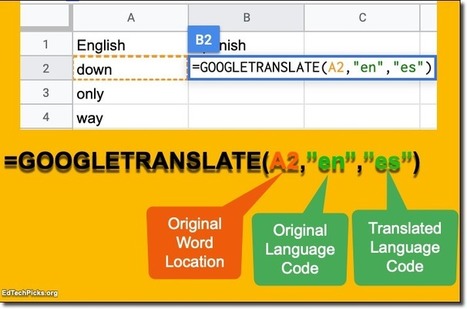
How to translate any list of words instantly in Google Sheets. Enter words in one column and use a simple formula to translate them.
Via Andoni Sagarna Izagirre
|
|
Rescooped by
Dennis Swender
from ¡CHISPA! Dual Language Education
September 8, 2019 12:00 AM
|
ENGLISH LEARNER ROADMAP Now Available Elementary School Teacher Toolkit Download Purchase Middle School Teacher Toolkit Download Purchase High School Teacher Toolkit Download Purchase These Toolkit…
Via Dr. Kathleen Contreras
|
|
Rescooped by
Dennis Swender
from Learning Blend
September 6, 2019 2:20 PM
|
Deconstructing Arabic in 45 Minutes Conversational Russian in 60 minutes? This post is by request. How long does it take to learn Chinese or Japanese vs. Spanish or Irish Gaelic? I would argue less than an hour. Here's th
Via Oliver Durrer swissleap.com
Atlanta Schools Ban Students, Siblings, Friends from Translating and Interpreting for Parents 24 Hours Ago Demand Drivers · By Marion Marking While other parts of the US public sector have shown signs of dialing down on providing free language access, at least one State Board of Education has unanimously approved a policy to provide “high-quality communication support services” free of charge to families of students who speak a language at home other than English. The Atlanta Board of Education in a newly approved Board Policy on Language Access basically directed all Atlanta Public Schools to provide high-quality language services to target families “so that those communications are equal to the communications provided in English.” The policy document dated August 5, 2019, further stated that such language services must be made “available free of charge to all district parents, staff and students.” ADVERTISEMENT According to an August 27, 2019 article in the Atlanta Journal-Constitution (AJC), roughly 3,640 students or “about 7% of the district’s 52,000 students live in a home where the language spoken is not English.” The most common language spoken in those homes is Spanish, followed by Chinese, French, Arabic, and Portuguese, the same report said. Prior to the approval of the new policy, Atlanta Public Schools had already increased their 2019 language services budget by USD 191,203 “to hire additional full-time staff members and pay for more assistance for families who don’t speak English,” the AJC reported back in July. Minimum Translation Requirements The new policy requires Atlanta Public Schools to, “at a minimum,” provide written translation of “critical district documents (paper and online), in the top 5 languages of the district,” just as they do for English-speaking parents. Additionally, translation of school-based documents (excluding classroom-level newsletters, syllabi, etc.) must be provided “from and to English, in Spanish and in any other language deemed appropriate by the school.” Where providing written translations is not practical, “documents will be orally translated” for parents with limited English proficiency (LEP), and parents can respond in either English or their own language. Credentialed Interpreters The Atlanta Board of Education also directed the state’s public schools to use only interpreters who are “approved by and meet all credential and training requirements established by the Office of ESOL & World Languages.” (The office is an arm of the Atlanta Public Schools system that provides “opportunities for cultural and linguistic enrichment” and “envisions a future of biliteracy in which all students will develop and maintain proficiency in at least two languages.”) The new policy goes as far as requiring that any interpreter used by the school should be “a neutral party” and “not omit or editorialize on the content of the conversation they are translating.” Slator 2019 Language Industry Market Report DATA AND RESEARCH 33 pages. Total market size, key verticals, services & tech landscape, market share by segment, M&A, and outlook. $385BUY NOW Where necessary, schools are required to provide interpretation services for meetings of the Atlanta Board of Education, parent conferences, student disciplinary hearings, among other activities. Finally, according to the new policy, “Schools may not rely on or ask students, siblings, friends or untrained school staff to translate or interpret for parents.”The Office of ESOL & World Languages responded to over 3,600 online requests for translation and interpretation from June 2018 to May 2019, according to the AJC. By Marion Marking Slator consultant and corporate communications professional who enjoys exploring Asian cities r Bond ‘Similar to Lyft or Uber’: California Judge Rules Interpreters Are Not Employees in IU Case by Marion Marking
Via Charles Tiayon
|
|
|
Rescooped by
Dennis Swender
from Language news
October 15, 2019 5:42 AM
|
The Critical Languages Program is designed to allow students to take courses in a language not commonly taught. Korean was a popular language in the program before courses started being offered through a more official program in the East Asian Studies (EAS) department.
Via Lingua Translations Limited - Language News
|
|
Scooped by
Dennis Swender
October 13, 2019 2:21 AM
|
People who speak more than one language are fascinating. They provide insight into the power of language and how it shapes the way we think and experience the world. In a recent study, it has been …
|
|
Rescooped by
Dennis Swender
from Into the Driver's Seat
October 8, 2019 5:32 AM
|
"On February 21, 2019, Smart Coos’ 90-day celebration leading up to International Mother Language Day culminated in the announcement of the First Annual National Bilingual Bee & Biliteracy Competition. The National Bilingual Bee & Biliteracy Competition will assess children’s proficiency in English along with one of these languages: Mandarin Chinese, French, Spanish or Haitian Creole. Participants must be between ages 6-15, who are proficient in more than one language or enrolled in a dual language/world language program at their school. Early Bird registration will open on February 21, 2019 on International Mother Language Day. The Competition will be held on June 1, 2019 in Brooklyn, New York. Participants are expected from all five-boroughs and the tri-state area."
Via Jim Lerman
Do you find yourself using the term 'a lot' with regularity? Break the habit with these more-specific synonyms.
Via Ana Cristina Pratas
Elementary English grammar lessons, for teaching and learning English. Includes clear and simple grammar explanations with example sentences for illustration, multimedia activities, games and quizzes. Part of a comprehensive collection of general English activities which caters for English language learners of all ages and at all levels.
Via Sue Lyon-Jones
|
|
Rescooped by
Dennis Swender
from Educación a Distancia y TIC
September 30, 2019 12:43 PM
|
The case for using DUOLINGO as part of the language classroom experience
Via LGA
|
|
Rescooped by
Dennis Swender
from Learning & Technology News
September 30, 2019 11:27 AM
|
As a novice teacher in North Africa in the early 90s, I remember clearly dissecting English language newspapers and magazines and scouring the local shops for bootlegged English language audio cassettes to find interesting content to base activities on for … Continue reading →
Via Nik Peachey
|
|
Rescooped by
Dennis Swender
from Digital Delights for Learners
September 29, 2019 7:58 AM
|
There are 780 different languages spoken in India. This conclusion was drawn after three years of thorough research done by People’s Linguistic Survey of India (PLSI). For the past two decades, Dr G.N.Devy has been working intensively to preserve the languages which risk becoming extinct, and it was under his leadership that PLSI conducted this extensive research. One of the world’s 7,000 remaining languages vanishes every other week and most linguists estimate that 50% of the world’s remaining languages will be gone by the end of this century. Other linguists estimate that commercialization and globalization will bring 90% of the present spoken languages to the verge of extinction. So we should not just be worried about biodiversity, but equally show our concern for preserving linguistic diversity as well. Language plays a pivotal and indispensable role in preserving culture. Hence every single Scandinavian country has invested heavily in preserving its language. A distinctive linguistic identity has brought economic success, making them richer than the rest of the world. They are lucky that they have not been colonized, and hence they do not suffer from an inferiority complex. While they marvel at English as a second language and top the world list in English fluency, they are simultaneously putting an extra effort into scientifically developing and protecting their indigenous languages. This means formulating explicit grammar rules and developing a clear linguistic standards through language institutions which are given the authority to monitor the foreign words included in the national languages every year. Native speaking writers, authors, poets, etc., are given monetary compensation for writing books and producing quality literature through the ministries of culture. Without the Danish, Swedish, Icelandic and Norwegian languages, it is impossible to imagine a feeling of belongingness that inspires people to pay almost half of their salary in taxes. It is language that creates the feeling of adherence, mutual respect, and especially trust in each other as fellow citizens. This mutual trust has created societies in Scandinavia which invest in each other, and a unique sense of trust called “tillid” (confidence) has been installed in the minds of all Scandinavians to the envy of the rest of the world. The crime rates are far lower than in the rest of the world and the minds are free to become creative. In Copenhagen, mothers leave their babies in prams in their gardens or outside cafe’s without constant observation, because people do not steal. Learning English as an international language is considered to be a virtue in Scandinavia, but strictly as a second language. It is, however, equally rewarding to learn German, French, or Spanish. After the Brexit farce, U.K is no longer considered a model country for the world. Europeans in general want to preserve their linguistic diversity. In India, the debate periodically tends to focus on a mutually exclusive exercise. The choice ought not to be between Tamil or Hindi but on how to preserve both these languages, which are among the oldest spoken languages in the world. Some of the words in the old Nordic languages are directly related to Sanskrit, as they belong to the Indo-European family of languages. The Scandinavian Vikings worshipped all kinds of gods and idols, quite similar to the civilizational belief system of contemporary India of those times. Preserving the linguistic diversity in India would help build bridges to languages which consider themselves as Indo-European languages. Australia used to be one of the most linguistically diverse areas in the world, with over 250 different languages, but colonization resulted in making most of them extinct. India, despite colonization, succeeded in preserving many of its languages. Fortunately, India is in the unique situation that it now has two languages, Hindi and Bengali, among the top ten most spoken languages in the world. Hindi can create a bridge between the peoples of India, Pakistan, Bangladesh, Nepal, Iran and Afghanistan. There is no competition to the sovereign position of Hindi as being the most spoken Indian language in USA and as the most spoken Indian language outside of India. So Hindi can definitely play a role in the creation of a distinct identity which will motivate the Indian diaspora to keep their cultural roots alive and their interaction with India intact. Those Indians who have not passed on their linguistic heredity have seen their children lose interest in India and Indian culture. Preservation of the languages of Southern India, like Tamil, Malayalam, Telugu, and Kannada can help preserve the tremendous cultural knowledge of food and literature that will be much appreciated when translated. It is a misnomer to consider someone modern just because he or she speaks only English. We are capable of speaking many languages. My knowledge of Scandinavian languages has given me enormous insight into the the functioning of the Scandinavian societies. Translating Danish into English disrupts so many nuances. This principle applies to many other languages. For social, cultural, spiritual, and aesthetic reasons, we should preserve languages, and hence the choice is not between Hindi or Tamil. The choice is to choose both at the same time, without losing interest in English. DISCLAIMER : Views expressed above are the author's own.
Via Charles Tiayon
Apple plans to have Siri talking you through health problems and translating speech within the next two years, according to a former contractor for Apple.
Via Charles Tiayon
|
|
Rescooped by
Dennis Swender
from Learning Blend
September 6, 2019 2:20 PM
|
Duolingo, which built a big business on a free app, may file to go public in 2020. If and when it does, the startup will give Pittsburgh a huge homegrown success story.
Via Oliver Durrer swissleap.com
|
|
Rescooped by
Dennis Swender
from Learning Blend
September 6, 2019 2:19 PM
|
Coffee shops vs. classrooms – who wins? (Photo: eye2eye) This is one of several articles planned as supplements to the original “How to Learn (But Not Master) Any Language in 1 Hour.�…
Via Oliver Durrer swissleap.com
|