


Bilingually Enriched Learners
3.8K views |
+0 today

 Your new post is loading...
 Scoop.it! 
Your second language is more rational than your first? http://t.co/9GsHZMkzst #cogsci #esl #ict4d 
Scoop.it!

Around The Web In ESL/EFL/ELL | Larry Ferlazzo’s Websites of the Day… http://t.co/SelTmYsATv
Scoop.it!

Guide to verb tense resources including tense explanations, quizzes, tense related lesson plans, tense review in context resources.
Scoop.it!

A linguist has concluded that a new language, with unique grammatical rules, has come into existence, created by children in a remote area of Australia.
Scoop.it!

A selection of Internet tools that can be highly useful to teachers of English as a second (or foreign) language.
Scoop.it!

Teaching a new language to non-native speakers may be one of the most challenging educational jobs out there, so ELL teachers can use all of the help they can get! Thankfully, many excellent resources for...
Scoop.it!

Threes Choose a long (twelve plus word) sentence, for example:‘It was late when I got home last night, and everyone was asleep.’ Write the words alternately in three boxes on the board: 1 It when home and asleep 2 was I last everyone 3 late got...
Scoop.it!

SEVERAL years ago we mentioned TestYourVocab.com here on the blog. Not long ago, the site reached its two millionth test result, and so the researchers have put... (Vocabulary facts for native and non-native English speakers!
Scoop.it!

English learning tips for English learners and teachers to help spice up your classes and improve your learning English experience. (RT @englishfeed: Ask yourself weekly: What do I want to learn this week?
Scoop.it!
From
bigthink

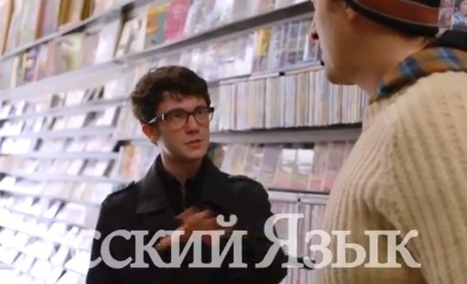
'Each language is in many ways an expression of how one society or culture thinks', says hyper-polyglot Tim Doner. 'I feel that when I start to speak foreign languages, a lot of times I become a bit of a different person. Perhaps I say things that I wouldn't necessarily say in English'. Via Help Traduzioni , Rodolfo Maslias

Help Traduzioni 's curator insight,
June 7, 2013 4:55 AM
"I feel that when I start to speak foreign languages, a lot of times I become a bit of a different person. Perhaps I say things that I wouldn't necessarily say in English."
Scoop.it!

Most experts agree that the best way to learn a language is by immersing yourself in it. Now, with more sophisticated technology, another theory around lang Via Nik Peachey

Nik Peachey's curator insight,
May 3, 2013 6:25 AM
Nice to see a few friends getting a mention in this article.
Scoop.it!

Moderation involves students’ participation to online communities and this is something that only you can encourage no matter how powerful a tool is. If participation is optional not all students are likely to contribute. On the other hand, if it is mandatory or marked it might feel like another task that needs to be done. It would be better to integrate it into your course so that students perceive it as an essential part of their learning. For example, you might start a discussion in class that could be continued online; or instead of asking them to write an essay, you could post a relevant video, ask them to discuss it with classmates online and then write something on this.
Via Nik Peachey
|
Scoop.it!

CHAMPIONS of language education will be more convincing if they admit the advantages that English brings as a global lingua franca, says scholar Kent Anderson.
Scoop.it!

Learn English like James Bond! Don't know how?
Scoop.it!
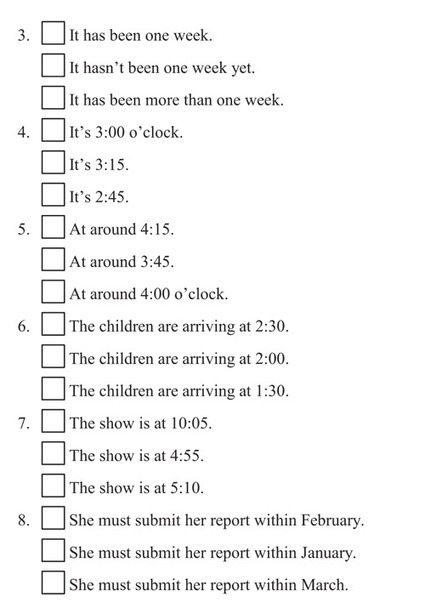
English Listening Skill - Time, quantity and comparisons - practice with time - http://t.co/m0XM60TsGH
Scoop.it!

Today we teachers have 2 ways to teach English as a second language. Teaching face to face or teach English using Skype. Benefit from both of them...
Scoop.it!

FREE TEFL WEBINAR - Join us today at 4pm EST to learn more about the course and teaching overseas! #tefl #esl http://t.co/h5dtDuqPNc
Scoop.it!
Lesson plan for esl classes focusing on vocabulary opposites for Intermediate Level Learners.
Scoop.it!

Multilingualism and commercial language: Vital for the U.S.
Scoop.it!

Common Word Spelling Exceptions in English (RT @englishfeed Many native speakers of English have problems with spelling correctly.
Scoop.it!
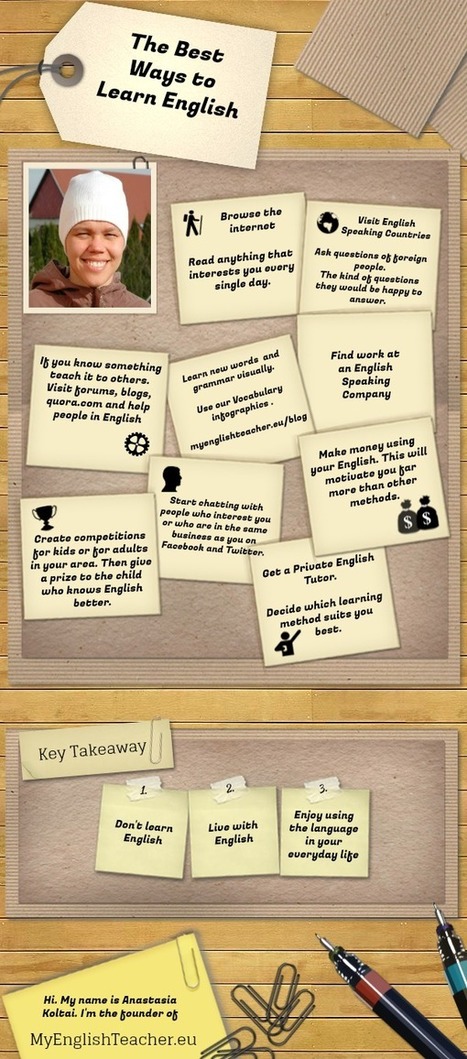
My name is Anastasia. I'm an English Language Learner. So I've created this Infographic to give you ideas about how I learned and still learn English.
Scoop.it!

From the website
8 Different Ways ESL Students Can Use Pictures When Learning English
- See more at: http://english-tonight.com/8-ways-you-can-use-pictures-to-speak-better-english/?buffer_share=5ebd3#sthash.mqTRSAZG.dpuf Via Jim Lerman

Jim Lerman's curator insight,
July 3, 2013 9:30 AM
These 8 strategies are excellent for teaching writing as well as developing creative thinking. They apply to far more than ESL education. 
HJackson's curator insight,
July 3, 2013 8:45 PM
Appears to be great inofmraiton for teaching ESL students.
Scoop.it!

Virtual role-playing games, which lead players through medieval fantasy worlds, are showing promise as a tool for helping non-native speakers with their ESL studies. Via Nik Peachey
Nik Peachey's curator insight,
April 5, 2013 7:29 AM
Schneider believes that MMORPGs have great potential as tools for ESL programs in US schools. It's a notion born of a project Schneider and Zheng worked on earlier this year, in which a group of SUNY Potsdam graduate students tutored a group of Chinese middle schoolers in English through online computers games. 
Joe Pereira's comment,
April 5, 2013 10:23 AM
Always good news to know academics are giving value to DGBL, but the article makes it sound like research on using games (and particularly WoW and other MMORPGS) for learning/language learning is a new thing. Scott Thorne and Hayo Reinders have published extensively in using them for EFL.

Barbara Truman's curator insight,
April 6, 2013 8:28 AM
Role play. Valuable for many scenarios. How can they be designed for families in support of education.
Scoop.it!

Developing a strong vocabulary is an important area of focus for ELLs who are building their reading comprehension. Educators use a variety of strategies to grow readers in their classroom, and there are many free iPad apps that support vocabulary acquisition. Via Nik Peachey
Nik Peachey's curator insight,
May 9, 2013 3:22 AM
Just four apps mentioned here, but that's probably a good start. 
Blake Turnbull's curator insight,
May 13, 2013 5:19 PM
We all know who important vocabularly acquisition is, and so free apps to aid in this process are certainly a bonus!! This article looks at 4 apps: Kids' Vocab by MindSnacks, English First High Flyers, Flashcardlet, and Futaba, with details about them all and the way in which they can support vocabulary acquisition. 
Jhon Stiven Hernandez Gutierrez's curator insight,
August 1, 2018 10:57 AM
The article highlights the importance of integrating technology and language learning. The author mentions that students can develop their language skills by engaging apps which include differents games. The first app, which is called Kids' Vocab, is a tool for helping children increase their vocabulary. New words are presented by categories and learners can practice them by playing games. The second application is called EF high flyers, and it enables language learners to practice new vocabulary by the use of flashcards. This tool includes audio, images and quizzes. The next app is Flashcardlet and is similar to the previous one in that students can practise vocabulary through flashcards. And, the last app is called Futaba, and it is targeted to younger learners since they learn by playing games. This tool includes visual material so students can interact by matching pictures with definitions. |







Well pivo sounds funny, and Cervesa sound classy. I wonder how you say "Cwrw". Maybe: " See-warwar". It's funny.
This map tells us all the different ways that people say the word "beer" in Europe. All the light brown regions call it beer or bier. The dark brown calls it ale and the yellow regions call it pivo. Black regions have other untitled names for beer and the oranges regions refer to beer as cerveza. According to the map, a majority of Europe uses the words pivo and beer/bier. Only a few countries use the world cervaza, which is interesting to me because this word was relatively familiar to me.
When it comes to languages, it's obvious that most of the English language from the United States spreads overseas to Europe. However, the accents of simple English comes from living in Europe so they put a little spin on the english language. Also, there are some languages that can have similar word pronunciations as English such as the french language and the german language. As you can see, most of those languages are on the western side of Europe but there is a big chunk of Spain that speaks the spanish language. Since Spain is as big as it is and it is furthest to the west than any other European country, that makes the United States have the spanish language as their most popular foreign language.