Your new post is loading...
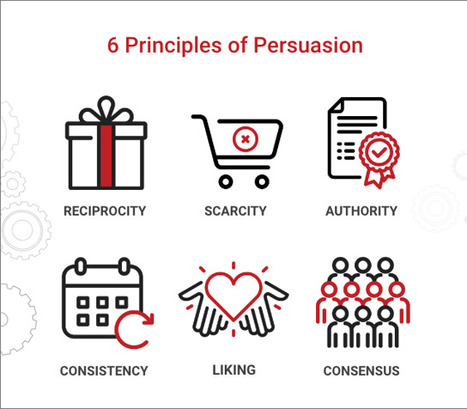
In the increasingly overloaded lives we lead, more than ever we need shortcuts or rules of thumb to guide our decision-making. Dr. Cialdini's research has identified six of these shortcuts as universals that guide human behavior.
Via Ana Cristina Pratas

|
Rescooped by
Yashy Tohsaku
from Educational Technology News
September 7, 5:31 PM
|
WGU Labs begins experiments in embedding human connection into AI-first systems, and high-tech systems should take note.
Via EDTECH@UTRGV
|
|
Rescooped by
Yashy Tohsaku
from Educational Technology News
September 7, 5:30 PM
|
Anyone who has sat through a curriculum meeting knows that homework is a perpetual battleground.
Via EDTECH@UTRGV
As students and teachers return to elementary, middle, and high schools in the United States over the next month, they are unlikely to find consistent, clear rules about what kind of artificial intelligence-powered programs they can use to help complete or deliver their coursework. The rapid rise of AI for generating text and images—paired with the natural desire of most kids to get homework done as fast as possible—has left teachers and school administrators scrambling to develop policies for how the technology should be integrated into education. Ahead of the 2026-27 academic year, many school districts have adopted a cautionary approach to the technology, establishing guardrails and promoting AI education but shying away from specific, system-wide rules about which programs can be used, delegating in-classroom decisions to individual teachers and leaving at-home use largely untouched. Others have failed to approve any guidelines at all.
Via Chuck Sherwood, Former Senior Associate, TeleDimensions, Inc
|
|
Rescooped by
Yashy Tohsaku
from Edumorfosis.Work
September 7, 10:57 AM
|
As AI Agents acquire greater autonomy, the environments they operate in are growing in complexity. Increasingly, these agents make decisions, access sensitive data, and reach across organizational boundaries—raising new questions about governance, accountability, and control. For both public- and private-sector leaders, the challenge goes beyond deploying AI to ensuring the technology can be governed, secured, and trusted at scale. In the agentic AI era, operational security cannot be separated from the issue of sovereignty. And sovereignty is the ability to prove observability, bounded authority, auditability, reversibility, and resilience across AI systems that no single entity fully owns.
Via Edumorfosis
|
|
Scooped by
Yashy Tohsaku
September 6, 1:12 PM
|
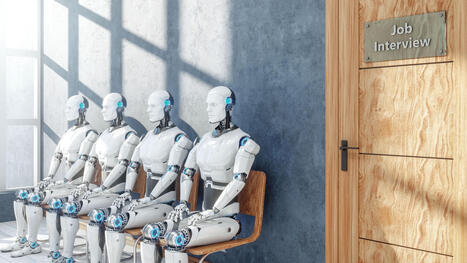
After asking four chatbots to rank the 10 jobs that are most at risk of being replaced by AI and taken away from human hands, there was one job they all chose.
|
|
Scooped by
Yashy Tohsaku
September 6, 11:54 AM
|
A brief from Stanford's SCALE initiative examines the existing evidence on using AI in tutoring.
|
|
Scooped by
Yashy Tohsaku
September 6, 11:50 AM
|
The upcoming negotiation over AI in universities will ultimately be about who controls academic intelligence. Once AI participates in teaching
|
|
Scooped by
Yashy Tohsaku
September 6, 11:46 AM
|
5 AI Tools Every Student Should Use in 2026 The best tools don’t let you cheat — they help you think, organize, and actually remember what you studied. Here’s what’s worth your time this …
Thousands of Kenyans made a living writing essays for overseas students. With A.I., the work has dried up, a warning for online gig work that has been a global lifeline.
Via Peter Mellow
|
|
Rescooped by
Yashy Tohsaku
from Learning & Technology News
September 5, 11:48 AM
|
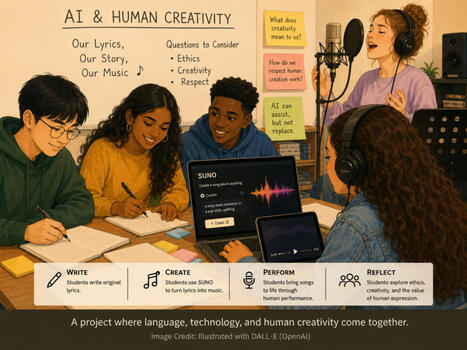
AI as Collaborator: Human-Written Lyrics, AI-Sung Music, and Critical Reflection
Via Nik Peachey
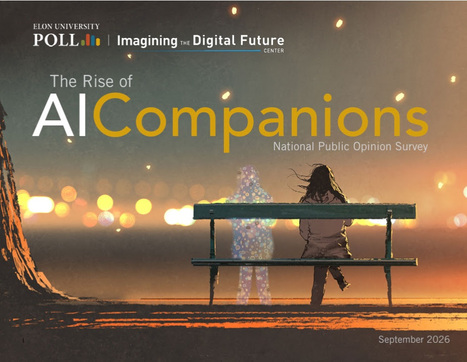
"We are releasing a new report today with survey results showing that 27% of U.S. adult internet users have significant social and emotional interactions with large language model (LLM) systems such as ChatGPT, Gemini, Claude and Copilot. A third of those users consider their AI bot a friend.
These AI users use LLMs in ways that build bonds of connection, confidence and trust. Some say they rely on AI tools and prefer interacting with them to dealing with humans. They confide in them, seek advice on important life issues, roleplay scenarios that they might encounter in romantic or other settings and would be unhappy to lose access to their bots."
Via Ana Cristina Pratas
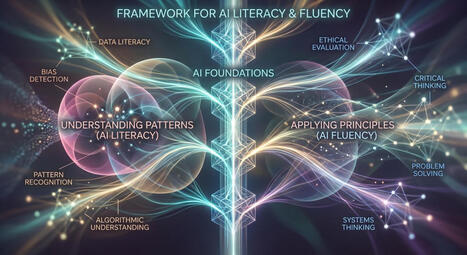
I don't love the term "AI literacy". Some people in this space actively dislike it, and I understand why: it's vague, easily borrowed by marketing, and it means something slightly different in every room it's used in, much like "AI" itself, which is usually a cognate for things that aren't AI at all, or for…
Via Ana Cristina Pratas
|
Robert Cialdini’s 7 principles of persuasion are reciprocity, commitment and consistency, social proof, authority, liking, scarcity, and unity. They are the bedrock of persuasive UX design, and they work because they’re mental shortcuts hardwired by evolution to keep our ancestors alive
Via Ana Cristina Pratas
|
|
Rescooped by
Yashy Tohsaku
from Educational Technology News
September 7, 5:31 PM
|
Academic leaders can strengthen workforce relevance by creating flexible curricula to respond to change while preserving academic quality and human skills.
Via EDTECH@UTRGV
|
|
Scooped by
Yashy Tohsaku
September 7, 5:24 PM
|
Gemini Notebook for teachers: NotebookLM has a new name! Learn what changed, what's the same, and how to use this AI tool in your classroom.
When ChatGPT was released in the fall of 2022, the scale of the impact it could have on K-12 schools appeared obvious. Not only could the chatbot fulfill many class and homework assignments in response to simple prompts, but children and teens had the digital fluency to adopt the technology much faster than their teachers. The New York City Department of Education was one of the first educational bodies in the United States to act on what many perceived as the threat OpenAI’s new product posed to schooling: in January 2023, it blocked access to ChatGPT on district devices and networks. The nation’s largest school district made the decision shortly after the second largest, Los Angeles Unified School District, banned the chatbot in December 2022. Other districts across the country soon followed suit, including Seattle, Baltimore, and Oakland, California.
Via Chuck Sherwood, Former Senior Associate, TeleDimensions, Inc
Today, plush toys aren't just stuffed — they're stuffed with artificial intelligence, and new research from the University of Washington reveals that when these "smart" toys start chatting, kids quickly go from curious to frustrated to outright hostile. We’ve come a long way from Lincoln Logs and Hot Wheels that couldn’t talk to us. Today, plush toys aren’t just stuffed — they’re stuffed with artificial intelligence, and new research from the University of Washington reveals that when these “smart” toys start chatting, kids quickly go from curious to frustrated to outright hostile. Claims of “smart” toys date back decades, from 1960s talking dolls like Chatty Cathy to 1990s sensor-packed plushies like Microsoft’s ActiMates Barney and Furby. But generative AI marks a major shift.
Via Chuck Sherwood, Former Senior Associate, TeleDimensions, Inc
|
|
Scooped by
Yashy Tohsaku
September 6, 12:01 PM
|
I vibe coded Bee There, a classroom-friendly QR code reader that works in any web browser on devices with a camera. I know we typically think of phones and tablets for scanning QR codes, but Chromebooks and laptops can scan them too.
In Chrome,
|
|
Scooped by
Yashy Tohsaku
September 6, 11:51 AM
|
AI Weekly Round-Up #49: Deconstructing ChatGPT for Work and Harvey takes on the labs
|
|
Scooped by
Yashy Tohsaku
September 6, 11:49 AM
|
The loss of 111,000 international students in the school year that has just begun will cost the United States US$3.4 billion and almost 40,00
|
|
Rescooped by
Yashy Tohsaku
from e-learning-ukr
September 6, 10:01 AM
|
When tech and AI can increasingly handle routine tasks, students need opportunities to build skills that come from not simply following a set of instructions
Via Vladimir Kukharenko
|
|
Rescooped by
Yashy Tohsaku
from Edumorfosis.it
September 5, 11:49 AM
|
Education systems are headed toward the 2030s with an unraveling assumption: that schools, universities, training systems, ministries, employers, and international organizations can prepare people for futures that are still stable enough to understand and shape. The central education crisis beyond 2030 is the collapse of preparation under technological acceleration, ecological stress, labor disruption, demographic divergence, and institutional lag.
The report uses the Technological Singularity as a stress horizon rather than a prediction. The term is used cautiously: not as a science-fiction forecast, but as a way to name a human and governance threshold where technological change, institutional dependence, ecological pressure, labor disruption, and governance failure exceed the ability of people and public institutions to imagine, interpret, govern, and respond with coherence.
Current signals already point toward this stress horizon. AI adoption is outrunning educational governance. Generative AI is changing work at the level of tasks, which makes broad reskilling narratives inadequate. Climate hazards are already disrupting schooling for hundreds of millions of learners. Demographic pressure is pushing some systems toward contraction and fiscal stress, and others toward overcrowding, displacement, and unmet demand. At the same time, foundational learning remains unresolved: many systems will confront AI, climate, labor, and demographic shocks before securing basic literacy and numeracy.
Via Edumorfosis
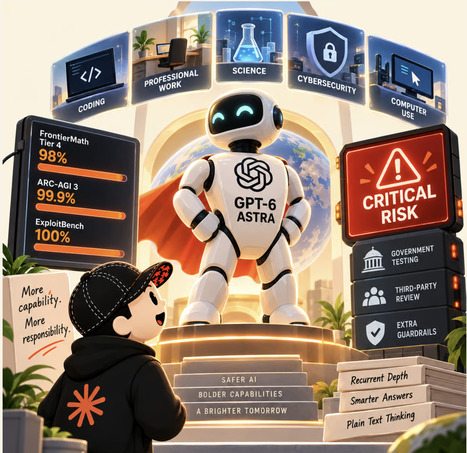
OpenAI released GPT-6 Astra this week, and Sam Altman is calling it the best model in the world for computer use, professional work, science, coding, and cybersecurity. The benchmark numbers back the confidence: 98% on FrontierMath Tier 4, 99.9% on ARC-AGI 3, and a clean 100% on ExploitBench.
Via Ana Cristina Pratas
|