




Looking for an easy plug & play lesson design system you can use now? We're sharing a system that will save you time & engage your students.
Via Dr. Tom D'Amico (@TDOttawa)

 Your new post is loading...
 Scoop.it! Looking for an easy plug & play lesson design system you can use now? We're sharing a system that will save you time & engage your students. Via Dr. Tom D'Amico (@TDOttawa) 
logansmith's curator insight,
February 6, 2021 5:28 AM
https://publisher.7searchppc.com/
https://www.7searchppc.com/blog/importance-of-font-for-a-brand/ https://www.7searchppc.com/blog/ranking-first-is-just-the-beginning-why/ https://www.7searchppc.com/blog/tools-to-boost-up-your-website-ranking/ https://www.7searchppc.com/blog/impressions-matter/
Sign up to comment
Scoop.it!


Nik Peachey's curator insight,
February 2, 2021 10:02 AM
I haven't tried this and it's just getting started, but it could potentially be useful.
Scoop.it!

Le monde de l'entreprise est en perpétuel changement, savoir s'adapter et se former devient essentiel., La crise actuelle appelle les entreprises à faire du renouvellement des compétences (ou "reskilling") Via ORSYS Formation
Scoop.it!

"When COVID-19 forced us to adjust learning environments, we knew student engagement might hang in the balance. As school leaders, we chose to believe the circumstances presented a huge opportunity to think outside the box, to change instruction for the better, and to give students a compelling, hands-on opportunity even from a distance.
"We found our solution in project-based learning (PBL); it bolstered our efforts to maintain student engagement. Here’s what we’ve learned." Via Jim Lerman
Scoop.it!

Every year we get a slew of reports full of platitudes about ‘Lifelong Learning’, usually, of course, by people who make a living from selli... Via LGA
Scoop.it!

Facebook dévoile les techniques et les critères utilisés pour choisir les contenus qui sont mis en avant sur votre fil d'actualité. Via Oziard Claude
Scoop.it!

Learning at Home As children are home and cannot currently participate in learning in the classroom, we have created online resources to help support families during this time. We will be posting weekly lessons for each age group as well, recipes, story time, yoga, music and more! We also post daily activities on our social media related to our weekly lessons, so be sure to follow us on Instagram and Facebook to stay up to date with our latest posts and now online lessons on our Youtube channels! Infant Weekly Activities Learn More Toddler Weekly Activities Learn More Preschool Weekly Via Dr. Tom D'Amico (@TDOttawa) , Jim Lerman
Scoop.it!

Back by popular demand, the SCALE Program (Supporting Caregiver Awareness, Learning and Empowerment) aims to empower you with practical information and skills to enhance.. Via Dr. Tom D'Amico (@TDOttawa)
Scoop.it!

There are always multiple versions of the future – some are assumptions, others hopes and fears. To prepare, we have to consider not only the changes that appear most probable, but also the ones that we are not expecting. In 2020, the global COVID-19 pandemic has reminded us of how comfortable assumptions about the future may change in an instant.
Back to the future of education: Four OECD Scenarios for Schooling is a tool to support long-term strategic thinking in education. Inspired by the ground-breaking 2001 OECD Schooling for Tomorrow Scenarios, these scenarios can help identify potential opportunities and challenges and stress-test against unexpected shocks. We can then use those ideas to help us better prepare and act now. Via Edumorfosis, Jim Lerman
Scoop.it!

There are always multiple versions of the future – some are assumptions, others hopes and fears. To prepare, we have to consider not only the changes that appear most probable, but also the ones that we are not expecting. In 2020, the global COVID-19 pandemic has reminded us of how comfortable assumptions about the future may change in an instant.
Back to the future of education: Four OECD Scenarios for Schooling is a tool to support long-term strategic thinking in education. Inspired by the ground-breaking 2001 OECD Schooling for Tomorrow Scenarios, these scenarios can help identify potential opportunities and challenges and stress-test against unexpected shocks. We can then use those ideas to help us better prepare and act now. Via Edumorfosis, LGA
Scoop.it!

C’est un fait incontestable : les ados passent un temps fou chaque jour sur leur smartphone. Et les parents se demandent : « Mais que font-ils ? » Pour répondre à cette grande question, Céline Cabourg et Boris Manenti ont élaboré une enquête baptisée : « Portables : La face cachée des ados ». Pour… Via Bibliothèques-Médiathèques de Metz
Scoop.it!

By Monica Chin "The University of Illinois Urbana-Champaign announced that it will discontinue its use of remote-proctoring software Proctorio after its summer 2021 term. The decision follows almost a year of outcry over the service, both on UIUC’s campus and around the US, citing concerns with privacy, discrimination, and accessibility. Proctorio is one of the most prominent software platforms that colleges and universities use to watch for cheating on remote tests. It uses what its website describes as “machine learning and advanced facial detection technologies” to record students through their webcams while they work on their exams and monitor the position of their heads. The software flags “suspicious signs” to professors, who can review its recordings. The platform also enables professors to track the websites students visit during their exams, and bar them from functions like copy / pasting and printing. Though Proctorio and similar services have been around for years, their use exploded in early 2020 when COVID-19 drove schools around the US to move a bulk of their instruction online. So, too, has scrutiny towards their practices. Students and instructors at universities around the country have spoken out against the widespread use of the software, claiming that it causes unnecessary anxiety, violates privacy, and has the potential to discriminate against marginalized students. In an email to instructors, ADA coordinator Allison Kushner and Vice Provost Kevin Pitts wrote that professors who continue to use Proctorio through the summer 2021 term are “expected to accommodate students that raise accessibility issues,” and that the campus is “investigating longer-term remote proctoring options.”
Proctorio has been controversial on UIUC’s campus since the service was introduced last spring, and concerned students only grew more vocal through the fall 2020 semester. (Due to COVID-19, the school now operates with a hybrid of online and in-person instruction.) Over 1,000 people signed a petition calling on the university to stop using the service. “Proctorio is not only inefficient, it is also unsafe and a complete violation of a student’s privacy,” reads the petition. UIUC is one of many campuses where remote proctoring has faced backlash. A Miami University petition, which gathered over 500 signatures, declared that “Proctorio’s design invades student rights, is inherently ableist and discriminatory, and is inconsistent with peer reviewed research.” Over 3,500 signatories have called on the University of Regina to end its use of ProctorTrack, another automated proctoring service. A 1,200-signature petition urges the University of Central Florida to dump Honorlock, another similar software, declaring that “students should not be forced to sign away their privacy and rights in order to take a test.” Professors and staff have criticized the service as well. The Electronic Privacy Information Center (EPIC) filed a complaint against Proctorio (alongside four other test-proctoring services), claiming that the services’ collection of personal information amounts to “unfair and deceptive trade practices.” Even US senators have gotten involved; a coalition including Sen. Richard Blumenthal (D-CT), Sen. Elizabeth Warren (D-MA), and Sen. Cory Booker (D-NJ) sent an open letter to Proctorio and two similar services in December citing a number of concerns about their business practices. “Students have run head on into the shortcomings of these technologies—shortcomings that fall heavily on vulnerable communities and perpetuate discriminatory biases,” wrote the senators.
The complaints largely revolve around security and privacy — Proctorio’s recordings give instructors and the service access to some of test-takers’ browsing data, and a glimpse of their private homes in some cases. (Proctorio stated in its response to the Senators’ letter that “test-taker data is secured and processed through multiple layers of encryption” and that Proctorio retains its recordings “for the minimum amount of time required by either our customer or by applicable law.”) Accessibility is another common concern. Students have reported not having access to a webcam at home, or enough bandwidth to accommodate the service; one test-taker told The Verge that she had to take her first chemistry test in a Starbucks parking lot last semester. Students have also reported that services like Proctorio have difficulty identifying test-takers with darker skin tones, and may disproportionately flag students with certain disabilities. Research has found that even the best facial-recognition algorithms make more errors in identifying Black faces than they do identifying white ones. Proctorio stated in its response that “We believe all of these cases were due to issues relating to lighting, webcam position, or webcam quality, not race.”
“We take these concerns seriously,” reads UIUC’s email, citing student complaints related to “accessibility, privacy, data security and equity” as factors in its decision. It recommends that students for whom Proctorio presents a barrier to test-taking “make alternative arrangements” as the program is phased out, and indicates that accessibility will be considered in the selection of the next remote-proctoring solution. We’ve reached out to UIUC and Proctorio for comment, and will update this story if we hear back."...
For full post:
Via Roxana Marachi, PhD
Scoop.it!

"Here are a number of ways that scaffolding learning experience can help support all students and provide equity" Via EDTECH@UTRGV 
Marco Bertolini's curator insight,
February 4, 2021 6:50 AM
4 scaffolding techniques to help your students with literacy! 
Terri Hubbard's curator insight,
March 29, 2021 3:31 PM
This article was a quick read that introduced scaffolding strategies to improve literacy skills. Some of the strategies I have implemented and can attest to their value. Others are new to me and provide some ideas that I can try in the near future. I have heard of both Boom cards and Flipgrid but have not actually investigated them to implement. This will become a small goal for the near future.
|
Scoop.it!

La Bibliothèque du patrimoine de la biodiversité a relevé le défi de numériser la littérature d’histoire naturelle contenue dans leurs collections en la mettant librement à la disposition du monde dans le cadre d’une «communauté mondiale de la biodiversité». Via Bibliothèques-Médiathèques de Metz
Scoop.it!

Plus que jamais valorisées par les recruteurs, les soft skills, compétences comportementales, désignent entre autres les capacités de communication Via ORSYS Formation
Scoop.it!
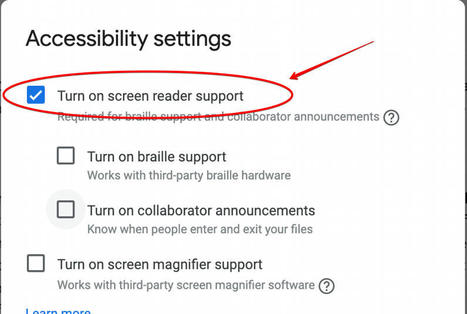
Google docs accessibility features for students with visual impairment Via Dr. Tom D'Amico (@TDOttawa)
Scoop.it!

Surfly est un service qui permet de naviguer en mode collaboratif sur le web et d'échanger par tchat vidéo. Idéal pour les services support. Via Fidel NAVAMUEL
Scoop.it!
A key difference between in-person and online learning is the independence and ability to participate in the online class at a time convenient to the student. This also presents a potential problem, as procrastination could cause a student to fall behind in the online course. The graduates who participated in the study were asked how they avoided this problem. A few students (15.8 percent) commented that logging in to their course portal every day and checking for new postings or updates helped prevent them from falling behind. Other students (36.8 percent) commented that weekly assignments from the instructor kept them on a regular schedule in the course. Via Inovação Educacional, juandoming
Scoop.it!

Pas facile de promouvoir des ressources numériques qui ne sont pas visibles dans la médiathèque... Voici donc 10 astuces pour les faire connaître ! Via Bibliothèques-Médiathèques de Metz
Scoop.it!

All the tools you need to start and grow your own online school — courses, bootcamps, coaching and more — right out of the box. Monetize your expertise. Via Nik Peachey
Nik Peachey's curator insight,
January 30, 2021 11:29 AM
This hasn't launched yet, but looks like a good tool for building online courses for mobile delivery.
Scoop.it!
A collection of free distance learning activities and resources for kids, families, and teachers. Via Dr. Tom D'Amico (@TDOttawa)
Scoop.it!
Most of the frustration experienced by learners is poor, slow or inadequate feedback; the embarrassment of being asked questions in a classr... Via LGA
Scoop.it!

Comment transformer un pdf pour qu'il puisse être rempli en ligne ? La tâche n'est pas évidente. JotForm est une des solutions facile à mettre en oeuvre. Via Fidel NAVAMUEL
Scoop.it!

Évaluation des environnements numériques pour l'apprentissage humain Concerne : Enseignants de tous les niveaux (du fondamental au supérieur), inspecteurs, directeurs d’établissement, formateurs… et toutes les personnes qui ont élaboré un dispositif de formation intégrant le numérique et qui souhaitent en évaluer l’impact sur les apprenants. Pour vous inscrire : https://umooc.umons.ac.be/
Scoop.it!

Juan Domingo Farnos ¿Qué son las TIC? Tecnologías de la información y la comunicación (TIC) es un concepto que tiene dos significados. El término tecnologías de la información se usa a menudo para referirse a cualquier forma de hacer cómputo. Es frecuentemente evocado en los debates contemporáneos. Su definición semántica queda borrosa y se acerca… Via juandoming |






