Your new post is loading...
We dig into how artificial intelligence can be used in education. I share seven tools that can enhance teaching and learning experiences.
Via Yashy Tohsaku, juandoming, LGA
Bienvenue dans mon nouveau point veille sur une semaine d'actualités pédagonumériques. Mais avant, je tenais à remercier au passage Raphaël Grasset pour m'avoir fait découvrir la semaine dernière sa solution pour développer l'autonomie et la performance des apprenants : Learning Coach. C'est un test psychométrique de 6 minutes qui établit le profil de l'apprenant et…
Via Vedrenne Guy
To order book, please visit: https://www.press.umich.edu/11621094/strike_for_the_common_good
Marachi, R., & Carpenter, R. (2020). Silicon Valley, philanthrocapitalism, and policy shifts from teachers to tech. In Givan, R. K. and Lang, A. S. (Eds.). Strike for the Common Good: Fighting for the Future of Public Education (pp.217-233). Ann Arbor: University of Michigan Press. To download pdf of final chapter manuscript, click here.
Via Roxana Marachi, PhD
As a teacher, you have a unique opportunity to model responsible AI use for your students and shape their understanding of this powerful technology. Let's explore how you can approach AI in an ethical manner in the classroom and what practices to avoid. 🧑🏫🚦
Via Nik Peachey, juandoming, LGA
Inspired by past educators, Aida Hadzovic has built a reputation for innovative teaching strategies for English. Hadzovic earned a degree in English education and later pursued a science degree in part because of the demand for science teachers in Brooklyn, New York. Her diverse background in teaching writing, science and coding positioned her well to participate in the Project Topeka pilot, a multifaceted AI program that gave real-time feedback to students to support the development of argumentative writing skills.
Via EDTECH@UTRGV
Juan Domingo Farnós La neuroeducación es un campo interdisciplinario que integra la neurociencia y la educación con el objetivo de comprender cómo funcionan el cerebro y la mente en el proceso de aprendizaje. Se basa en la idea de que para lograr una educación efectiva, es fundamental comprender cómo el cerebro procesa, almacena y recupera…
Via juandoming
How do college instructors ensure that their lessons are effective, and that students are grasping challenging concepts? How do a growing number of big companies train their employees and onboard new ones? How do a wide variety of government and private-sector organizations leverage modern tools to enhance learning and training? The processes are all different, but the ideal solution is the same: instructional design.
What was formed out of a need to provide skills training for thousands of individuals who were contributing to the war effort during World War II, instructional design today is one of the most vital and in-demand disciplines across all industries. Here is a quick guide to this exciting field and its future implications.
Via Edumorfosis, LGA
Microlearning is a learning method that delivers content in small, easily digestible chunks. The purpose of this blog post is to provide an introduction to microlearning, explain its benefits, and provide tips for designing and implementing effective microlearning programs.
Via EDTECH@UTRGV

|
Rescooped by
michel verstrepen
from L'eVeille
May 18, 2023 5:05 AM
|
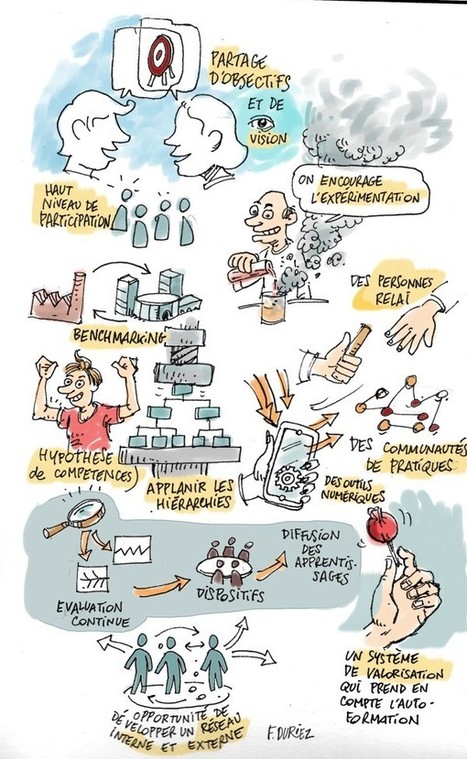
L'organisation apprenante est un concept relativement ancien, qui se concrétise de plus en plus grâce aux outils numériques de partage et de conception collaborative. Basée sur des principes simples dans leur énonciation, elle bouscule les fonctionnements pyramidaux, les silos et les conceptions très formalisées de la formation.
Via Sandrine Decamps
The emergence of AI brought together educators from all walks of life to reflect, explore perspectives, and examine implications on teaching and learning.
Via LGA
As educators we've all experienced the rise of new technologies along with the process of sorting out how each one may impact our work and our lives. Is the coming of AI any different? If so, how can we approach AI wisely?
Via EDTECH@UTRGV
El Instituto Nacional de Tecnologías Educativas y de Formación del Profesorado es la Unidad del Ministerio de Educación y Formación Profesional que trabaja en colaboración con administraciones e instituciones educativas para avanzar hacia una educación digitalmente competente en torno a tres ámbitos: Competencia Digital del Alumnado: este ámbito está enfocado a analizar esta competencia en … Continúa leyendo Competencia Digital Educativa
Via Gumersindo Fernández, juandoming
Juan Domingo Farnós «Dicen por ahí que las competencias digitales de los docentes solo se corresponden en importancia con la alfabetización digital de los aprendices» (Juan Domingo Farnós). Podría ser una frase retórica, pero a lo que va es a decir que las instituciones internacionales, UNESCO, ONU, los propios estados democráticos… no paran de hablar de…
Via juandoming
|
Ces 3 mini-jeux interactifs sur le thème du Digital Learning ont été créés avec l'outil Storiz - LCMS Pédagogie Nouvelle Génération du Groupe Bizness
Via Vedrenne Guy
A university in Mexico has developed and deployed an educational technology ecosystem that incorporates artificial intelligence with a view t
Via LGA
A patchwork of platforms: mapping data infrastructures in schools // Pangrazio, Selwyn, & Cumbo (2022)
"Abstract
This paper explores the significance of schools’ data infrastructures as a site of institutional power and (re)configuration. Using ‘infrastructure studies’ as a theoretical framework and drawing on in-depth studies of three contrasting Australian secondary schools, the paper takes a holistic look at schools’ data infrastructures. In contrast to the notion of the ‘platformatised’ school, the paper details the ad hoc and compromised ways that these school data infrastructures have developed – highlighting a number of underlying sociotechnical conditions that lead to an ongoing process of data infrastructuring. These include issues of limited technical interoperability and differences between educational requirements and commercially-led designs. Also apparent is the disjuncture between the imagined benefits of institutional data use and the ongoing maintenance and repair required to make the infrastructures function. Taking an institutional perspective, the paper explores why digital technologies continue to complicate (rather than simplify) school processes and practices." For journal access, please visit: https://www.tandfonline.com/doi/abs/10.1080/17439884.2022.2035395?journalCode=cjem20
Via Roxana Marachi, PhD
Evolution of artificial intelligence has been receiving mixed response. ChatGPT took the world by storm and many such AI chatbots have surfaced giving a hard time to many business owners. Read this article to understand how AI advancement is affecting businesses and changing the face of edtech.
Via Yashy Tohsaku, LGA
As a doctoral student at the University of California at Los Angeles, I was among those who got a recent campus-wide email with an urgent directive: Don’t use AI chatbots like ChatGPT or Bard or Bing, as doing so “is equivalent to receiving assistance from another person.”
Upon reading it, I took a pause. I’m a former educator in the process of writing my dissertation for my Doctorate of Education, as part of a part-time program while working a full-time job at Google. And as someone who is also a former journalist and editor for EdSurge, I recognize that we should never plagiarize, and that artificially-intelligent chatbots are very, very capable of responding to prompts like “Write me a 500-word essay on Shakespeare’s Twelfth Night.”
But as a student, and frankly, as a former teacher, my university’s approach struck me as incredibly short-sighted.
Via EDTECH@UTRGV
Juan Domingo Farnós Juan Domingo Farnós es un reconocido experto en educación disruptiva y ha realizado importantes contribuciones en el campo de la inteligencia artificial aplicada a la educación. Se ha centrado en cómo la tecnología puede transformar los procesos de aprendizaje y mejorar la experiencia educativa, dando especial importancia al diseño de algoritmos para…
Via juandoming
A school district in Washington state is trying out an artificial-intelligence-powered instructional coach.
Via EDTECH@UTRGV
Challenge: Using ChatGPT for 30 minutes a day for 30 days to explore its potential in work and daily life. Results, guidelines, and comparison included.
Via Peter Mellow, juandoming
RécitLongtemps axées sur la transmission du savoir académique, les universités développent l’enseignement des ces compétences transversales de plus en plus recherchées dans le monde professionnel. 17/05/2023
Via Ufcv Officiel, Sabrina M. BUDEL, juandoming
In this blog, we're sharing videos explaining the top learning theories that you must master as an Instructional Designer for eLearning.
Via Mariano Fernandez S., LGA
From curriculum to technology concerns, consider these essentials for creating alternative education opportunities at your institution.
Via EDTECH@UTRGV
|